Monastery of the Holy Cross

  • Home
  • About
    • Benedictine Life
    • History
    • Video Gallery
    • Et Incarnatus Est - The Prior's Blog
  • Visit Us
    • Guesthouse
    • Prayer Schedule
      • Christmas 2025
    • The Catholic Readers Society
  • Vocations
    • Monastic Experience Weekend
    • Formation
    • Oblates
      • Oblate Podcast
  • Solemn Vespers
    • Solemn Vespers for Corpus Christi
    • Chant
  • Contact
  • Donate

Articles under Culture

The World, the Flesh, and the Devil: The First Precaution Against the Devil

May 27, 2026

John of the Cross offers us three precautions when engaging in spiritual warfare against the Devil. He is writing for contemplative religious, and so we will need to translate these into terms that will make sense in the world. But it probably is good to bear in mind his original teaching in its religious context, so that we don’t subtly weaken his points.

The first precaution is that we never take on any good work, outside of what is assigned under obedience and the obligations of our state. In translating this to the secular situation of the laity, it’s important to note that we cannot, for example, equate a boss, or a pastor, or even a spouse with a religious superior, to whom religious make an explicit vow of obedience.

Outside of the cloister, this then calls for discernment and an earnest effort through prayer and consultation to hear the Holy Spirit and have the docility to say yes. How does this work, practically?

First of all, the obligations of our state in life do present an analog between the cloister and the Christian life of the laity in the world. If we are students, we have an obligation to do our study, show up for class and the like. If we are parents, we have obligations to our spouses and children. If we are employed, we have obligations to our company and coworkers, and so on. If a new project will cause us to fail to meet these obligations, then it is probably not from God.

In cases that are unclear, Ignatian spirituality offers us a method for discernment. First, we must be clear about the likely outcomes of competing plans of action. Let me use an example from the late Cardinal George of blessed memory. When he returned from the conclave that elected Pope Francis, he spoke to a meeting of religious leaders and described the awesome responsibility of choosing, with the guidance of the Holy Spirit, the next successor to Peter.

The first question is, who are the candidates likely to be in the running? If there are, let’s say, three strong candidates, I need to ask myself: What are their strengths and weaknesses? What situations in the Church is each one likely to address? Are there situations in the Church that I find urgent, and how will each one meet these challenges?

The next step is the one that calls for prayer and deep faith. I need to imagine each person being chosen pope and imagine the likely good or lack thereof that will come of each candidate’s potential papacy. Only when I arrive at peace with the prospect of each candidate as pope, with all of his strengths, weaknesses, and personal experiences, will I be ready to vote. At that point, I will no longer be at the mercy of my own fears, whims, preferences and agendas. I can ask myself: which one of these options genuinely seems best for the Church? And answer it honestly.

So when we are presented with an initiative of some kind, if a colleague asks me to join in a new project, I need to be clear about what the likely effect will be of saying yes and of saying no. When I am ready to accept both options with peace in my heart, then I am ready to ask which one is best for me, for my family, for the Church.

There is one more piece to this process for those who do not have a religious superior. Are there persons in my life from whom I am obliged to seek counsel before a decision of this weight? Are there persons whose counsel I respect who could help me think through the decision? I said a moment ago that a spouse is not a religious superior. Spouses are not bound to obey each other in the way a religious obeys a superior. But married persons are bound to make important decisions only after consulting their spouses and listening to counsel openly, without trying to sway their response with emotional reactivity. The decision may still be yours to make, but it should take into consideration the counsel of the spouse. And if we trouble someone for advice, we should take it very seriously.

Another thought along these lines: when should I help someone? In the monastery, I’ve discovered that this isn’t as obvious as it sounds. Monks like to be helpful, but not everyone wants to be helped. Important questions include, “Has this person asked for my help, and am I willing to offer the help that he says that he needs?” “Is someone else supposed to be helping, and will my help be an implied criticism of someone in charge?” Helping someone can be delicate if there is an imbalance of power. Can I help in such a way that the person isn’t shamed by my magnanimousness? Can I do so as a true sister or brother rather than as a benefactor?

(Here is the Introduction to the whole series. Here are The First Precaution Against the World and The Second and Third Precautions Against the World. Here are Part 1 of the Introduction to Precautions Against the Flesh and Part 2 of the Introduction to Precautions Against the Flesh. Here are The First, Second and Third Precautions Against the Flesh. Here is The Introduction to Precautions Against the Devil.)

The World, the Flesh, and the Devil: Introduction to Precautions Against the Devil

May 22, 2026

By the sixteenth century, the era of Saint John of the Cross, the Church recognized three particular enemies of the soul: the World, the Flesh, and the Devil. While this formulation doesn’t appear explicitly until the high Middle Ages, the monastic Fathers wrote about spiritual warfare from a similar set of considerations. Their view of the soul was based on the three appetites or desires that move us to act. The lowest, the concupiscible, is our desire for bodily life and pleasure. The corruption of this desire is what Saint John calls the Flesh. He also says that the attacks against by the Flesh are the most tenacious and continue as long as the old Man survives in us. This comports well with what the monks of old warned their disciples, that sexual desire and the desire for inordinate eating will be temptations to the end of our lives for most of us.

The virtues that help us to govern these desires are especially temperance and courage.

More noble than the concupiscible desires are the irascible desires, which we normally think of as related to emotions like anger and sadness. We desire safety, honor, recognition, and the freedom to act, and when these are thwarted we are tempted to lash out in anger or grow sullen and cynical. These desires are nobler because they relate our souls to the world around us, rather than simply to our own bodies. The corruption of these desires is what John calls the World. He says that these are the simplest temptations to vanquish.

The virtues that we need to cultivate to fight back against the World are courage and especially justice.

The most difficult temptations to understand arise from the Devil, and these attack the intellect and will. The will is our “intellectual appetite,” meaning it is what we want to do after we’ve weighed options and made a decision. The vice that is especially dangerous here is pride, which is the vice that characterizes the Devil himself. The cardinal virtue that needs cultivating in this case is prudence. The Church’s own reflection on the Incarnation helps us to see the importance of the dispositions of humility and obedience.  These two stances, modeled for us by Christ Himself, show us how to develop a truly Christian prudence, one that can fight back against the Devil’s temptations.

What are these temptations? The Devil wants us to misjudge, to choose what is evil disguised as good. In other words, we are likely to be led astray by projects that appear to be good, but in fact weaken our docility to God and to the obligations attached to our state of life. This is connected to pride because we often choose tasks with an unrealistic view of our own ability to bring them to a good completion. We may seek out projects that will make us appear more virtuous to others than we are, rather than choosing a less spectacular path that leads to genuine virtue.

John of the Cross offers us three precautions when engaging in spiritual warfare against the Devil. He is writing for contemplative religious, and so we will need to translate these into terms that will make sense in the world. But it probably is good to bear in mind his original teaching in its religious context, so that we don’t subtly weaken his points.

(Here is the Introduction to the whole series. Here are The First Precaution Against the World and The Second and Third Precautions Against the World. Here are Part 1 of the Introduction to Precautions Against the Flesh and Part 2 of the Introduction to Precautions Against the Flesh. Here are The First, Second and Third Precautions Against the Flesh.)

The Word, the Flesh, and the Devil: The First, Second and Third Precautions Against the Flesh

May 15, 2026

(Here is the Introduction to the whole series. Here are The First Precaution Against the World and The Second and Third Precautions Against the World. Here are Part 1 of the Introduction to Precautions Against the Flesh and Part 2 of the Introduction to Precautions Against the Flesh.)

Now we turn again to Saint John of the Cross. In the autumn, I mentioned that he had written a short work on our theme for a new Carmelite convent. So he is writing to women who would presumably already be committed to a program of celibate chastity, regular and difficult fasting, and other typical deprivations associated with religious life. But I also believe that what he has to say will be very much of use to persons in the world.

In his first precaution against the flesh, John asserts that every one of my religious brothers and sisters was sent by God to fashion me, as a sculptor fashions a sculpture by blows. Unkind actions, words and gestures cause me pain, but if I see this as purposed by God, I can remain submissive under these treatments. He believes that we will not make headway against sensuality if we are not able to bear these difficulties with patience.

To translate this into the secular state, I think that we can say that, in any line of work that we have undertaken to serve God, our first presumption should be that the difficulties caused by others in that line of work can be borne for just this purpose. We can to learn to bear with irritation, annoyance, pain and the like. Granted, these areas of work do not come with the same guarantee that religious vows are meant to safeguard. Still, bearing the weakness of body and character of those whom God gives us in our walks of life will go a long way to purifying us of self-regard and a lazy selfishness.

John’s second precaution is that, if a work is in the service of God, we should not give it up when it ceases to bring us satisfaction or pleasure. The liturgy, keeping the accounts, cooking, whatever it is. We should learn to do these things apart from whatever pleasure we might expect from them.

This, again, will happen in any line of work. There will come a time when it no longer pleases. The world today urges us to move on rather than accepting the possible benefits of tedium and self-conquest. Again, I am not saying that there will never come a time when the problems associated with your work will not be a good reason to look for another job. But we can first use that boredom and nuisance for spiritual gain.

What derives from this is his last precaution, that we should no longer hope for pleasant feelings in lectio divina, in the liturgy, in any prayer or spiritual exercise that we undertake. Indeed, when they bring bitterness, we should embrace the difficulty, what Benedict would call the dura et aspera.

John’s suggestions seem timely in our world today. The world is geared toward maximizing choice, which usually means maximizing pleasure and comfort, avoiding anything we find inconvenient or annoying. We are frequently told that authenticity requires giving in to any and all desires and curiosities, regardless of whether the kind of instability this invites does real damage to our character. It is a sign of the loss of a larger Christian worldview, centered on the Cross and the hard work of redemption. This season is an opportunity to re-engage in recapturing the world for Christ beginning with our own hearts.

Silence (and Noise) in the City

April 22, 2026

As the weather warms up, we tend to keep our windows open, as we only have air conditioning in a few areas of the Monastery. This lets in more of the typical noise of the city. This time of year, more people are outdoors, so there’s more sound to start with. Sometimes I’ve been asked whether the noise causes problems for prayer. This question isn’t as easy to answer as it appears. Many “problems” in life are so only because we don’t have the insight to handle them properly. Perhaps if I were fully a man of prayer the noise wouldn’t be an obstacle at all.

As a general rule, I don’t find the noise to be distracting. Chicagoans are famous for being able to stop mid-sentence when the El trains pass by, then pick up where they left off. Noise is the baseline background to everything one does in the city. But more than that, noise is a sign of life. It happens because people are in motion, engaged in activity (admittedly not all of it edifying). We monks are here to serve just these people by our prayer and our witness to the joy of the Gospel. In a quiet way, literally, we offer an alternative vision of community and invite those around us to see the difference that Christ makes. The fact that our habits are radically different from the world around us is exactly what draws attention.

The World, the Flesh, and the Devil: Introduction to Precautions Against the Flesh, Part 2

March 18, 2026

(Here is the Introduction to the whole series. Here are The First Precaution Against the World and The Second and Third Precautions Against the World. Here is Part 1 of the Introduction to Precautions Against the Flesh.)

There is a place for pleasure in the Christian life. Aristotle astutely noted that pleasure typically accompanies the completion of a good action, an action with a properly ordered goal. What the flesh would have us do is to seek this pleasure for its own sake. Here lies the beginning of addiction. When pleasure is unhitched from productive actions and achievement, it becomes its own goal. And when it becomes its own goal, our bodies demand that pleasure continually increase in intensity.

So, goals exercise a certain restraint on pleasure. If they are worthwhile, they always entail accepting a certain amount of discomfort, pain, and danger. To become a great academic requires reading and writing when it is not pleasurable to do so. It requires sacrificing other potential good actions which might bring a certain amount of comfort. It requires being tested and corrected by one’s teachers and peers, perhaps even being subject to ridicule and career sabotage. But the young scholar undertakes those risks, believing that becoming learned and being able to credibly teach others will lead to the pleasures proper to a cultivated mind.

As Saint Paul again points out, athletes deny themselves all kinds of things. We can take up his metaphor and note how strength conditioning requires that we continually force our muscles to move weights that cause pain and discomfort.

We have seen that goals naturally tend to reorient pleasure. But what about choosing proper goals? Saint Ignatius of Loyola has made one important contribution to this theme. If I need to choose between two courses of action, when will I know that I am ready to make the choice? The answer has to do with unearthing hidden fears, sensual inclinations and the like. In addition to gathering information germane to my choice, I also must frankly examine the likely fallout from each choice. Only when I am ready to accept whatever discomforts are associated with both choices, am I ready to choose fully rationally, without being swayed by an irrational aversion to difficulties.

If a lot of this sounds like Stoicism, that is because the Stoics’ take on these questions is remarkably similar to the Christian. One area where the Christian parts ways with the Stoic is in this notion of provoking the flesh by voluntarily taking on deprivations. If I could summarize this briefly, and inadequately, while the Stoics contributed much to our understanding of these battles, they shared with other schools of Greek philosophy a tendency to conflate sin and ignorance. They moved closer to the Christian position than did, say, Socrates, but there is still a sense that once the intellect is healed, the will inevitably follows. The Christian, by contrast, believes that the will must be regenerated by grace in order that the intellect may be healed.

Homily for the Third Sunday of Lent

March 11, 2026

Human beings, like all animals, are creatures of desire. We desire food and drink, and we have this desire because we need nourishment to stay alive. And again, this makes us akin to other animals. While plants also need nourishment, they lack desire, properly understood, because they lack awareness of their need. Animals not only hunger but deliberately set off to find food.

In this area, what distinguishes us from other animals is that we can use our reason to determine how to satisfy our natural desires. We can even deliberately not eat, enduring hunger pains for some greater goal such as fasting or dieting. We can also use our intelligence to alter the food we get by cooking it, mixing ingredients, and so on, to produce something that tastes good.

We go even further, using meals to symbolize other desires. For example, we desire companionship and community. A decision to eat together is a decision to satisfy that higher desire. What the philosopher Aristotle discovered is that we have a tendency to rank our desires. He explained this at the beginning of his book on ethics.

When we see someone carrying out an action, and we ask him, “What are you doing?”, we expect that the reason he gives will point to a desire that he is attempting to satisfy.

“Why do you get up at 5:00 a.m.?”

“To get to work on time.”

Aristotle then points out that we can continue to ask, “Why?” to the answer.

“Why do you want to get to work on time?”

“Because I want to get paid and not laid off.”

“Why do you want money?”

And so on.

These chains of questions will always terminate at the one thing that Aristotle says we seek for its own sake, which is happiness. We don’t normally ask people, “Why do you desire happiness? What good is it?”

We all recognize this is a sufficient answer to any question about someone’s motive. If it makes you happy, go ahead!

Aristotle’s theory is pretty sound, but I also think that it requires some filling out. For example, he did not deal with an interesting phenomenon that we find in the Old Testament.

I’m thinking of the prophets. If we were to ask Jeremiah why he was continually criticizing the rulers of Jerusalem, it would be a stretch to show that he did this because he thought somehow it would make him happy. What he desired was something more like proper worship of God. If I could use the words of the Beatitude, he hungered and thirsted for justice.

Alright, with that as background, we look at today’s gospel. We see that, from one perspective, it is all about desire. Both the Samaritan woman and Jesus desire water. Both Jesus and the disciples desire food. And Saint John the Evangelist shows us how these desires point to a higher yearning in the human soul.

Jesus says to the woman, “If you knew the gift of God and who is saying to you, ‘Give me a drink,’ you would have asked him and you living water.” In other words, if we knew the gift of God, we would desire it.

What is God’s gift?

It is the Holy Spirit. Before the Son of God came into the world, would we even have suspected that it was possible to receive God’s Holy Spirit? I think yes and no.

There are stories from many ancient cultures in which a divine spirit enters a human being, making him or her capable of particular impressive deeds, such as the writing of poetry or the invention of writing itself. We say of the Holy Spirit that He has spoken through the prophets, that in some way, they were conduits of the Holy Spirit.

But what Jesus is promising to the woman at the well is something more profound, a permanent union of ourselves with God. This promise reveals to us that our desires for truth, justice, and beauty are in fact different ways of longing for God. That only God can satisfy, and He intends to do this for us in a way surpassing anything we can imagine.

How are we to respond to this offer from God?

Let’s go back to the gospel reading. When the woman is persuaded that Jesus has something of value to offer, she asks for it outright. And so we, too, should ask. Here, though, we should bear in mind that the gift that Jesus is offering will only be available after His death.

What Jesus does next is surprising: He gently talks the Samaritan woman into an admission of her own serial relationship failures. Is Jesus saying that He will only give the Spirit once she’s fixed all her problems?

No, the Catholic Church doesn’t teach that.

Also bear in mind that the woman still thinks that they are talking about water. Things change, however, when she realizes that Jesus is a prophet. This suddenly prompts her to speak about proper worship of God, a point of sharp dispute between Jews and Samaritans at the time.

Jesus says that God the Father seeks people to worship Him in spirit and truth. This is where God’s invitation points, that we learn to worship Him properly. What this means in the context of this homily is, once again, that God is the final terminus of desire, God is what we crave in our heart of hearts, whether we are aware of it or not.

And the expression of this desire is literally worship. The word worship is derived from the same root as the word “worth.” Worship is then that activity in which we acknowledge that which has highest value, God Himself.

This is what I said that the prophets like Jeremiah were desiring rather than earthly happiness. And it was, in some sense, the Holy Spirit that both satisfies that desire and inflames it. The reason that Jesus brings up the ex-husbands of the Samaritan woman is to help us see that we can’t obtain satisfaction of this desire for God without correcting our lower desires.

The longing for love that the Samaritan woman manifested in her many marriages was a sign that could have pointed to God but did not. At some level that is why the marriages didn’t work.

Jesus is healing her and recalibrating this desire, and it truly changes the woman. She goes from being someone avoiding the eyes of others to speaking directly and persuasively to them.

As we move toward the middle of Lent, what desires of ours point away from God, and how can we redirect them? Is there a hidden sin that I’m keeping from God and from my own scrutiny out of shame? And if so, how might Jesus’s gentle example move me to re-examine and heal my own past?

As we cooperate with God’s grace in this process of healing, the Holy Spirit will become more of a conscious companion. And what more could we ask for than that?

The World, the Flesh, and the Devil: Introduction to Precautions Against the Flesh, Part 1

March 6, 2026

(Here is the Introduction to the whole series. Here are The First Precaution Against the World and The Second and Third Precautions Against the World.)

In his Letter to the Galatians, Saint Paul writes, “Now the works of the flesh are plain: immorality, impurity, licentiousness, idolatry, sorcery, enmity, strife, jealousy, party spirit, envy, drunkenness, carousing and the like.” This quote helps to situate what we mean when we say that one of the three enemies of the soul is the flesh. Perhaps when we hear “sins of the flesh” we are inclined to narrow down the temptations of the flesh to lust and gluttony, with a nod toward other excesses of alcohol or drug consumption. But the tradition sees the danger here at a deeper level because of the subtle corruptions of our intellect and will that come about from an undue search for pleasure, comfort, and safety.

In our posts last year, we looked at the three traditional enemies of the soul, the World, the Flesh and the Devil. We saw that they correspond to three parts of the human soul. The Flesh is a distortion of the concupiscible part of the soul, that which seeks health, self-preservation and procreation. The World distorts the irascible part of the soul, that which governs anger, sadness, and to a certain extent vainglory. The Devil operates primarily on our intellect, distorting our notion of ourself and of God.

Jesus’s temptations in the desert also typify these three battles. The temptation to turn stones into bread is clearly a temptation of the hungering and fatigued flesh. The temptation to exercise power over all the nations is a world-related one, and the temptation to tempt God, to force God’s hand, is specifically diabolical.

So let’s begin with Jesus’s fast of forty days. The first interesting aspect of this is that Our Lord’s fast was a provocation. He is forcing the battle against the flesh out into the open. Later on, I will be making a brief comparison between the Christian understanding of the flesh versus the Stoic version. One of the important contrasts is here, that Jesus deliberately chooses prolonged hunger in order to get the Tempter to manifest himself on the pretense of the flesh.

Jesus is teaching us that it is a good practice to choose, for a season, what is uncomfortable, whether it be the discomfort of hunger, of a hard chair without a cushion, which is a typical monastic discipline, or hard manual labor. The goal is to get the flesh to mumble and complain against us and then to respond with a simple “no.” This has the eventual effect of freeing us from unthinking sensuality, which often operates at a subconscious level.

When we attempt these things, we can now see that the Tempter will use our discomfort as a pretext. Jesus’s response is interesting: “Man does not live on bread alone.” This is to say that our survival does not depend on comfort and ease.

One of the tempting ideas that the modern world has put into our minds is that these ascetical practices of the great saints of old—wearing hair shirts, sleeping on the ground, eating once every other day—will make us unhealthy, cause us to wither into resentful Feraponts. But in fact the Christian tradition, and more specifically the monastic tradition has always made a distinction between causing pain or discomfort and causing injury and harm. Not all pain is associated with damage.

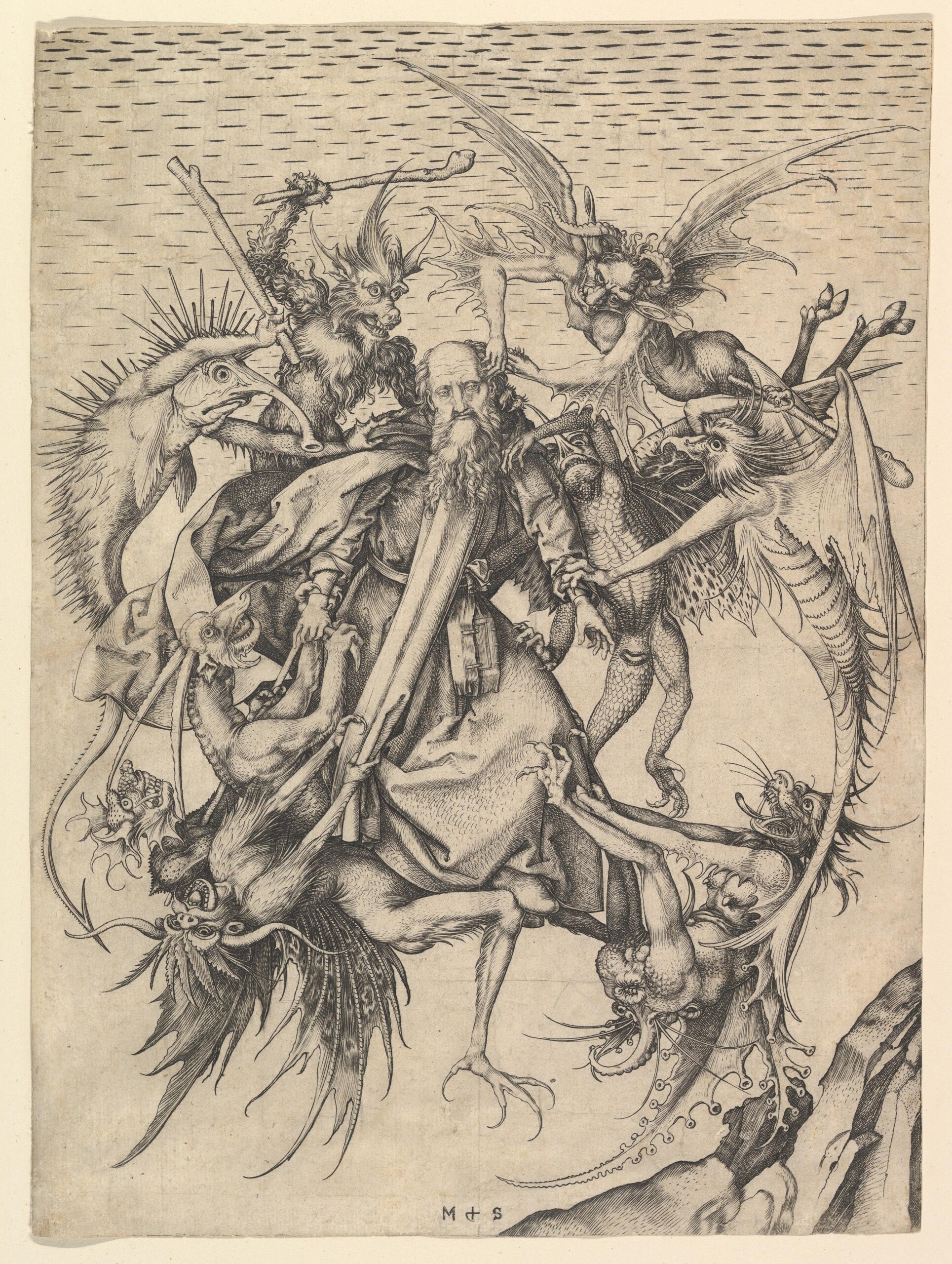
And indeed, relaxation has its place. A story is told of Saint Antony the Great one of the champions of extreme ascetical practices. A farmer, having heard about Antony incredible feats of self-denial, was scandalized when he saw the great man from a distance, talking and even joking with a group of younger monks. When he confronted the saint Anthony had him string his bow and shoots a series of arrows. After a few bowshots, the farmer objected: if he continued to stretch his bow in this way, it would break. So too, said Saint Anthony, with the monk. It is not healthy to practice asceticism without relaxation.

This is also true when our health is compromised. Sometimes survival and the restoration of health requires treating the body gently. The pain and discomfort of sickness or age, when borne well, are penance in and of themselves.

Dealing with the Lenten malaise

February 25, 2026

The opening days of Lent are often filled with enthusiasm, a sense of purpose and newness. But Lent is a long season. After a week or two, my own resolutions start to appear more difficult than I had anticipated. What I have found helpful in dealing with this typical Lenten malaise is to focus on simply carrying out the fast, or whatever other resolution I made, without much regard to any tangible “result.”

Aiming at a result is a temptation of Lent. The truth is that we are seeking to grow closer to God, a God who is infinitely greater than anything we can imagine. We can’t really know what a better relationship with God is like. Instead of tracking my weight when I fast, I simply abstain from a meal, or from meat, without asking what it’s for, other than that I pledged to do this for God. Similarly, we can’t know for certain how any alms that we give will be used. Most of all, we can’t know ahead of time what results will come from prayer.

Once we have made the simple resolution to carry out our Lenten penance, we can take a more objective view of how these practices, recommended by Jesus Himself, subtly change us. They challenge me to identify and renounce a tendency toward complaint or victimhood. They help me to discover faults that I hide by eating nice food, buying nice things, and enjoying entertainments instead of prayer. Here is where the real work of conversion takes place. Let’s not waver in our resolutions!

Because she loved more…

February 10, 2026

Today we conclude our annual retreat, and if you are thinking to yourself that we just did this a few months ago, you would be right. We have moved the time of our retreat back to February from November, where we observed it from 2018 until 2025. Today is an opportune day to end the retreat, since we have the custom of renewing our vows on the final day of the retreat. Today is the Feast of Saint Scholastica, the sister of Saint Benedict.

We know precious little of the life of Saint Scholastica, which was included by Saint Gregory the Great in his Dialogues, a book about the holy men and women of Italy of his time. We know that she had a convent near the great abbey of Monte Cassino, where he lived the last years of his life, and that she would go out of the convent annually to visit her saintly brother and discuss the joys of the spiritual life.

Gregory also tells us that her prayer was more powerful than her brother’s because she loved more. This should always be a burr in the saddle for the men’s branch of the Benedictines. Our order of monks has much to pride itself on: a 1500 year history during which hundreds and hundreds of monasteries helped to build up Europe, develop the Church’s liturgy, preserve the literary works of ancient Latin scholars, run the first schools for children, and on and on. In uncertain times like our own, there are many who look to monks for the “Benedict Option,” to renew this work of cultural preservation through the current Dark Age. If God wills it, may it be so.

But all of this work can miss the admonition of Saint Scholastica. At one point in the story of her last days, she says to Benedict, “I asked you and would not listen. I asked my God and He listened.” This a good-natured chiding, to be sure, but it contains a sharp point. Benedict begins his Rule with the word, “Listen,” and Saint Scholastica is suggesting to him that he isn’t living by his own teaching. He is forgetting what Saint Paul says in his First Letter to the Corinthians, as I would put it (if you will allow a paraphrase and a bit of hyperbole), “If I have the perfect observance of the monastic way of life, compose great works of theology, and preserve Western civilization, but have not love, I am a noisy gong or a clanging cymbal.”

So as we monks renew our solemn profession to continue in a life of obedience, stability and conversion of life, we should keep in mind Saint Scholastica’s challenge and example. May we do more—certainly! –not necessarily because we are strong or clever. In God, let us accomplish all that we do because we love.

Homily for Christmas Eve

December 27, 2025

The entrance of the Son of God into the world is the most consequential event in all of history. Whatever we previously thought it meant to be human is fundamentally changed—very much for the better—by the discovery that our nature is completely compatible with God’s nature. Whatever we thought it meant to be God is also changed—and again, this change is for the better—because we now know that God is love, that God is communion. And of course, these discoveries about the two natures of God and man are an improvement over whatever went before simply because they are also true.

We often say that Jesus became like us in every way except for sin. And this is undoubtedly true, well-attested in the Scriptures and in the Tradition. But this qualification about sin obscures something of earth-shattering importance: sin is not natural to human beings; sin is a corruption of human nature. I will return to this in a moment, but for now, let us note that human nature is compatible with the divine nature, so long as that human nature is freed from sin.

When I said a moment ago that the Incarnation changes our knowledge of God, we should note that it is a change foreshadowed by God’s history with the human race. There are two aspects of this history, at least as I would like to tell it to you this evening. The first is the gradual realization of human beings that God is utterly transcendent. This realization was quite an achievement; most cultures are content to have a provincial idea of God. Ancient peoples were fine with there being multiple gods, and were apt to switch allegiances when one god seemed more powerful than another. It is the genius of two different cultures, the Jewish and the Greek, that they gradually came to understand that for God to be truly godlike, there could only be one, and this God must be somehow greater than the universe. When I mention Greek culture, really mean a small, radical subculture of Greek philosophers who derived the notion of monotheism.

Such a God is terribly powerful, and yet both the Jews and Greeks intuited that God is also just and true and therefore is not given to arbitrary displays of power. Here, though, is where the two cultures diverge. For Greeks like Aristotle, God withdraws into an inaccessible solitary bliss. For the Jews, God is puzzlingly close to the downtrodden, exiles, widows and orphans. They knew this because they experienced it. The Jews were conquered in turn by the Babylonians, the Macedonians (after being liberated by the Persians), then by the Romans. We hear this evening that Joseph and Mary needed to travel to Bethlehem to satisfy the
taxing strategy of Caesar Augustus. They are an occupied people at the moment that God appears as a child of a Jewish woman.

Throughout all of these tragedies and disappointments, God did not abandon His people, and this suggested that God was somehow a God of love. This was abhorrent to the Greeks. Love makes us vulnerable, and gods by apparent definition, can never be weak or vulnerable, and certainly not the supreme God. Love seems to imply that we need someone else, and God cannot need anything.

And so when we peer into the manger tonight and see God, the Son of God, as a vulnerable infant, dependent utterly on His Mother for sustenance and nurturing, this is a radical discovery about God, that He really loves us so much that He is willing to offer Himself to us, to placed in our arms, on our tongues. This is, strangely, who God is, and yet when we think of it, it rings true. It somehow confirms what we had not dared to hope, that all of creation, good as it is, beautiful as it is, is yet gratuitous, a grace a gift from a God Who loves us, and made us for Himself. He is not a God Who dominates, Who pulls rank. He is not first of all a scold, a gaslighter Who claims to love us while pointing out our every flaw. He is love pure and simple, vulnerable and waiting for us to say, “Yes, I love you, too.”

All of these insights we could derive from the Christmas story. But what about our response? Is the Incarnation something we celebrate today because it happens to be the anniversary of Jesus’s birth? Is it something that God did once upon a time, and now He no longer Incarnates Himself? Clearly this isn’t the case, and here is where I return to a thread I left off a few minutes ago. I said that sin is a corruption of human nature, and we know this because the perfect union of the human and the divine is in a sinless man. Jesus is not an isolated example of sinlessness. He is the beginning of our sinlessness, our union with God. In the words of Saint Athanasius, “God became man so that man might become God.” We are invited to follow the example of the Virgin Mary, and by the invitation He gives to us in baptism, to welcome the life of Christ in our hearts, to be transformed by love, and, let’s be honest by vulnerability, that sin might be rooted out of us, that we might die to ourselves so as to live the divine life of Christ. This can be a scary proposition for sure, but this night we have this assurance from God: He loves humankind so much that entered completely into our human world, with all its typical concerns, struggles, joys, heartaches,
boredom, insight, whatever we experience as human beings, Christians experience with God as our eternal partner in love.

  • Go to page 1
  • Go to page 2
  • Go to page 3
  • Go to page 4
  • Go to Next Page »
 
© 2026 Monastery of the Holy Cross
  • Accessibility
Web Design by ePageCity