Monastery of the Holy Cross

  • Home
  • About
    • Benedictine Life
    • History
    • Video Gallery
    • Et Incarnatus Est - The Prior's Blog
  • Visit Us
    • Guesthouse
    • Prayer Schedule
      • Christmas 2025
    • The Catholic Readers Society
  • Vocations
    • Monastic Experience Weekend
    • Formation
    • Oblates
      • Oblate Podcast
  • Solemn Vespers
    • Solemn Vespers for Corpus Christi
    • Chant
  • Contact
  • Donate

Articles under Culture

Reason and Faith

May 21, 2020

I was a big science fiction fan as a kid. I read everything I could find by Isaac Asimov, and I memorized episodes of Star Trek. In high school, I subscribed to Asimov magazine, and it was from reading the short stories and novellas therein that I came to the realization that the Golden Age of science fiction was long gone. So I was somewhat prepared to be cynical when Star Trek: The Next Generation debuted my senior year.

“The saddest aspect of life right now is that science gathers knowledge faster than society gathers wisdom.”–Isaac Asimov

On the whole, I enjoyed the show, but a comparison between the two Star Treks at the time confirmed for me that the adventure, mystery, and humanity of the original was losing out to militarism, expertise, and a kind of bureaucratic stuffiness in the new series. Later seasons managed to fix many of the glaring problems of the early seasons, but I had lost interest by then, and was devoting my creative energies to music and Shakespeare.

One episode summarized the problems for me. All I can remember about it was that some kind of tear had opened up in the space-time continuum (!), and if the Starship Enterprise couldn’t get there and knit it up somehow, that reality would cease to exist. No pressure! Beneath the surface of this implausible plot device, it would appear that human beings have become responsible for literally everything. 

And isn’t this how we all feel sometimes? We are urged to feel simultaneously responsible for:

Reducing global temperatures
Every questionable thing the President says or Tweets
Making sure people in Michigan don’t die of COVID-19
Figuring out how to get our two-year-olds into Stanford
Ending terrorism (or evil itself, if George W. Bush is to be heeded)
Getting the bishops to be more disciplined
Making sure no kids anywhere get bullied
Donating to groups fighting cancer, Alzheimers, et al
Ending poverty
Murder Hornets

Now I assume that, most of the time, our conscious minds understand that we can’t do everything. But the cumulative effect of the impulse to solve every problem is chronic anxiety. As I wrote in the previous post, this is, in fact, a recipe for irrationality. To assume responsibility for all of the world’s problems is fundamentally unreasonable, but we rarely permit ourselves to admit this squarely. The result is a worldview with a large, false supposition built in.

According to family systems therapy, stress is not produced by overwork. Rather, overwork is one symptom of stress that has its roots in being overly responsible. Our present stressed-out overfunctioning is further fueled by a simplistic notion that our American political system is a democracy. It’s not, in fact. We live in a representative democracy, more formally called a republic. The reason I point this out is that a flat ideology of “democracy,” suggests that we are all responsible for everything in our country, and that the only way to address this responsibility is through constant monitoring of the news and constant argument. And it’s exhausting!

What if we’re not responsible for all that other stuff? Who might be? What if we felt that, behind it all, the maintenance of the space-time continuum was God’s prerogative and not ours? I often find that God raises up ingenious and courageous helpers at fortuitous moments. These helpers see the same problems I see, but have the intelligence, experience, and resources that I lack. It’s always possible, too, that a problem can’t be solved immediately. I will return to that possibility below.

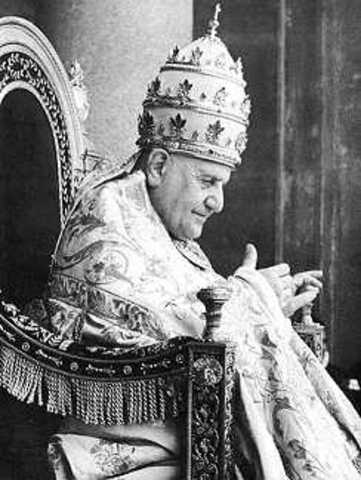
“We feel that we must disagree with those prophets of doom who are always forecasting disaster.”–Pope Saint John XXIII

Pope Saint John XXIII offered this prayer each night before bed: “Well Lord, it’s your Church, you take care of it; I’m going to sleep.” Similarly, when Napoleon Bonaparte confronted Cardinal Consalvi and threatened to destroy the Catholic Church, the Cardinal’s response was, “Your majesty, we, the Catholic clergy, have done our best to destroy the church for the last 1,800 years. We have not succeeded, and neither will you.”

These are quotes by men of deep faith, but they are also clear-eyed realists. There’s nothing childish about this faith. It’s an acknowledgement that there are powers at work in the world well beyond what we can touch. Our task is to figure out our assignment and then resolve to stay at our posts. The pagan heroes of old understood that fate was not something that they could determine. It was, however, theirs either to reject or to accept nobly and graciously. By accepting fate, heroes also accepted the relatively confined spheres of action in which it is enacted. Beowulf died slaying the dragon that was threatening his native Geatland (southern Sweden), but the dragon never was a serious threat to the lands of most other contemporary peoples. Peruvian dragons were, presumably, for Peruvian heroes to deal with. And in heaven, the great band of dragon-slayers will have its own special space at the bar where they will hang out and share stories from every corner of the globe.

Realism is central to thinking rationally about our options for acting. Hyper-responsibility inclines us either to grandiose, impossible projects, or to paralysis. Bipolar disorder happens when someone oscillates between these two unrealistic options. Some choose to escape this oscillation by a strategic retreat into chronic complaint. None of these approaches are reasonable, nor are they mature. Hidden fears are continuing to contaminate our thinking.

Faith is a gift from God. This gift frees us from fear, and it frees us to risk the good even when we might suffer for it. In our present climate, I suspect that many of us are tempted to choose lesser goods because, in a highly polarized environment, we fear failure, rejection, and ostracization. If we remember that our Leader leads by way of the Cross, we can let go of the notion that the suffering we experience is a sign of God’s rejection or our failure. Nor is it our responsibility even to change those who cause us suffering, any more than Christ felt it important to win over Pilate and the Sanhedrin.

Faith is often presented as the opposite of reason, but this is a mistake. The opposite of reason is reactive fear. Faith is the friend of reason. In fact, it is the precondition for the full flowering of reason.

What To Do When There Are No Good Choices

April 28, 2020

“But come! With hope or without hope we will follow the trail of our enemies. And woe to them, if we prove the swifter! We will make such a chase as shall be accounted a marvel among the Three Kindreds: Elves, Dwarves, and Men. Forth the Three Hunters!”

–J.R.R. Tolkien, The Lord of the Rings: The Two Towers, Chapter I

The speaker in the excerpt is Aragorn, fated to be king, but, at this point in the story, merely the failed leader of the Fellowship of the Ring. Earlier in the chapter, he observes, “All that I have done today has gone amiss. What is to be done now?” The Ring and its Bearer have vanished, the stout Boromir lies slain, and two other hobbits of the Fellowship have been captured. Aragorn has no good choices in front of him: “An evil choice is now before us.” There is good reason to fear the worst, that the evil Sauron will regain the Ring and use it to exercise totalitarian rule over Middle Earth. 

We face a perplexing situation as the pandemic drags on. How shall we proceed? Tolkien, Shakespeare and other great authors offer us lessons in just such choices. Aragorn ultimately decides to proceed on the basis of the virtues, particularly the virtues of honor, courage, and nobility. He and the other two remaining members of the Fellowship first give proper commendation to the fallen Boromir, which is the just and honorable thing to do. Next, they resolve to rescue and avenge their captured friends. Such is the context of the opening quote above. There seems to be little or no hope. Readers of Tolkien’s Silmarillion will be familiar with this type of predicament. Tolkien is borrowing it from a widespread trope in the literature of heroic paganism. Pagan heroes such as Hector, Siegfried, Beowulf, and perhaps even Anakin Skywalker, are faced with lose-lose situations. Heroism is obtained by accepting one’s fate courageously, honorably, and nobly.

“I never took the Kobayashi Maru test until now. What do you think of my solution?”–Mr. Spock acts decisively when there are no apparently good choices.

Is this not how our lives feel right now under the dual threats of a pandemic and economic disaster? There are no good choices. It’s important to admit this because if we imagine that there is a right choice, we may well fall prey to finger-pointing, polarization, and a self-defeating victimization narrative. The great pagan heroes were not victims. Aragorn himself had no time to point fingers. “It is I that have failed.” What is especially important is that Aragorn also does not collapse into paralysis: “We that remain cannot forsake our companions while we have strength left.” He chooses an honorable and courageous course, well aware that it is a long shot. But if he fails, he will at least fail doing something excellent, attempting to honor his friendship with the missing hobbits.  

What is more, the author of this story is not a pagan, but a Catholic. This means that no situation is ever truly hopeless. Christian hope is a theological virtue, a gift from the God Who has proven Himself faithful and more powerful than death and despair. This allows us to go beyond even what is just, courageous or noble. We should still choose this, of course, but we add to this natural virtue the horizon of hope. God can see all kinds of possibilities that we can’t yet. Welcoming the gift of hope is largely a matter of cooperating with the divine.

Hope allows us to remain active participants in the drama that is our lives. A large part of the fear, anxiety, and depression that have been affecting us reflect a sense that nothing we can do will change the situation. It is true that most of us will not make a big difference in, say, public policy at the federal, state, or even city level. But this is true at all times, and not just in times of crisis. We can make a big difference in our outlook and the outlook of our families and friends. And hope, like all virtue, is contagious. If enough of us are re-empowered to take action, who knows what breakthroughs we might discover? When we hope, we open ourselves to God’s perspective, a greater vista than that offered by typical politics or science.

So what can you do today for someone you love? What do you owe your family today? What do we owe ourselves? What ignoble behaviors can we identify in our lives that we can resist? These and other questions like them are always good to ask, but we easily overlook them when a situation feels beyond our control and the future feels suddenly uncertain.

The truth is that our future has always been uncertain. On January 1, 2020, our future was just as uncertain as it is today because it was exactly the same future. We just didn’t know certain things four months ago that we know now. In this life, circumscribed by our births and our ultimate deaths, things are always uncertain. The successes of science and sociology have tended to obscure this fundamental truth. However, being reminded of it is not a bad thing, though we might wish that it had become clearer without the intervention of a potential disaster. 

Our choices are always made in the face of an uncertain future. Often enough, choices that seemed to be correct at one point in our life look terrible in hindsight, and vice versa. What we always need in the face of such choices is hope that no matter how bad things get, God is accompanying us in the persons in our lives, especially those imbued with virtue. When there are no good choices, we are still free. In fact, we are freed precisely from the burden of having to be “right” in a narrow technocratic or utilitarian sense. We are free to ask the more important question, “What kind of person, city, and nation do we want to be in the midst of our suffering?”

Tolkien answers for Aragorn in his actions. “On and on he led them, tireless and swift, now that his mind was at last made up.”

Is Patriotism a Christian Virtue?

July 3, 2019

The Fourth of July is, hands down, the loudest day in our Bridgeport neighborhood. It’s always amusing when we have a new person in the community this time of year, impishly warning them what is coming: an hours-long, non-stop barrage of explosions coming from every conceivable direction. Many of our neighbors leave for a few days, especially those with dogs. We, too, used to find a refuge away from the city. Hours of explosions throughout the night is not conducive to a contemplative atmosphere, to say the least. We’ve learned to make peace with the situation by watching edifying movies into the night and having a sleep-in on the 5th.

Read More »

Can Faith Be Argued?

February 24, 2019

“We begin from faith, not reason. ‘Credo ut intelligam.’ But how does one argue faith?”

A friend recently asked me this question on a Facebook thread. The thread was about the degenerating relationship between the sexes, though the problem is clearly a more general one. That problem is one inherent in human nature and one that the institution of culture address: how do we resolve disagreements? I suspect that most of us, without reflecting on the problem, assume that we reason toward agreement. This would be terrific were it so; but this requires that we share premises and that we are skilled at drawing logical inferences from premises and applying them to particular cases. In other words, it requires that we be virtuous, using charity with our fellows and cultivating prudence.

Read More »
  • « Go to Previous Page
  • Go to page 1
  • Go to page 2
  • Go to page 3
  • Go to page 4
 
© 2026 Monastery of the Holy Cross
  • Accessibility
Web Design by ePageCity