Monastery of the Holy Cross

  • Home
  • About
    • Benedictine Life
    • History
    • Video Gallery
    • Et Incarnatus Est - The Prior's Blog
  • Visit Us
    • Guesthouse
    • Prayer Schedule
      • Christmas 2025
    • The Catholic Readers Society
  • Vocations
    • Monastic Experience Weekend
    • Formation
    • Oblates
      • Oblate Podcast
  • Solemn Vespers
    • Chant
  • Contact
  • Donate

Articles tagged with liturgy

Homily for Holy Thursday

April 9, 2020

[The following is the text preached by our deacon Brother Joseph at the Holy Thursday Mass of the Lord’s Supper.]

On a late November morning in 2004, I got up at 5 a.m., stopped at Starbucks for coffee and a pumpkin scone just as they opened, and blazed my way up the winding ascent of the Ute Pass into the Front Range of Colorado, where I was living at the time.  I spent several hours hiking up to the snowy, wind-scoured heights of Bison Peak in the Lost Creek Wilderness, seeing no one until almost halfway back down the mountain.  On the way home, I picked up a take-and-bake pizza from Papa Murphy’s, which I ate alone in my apartment.  And that was how I celebrated Thanksgiving.  It was not a Norman Rockwell slice of Americana with generations of family members gathered around a table groaning under a roast turkey and all the trimmings.  Neither was it a despondent, lonely day.  It was the fourth consecutive Thanksgiving I had spent in Colorado, and in previous years I had celebrated with friends who were also unable to make it back home.  But I was moving back to Michigan in just over a month to be closer to my family, and Thanksgiving alone was not the most lonely option.  I knew where I was from, where I was going, and where I belonged, even if I wasn’t actually there.  And while I was still eating a mediocre pizza by myself, I knew that 1500 miles away there was a table in my father’s house with a place for me.  I expect that we all have had these experiences of gatherings that were incomplete, whether we were the one absent or it was someone else.

We are gathered tonight to celebrate the institution of the Eucharist, the great festal family banquet of the Church.  But this year is different.  The church is decorated as usual and ablaze with light.  The brothers have entered with incense and chant.  But I stand here at the ambo and look out over empty pews, and I know the doors of the church remain locked.  It threatens to cast a pall over the celebration.

But this overlooks the important fact that we only miss what ought to be present.  We don’t miss strangers who aren’t at Thanksgiving dinner with us: we miss our absent family members.  The very sense of absence and loss we feel tonight is proof that we all have been called to the Supper of the Lamb.  We all belong here, where God has prepared a place for us, his beloved children.  It is a place that was created for us from before time began, that became ours in baptism, and has become ever more our own by our past participation in the Mass.

We can also overlook the reality that at times God withdraws from us, not to punish us, but because in his love he desires to rekindle and stir up our longing for him.  “Familiarity breeds contempt,” says the proverb, but “absence makes the heart grow fonder.”  This is a time of absence and spiritual hunger, but even that proves that our true food is in Christ.

And while to the disciples the Last Supper was complete in their small group, Jesus saw beyond to all those who would ever be members of the Church.  In that small gathering he saw everyone who would ever come to believe through the message they would proclaim, a message that would spread and bear fruit throughout the whole world, across all time.  Even there in the upper room he saw you and prayed to the Father for you, even as tonight be sees you and prays for you, for he sees not only what is, but what will be, when he has gathered us all to himself in heaven.  The words of Shakespeare’s sonnet could be our Lord’s own when he says, “Thyself away are present still with me, For thou not farther than my thoughts canst move, And I am still with them, and they with thee.”
The Mother of God and the Incarnation

December 31, 2019

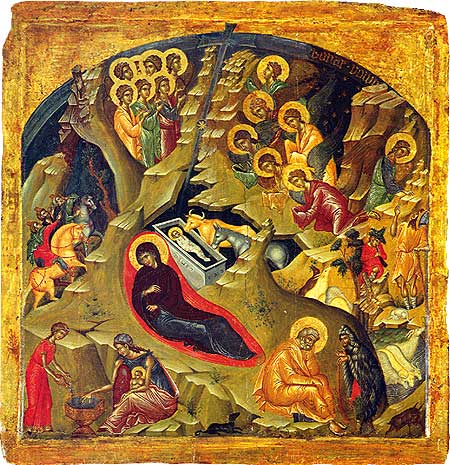
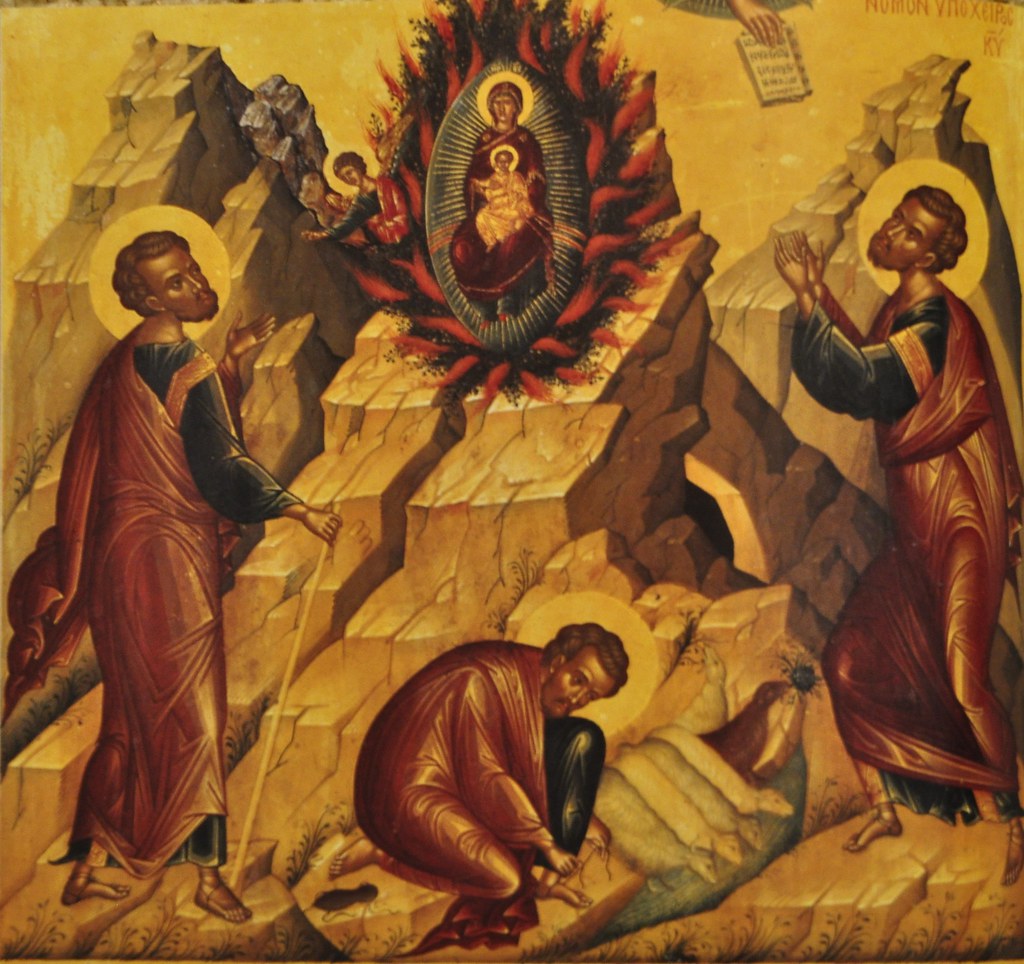
It is common to use evergreen boughs to decorate for the Christmas season. Like the image of the Burning Bush, the evergreen points us toward a mysterious source of life, a current just beneath the surface of our world, bursting through like a hidden spring at certain moments. Amid the entropy of our deciduous (Latin decidere, to fall into ruin, to die) world, signs point us toward this inexhaustible font. The contrast between the autumnal coloring of leaves and the steady greenery of needles, like the contrast between the sidereal firmament and plummeting meteors, speaks to us of a contrast between a permanent world, as yet only hinted-at, and the restless burgeoning and decay of the palpable.

The signs of permanence and stability, the evergreens, the stars, the Burning Bush, appear very much within our world of flux. This is itself significant, for it suggests that our salvation is not so much a separation from the material as it is a rejuvenation of the very cosmos itself. So says Saint Paul:

“Creation was subjected to futility, not of its own will but by the will of him who subjected it in hope; because the creation itself will be set free from its bondage to decay and obtain the glorious liberty of the children of God.”
—Romans 8: 20-21

It is because of this link between our salvation and the liberation of creation that the prophecies of the Old Testament have retained their value. Even after the Fall, creation has borne traces of its lost transparency as well as its destined rebirth. This is to say that creation itself has continued to point toward God its boundless Source. “Ever since the creation of the world [God’s] invisible nature, namely, his eternal power and deity, has been clearly perceived in the things have been made [Romans 1: 20].”

Danger enters from the darkening of our intelligence that followed on the loss of trust in God. The Tree of the Knowledge of Good and Evil lost its sign value as a marker of God’s love and guardianship of Adam and Eve and became (falsely, by the trickery of the serpent) a counter-sign of a supposed arbitrary tyranny. Once faith has been broken by this kind of mistrust, creation ceases to speak lucidly. We ourselves are tempted to be entrapped by the disintegrative forces unleashed by sin, to try and hold on to creatures whose decay is meant to warn us to return to the source of life.

According the Wisdom of Solomon, our predicament can be thus summarized:

“From the greatness and beauty of created thing comes a corresponding perception of their Creator….as [the pagans] live among his works…they trust in what they see, because the things that are seen are beautiful….But [they are] miserable, with their hopes set on dead things.”
—Wisdom 13: 6-7; 10

Even the chosen people of Israel needed constant reminding of the invisible and immaterial God Who communicates through the visible and material. It is significant (another “sign-being-made”) that in Hebrew, the same word, dabar, means “word” and “thing”—a commingling of the spiritual and the perceptible. The prophets communicated not only by speaking, but by proto-sacramental actions and objects. All of these point to the mystery that we celebrate this night, the sudden illumination, not of a lowly shrub on the side of Mount Horeb, but of the human race and all creation by the Motherhood of the Virgin Mary.

We can describe in minute detail how conception takes place, in terms of the mingling of genetic material and the implantation of an embryo in the tissue of its mother’s womb. But can we perceive how a human life, consciousness, the whole mystery of personhood is set in motion by these intricate biological events? Once more we are brought to the boundary between contingent materiality, and the mysterious Source of life itself. This Source has been at work since the beginning of time. Moses and the prophets, culminating in John the Baptist, pointed to its manifestations, celebrated in tonight’s antiphons. We the baptized have the joy of partaking in it:

“For in the mystery of the Word made flesh/a new light of your glory has shone upon the eyes of our mind,/so that, as we recognize in [Christ] God made visible,/we may be caught up through him in love of things invisible.”
—Preface I of the Nativity

May your New Year be filled with the illumination of the Son of God and His immaculate Mother! May we learn anew how to live sacramentally, pointing others to God’s manifestations in our world today.

Merry Christmastide!

Form Focuses and Releases Energy

April 1, 2019

Today is Debbie Reynolds’s birthday. She is the most energetic woman I’ve ever seen on screen. What strikes me whenever I’ve watched her dance is this: her mastery of technique is what makes her energy so intense and infectious. Her poise and carriage are never tense nor slack; she is an icon of the (apparently) effortless channeling of the potential into the kinetic.

Read More »

Solemn Vespers Monday night!

December 29, 2018

[The following are the program notes for First Vespers of the Solemnity of Mary, the Mother of God, to be celebrated Monday, December 31 at 5:15 p.m. We hope that many of you can join us and ring in the new year with this beautiful celebration!]

Read More »

Understanding Christ’s Kingship

November 24, 2018

The concept of kingship, considered throughout history and in multiple cultural contexts, varies quite a bit. Contemporary Americans tend to equate kings with tyrannical figures wielding huge amounts of arbitrary governmental power, whether it be the power of taxation exercised unhappily by George III at the expense of the Colonies, or the power of complete policy control as brandished by the Sun King, Louis XIV (“I am the state,” “L’état, c’est moi,” was his memorable way of expressing it).

Read More »

Radical Witness and Saint Lawrence

August 10, 2018

Monks in the modern world are daily confronted with incongruities. We dress in tunics and scapulars that were the workaday clothing of sixth-century peasants. We pray the Psalms, composed some three thousand years ago in a language that does not translate into contemporary idioms very well. Many of our customs date from the early Middle Ages (suddenly a controversial era!), presupposing a worldview that is unfathomable to many of our neighbors in Chicago.

Read More »

Solemn Vespers at the Monastery, July 28

July 24, 2018

Our next celebration of Solemn Vespers with Schola Laudis will be this Saturday, July 28. What follow are my program notes for the occasion. For more information, click here.

Read More »

Why Monks Sing

May 26, 2018

Yesterday, I received an email from Jon Elfner, a friend of mine.  The email read, in part:

Read More »

Liturgy as Everyday Life

May 13, 2018

[The following is from the program notes from our last celebration of Solemn Vespers.]

The Sixth Sunday of Easter is not the flashiest of liturgical events. We’re a good ways out from the euphoria of Easter, but not quite at the Ascension yet. It seems like a good time to step back at think about the liturgy in general.

Read More »

The Ascension

May 10, 2018

Poetry tills and harvests in the fields of metaphor.

When Shakespeare’s Romeo muses, “Juliet is the sun,” he is not making a statement that is literally true. But it is true. How so? Oddly enough, answering this question involves us in more metaphorical speech.

Read More »
  • « Go to Previous Page
  • Go to page 1
  • Go to page 2
  • Go to page 3
  • Go to page 4
  • Go to Next Page »

Blog Topics

  • Beauty (22)
  • Contemplative Prayer (60)
  • Contra Impios (2)
  • Culture (32)
  • Discernment (32)
  • Formation (16)
  • General (42)
  • Going to the Father (18)
  • Gregorian Chant (5)
  • Holy Spirit (7)
  • Jottings (27)
  • Liturgy (98)
  • Meditations on Heaven (4)
  • Monastic Life (58)
  • Moral Theology (53)
  • Music (18)
  • Scripture (60)
  • The Cross (3)
  • Vatican II and the New Evangelization (21)

Blog Archives

  • April 2026 (1)
  • March 2026 (4)
  • February 2026 (3)
  • January 2026 (2)
  • December 2025 (6)
  • November 2025 (4)
  • October 2025 (2)
  • September 2025 (2)
  • August 2025 (3)
  • July 2025 (4)
  • June 2025 (4)
  • May 2025 (3)
  • April 2025 (4)
  • March 2025 (4)
  • February 2025 (3)
  • January 2025 (5)
  • December 2024 (8)
  • November 2024 (3)
  • October 2024 (9)
  • September 2024 (8)
  • August 2024 (9)
  • July 2024 (9)
  • June 2024 (8)
  • May 2024 (9)
  • April 2024 (4)
  • November 2023 (1)
  • April 2023 (1)
  • December 2022 (1)
  • October 2022 (1)
  • March 2022 (1)
  • February 2022 (1)
  • August 2021 (2)
  • June 2021 (1)
  • May 2021 (1)
  • April 2021 (1)
  • February 2021 (2)
  • January 2021 (1)
  • December 2020 (1)
  • August 2020 (4)
  • June 2020 (1)
  • May 2020 (4)
  • April 2020 (9)
  • March 2020 (4)
  • February 2020 (1)
  • January 2020 (1)
  • December 2019 (1)
  • July 2019 (2)
  • June 2019 (1)
  • May 2019 (1)
  • April 2019 (2)
  • March 2019 (1)
  • February 2019 (3)
  • January 2019 (1)
  • December 2018 (1)
  • November 2018 (2)
  • October 2018 (2)
  • September 2018 (2)
  • August 2018 (1)
  • July 2018 (2)
  • June 2018 (4)
  • May 2018 (7)
  • April 2018 (1)
  • March 2018 (1)
  • February 2018 (1)
  • January 2018 (2)
  • November 2017 (1)
  • October 2017 (1)
  • September 2017 (1)
  • August 2017 (1)
  • July 2017 (2)
  • June 2017 (2)
  • March 2017 (1)
  • February 2017 (2)
  • December 2016 (1)
  • November 2016 (3)
  • August 2016 (2)
  • May 2016 (2)
  • April 2016 (5)
  • March 2016 (2)
  • December 2015 (1)
  • November 2015 (2)
  • October 2015 (3)
  • August 2015 (10)
  • July 2015 (12)
  • June 2015 (17)
  • May 2015 (2)
  • April 2015 (7)
 
© 2026 Monastery of the Holy Cross
  • Accessibility
Web Design by ePageCity