Monastery of the Holy Cross

  • Home
  • About
    • Benedictine Life
    • History
    • Video Gallery
    • Et Incarnatus Est - The Prior's Blog
  • Visit Us
    • Guesthouse
    • Prayer Schedule
      • Christmas 2025
    • The Catholic Readers Society
  • Vocations
    • Monastic Experience Weekend
    • Formation
    • Oblates
      • Oblate Podcast
  • Solemn Vespers
    • Chant
  • Contact
  • Donate

Articles under Moral Theology

The World, the Flesh, and the Devil: Introduction to Precautions Against the Flesh, Part 2

March 18, 2026

(Here is the Introduction to the whole series. Here are The First Precaution Against the World and The Second and Third Precautions Against the World. Here is Part 1 of the Introduction to Precautions Against the Flesh.)

There is a place for pleasure in the Christian life. Aristotle astutely noted that pleasure typically accompanies the completion of a good action, an action with a properly ordered goal. What the flesh would have us do is to seek this pleasure for its own sake. Here lies the beginning of addiction. When pleasure is unhitched from productive actions and achievement, it becomes its own goal. And when it becomes its own goal, our bodies demand that pleasure continually increase in intensity.

So, goals exercise a certain restraint on pleasure. If they are worthwhile, they always entail accepting a certain amount of discomfort, pain, and danger. To become a great academic requires reading and writing when it is not pleasurable to do so. It requires sacrificing other potential good actions which might bring a certain amount of comfort. It requires being tested and corrected by one’s teachers and peers, perhaps even being subject to ridicule and career sabotage. But the young scholar undertakes those risks, believing that becoming learned and being able to credibly teach others will lead to the pleasures proper to a cultivated mind.

As Saint Paul again points out, athletes deny themselves all kinds of things. We can take up his metaphor and note how strength conditioning requires that we continually force our muscles to move weights that cause pain and discomfort.

We have seen that goals naturally tend to reorient pleasure. But what about choosing proper goals? Saint Ignatius of Loyola has made one important contribution to this theme. If I need to choose between two courses of action, when will I know that I am ready to make the choice? The answer has to do with unearthing hidden fears, sensual inclinations and the like. In addition to gathering information germane to my choice, I also must frankly examine the likely fallout from each choice. Only when I am ready to accept whatever discomforts are associated with both choices, am I ready to choose fully rationally, without being swayed by an irrational aversion to difficulties.

If a lot of this sounds like Stoicism, that is because the Stoics’ take on these questions is remarkably similar to the Christian. One area where the Christian parts ways with the Stoic is in this notion of provoking the flesh by voluntarily taking on deprivations. If I could summarize this briefly, and inadequately, while the Stoics contributed much to our understanding of these battles, they shared with other schools of Greek philosophy a tendency to conflate sin and ignorance. They moved closer to the Christian position than did, say, Socrates, but there is still a sense that once the intellect is healed, the will inevitably follows. The Christian, by contrast, believes that the will must be regenerated by grace in order that the intellect may be healed.

Homily for the Third Sunday of Lent

March 11, 2026

Human beings, like all animals, are creatures of desire. We desire food and drink, and we have this desire because we need nourishment to stay alive. And again, this makes us akin to other animals. While plants also need nourishment, they lack desire, properly understood, because they lack awareness of their need. Animals not only hunger but deliberately set off to find food.

In this area, what distinguishes us from other animals is that we can use our reason to determine how to satisfy our natural desires. We can even deliberately not eat, enduring hunger pains for some greater goal such as fasting or dieting. We can also use our intelligence to alter the food we get by cooking it, mixing ingredients, and so on, to produce something that tastes good.

We go even further, using meals to symbolize other desires. For example, we desire companionship and community. A decision to eat together is a decision to satisfy that higher desire. What the philosopher Aristotle discovered is that we have a tendency to rank our desires. He explained this at the beginning of his book on ethics.

When we see someone carrying out an action, and we ask him, “What are you doing?”, we expect that the reason he gives will point to a desire that he is attempting to satisfy.

“Why do you get up at 5:00 a.m.?”

“To get to work on time.”

Aristotle then points out that we can continue to ask, “Why?” to the answer.

“Why do you want to get to work on time?”

“Because I want to get paid and not laid off.”

“Why do you want money?”

And so on.

These chains of questions will always terminate at the one thing that Aristotle says we seek for its own sake, which is happiness. We don’t normally ask people, “Why do you desire happiness? What good is it?”

We all recognize this is a sufficient answer to any question about someone’s motive. If it makes you happy, go ahead!

Aristotle’s theory is pretty sound, but I also think that it requires some filling out. For example, he did not deal with an interesting phenomenon that we find in the Old Testament.

I’m thinking of the prophets. If we were to ask Jeremiah why he was continually criticizing the rulers of Jerusalem, it would be a stretch to show that he did this because he thought somehow it would make him happy. What he desired was something more like proper worship of God. If I could use the words of the Beatitude, he hungered and thirsted for justice.

Alright, with that as background, we look at today’s gospel. We see that, from one perspective, it is all about desire. Both the Samaritan woman and Jesus desire water. Both Jesus and the disciples desire food. And Saint John the Evangelist shows us how these desires point to a higher yearning in the human soul.

Jesus says to the woman, “If you knew the gift of God and who is saying to you, ‘Give me a drink,’ you would have asked him and you living water.” In other words, if we knew the gift of God, we would desire it.

What is God’s gift?

It is the Holy Spirit. Before the Son of God came into the world, would we even have suspected that it was possible to receive God’s Holy Spirit? I think yes and no.

There are stories from many ancient cultures in which a divine spirit enters a human being, making him or her capable of particular impressive deeds, such as the writing of poetry or the invention of writing itself. We say of the Holy Spirit that He has spoken through the prophets, that in some way, they were conduits of the Holy Spirit.

But what Jesus is promising to the woman at the well is something more profound, a permanent union of ourselves with God. This promise reveals to us that our desires for truth, justice, and beauty are in fact different ways of longing for God. That only God can satisfy, and He intends to do this for us in a way surpassing anything we can imagine.

How are we to respond to this offer from God?

Let’s go back to the gospel reading. When the woman is persuaded that Jesus has something of value to offer, she asks for it outright. And so we, too, should ask. Here, though, we should bear in mind that the gift that Jesus is offering will only be available after His death.

What Jesus does next is surprising: He gently talks the Samaritan woman into an admission of her own serial relationship failures. Is Jesus saying that He will only give the Spirit once she’s fixed all her problems?

No, the Catholic Church doesn’t teach that.

Also bear in mind that the woman still thinks that they are talking about water. Things change, however, when she realizes that Jesus is a prophet. This suddenly prompts her to speak about proper worship of God, a point of sharp dispute between Jews and Samaritans at the time.

Jesus says that God the Father seeks people to worship Him in spirit and truth. This is where God’s invitation points, that we learn to worship Him properly. What this means in the context of this homily is, once again, that God is the final terminus of desire, God is what we crave in our heart of hearts, whether we are aware of it or not.

And the expression of this desire is literally worship. The word worship is derived from the same root as the word “worth.” Worship is then that activity in which we acknowledge that which has highest value, God Himself.

This is what I said that the prophets like Jeremiah were desiring rather than earthly happiness. And it was, in some sense, the Holy Spirit that both satisfies that desire and inflames it. The reason that Jesus brings up the ex-husbands of the Samaritan woman is to help us see that we can’t obtain satisfaction of this desire for God without correcting our lower desires.

The longing for love that the Samaritan woman manifested in her many marriages was a sign that could have pointed to God but did not. At some level that is why the marriages didn’t work.

Jesus is healing her and recalibrating this desire, and it truly changes the woman. She goes from being someone avoiding the eyes of others to speaking directly and persuasively to them.

As we move toward the middle of Lent, what desires of ours point away from God, and how can we redirect them? Is there a hidden sin that I’m keeping from God and from my own scrutiny out of shame? And if so, how might Jesus’s gentle example move me to re-examine and heal my own past?

As we cooperate with God’s grace in this process of healing, the Holy Spirit will become more of a conscious companion. And what more could we ask for than that?

The World, the Flesh, and the Devil: Introduction to Precautions Against the Flesh, Part 1

March 6, 2026

(Here is the Introduction to the whole series. Here are The First Precaution Against the World and The Second and Third Precautions Against the World.)

In his Letter to the Galatians, Saint Paul writes, “Now the works of the flesh are plain: immorality, impurity, licentiousness, idolatry, sorcery, enmity, strife, jealousy, party spirit, envy, drunkenness, carousing and the like.” This quote helps to situate what we mean when we say that one of the three enemies of the soul is the flesh. Perhaps when we hear “sins of the flesh” we are inclined to narrow down the temptations of the flesh to lust and gluttony, with a nod toward other excesses of alcohol or drug consumption. But the tradition sees the danger here at a deeper level because of the subtle corruptions of our intellect and will that come about from an undue search for pleasure, comfort, and safety.

In our posts last year, we looked at the three traditional enemies of the soul, the World, the Flesh and the Devil. We saw that they correspond to three parts of the human soul. The Flesh is a distortion of the concupiscible part of the soul, that which seeks health, self-preservation and procreation. The World distorts the irascible part of the soul, that which governs anger, sadness, and to a certain extent vainglory. The Devil operates primarily on our intellect, distorting our notion of ourself and of God.

Jesus’s temptations in the desert also typify these three battles. The temptation to turn stones into bread is clearly a temptation of the hungering and fatigued flesh. The temptation to exercise power over all the nations is a world-related one, and the temptation to tempt God, to force God’s hand, is specifically diabolical.

So let’s begin with Jesus’s fast of forty days. The first interesting aspect of this is that Our Lord’s fast was a provocation. He is forcing the battle against the flesh out into the open. Later on, I will be making a brief comparison between the Christian understanding of the flesh versus the Stoic version. One of the important contrasts is here, that Jesus deliberately chooses prolonged hunger in order to get the Tempter to manifest himself on the pretense of the flesh.

Jesus is teaching us that it is a good practice to choose, for a season, what is uncomfortable, whether it be the discomfort of hunger, of a hard chair without a cushion, which is a typical monastic discipline, or hard manual labor. The goal is to get the flesh to mumble and complain against us and then to respond with a simple “no.” This has the eventual effect of freeing us from unthinking sensuality, which often operates at a subconscious level.

When we attempt these things, we can now see that the Tempter will use our discomfort as a pretext. Jesus’s response is interesting: “Man does not live on bread alone.” This is to say that our survival does not depend on comfort and ease.

One of the tempting ideas that the modern world has put into our minds is that these ascetical practices of the great saints of old—wearing hair shirts, sleeping on the ground, eating once every other day—will make us unhealthy, cause us to wither into resentful Feraponts. But in fact the Christian tradition, and more specifically the monastic tradition has always made a distinction between causing pain or discomfort and causing injury and harm. Not all pain is associated with damage.

And indeed, relaxation has its place. A story is told of Saint Antony the Great one of the champions of extreme ascetical practices. A farmer, having heard about Antony incredible feats of self-denial, was scandalized when he saw the great man from a distance, talking and even joking with a group of younger monks. When he confronted the saint Anthony had him string his bow and shoots a series of arrows. After a few bowshots, the farmer objected: if he continued to stretch his bow in this way, it would break. So too, said Saint Anthony, with the monk. It is not healthy to practice asceticism without relaxation.

This is also true when our health is compromised. Sometimes survival and the restoration of health requires treating the body gently. The pain and discomfort of sickness or age, when borne well, are penance in and of themselves.

Dealing with the Lenten malaise

February 25, 2026

The opening days of Lent are often filled with enthusiasm, a sense of purpose and newness. But Lent is a long season. After a week or two, my own resolutions start to appear more difficult than I had anticipated. What I have found helpful in dealing with this typical Lenten malaise is to focus on simply carrying out the fast, or whatever other resolution I made, without much regard to any tangible “result.”

Aiming at a result is a temptation of Lent. The truth is that we are seeking to grow closer to God, a God who is infinitely greater than anything we can imagine. We can’t really know what a better relationship with God is like. Instead of tracking my weight when I fast, I simply abstain from a meal, or from meat, without asking what it’s for, other than that I pledged to do this for God. Similarly, we can’t know for certain how any alms that we give will be used. Most of all, we can’t know ahead of time what results will come from prayer.

Once we have made the simple resolution to carry out our Lenten penance, we can take a more objective view of how these practices, recommended by Jesus Himself, subtly change us. They challenge me to identify and renounce a tendency toward complaint or victimhood. They help me to discover faults that I hide by eating nice food, buying nice things, and enjoying entertainments instead of prayer. Here is where the real work of conversion takes place. Let’s not waver in our resolutions!

The World, the Flesh, and the Devil: The Second and Third Precautions Against the World

December 23, 2025

(Here is the Introduction to this series and the First Precaution.)

The second precaution against the world regards the attraction that temporal goods have for us. A family has certain financial needs that a religious does not.  But for the lay person, as well as for the religious, it is a question of distinguishing needs from desires.

The last precaution against the world is to guard ourselves against thinking about events in the community. “Never be scandalized or astonished at anything you happen to see or learn of, endeavoring to preserve your soul in forgetfulness of all that.” “Even if you should live among [literal] devils you should not turn the head of your thoughts to their affairs, but…strive to keep your soul occupied purely and entirely in God.”

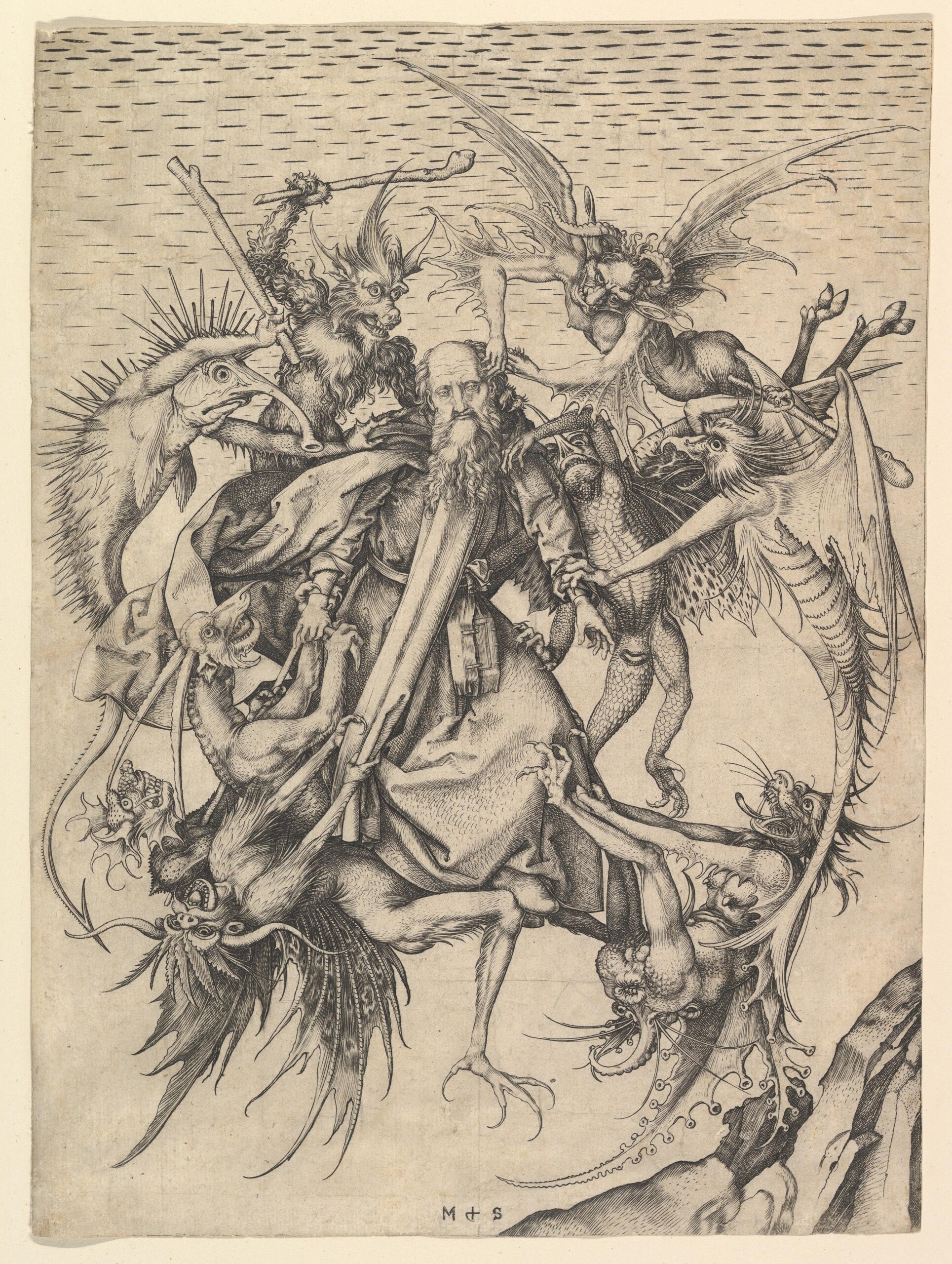
This aside about devils opens up an interesting clue to the meaning of this precaution. If you call to mind the famous drawing by Martin Schongauer of Saint Antony’s temptations, you will remember that the demons are poking at the saint, pulling his beard and so on. And he is completely tranquil and serene in the center of all this mischief. We are familiar with interpreting this in terms of thoughts. For example, when we pray, are we not immediately pushed and pulled in all directions by distractions? And does not the monastic tradition teach us that these distracting thoughts are, much more often than not, the product of demonic intrusion? The remedy is simply to return to the Psalms, or whatever meditation we have undertaken.

Now, Saint John Cassian says that the hermit fights the devil one on one. But the cenobite, the monk in community, fights the devil in his brothers. Does not this suggest that the distracting behavior of my brother is an occasion for the devil to turn my thoughts away from God? John of the Cross agrees: “There is never a lack of devils who seek to overthrow the saints; God permits this [state of affairs] in order to prove and try religious.”

John makes it clear that one of the most problematic temptations is to speak about what we’ve seen with another monk. He says that we should never do this. When we fail in this way, do we not often excuse ourselves ahead of time by claiming that we are acting out of love and concern? At a minimum, before we say anything, we might ask these questions. If the brother is truly in danger or is truly endangering others, who should know about it? Who would have the authority to address it? And then, how likely is it that the person in authority, abbot or novice master or whoever is the overseer in this case, doesn’t know what’s happening? How motivated am I, really, by love for the brother? Is it likely that I am in fact motivated by my own demand for others not to impinge on my peace of mind?

Now apply all that I’ve said to the hyper-reactive world of social media!

Once again, we see that the “worldliness” in this case is about a certain level of comfort, safety and self-insulation, a need to control my environment rather than adapt. We see also a way of identifying the three enemies of the soul with the three parts of the soul. The flesh clearly refers to temptations that arise from the concupiscible part of the soul. The devil, who we said earlier is connected to the intellect, refers to temptations that afflict the rational part of the soul. And the middle part of the soul, the irascible, is that part that deals with danger, discomfort and so on. Is it not often the case that when we feel the need to speak about something scandalous or merely annoying that we are moved by anger or sadness? God gave us anger to drive away true temptations, not to drive a wedge between ourselves and other. And sadness is a sign that something that we valued is being taken away. It is an invitation to let go of identifying myself with that imagined good, to open within myself a space for the True Good, Jesus Christ Himself. The world would encourage our false self to just such identifications, and the false self by its nature wishes to separate from others. Thus the devil puts us at odds, labeling others as either friends or enemies, depending on whether they can provide us with the goods to which we are accustomed or which we feel are our due. The true self, the life of Christ within, grows by constantly opening itself to a divine perspective, a boundless love that gives without counting the cost and has compassion on all.

The World, the Flesh, and the Devil: The First Precaution Against the World

December 18, 2025

(Here is the Introduction to this series.)

I have already noted that the world, which shows itself an enemy through the middle part of the soul, especially afflicts the will.  This is our ability to choose goods based not on immediate desire, but on an apprehension of a future benefit or danger. The will is also the faculty that loves—love being a choice rather than a rational thought or a base desire.

And indeed, in his short work The Precautions, Saint John of the Cross immediately identifies love as the arena of the combat with the world. His first question to those who would do battle with the world is, “Whom shall we love?”

John recommends loving no one person more than another, and forgetfulness of all particular affections or hatreds. Do not think about others, neither good things nor bad.

This is sound monastic doctrine, though difficult in practice. Let’s begin with the very challenging teaching that we should not love one person more than another. This derives directly from the gospel. Jesus says that if we do not approach Him without hating father and mother, we cannot be His disciples. So John is channeling one of Jesus’s most difficult teachings.

Part of the difficulty is that there are relationships whose very nature incurs a certain debt, often mutual, but sometimes in one direction. For example, children are commanded to honor their fathers and mothers. This must be done whether one loves one’s parents or not. We show honor not because we love our parents more than others (though that may be the case), but because honor is the correct disposition toward a parent. This discipline of honor allows us to follow the teaching of Saint Peter, who says in his First Letter that we should honor all. By practicing honor toward certain persons, we can learn to transfer that honor to all persons.

This opens a way to understand what it might mean to love everyone with the same intensity. Loving a specific person is not necessarily the obstacle that it at first appears to be. The question is: will this love I feel and then exercise toward this person, who is God’s gift to me, will this love instruct me on how to treat everyone else? When I have discovered what it means to love one person, can I discipline myself to treat others as if I loved them? When I interact with someone whom I find disagreeable, I can ask, “How would I treat this person if I loved him or her the way I love my best friend?”

I believe that parenthood has a built in pedagogy here. Parents know that it is impossible to love every child the same way. But one must love each child in some sense equally. This requires a deep interest in knowing their nascent personhood, the specific needs of each child. In other words, parents must learn how to love the correct way for each child.

When we begin to open up this love toward others, I want to offer one of my own precautions. We are not talking about letting other persons determine us, and certainly not toxic persons. Love for someone making very poor choices can take the form of “tough love,” letting the person experience the pain that comes from poor choices. Even the incarceration of a criminal can be seen, if done properly, as an act of love, for it prevents the criminal from committing further acts that damage the soul. In any case, I am advocating for a clear-eyed love, not enmeshment with everyone else’s failings. This is why John also says that we must have equal forgetfulness of all persons. We must know where our feelings end and theirs begin, where we can reasonably be expected to help, and where our help means getting drawn into responsibility for unhealthy behavior.

It is interesting that we are commanded to honor our parents rather than to love them. On the other hand, we are commanded to love our neighbor as ourselves. Jesus famously reinterprets the idea of a neighbor in the parable of the Good Samaritan. The neighbor is a person who incurs a certain type of debt, actually a kind of “reverse debt,” something owed to another who is the one in need, and who happens to be near me. In such a circumstance, I am invited to become the tangible mercy and compassion of God toward the poor, the sick, and the abandoned, simply because God put me there.

Let’s note in completing this meditation that every person we meet each day has experienced hurt, disappointment, injury—the list could go on and on. We can’t really know the extent to which that person needs compassion, a kind word, maybe just forbearance. And so he is my neighbor, the one to whom I owe love.

In what sense is the world the enemy in these expressions of honor and love? The world has fallen under the domination of the devil, the diabolos, the one who divides. Particular love and honor, as I have hinted, is given to us by God as a part of His pedagogy. It is when we want to hold onto that love and use it for our own purposes of comfort, pleasure, safety, or whatever, that it causes us to become possessive and to separate. We can attempt to build up a world centered on ourselves, based on our preferences. This is the hostile face of “the world”:  when we seek division based on our own judgments and not God’s.

The second part of John’s exhortation tells us not to think about others. Do we not again need to do this sometimes? Doesn’t a novice master or a teacher need to think about the character of the novice or student in order best to love him and serve his needs for conversion and growth? Do we not need to think about others any time we engage in a cooperative action?

Here is where John’s exhortation to think neither good nor bad comes in. He is exhorting us to evaluate the person not in a moral sense. Any such judgment will be ill-informed and biased. Rather, there are situations where love indeed requires us to make prudential judgments about the best way to interact with specific persons. Here’s the rub: it is extremely difficult to parse the difference between the moral judgment and the practical judgment.

I believe that the distinction arises from how the thought affects me. Does the thought of the other person’s character and assumed motivations move me to change my own approach and dispositions to adapt myself to that person? Or is my first thought to demand that the other person change?

Saint Benedict confirms this approach when he teaches that the abbot must adapt himself to each monk’s character and intelligence. An abbot is someone who really must think about others, as any father must think about his children. But the result of this thought, in the case of an abbot, is not first of all a demand that the monk change, but rather is a discovery of inadequacy in oneself. Or if we put this positively, it is an opportunity to grow in self-knowledge and wisdom.

The World, the Flesh, and the Devil: Introduction

December 11, 2025

Saint Paul writes to the Ephesians:

“You [Christ] made alive, when you were dead through the trespasses and sins in which you once walked, following the course of this world, following the prince of the power of the air, the spirit that is now at work in the sons of disobedience. Among these we all once lives in the passions of our flesh.”

This is the most immediate scriptural citation behind the traditional formulation of the three enemies of the soul, The World, the Flesh, and the Devil. This is one of the traditional means of distinguishing between the spirits opposed to God and the Holy Spirit, and by the High Middle Ages, we see this triad quoted by Saint Thomas Aquinas as something widely known and accepted in Catholic moral theology.

Saint Paul says that we once walked in the course of this world, the first enemy. The second, the prince of the power of the air, refers to a belief that demons inhabited the air between earth and heaven, and prevented our ascent there. We see this in icon of the Ladder of Divine Ascent, where monks are attempted to climb to heaven, but are being pulled at, and even at times pulled down by flying demons.

Finally, Paul mentions the passions of the flesh.

In a series of upcoming posts, I will be meditating on these three enemies of the soul: the world, the flesh, and the devil. I will be making use of the thinking of Saint John of the Cross, who does a brief exposition of them in a short work called The Precautions. This is written for cloistered religious, and I plan to follow it pretty carefully, making some suggestions about how we might adapt it to the lay state, and I hope that our later discussion can be an opportunity to flesh out how best to make this adaptation.

In this work, he says that the world is the enemy least difficult to conquer, and so we will happily begin our reflection there. But by way of introduction, I will say a bit more in general about the three enemies.

John of the Cross goes on say that the devil is the hardest to understand, and the flesh is the most tenacious.

In his formulation, we can see that defeating the devil requires purification of the intellect, and battling the flesh the purification of the lower appetites, which leaves the higher appetite of the will as the field of combat against the world.

In traditional monastic spiritual theology, which follows on that of Plato and Aristotle, the soul is divided into three parts. The highest is the rational, and the lowest is called the concupiscible. In the middle is the irascible. If we work our way up, we discover that the concupiscible appetites are those of pleasure and a sort of mindless self-preservation, the interior physical needs of the body. The thoughts connected with this part of the soul are primarily gluttony and lust, though avarice is partly connected to this lower part of the soul.

The middle part of the soul regards our relationships to persons and to good and evil. This irascible part used anger to fend off danger and sadness to remind us of previous mistakes and losses. Under the power of sin, we mistakenly use anger against other persons and sadness against others who we feel deprive us in some way. It culminated in sloth or accedia, a kind of abandonment of any spiritual ideal. This is the area we will be looking at in the next post.

Finally, the rational part manifests itself in pride and vainglory.

Natural contemplation, the meaning of creatures, and the end of the virtues

November 5, 2025

When I initially read Cassian’s first Conference, I found the discussion there of the goal (scopos) and end (telos) of the monk to be interesting but not particular engaging on a personal level. Over the years, as I re-read it, it occurred to me that the problem was the entire worldview that formed me. This worldview sees no goals to anything in the cosmos, depicting it as the open-ended development of initial conditions and inputs of force and motion. That matter and energy happened to produce human beings, gemstones, scorpions and tornadoes is a quirky and ultimately inexplicable part of this random development.

It was through reading Dante, Charles Williams, Chesterton and MacIntyre that I gradually came to understand the perfections of creatures, first on an intellectual level of assent, and eventually at the level of the heart, of appreciation and gratitude. This helped to open up for me what Evagrius calls natural contemplation: the graced ability to see creatures from the spiritual perspective, the perspective of God and the angels, the perspective of eternity.

Natural contemplation means accepting that creatures have meaning. They have ways of flourishing and ways of failing to flourish. We participate in God’s life-giving grace when we work towards this flourishing—or even simply allow it to happen, take note of it, and give God glory.

An example that I have frequently used to illustrate this is that knives are meant for cutting things, and they work best when we understand the type of knife that we are holding. When we use a serrated knife with the right pressure, allowing the blade to gain purchase on the bread crust, we can gently guide it, according to its nature, through the bread. But when we use it like a guillotine, pressing straight down until the piece of food pops apart, the knife, as if objecting to being handled incorrectly, issues a loud report from the plate (which is perhaps also objecting to our misuse of its nature).

We go a step further when we use a knife as if it were a screwdriver or prybar. Sadly, this is a common mistake, to judge by the number of knives in our kitchen that are missing tips. But it is an outgrowth, even if a somewhat trivial one, of a worldview that gives objects no meaning, no goal, no nature. Since they have no inherent telos, we are free to make use of them as our wills desire. And so a knife becomes a screwdriver, and in secular culture men become women and women men.

If we lack the ability to be receptive to the goal or end of other creatures, is it really a surprise that we struggle to see our own lives as goal-driven? Human beings flourish in predictable ways. We will move toward this type of flourishing life not by examining our inner movements, but by attending to objective standards like the virtues.

All of the activities of the monastery gain their worth from what they contribute to a growth in virtue and an awareness of our final destination. At the judgement, God will not ask us if we got our work done on such and such a date, but if we labored to serve our neighbor in love, or if we sacrificed ourselves for the poor. We will not be asked if we were true to ourselves, because who we are in Christ is something beyond our ability to discern at the moment.

Fr. Timothy recently mentioned a reading from Saint Teresa Benedicta of the Cross. She says that, at the end times, God will reveal our proper name to us: we won’t understand fully who we are until then. But virtue will help offer us glimpses along the way. If we are growing in virtue, we are more likely to understand creatures from a proper theological perspective. If we are growing in virtue, we are more likely to be asked to step out of our present comfort zone and take up a task that will stretch us, perhaps quite a lot. But if we lack virtue, others will be reluctant to give us those opportunities to learn whether we have the skill to serve the community and the Church at a new level.

Conference on the Priority of Persons over Rules

July 18, 2025

Tonight, I would like to follow up on a topic that I spoke about during Chapter last week, and that is the priority of persons over rules. I asked Br. Anthony to look up some examples of this contrast in the Sayings of the Desert Fathers. Some of the examples I will use tonight are the ones he found.

It occurred to me that a major source of the appeal of the Desert Fathers as spiritual teachers is precisely that they refuse to formulate rules. In fact, they seem to be better known for finding all kinds of exceptions to rules. Here’s an example:

A directive was once issued at Scete: “Fast this week.” It came about that some brothers from Egypt visited Abba Moses and he cooked them a little gruel. Seeing the smoke, his neighbors told the clergy: “Here, Moses has broken the directive of the fathers and cooked himself some gruel.” “We ourselves will speak to him when he comes,” they said. When Saturday came round, the clergy, well aware of the great discipline of Abba Moses, said to him before the company: “Oh Abba Moses, you have broken men’s directive but fulfilled God’s.”

The priority of persons is often very explicitly taught by the Fathers. Here is a saying of Antony the Great:

Life and death depend on our neighbor: for if we win over our brother, we win over God, but if we offend our brother, we sin against Christ.

Here, I will note that we do not typically win someone over by quoting the rule book to him. This doesn’t mean that it isn’t sometimes an act of charity for someone to state the Church’s teaching clearly. Among the spiritual works of mercy are instructing the ignorant and admonishing the sinner. Saint Benedict clearly wants the abbot to intervene when a brother is acting disobediently or contrary to the community’s customs.

But notice that here, it depends in another way upon persons: the abbot is the one who determines when and how to intervene, and this can’t be predicted ahead of time by rules. Our current Abbot Visitor, Abbot Cuthbert, once quoted another abbot, I believe an abbot of Solesmes, saying that in a monastery there should be many strict rules, and many dispensations from those rules. But there are not rules for when to grant a dispensation. That depends on the abbot’s personal judgment.

The abbot according to Saint Benedict is a master of virtue. And we know that the virtuous action cannot be legislated ahead of time and out of context. I believe that Alasdair Maclntyre, in the book Dependent Rational Animals, has also demonstrated that we cannot learn virtue apart from the concrete situations that involve us in the lives of others, and involve them in our lives.

What this means in practice is that virtue can only be learned by faith. In other words, we learn the virtuous action by imitating the one who already possesses virtue, which means that we trust that person’s example, and we act without fully knowing what we are to learn by that action. And then, one hopes, through consenting to that action by an act of trust, observing the consequences of that action, and sympathetically observing how it affects others, we gain insight into what is truly virtuous.

So again, the Desert Fathers embody this principle very strictly. We have example after example of virtuous actions and the responses of the other monks, usually edified, but occasionally scandalized. Typically those who are scandalized are so either because they insist on a rule, or because they insist on the action fitting their understanding of the situation, rather than trusting in the example of a wiser monk.

Conference on Thoughts

July 8, 2025

It’s been awhile since I last addressed this subject. Evagrius, Cassian and Maximus offer a good deal of technical advice, and we should make a habit of regularly reviewing their teachings. What I offer tonight is a reflection on my own experience in the spiritual battle, including insights from spiritual direction with many monks, priests and others over the years.

Our thoughts are not ourselves. This can’t be overstated. Just because we have a thought or a feeling, no matter how intense it is, does not make it worth our time or worry. All thought should be subject to discernment.

I say this because I have watched well-intentioned people get very hard on themselves for having certain kinds of thoughts. Yes, sometimes we bring these on ourselves by our earlier choices. But this still doesn’t mean that we will make any progress by getting sad about having them, or getting angry or frustrated with ourselves or others.

Any thought can be let go of, or we can at least loosen its grip on ourselves. It is a good practice, maybe ten minutes a day, just to sit still and watch our thoughts. There are many images for how to do this, and how to learn to disengage from a thought. One is to imagine thoughts as so many boats floating down a stream. It’s alright to look at what is in the boat, but don’t get in the boat yourself; let it float away.

Another way to disengage is to use a word or short phrase. I often use, “Amen,” or “Jesus,” or “Jesus, Mary, Joseph,” or “Holy angels of God.” In some ways, the content doesn’t matter. The words are there to place gently upon whatever thought we wish to let go of. Many thoughts recur frequently. The worst thing we can do is get angry because they won’t go away. Again, if I have an angry thought against a brother, I take the word “Amen,” and set it lightly upon that thought and let it go. If it returns, I’m not surprised, I’m not impatient; I simply make the same action of reciting my sacred word and moving on.

Making a habit of doing this intentionally each day is very useful because we learn—slowly, eventually—not to get taken in by thoughts when they surprise us.

Another important habit to cultivate is to question our thoughts, especially if we can notice that a thought has accompanied us into the monastic life from our families, workplaces, or local cultures (for example, urban life, country life, academia, the art world, the military). What was the right way to sweep a floor at home might not be the way the community wants me to do it. If I’m corrected, I am offered the opportunity to let go of another kind of thought.

A particularly pernicious thought is the idea that I have some responsibility to change someone else, to focus on his faults and figure them out. Let’s figure ourselves out first. But we can’t do this, frankly, if we’re always right. All that means is that we never get to the bottom of our prejudices and preferences. If we are always angling to get our way, even if we cloak it under the pretense of helping other to do things “the right way,” we will never question our thoughts. We will never broaden our horizon.

It’s good to ask questions, to be the dumbest person in the room. To be curious about what other people’s experiences are. To notice how others do things differently, especially when they seem to excel in something.

In the best case scenario, we would have holy mentors. But would we even know whether they were holy? That’s another thought, and I’m not sure we’re well-positioned to recognize real holiness or insight. But we can always gain valuable experience by trying out someone else’s method of action. And God will reward us for our self-denial.

  • Go to page 1
  • Go to page 2
  • Go to page 3
  • Interim pages omitted …
  • Go to page 6
  • Go to Next Page »

Blog Topics

  • Beauty (22)
  • Contemplative Prayer (59)
  • Contra Impios (2)
  • Culture (32)
  • Discernment (32)
  • Formation (16)
  • General (42)
  • Going to the Father (18)
  • Gregorian Chant (5)
  • Holy Spirit (7)
  • Jottings (27)
  • Liturgy (96)
  • Meditations on Heaven (4)
  • Monastic Life (58)
  • Moral Theology (53)
  • Music (18)
  • Scripture (59)
  • The Cross (2)
  • Vatican II and the New Evangelization (21)

Blog Archives

  • March 2026 (3)
  • February 2026 (3)
  • January 2026 (2)
  • December 2025 (6)
  • November 2025 (4)
  • October 2025 (2)
  • September 2025 (2)
  • August 2025 (3)
  • July 2025 (4)
  • June 2025 (4)
  • May 2025 (3)
  • April 2025 (4)
  • March 2025 (4)
  • February 2025 (3)
  • January 2025 (5)
  • December 2024 (8)
  • November 2024 (3)
  • October 2024 (9)
  • September 2024 (8)
  • August 2024 (9)
  • July 2024 (9)
  • June 2024 (8)
  • May 2024 (9)
  • April 2024 (4)
  • November 2023 (1)
  • April 2023 (1)
  • December 2022 (1)
  • October 2022 (1)
  • March 2022 (1)
  • February 2022 (1)
  • August 2021 (2)
  • June 2021 (1)
  • May 2021 (1)
  • April 2021 (1)
  • February 2021 (2)
  • January 2021 (1)
  • December 2020 (1)
  • August 2020 (4)
  • June 2020 (1)
  • May 2020 (4)
  • April 2020 (9)
  • March 2020 (4)
  • February 2020 (1)
  • January 2020 (1)
  • December 2019 (1)
  • July 2019 (2)
  • June 2019 (1)
  • May 2019 (1)
  • April 2019 (2)
  • March 2019 (1)
  • February 2019 (3)
  • January 2019 (1)
  • December 2018 (1)
  • November 2018 (2)
  • October 2018 (2)
  • September 2018 (2)
  • August 2018 (1)
  • July 2018 (2)
  • June 2018 (4)
  • May 2018 (7)
  • April 2018 (1)
  • March 2018 (1)
  • February 2018 (1)
  • January 2018 (2)
  • November 2017 (1)
  • October 2017 (1)
  • September 2017 (1)
  • August 2017 (1)
  • July 2017 (2)
  • June 2017 (2)
  • March 2017 (1)
  • February 2017 (2)
  • December 2016 (1)
  • November 2016 (3)
  • August 2016 (2)
  • May 2016 (2)
  • April 2016 (5)
  • March 2016 (2)
  • December 2015 (1)
  • November 2015 (2)
  • October 2015 (3)
  • August 2015 (10)
  • July 2015 (12)
  • June 2015 (17)
  • May 2015 (2)
  • April 2015 (7)
 
© 2026 Monastery of the Holy Cross
  • Accessibility
Web Design by ePageCity