Monastery of the Holy Cross

  • Home
  • About
    • Benedictine Life
    • History
    • Video Gallery
    • Et Incarnatus Est - The Prior's Blog
  • Visit Us
    • Guesthouse
    • Prayer Schedule
      • Christmas 2025
    • The Catholic Readers Society
  • Vocations
    • Monastic Experience Weekend
    • Formation
    • Oblates
      • Oblate Podcast
  • Solemn Vespers
    • Solemn Vespers for the Sixth Sunday of Easter
    • Chant
  • Contact
  • Donate

Articles under Vatican II and the New Evangelization

Corpus Christi in Bridgeport

June 29, 2025

Last Sunday, we celebrated Corpus Christi with a Eucharistic procession. We processed around our neighborhood of Bridgeport, singing hymns. It’s always a bit amusing to see the reactions of unsuspecting denizens when they see us coming! We also had some students from the Chicago College of Performing Arts (at Roosevelt University) join us, singing Mozart’s Eucharistic motet Ave verum corpus (Hail, true Body!) and other music. It was an uplifting experience making a public confession of our faith in the loving Lord Jesus Christ, Who continues to nourish us spiritually and to guide us toward His kingdom.
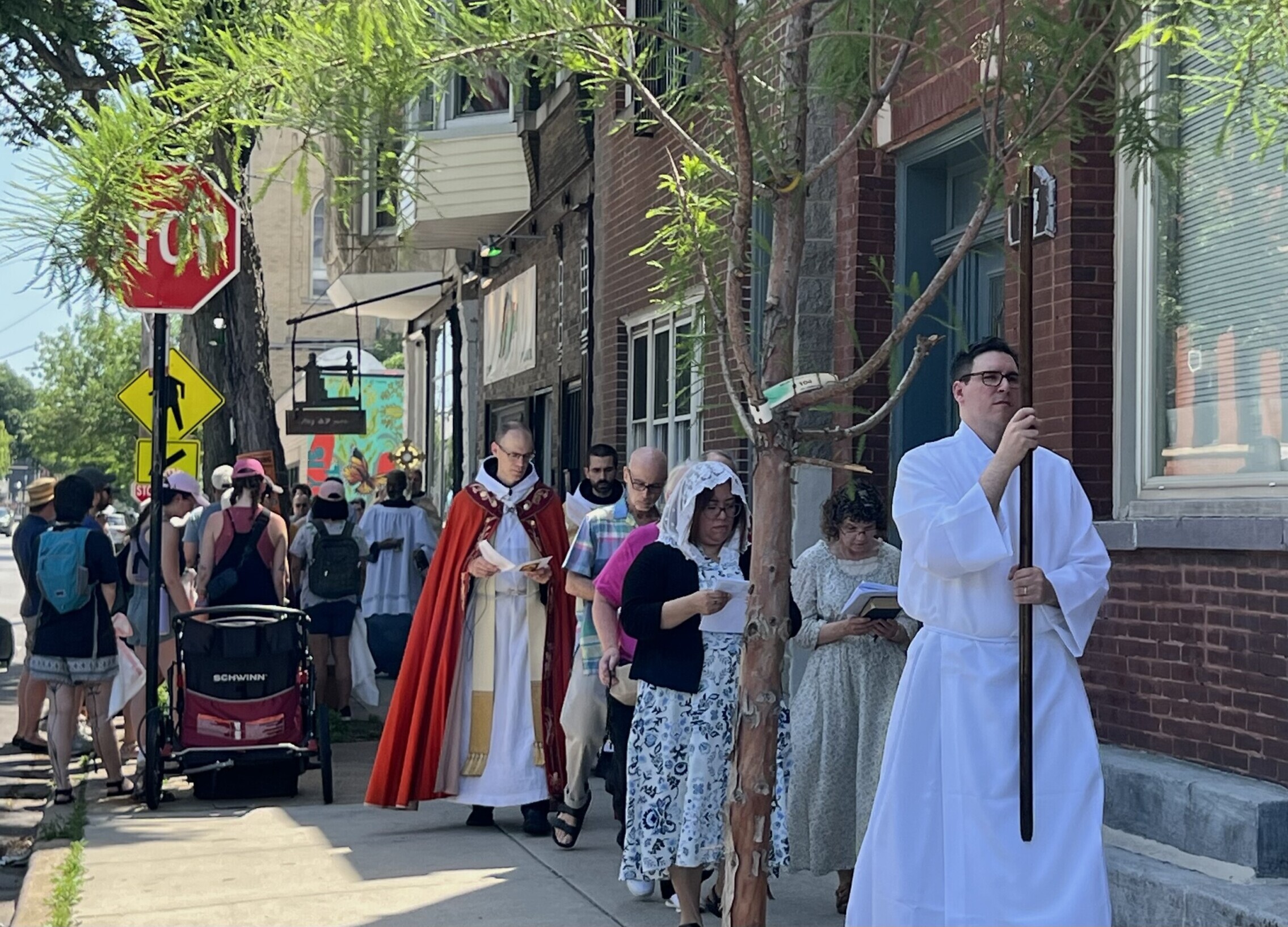
I don’t believe that anyone in the neighborhood was doing Corpus Christi processions when we arrived. About twenty years ago, we approached Father Donald Craig, then the pastor of our nearest parish, Saint Mary of Perpetual Help, about collaborating on a procession. He was extremely enthusiastic, and for many years, we joined forces with the parishioners there. Now we each do our own separate processions (and cover more ground that way!). And it seems that these processions are really making a big comeback, here in Chicago and in other U.S. cities, which is very encouraging.

Vocation and Expertise: Homily on Luke 5:1-11

February 11, 2025

All four gospels tell us the story of the calling of the first apostles. In Matthew and Mark, Jesus walks along the shore and calls, first Peter and Andrew, and then James and John. They immediately leave their nets and follow him. In these cases, we see Jesus, the Son of God, commanding, and others simply dropping everything and following Him, as is proper for One Who is God. Even so, already in the early Church, there were concerns that this seemed unrealistic. Perhaps John and Luke were aware of those concerns, since they fill in quite a few details.

In Luke’s gospel, we’ve already met Simon by the time of the calling of the apostles. After Jesus is rejected by the people of Nazareth, he goes to Capernaum, the city where Simon and Andrew live. He stays for a time at Simon’s house, curing his mother-in-law. Simon has already seen Him work a sign. So it’s interesting that, when Jesus goes to the seashore to preach, He ends up asking Simon for the use of his boat. That morning’s fishing was finished, and the results hadn’t been good. When Jesus tells Simon to put out into the deep and let down the nets, Simon’s first reaction is perhaps typical of an expert whose expertise is being challenged a bit. Aren’t you a carpenter? We’re the fishermen, and we’ve already been out there! No fish, I assure you. But…if you say so!

It’s a bit impudent on Simon’s part. He’s already seen Jesus work a sign of healing on his mother-in-law, but he doesn’t seem to believe that Jesus can just as easily work a miracle in the sea.

So here we have a lesson. It’s often in the places of our own comfort where we are most apt to lose sight of Jesus. Where we are the experts, we don’t see the need for God to interfere and upend our predictions and forecasts. Even when our own efforts produce no fish! We are only fruitful in what matters most when we are obedient to Jesus’s commands and seeking to do His will. The fruits of our labors may be quite unexpected. So while we can be a bit critical of Simon for his resistance, we should ask ourselves, where am I resistant to Jesus’s commands? In what area of my life do I think, “Well, I’ve already tried that, and nothing came of it; so even though I know it’s what God is asking me, I don’t see the point”?

Now Simon’s reaction is quite telling. When he witnesses the sign, he’s completely overcome with a sense of shame and guilt. He sees in a moment just how worldly his thoughts are, how limited is his sense of what is possible with God. So he falls to his knees and asks Jesus to depart. Jesus will have none of it: this sign is about Simon’s true vocation, not to be a fisherman catching fish, but to catch men and women in the nets of the gospel!

And from this vantage point, I want to enter the story and say to Simon, “Hey, stand up! This isn’t about you! Stop focusing on yourself, and listen to what Jesus is saying!”

In relating the call of the first apostles, the gospels give us the pattern of all vocation in the Church. Every one of the baptized has a vocation. This was one of the great teachings of Vatican II that we haven’t internalized enough. The laity have an indispensable vocation to spread the gospel in the workplace. We need this more than ever as work gets more and more specialized. We need the expertise of the various professions to understand what is compatible with the gospel and what needs purification. The priests and religious are partners in this work, needed to help work through some of the more challenging situations of the modern world, but the vocation of the laity is surely of grave importance.

So watching Simon Peter being called today, let’s review what this story tells us about vocation. The first point is that we may already feel like we know the Lord: He’s been to our house, He preached from our boat. But then we may sense that He is asking something a little more difficult, something that perhaps calls into question our expertise. Will we at least go along with it, simply out of obedience, as Simon did, or will we delay, resisting because of the threat to our comfort and know-how?

When we, or even more, the Church, comes to the conclusion that we are being asked to put out to the deep, to rely on God alone, will we focus on ourselves? “Oh, I could never do that. I’m too weak, I have no training, and maybe, at heart, I’m just afraid.” Well, our vocation is not about us; it’s about Jesus Christ and His mission. And if He is calling us, He knows best why and how it’s going to work. Our job is fidelity and trust. As Saint Paul reminded us in the second reading, “Not I, but the grace of God that is with me.” Let us call to mind all that God has done for us, and seek to go deeper in our personal vocations.

He Is Not Here! Homily for the Easter Vigil

April 8, 2021

On the seventh day of creation, God rested.

From a theological and philosophical standpoint, this is quite a statement: philosophers would say that God’s Being is interchangeable with His acting. There is no separation between the two, and for God to rest seems like a contradiction, in one sense. Jesus Himself said that His Father is always at work. But we see two meanings of it in tonight’s liturgy.

Come to me, all who labor and are heavy burdened. Enter into my rest.

The first is that it is on the seventh day of the week, that Christ, the Son of God—Who is God—rests in the tomb. And we see even more profoundly that this is the cost to God of creation. God’s willingness—His “permissive will”—to open a space for other creatures of reason and will to act, to be free—this is a great risk that God takes, inviting us to act freely, to act reasonably (one hopes). And the cost of this is shown exactly by Christ’s death. This is the price of giving us freedom.

God is not giving up on us, though: in Christ’s Resurrection, which we celebrate tonight, we see an “eighth day” opening up, a new creation. And we are “recapitulating” this action of God.

The liturgy is the manifest action of Jesus Christ in the world. In the document Sacrosanctum Concilium [par. 7], the first document issued by the fathers of Vatican II, it says that the liturgy is the action of Christ, the High Priest. So what are we doing, then?

Well, we the baptized are members of His Body In acting out the liturgy, we are making visible what Christ is doing. When we participate in the liturgy, by our actions and by our attentiveness, we are conformed, body, mind, and spirit, to Christ Himself, Who is acting through us, impressing the form of His own life upon our own, giving us a new life. In celebrating the mystery of His Passion, Death, descent into hell and Resurrection, we ourselves undergo this same experience, in a mysterious way. As Saint Paul says in tonight’s epistle: “if we have grown into union with him through a death like his, we shall also be united with him in the resurrection.”

These are lovely words of comfort and consolation in the midst of, and at the end of, an annus horribilis.

So, how much do we feel—experience—the effects of our resurrection?

Now before you think that I’m trying to give you a guilt trip, implying that we all need to try harder to feel good about our resurrection in Christ, let me assure that I mean no such thing. I’m not here to increase your burdens—I promise you!

For starters, we should never try to engineer our own salvation by works.  And that includes working up happy feelings to prove to ourselves that we are saved. Rather, our salvation mysteriously takes place in the realm of faith, and this may or may not be accompanied by corresponding feelings.

I want to emphasize this particularly because I suspect that many of us have experienced at least a year of ambiguous feelings at best. I imagine that most of us, on the earthly plane, have been feeling helpless, anxious, frustrated, even depressed. And if we associate how we feel with the objectivity of our salvation in Jesus Christ, we probably will end up feeling hopeless besides, judging ourselves unworthy of God’s attention, just at the moment we need God’s solicitude more than ever.

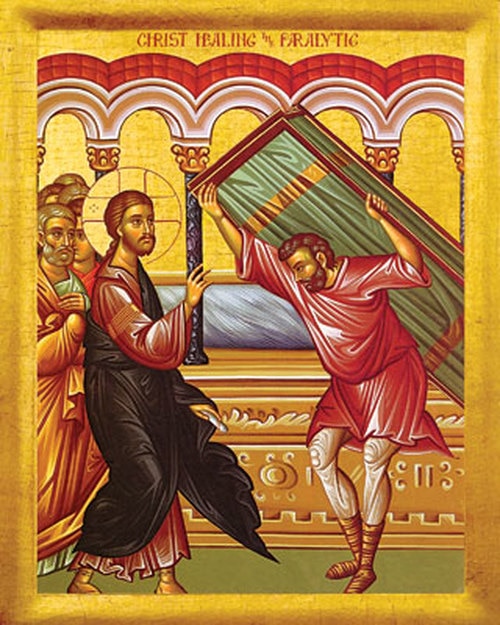
Christ healing the paralytic. Haven’t we all had the experience of feeling paralyzed in the last year?

Most of us have never had quite the opportunity to share in Christ’s death before this year, when we’ve experienced a cascade of sufferings, many of them unforeseen and unpredictable.  The sufferings associated with a pandemic, with quarantines, loss of contact with loved ones, loss of pastimes, travel, and cultural events that lighten our lives, have in turn made the normal sufferings that much harder to bear: the deaths of loved ones, illness, broken relationships, financial hardships, difficulties at work, and so on.

Now with that background, let me return to my central question:

How am I experiencing Resurrection in Christ?

We have been led into the darkened church by the inextinguishable light of Jesus Christ, our brother and our head. We have heard of the empty tomb, and Paul has confirmed what the young man in white told the women inside that empty tomb: He is alive: death is not the end. What will this mean for us when we go forth from this celebration tonight, the celebration of our own resurrection and illumination in faith?

Assuredly, we all have some immediate grasp of what it means to live. I don’t mean merely to be alive and not dead. Rather I mean the experiences of great joy, hope, great encounters with beauty and goodness and love

The best we can say about the life that God gives us after our resurrection is that it in some way fulfills all the best promises that these previous experiences betoken. But we don’t really know what this new life is like until we experience it. There is something incomprehensible—at least at first—about living a resurrected life. Because this is an eternal life, God’s own infinite life, there will always be something about it that is unfamiliar.

We’ll never exhaust the mystery of God. If we feel out of our depth, that might be a good sign—that we are open to God revealing to us a new way to think, to feel, and experience the world.

All praise to Christ our Light!

In the meantime, we continue to live in an in-between state, remaining in the flesh even as we strive to live according to the Spirit. This means that much of the Christian interior life depends on interpretation—we can interpret in one of two ways: the flesh or the Spirit. We can interpret every single event of our lives in these ways, events like we’ve been experiencing.

Two chapters after tonight epistle, Saint Paul tells us that we can set our minds on the flesh or on the Spirit. And that the effect of setting our minds on the Spirit is life and peace.

In this same eighth chapter of Romans, Saint Paul tells us something that should be very comforting. We are heirs with Christ, provided that we suffer with Him. Suffering is not meaningless if it done with Christ. This means that our suffering is not proof of God’s abandonment—far from it.

As the Easter candle went before us into the dark Church tonight, Christ has gone before us into the hell of suffering. He’s gone into the darkness of each of our hearts, and brought His light there. so that when we go into our hearts, and we feel all this difficulty, when we arrive there ourselves, He is there to accompany us, to comfort us, and…to show us the way out.

Christ leading Adam and Eve out of hell, and, in them, all of their children–including you.

Perhaps in years past, when life seemed to be going reasonably well compared to the last few years, we could confuse the good feelings about Easter, natural feelings, not bad in themselves, but still somewhat human and limited, with what a resurrected life of faith feels like. But this year, many of us have had a taste of what death feels like, and consequently, I would think that our experience of the resurrection can undergo two transformations as well.

First of all, it might not feel like previous feelings associated with Easter because we have been more closely conformed to Christ’s Passion. But if this is true, it is also true that we can be more confident this year that Christ has been walking with us through that shadow of death that has been threatening us.

What Pope Benedict XVI said about Christ’s death can be applied both to our deaths and to our suffering:

“Death, the illogical, the unspiritual and senseless…becomes [in Christ’s death] an active spiritual event. Death, the end of communication, becomes an act of communion of Jesus with everyone, and in him, of everyone with everyone.”

We all share the experience of suffering and death.

If we can discover in our recent suffering our communion with Christ’s suffering, we can discover our communion with each and every person who is our neighbor. We can be ambassadors of compassion. And, through suffering in communion with Christ, we can discover our communion with God, which is to say, mysteriously but truly, with our eternal life.  If we can re-enter those places of darkness and find in them waiting for us the lumen Christi, the light of Christ alive and life-giving.

How blessed we are to be together this night, the night of nights, when death was broken and God’s love was poured in our hearts. For the sake of the rest of the church, especially for those not able to be in an assembly tonight, let us welcome God’s love anew. And let us ask the Holy Spirit for to renew our minds, to help us think differently, with the mind of Christ, that we may know how to identify the signs of the resurrection in our lives, to become more and familiar with this inbreaking new life, and to live out of it.

[To listen to a podcast of this homily, click here.]

Ascension

May 24, 2020

As the Catholic Church in the United States celebrates the solemnity of the Ascension today, I noticed that the reading assigned to the office of Vigils for this day, Ephesians 4: 1-22, clearly relates to themes I’ve been developing in recent posts. Today would be a good opportunity to look a bit deeper at the theological underpinnings of the following themes: 1) differentiation of responsibility in a healthy community; 2) that this differentiation promotes maturity, and 3) maturity is about rationality. 

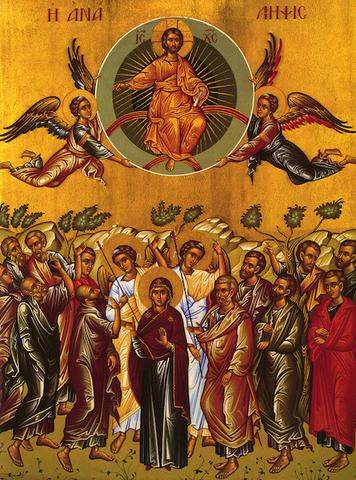
One preliminary point is of great importance: while the Church has traditionally separated the dates for the celebration of the Resurrection, Ascension, and Pentecost (the sending of the Holy Spirit), these should be understood as one Mystery. Thus, the Ascension is not only the enthronement of the risen Jesus at the right hand of God, it is also the birth of the Church (Christ’s resurrected Body, into which the baptized are incorporated). Liturgically, this birth of the Church is connected to the sending of the Holy Spirit, which Christ promised before His Ascension.

Paul, then, begins this meditation (which he writes from his jail cell in Rome), emphasizing the unity of the Church:

“I, then, a prisoner for the Lord, urge you to live in a manner worthy of the call you have received, with all humility and gentleness, with patience, bearing with one another through love, striving to preserve the unity of the spirit through the bond of peace: one body and one Spirit, as you were also called to the one hope of your call; one Lord, one faith, one baptism; one God and Father of all, who is over all and through all and in all.” [Ephesians 4: 1-6]

In our highly polarized environment, calls to unity are often heard as covert means of suppressing diversity. Indeed, one frequent criticism of Catholic Christianity targets the heavy freight of dogma to be taken on faith. This would seem to be the opposite of the rationality that I recently claimed comes from faith. From the standpoint of this criticism, faith would be submission to an authoritarian imposition of ideas and, therefore, a stifling of personal inquiry and questioning.

Thus, it is of some importance that Paul immediately switches to diversity within the Body:

But grace was given to each of us according to the measure of Christ’s gift. Therefore, it says:

“He ascended on high and took prisoners captive;
he gave gifts to men. [N.B. “gifts” in this context refers to the Holy Spirit]”…

And he gave some as apostles, others as prophets, others as evangelists, others as pastors and teachers, to equip the holy ones for the work of ministry, for building up the body of Christ,” [vv. 7-8, 11-12]

Here we see the differentiation of responsibility. Not everyone is given responsibility for preaching or teaching. At Vatican II, this idea of Paul’s received a significant development. It was recognized that the Church, existing in the world, needs the expertise of lay persons who understand finance, law, medical ethics, economics, history, and so on. These can be seen genuinely as gifts from the Holy Spirit for the building up of the body of Christ. No longer does all of the responsibility fall on bishops and priests. Bishops need to consult with lay experts in a variety of fields precisely in order to hammer out theological positions.

From another perspective, dividing responsibility reduces anxiety and thus promotes mature reflection. The great sociologist, Mary Douglas, in her underappreciated book Natural Symbols makes this point from another perspective. She compares different types of community organization, and shows that small groups with a lack of differentiation of roles tend to suffer from fear of the world, witch hunts, and the like. By contrast, large, differentiated societies tend to promote intricately intertwined and symbolic understandings of the world. They tend to be quieter, more conducive to scientific and artistic achievements. This is not to say that they have no problems whatsoever. But it supports the overall principle that dividing up areas of responsibility reduces systemic anxiety. It also supports the notion that entry into the Church promotes rationality.

The next section of Ephesians amazes me:

“until we all attain to the unity of faith and knowledge of the Son of God, to mature manhood, to the extent of the full stature of Christ, so that we may no longer be infants, tossed by waves and swept along by every wind of teaching arising from human trickery, from their cunning in the interests of deceitful scheming. Rather, living the truth in love, we should grow in every way into him who is the head, Christ, from whom the whole body, joined and held together by every supporting ligament, with the proper functioning of each part, brings about the body’s growth and builds itself up in love.” [vv. 13-16; my emphasis]

The unity of faith and knowledge is “of the Son of God,” Who is Truth. Since “all things came to be through Him [John 1: 3],” a true understanding of the cosmos opens up in the community of faith.

In other words, unity comes not from unthinking submission to dogmas imposed by authoritarian means. We all know, of course, that sometimes each of us must make an act of faith that an expert knows more than we do, and the expert can’t explain everything about a topic quickly. This act of faith presumes that what the expert knows is true, and that if we had enough time and training and facility, we would see the same truth as the expert, precisely because a mark of Truth is that it is the same for everyone. Thus unity arises from knowledge of the truth, and this acquired knowledge is a communal, cooperative affair. None of us is responsible for knowing everything. We must rely on “faith” that others will point us to truths that we cannot investigate entirely for ourselves.

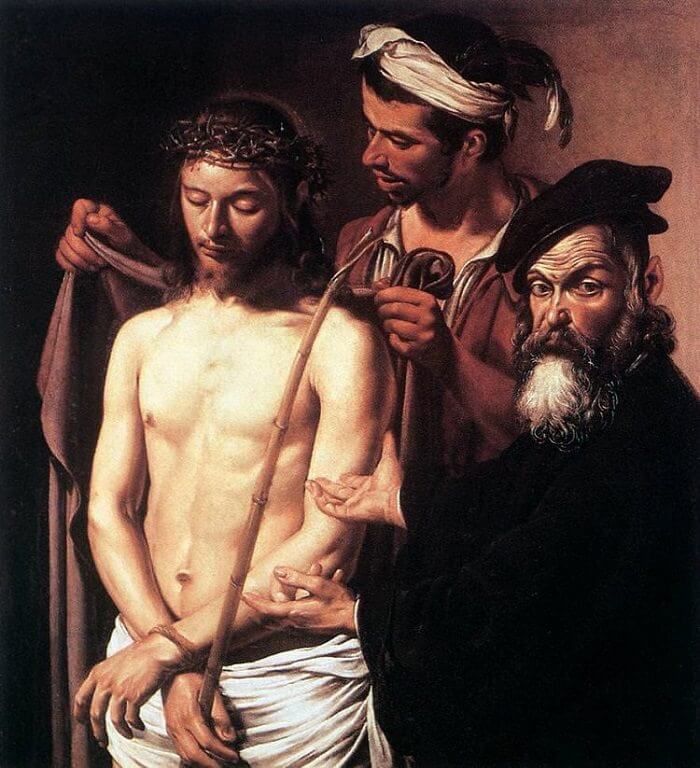
Caravaggio’s depiction of Christ presented by Pilate. “Behold the man,” ironically points to the fulfillment of what God initiates in Genesis 1: 26. Whereas all other creatures spring to life when God says, “Let there be…” in the case of “man,” God says “Let us make man.” Here He is.

What is more, this faith and knowledge moves us toward maturity. “To mature manhood,” translates the Greek phrase, eis andra teleion. Knowing precisely what Paul means here is not easy because of the elasticity of the word andra, the dative form of the word for an adult man. We could, for example, translate this as “to mature adulthood.” However, it is also possible that andra is being used as a synonym for the more common Greek noun anthropos, which appears later in this same chapter, verses 23-24:

“be renewed in the spirit of your minds,and put on the new [man],* created in God’s way in righteousness and holiness of truth.”

This “new man” is Jesus Christ Himself, the goal [telos, from which we get teleion, or “matured”] of all creation. By our incorporation into His Body, we enter into that new society in which reason is allowed fully to flourish by faith. 

It is of Christ that Pilate says, “Behold the man [anthropos]” just before His Crucifixion. In John’s Gospel, this is the hour in which all things are “finished” [tetelestai–from the same root as “mature” above]. It is also the moment at which Christ gives over the Spirit [John 19: 30].”**

Mature adulthood then, arises from our discovery of ourselves as members of a new community, rooted in Truth and Love. When we accept this new identity (the “new name” of Revelation 2: 17), and stay at our assigned posts, we can trust that God will mysteriously bring about the fulfillment of the resurrection by the renewal of our minds by the Truth. This will allow us to live authentically and avoid being taken in by human trickery–a valuable skill at any time, but perhaps especially in our present moment.

* The New American Bible Revised Edition unhelpfully translates this as “new self.” I’ve inserted “man” instead of “self,” for reasons that should be fairly clear.

** I am indebted to Fr. John Behr for this paragraph.

Prima Theologia

June 6, 2015

Key concept #1: Liturgy is theology. In fact, it is primary theology.

The “Benedict Option” as exercised by actual Benedictines, is not a rejection of the world, but of regnant worldviews that distort and obscure the gospel. Which is to say such worldviews obscure reality.  This is because Christ the Truth came from the Father to free us from sin and error. Worldviews are not so easy to change. They are generally the whole background of everything we think and do. To subject our worldview to a systematic examination can be profoundly disorienting. We should recall that it took Saint Paul many years to sort out the full implications of his conversion (he doesn’t specify, but note the passage of seventeen years in Galatians 1: 18–2: 1, some of which was certainly spent rethinking everything). Saint Antony the Great retreated to the desert around the age of 20 and emerged as a public figure again at 50. Things take time.

Paul's early career was a series of reversals. Here is depicted his stealth escape from Damascus, the city where he had gone to persecute Christians.

Paul’s early career was a series of reversals. Here is depicted his stealth escape from Damascus, the city where he had gone to persecute Christians.

But it helps when others can point out something of the goal, something of the discrepancy between what we had been taking for granted and what our new worldview-in-Christ should look like.

In the early Church, theology was roughly the equivalent of contemplative prayer, a first-hand, personal knowledge of God. This is to be distinguished from knowledge about God or from mere knowledge that God exists, hearsay accounts of God. But contemplative prayer took for granted the Church and the Church’s regular engagement in liturgy. Liturgy is our participation in the exercise of Christ’s high priesthood, the lifting up of our hearts and minds to God, our mystical encounter with God.

Toward the end of the Middle Ages, the word ‘theology’ began to undergo a certain transformation, becoming the more familiar academic concept. This wasn’t entirely bad; in fact, there were many good things that came about from the more systematic application of philosophical methods to the common fund of the knowledge of God.

Bl_Columba_Marmion

Blessed Columba Marmion, OSB

But this new idea of theology is at a second remove from the encounter with God. At least it can be performed that way. This began to be felt as a problem in the early nineteenth century, as the effects of the Enlightenment began to be felt even within the Church. The roots of the liturgical movement are found in the efforts of Dom Prosper Gueranger and the Wolter brothers at Beuron. In both cases, an effort was made to experience a fuller liturgical celebration. The movement gained greatly in the twentieth century and bore real fruit in the Second Vatican Council (even if it’s taken us time to sort of the wheat from the tares in the intervening years). The liturgical reforms of Vatican II were meant to help re-open the font of theology to everyone, to make available the insights of Benedictines like Odo Casel, Lambert Beaudoin, and Blessed Columba Marmion, for the whole Church, especially those outside the cloister.

Joseph Bottum relates a telling anecdote in An Anxious Age. He is discussing contemporary Catholicism with students in California. One tells him, “I just go to church for confession, to pray, and to take Communion.” The gist of the story, in Bottum’s version, is that young people tune out the homilies and don’t expect much from priests, other than that they show up and dispense the sacraments. What strikes me in this quote is the lack of any sense that Communion, confession, and prayer are all liturgical acts, couched in a whole world, strewn with Biblical vocabulary, thick symbolic gesture, and so on. Rather than living an entirely new life in Christ, the sense is that we go on living in the old world, the one that’s passing away, and from time to time we get our sacramental immunization shot a church, then return to that old world, hopefully not to lose too much fervor along the way. This is better than skipping church! But is it adequate to the New Evangelization that we are being challenged to undertake?

We all know (thanks to Vatican II and Saint John Paul II) that the Eucharist is the source and summit or our baptismal lives. But how do we make sense of it? The Church has given us a whole liturgical discipline to assist us in unpacking the life-altering content of Christ’s gift.

Acclimating ourselves to this “Liturgical Asceticism” (I use here Notre Dame prof David Fagerberg’s term) takes time. And so often when I mention this idea of liturgy as primary theology, the concern is that we need something more immediate, effective, engaged! Something slimmed down for a jet-set generation.

But this was part of my point in mentioning Paul and Antony. Learning to see with spiritual eyes does take time. Yes, there are prodigies like St. Thérèse of Lisieux, who benefit from saintly parents and a strong Catholic culture in general. But for most of us, in most ages of the Church’s history (we conveniently forget that the first thousand years were not always so resoundingly successful in the West!), divinization is a long, and sometimes arduous process. And why not? Isn’t the God of all peace worth the finite struggles of this temporal life? More to come.

Hand On What You Receive

June 8, 2015

Key concept #2: Traditions are arguments before they are agreements. And then they are arguments after they are agreements.

(h/t to Adrian Belew)

This appears to me as one of Alasdair MacIntyre’s most important insights. He borrowed the idea from Blessed Cardinal Newman, and he refined it considerably.

Why is this important? For several reasons, though I will mention two today.

In my previous post, I said that liturgy is ‘first theology‘. A fine sounding notion! But what do we find when we gaze out upon the liturgical scene in the contemporary Church? Lots of disagreement. In fact, you will hear Catholics say that we’ve been fighting over the liturgy for forty years or more. And this liturgical stew only got messier when Pope Benedict XVI gave priests permission for a wider use of the ‘extraordinary form’ of the Mass. So what, exactly is the material of the liturgy at this point, the material that is supposedly going to give form to prima theologia?

I would not argue that our present situation is ideal. But I also don’t believe that the situation in, say, 1950 was ideal, either, but for the opposite reason. Church tradition had come to be seen as something unchanging and unquestioned. Now, by contrast, it has come to appear as something up for grabs. The reality is something else. Tradition is an argument. And it is an agreement on what to argue about and how to argue. It is not true that tradition-as-argument means ‘anything goes’. It may appear that way in an emotivist society, such as ours is, where arguments are not rational but are exercises in emotional manipulation.

This brings me to the second point. The idea that traditions are arguments makes it possible for them to be rational. MacIntyre generally shows great respect for other thinkers, even when he strongly disagrees with them. This makes his open criticism of Edmund Burke more piquant. Why is Edmund Burke in his sights?

During and after the French Revolution, Burke began to write down his intellectual defense of Tradition. Few people are aware of just how radical many elements of the Revolution were. There were movements to change the names of the days of the week and the months of the year. There were proposals to renumber the years, using a starting point other than the birth of Christ. There were proposals to change the length of the week and the month, to remove them from the lunar associations. Why? The supposed goal was to organize society in a more rational manner. A month of 30 days or so may or may not prove functionally most effective for human organization, or so the theory went. So maybe ten months of 36 days would make more sense. Maybe eight days of work and two days off…It was all slightly crazy, though it must be stressed that this was done in the name of reason.

So what did Burke do? Did he give a defense of the rationality of tradition in the face of these assaults? Not really. In fact, in his writings he comes close to celebrating tradition precisely as irrational. And this thinking has infected us ever since. Why genuflect when you come into Church? Because the Tradition says so! And don’t ask any more questions! Why did the old Ember Days have seven readings on Saturday? Who knows? And who cares what reasons there might have been–we ‘traditionalists’ don’t need to ask these questions. [This is strongly akin to the same way in which ‘blind obedience’ came to be a religious virtue.] I’m exaggerating, but the point is, for a tradition to be rational requires something like what Newman and MacIntyre have taught us: there must be some way for those engaged in the tradition to give each other persuasive reasons for doing one thing rather than another.

As a young man, Newman discovered that the post-Apostolic Church shaped tradition be arguing about its development.

As a young man, Newman discovered that the post-Apostolic Church shaped tradition by arguing about its development.

Where we stand with the liturgy today is, I believe, somewhere before the midpoint of what I hope will turn out to be a fruitful (though tumultuous, alas) reflection on the meaning of the liturgy. Consider the choice facing a pastor who wishes to celebrate the extraordinary form of the Mass: he could, of course, simply begin offering Mass in this way because he has personal feelings in favor. But more often, what happens is that he decides to do so for reasons: to educate his parishioners on the broader tradition of the liturgy; to foster a greater sense of devotion; and so on. Now, once he gives such reasons, and hopefully he does so either in some public parish forum or to his fellow clergy in the local deanery, he is open to being criticized for his choice and for his supporting reasons. He will have to make a defense of his reasoning, and he will have to appeal to shared agreements about the liturgy in order to persuade others. He may end up abandoning the project, or he may convince others to begin celebrating the extraordinary form. Or they may continue to disagree, but now the argument has become considerably more refined on both sides (we hope). Everyone has had to reflect together, and so have become more reflective and reasoned. And out of such exchanges, the Church as a whole will gradually come to have better and better reasons for clearer and clearer choices. As poor choices are weeded out and lame reasons are abandoned, the liturgy will come to be more recognizably consistent, and–very importantly–more ‘rational’ itself. But not ‘rational’ in the Enlightenment sense–I mean this in the sense that we are to offer to God “rational worship!”

“I appeal to you therefore, brethren, by the mercies of God, to present your bodies as a living sacrifice, holy and acceptable to God, which is your spiritual [Greek–logiken…logical!; Latin–rationabile…rational!] worship [Rom 12: 1].” This in turn will allow us to “be prepared to make a defense [lit. “to give a reason”; Gk–logon, Latin–rationem] to any one who calls you to account for the hope that is in you [1 Peter 3: 15].”

P.S. For those of you who don’t know who Adrian Belew is, he wrote and sang (? shouted?) the lyrics to this…song:

When Tradition Hides

June 16, 2015

I’ve mentioned ‘discontinuity’ a few times in recent weeks. This is what happens when a tradition like monastic life or liturgical music suddenly takes on a strikingly different form than what came immediately before. Why does this interest (or concern) me? If you are allergic to long quotations, you probably can read the first and last sentence of what follows, and still get the gist:

Read More »

When I Am Weak

June 29, 2015

Today we celebrate the martyrdoms of Peter and Paul, twin pillars of the Roman Church, the Rock and the Apostle. Both of these men learned the hard way what Paul was to make into a famous maxim. All Christians would do well to adopt it.

When I am weak, then I am strong.

Second Corinthians is such a lovely letter, filled with brutally honest pathos:

Read More »

Obergefell v. Hodges: Second Thoughts

June 30, 2015

In my “first thoughts,” I suggested that Christians interested in upholding the Church’s view of marriage might be better off letting go of a language of rights, since rights divide a coercive power from a class of victims. Turning this around we can also say that appealing to rights is a way of claiming the mantle of a victim and casting the Other as a victimizer. Either way, I think that it is clear that any sense of a genuine common good is undermined, subtly, by naked appeals to rights. Catholic social teaching depends on a clear sense of a common good, and a disciplined determination to live by it.

from Georges Rouault, Miserere

from Georges Rouault, Miserere

Here is where quite a bit of “Benedict Option” language also seems counterproductive, probably unintentionally. It sets the Opting party against the world. The language of separation tends toward a language of rejection. Now of course there are many attitudes in today’s dominant culture that a disciple of Jesus Christ must reject, and sometimes this rejection calls for disengagement from particular social structures. Repentance and conversion require new ways of living, and this means that behaviors must change. Conversion might require me to stop going to bars, or to movies, to the Freemason meetings, to my mistress’s apartment, and even to my place of employment. But the point of this is not to say, “Too bad for you, I’m outta here.” Rather, the penitent is aiming at identifying personal behaviors that are harmful and eliminating them.

If we actually believe in a common good, one of the best things that any one of us can do for others is to live a truly penitent and evangelical life. For when any one of us begins to live more vibrantly in Christ, all will benefit. Right?

And the inverse holds as well. When someone lives in contradiction to the truth, all suffer in some way.

Here is where I get to the Supreme Court ruling from three days ago. It is important to understand that what I am going to write needs to be read from a position of weakness (see my last post for an explanation).

This week’s Collect reads, in part:

grant, we pray,
that we may not be wrapped in the darkness of error
but always be seen to stand in the bright light of truth.

The bright light of truth! What a gift to know the Truth Who sets us free.

How deeply do we believe in the truth of the Church’s revelation? One of the dangerous habits of mind generated by our cultural emotivism is the assumption that any supposed statement of truth is in fact a statement of personal preference. From this perspective, all claims to truth are actually strategic claims, manipulating the hearer to feel obliged to accept what’s being stated. In other words, emotivism makes us all nihilists to some extent, perhaps a larger extent than we realize.

This conclusion, that many of us are closet nihilists, seems to me borne out by the fear, anger, and anxiety that I’ve encountered over the years when contemporary mores are discussed among Catholics. When, aided by the Church’s teaching, we identify actions as good or bad and we identify statements as true or false, how we happen to feel about the action or judgment makes no difference. Jesus Christ rose from the dead, and nothing changes about that if I happen to feel overjoyed about it or flatly unemotional. When we communicate the truth of the Faith, there is a tendency to add zest or urgency to our statements of truth by smiling, showing enthusiasm or worry or whatever. We act as if the Truth needs some goosing up, that it doesn’t stand on its own. But if the truth can’t stand on its own, it’s probably not true. [Digression: I personally see this as a weakness in the otherwise entertaining opinions penned by Justice Scalia.]

The other problem with emoting too much in discussions of truth is that the focus tends to be on ourselves and our feelings too much of the time. Thus many conservative responses to Obergefell v. Hodges that I’ve seen have focused on the dangers to Christians in the coming extension of the Culture War. Mind you, I think that these dangers are real, but again this reality isn’t going to be altered by me fulminating about it.

St. John Chrysostom, patron of preachers, champion of St. Paul

St. John Chrysostom, patron of preachers, champion of St. Paul

But the curious things about the Supreme Court ruling is this: if the resulting deformation of marriage really is about a false understanding of the nature of marriage, then the Court’s ruling will also harm precisely the persons that it is intended to help. This is just an inference from everything I’ve said so far. How will it hurt them? I have no clear idea at the moment. Nor do I wish to cook up a prophecy about what sort of harm is coming. But if this is true, then my concern should also be for my fellow Americans, providentially given to me by God for our mutual salvation, who embrace this new reality, even when they have the for the best possible intentions. Again, I would not attempt to walk up to a gay couple and baldly assert this and use it as grounds for them to renounce their marriage. I merely raise the issue to point out that it is possible to broaden our thinking about the situation in such a way as to keep from falling into the same adversarial stances that typify American public debates.

And even if it should come about that we suffer in some way for our beliefs, even this is more harmful, from the standpoint of faith, to the aggressor than to the victim. Here’s Saint John Chrysostom, the Golden-Tongued Wonder.

This is more than any one thing the cause of all our evils, that we do not so much as know at all who is the injured, and who the injurious person.

In focusing on the potential harm coming to those who oppose the redefinition of marriage, that is, to one segment of our world, we are liable to lose sight of the harm that we are all suffering together. Thus Pope Francis, “When our hearts are authentically open to universal communion, this sense of fraternity excludes nothing and no one.” [Laudato si, 92]

Liturgy and the Stance of Weakness

July 1, 2015

Much of the exasperation with what people term “organized religion” comes from the fact that the Christian church has often given so much weight to doctrinal accuracy that the life-giving potential of worship, and faith itself, gets lost in the shuffle, made all but inaccessible to the skeptical multitudes. The poet Jonathan Holden epitomized a common attitude when he stated in The American Poetry Review that because “religious doctrine delivers us an already discovered, accepted, codified system of values–official truth,” a truth he defines as “static,” it can never attain the authenticity of a well-made work of art.–Kathleen Norris, Amazing Grace: A Vocabulary of Faith

I for one am grateful to profit from the great work of the saints, theologians and philosophers who have gone before me and have done so much to clarify the teachings of the Church. But I see Holden’s point here.

There is a danger to inheriting an accepted, codified system of values. We Catholics can lose our hunger for the dynamism of faith, a dynamism that is fueled by challenges, doubts and arguments. It is a gift to have to hand well-thought-out stances from the Catechism and Canon Law, but how do I know if I understand them properly? How can I be sure that I am applying them in the correct contexts?

An example I like to use is the “universal call to holiness.” This is a good, solid teaching rooted in the one baptism that all Christians share. It became obscured with the rise of a type of clericalism in the Middle Ages, along with the rise of the religious orders. Before the Second Vatican Council, it could appear that the Church had two levels of holiness, the religious and ordained ministries, and then the laity. The Council Fathers stated clearly that all members of the Church are called to holiness.

In my experience since the Council, this teaching is often misinterpreted, ironically enough, because of a lingering bias toward clericalism. “The priests had their turn to be holy [meaning occupying privileged places at the liturgy and elsewhere] and now it’s the laity’s turn.” What should have been a call to greater self-renunciation and prayer appeared paradoxically to call for greater assertiveness and personal privilege for persons who “felt called.” The universal call could even be used by religious as an excuse not to engage in holy practices, since these might reinforce the distinction between religious and laity and suggest that we still had a two-tiered structure of holiness.

What went wrong? The term and the teaching are correct, but the context in which the universal call is heard and interpreted causes a distortion. What is this context? We can describe it in many ways. Our cultural situation inclines us to atomistic individualism and its attendant focus on personal rights and equality, and our ecclesial situation, at least in the years immediately following the Council, inclined us to a “professional” understanding of the charisms, an understanding based in an overemphasis on the Church as the “Perfect Society,” and exemplified by the priest as certified dispenser of sacraments, reporting to the bishop as CEO of the diocese.

What is the correct context, then, and how do we find it, if we have to live in a culture that causes these distortions? The answer is found in the liturgy. Ut legem credendi lex statuat supplicandi. “That the law of praying established the law of believing.” Often this more exact phrase is rendered more simply, “Lex orandi lex credendi,” the law of prayer is the law of belief. In either case, we see that the “already discovered, accepted, codified system of values” should be in-formed by the practice of the liturgy, in which we conform ourselves to the high priestly prayer of Jesus Christ. This is what Kathleen Norris is after when she contrasts doctrinal accuracy with “the life-giving potential of worship.”

This also connects with what I was attempting to explain in yesterday’s post. Church teaching has not recognized same-sex marriage, and the weight of tradition is against such recognition. But how do we understand and live the truth of this teaching? As I wrote yesterday, I don’t really know, and I’m not sure that anyone is all that sure. We are in uncharted waters, and the biases of my own culture are against me [see: The first engagement with culture is at the level of thoughts]. I need a renewal of my mind and heart and I need the power of God to do this. So I must be content with my weakness.

The liturgy is the exercise of the high priesthood of Jesus Christ. When we enter the liturgy, it is Christ Who is the main ‘agent’ (which is why so many discussions about ‘active participation’ are confused), and we are all participants in His action of praising the Father in the Spirit. We are caught up in a world being brought into being, a world in which the True Light enlightens our minds and hearts that we may discern what is God’s will and carry it out with courage. At the liturgy, it is alright to be weak, because there God is strong, and this becomes our default stance toward the world. Liturgy is also full of a lot of confounding rites, texts, vestments and stimuli at once disorienting and reorienting. In this space of conversion to a new orientation toward Christ in all things, we have the chance to reassess argument, to hear anew the Word instructing us. We also see and experience the persons to whom we must first submit our ideas for living a new life. The liturgy sets the bounds of the community of faith and gives us our first audience for a new understanding.

More to come.

  • Go to page 1
  • Go to page 2
  • Go to page 3
  • Go to Next Page »

Blog Topics

  • Beauty (22)
  • Contemplative Prayer (61)
  • Contra Impios (2)
  • Culture (33)
  • Discernment (32)
  • Formation (16)
  • General (43)
  • Going to the Father (18)
  • Gregorian Chant (5)
  • Holy Spirit (7)
  • Jottings (27)
  • Liturgy (99)
  • Meditations on Heaven (4)
  • Monastic Life (59)
  • Moral Theology (53)
  • Music (18)
  • Scripture (60)
  • Silence (1)
  • The Cross (3)
  • Vatican II and the New Evangelization (21)

Blog Archives

  • April 2026 (3)
  • March 2026 (4)
  • February 2026 (3)
  • January 2026 (2)
  • December 2025 (6)
  • November 2025 (4)
  • October 2025 (2)
  • September 2025 (2)
  • August 2025 (3)
  • July 2025 (4)
  • June 2025 (4)
  • May 2025 (3)
  • April 2025 (4)
  • March 2025 (4)
  • February 2025 (3)
  • January 2025 (5)
  • December 2024 (8)
  • November 2024 (3)
  • October 2024 (9)
  • September 2024 (8)
  • August 2024 (9)
  • July 2024 (9)
  • June 2024 (8)
  • May 2024 (9)
  • April 2024 (4)
  • November 2023 (1)
  • April 2023 (1)
  • December 2022 (1)
  • October 2022 (1)
  • March 2022 (1)
  • February 2022 (1)
  • August 2021 (2)
  • June 2021 (1)
  • May 2021 (1)
  • April 2021 (1)
  • February 2021 (2)
  • January 2021 (1)
  • December 2020 (1)
  • August 2020 (4)
  • June 2020 (1)
  • May 2020 (4)
  • April 2020 (9)
  • March 2020 (4)
  • February 2020 (1)
  • January 2020 (1)
  • December 2019 (1)
  • July 2019 (2)
  • June 2019 (1)
  • May 2019 (1)
  • April 2019 (2)
  • March 2019 (1)
  • February 2019 (3)
  • January 2019 (1)
  • December 2018 (1)
  • November 2018 (2)
  • October 2018 (2)
  • September 2018 (2)
  • August 2018 (1)
  • July 2018 (2)
  • June 2018 (4)
  • May 2018 (7)
  • April 2018 (1)
  • March 2018 (1)
  • February 2018 (1)
  • January 2018 (2)
  • November 2017 (1)
  • October 2017 (1)
  • September 2017 (1)
  • August 2017 (1)
  • July 2017 (2)
  • June 2017 (2)
  • March 2017 (1)
  • February 2017 (2)
  • December 2016 (1)
  • November 2016 (3)
  • August 2016 (2)
  • May 2016 (2)
  • April 2016 (5)
  • March 2016 (2)
  • December 2015 (1)
  • November 2015 (2)
  • October 2015 (3)
  • August 2015 (10)
  • July 2015 (12)
  • June 2015 (17)
  • May 2015 (2)
  • April 2015 (7)
 
© 2026 Monastery of the Holy Cross
  • Accessibility
Web Design by ePageCity