Monastery of the Holy Cross

  • Home
  • About
    • Benedictine Life
    • History
    • Video Gallery
    • Et Incarnatus Est - The Prior's Blog
  • Visit Us
    • Guesthouse
    • Prayer Schedule
      • Christmas 2025
    • The Catholic Readers Society
  • Vocations
    • Monastic Experience Weekend
    • Formation
    • Oblates
      • Oblate Podcast
  • Solemn Vespers
    • Solemn Vespers for the Sixth Sunday of Easter
    • Chant
  • Contact
  • Donate

Articles under Vatican II and the New Evangelization

Going to the Father, Part 1: Liturgy as Evangelization

July 6, 2015

We are preparing to have a new choir constructed and installed in our church. I have been invited by Fr. Anthony Ruff, OSB, at Pray Tell Blog, to offer some explanation of the theology behind the shape and placement of the choir. As a prelude to this project, and to give the fullest possible context, I would like to tell the story of our liturgical development, from the foundation of the monastery to the installation of the choir.

This story begins with our three founders working as missionaries in Haiti and Brazil

Read More »

Going to the Father 2: The Land of Unlikeness

July 7, 2015

As our brothers were preparing to come to Chicago to begin living the quasi-monastic life of the Community of Jerusalem, one brother discovered an article written by the late Fr. Aidan Kavanagh, OSB. Fr. Aidan was a monk of St. Meinrad’s Archabbey and a liturgist. His book On Liturgical Theology is a modern classic, a book to be read and savored again and again. The article appeared in Worship magazine, and, if memory serves, was his acceptance speech upon receiving an award from St. John’s School of Theology in Collegeville,

Read More »

What is the Liturgy?

August 10, 2015

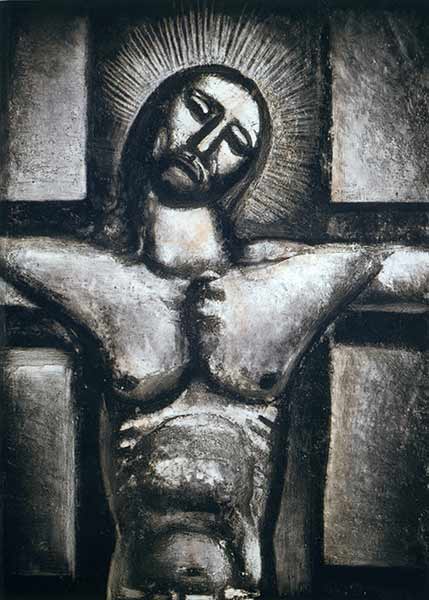
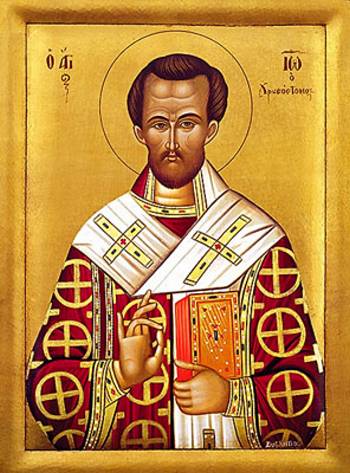
At one point in yesterday’s Oblate meeting, we discussed the difference between devotional pictures and icons. This discussion took place in a conference based on Pope Benedict XVI’s The Spirit of the Liturgy. And so it was noted that icons and devotional pictures might share themes, and composition. Pictures might even be of  icons. But icons are always liturgical. The way an icon is prepared, the fasting that an iconographer undergoes, the forty days that an icon traditional rests upon a consecrated altar, and the final blessing of the icon by an ordained priest using holy water marks this object as part of the liturgy. A reproduction of an icon, such as those that adorn our home page, are not liturgical objects in this sense, but are devotional. As such, they extend from the liturgy and should lead us back to the liturgy. Reverence for an icon is a liturgical act, pious thoughts and prayer before a devotional picture is not–though these are perfectly good, even necessary, activities when one is not able to attend the liturgy itself.
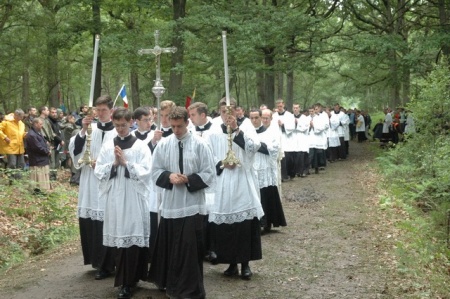
Corpus Christi Procession: the liturgy goes out into the world.

Corpus Christi Procession: the liturgy goes out into the world.

I open with this reflection to draw attention to the breadth of what we mean by the liturgy. In the previous post, I noted that I needed to say something about what the liturgy is. I’ve spent a good amount of time explaining the liturgy’s interior, spiritual reality. From this vantage point, the liturgy is the work of Christ the high priest, bringing us to the Father in the Spirit, mediating for us and by means of us, His Body, for the salvation of the whole of the cosmos.

But how does this happen, and how do we know that it is happening? The liturgy also has an exterior, incarnated reality, in that it takes place by means of certain types of persons (the baptized generally, the ordained ministers in a more specific sense), at certain times, in certain places (mainly churches, but also anywhere that the faithful gather in Christ’s name), by means of certain texts and ritual actions, and with certain instruments (bread and wine, water, oil, stone, incense, vestments, icons, crosses, candlesticks, wax, etc.).

Catholics are apt to the of the Mass when someone says, “liturgy.” And this is a good impulse, though a truncated one. The liturgy’s center is indeed the Eucharist, but to reduce the liturgy to Mass is quite problematic. The liturgy includes all of the sacraments. It also includes the whole Divine Office. This is not an obligatory part of the liturgy for the laity. However, since it is the liturgy, the Divine Office possesses an efficacy for uniting us in spirit to God that non-liturgical prayer does not have (I plan to write about how to pray the rosary in a ‘liturgical’ manner, and why this is the deeper spirit of this beautiful–almost indispensable–devotional prayer).

But…I’m still not finished listing the events that make up the liturgy. Blessings pronounced by a priest are part of the liturgy, and blessed objects retain a connection to the liturgy. So what I said above about icons falls in here. So do meals (!). Exorcisms, processions, religious professions, oblations and promises are all part of the liturgy. The marriage act itself is liturgical, since it is intrinsic to the confection of the sacrament of matrimony (this is also why same-sex marriage, whatever merits there might be to bestowing recognition on a stable partnership of love, cannot be considered Christian marriage).
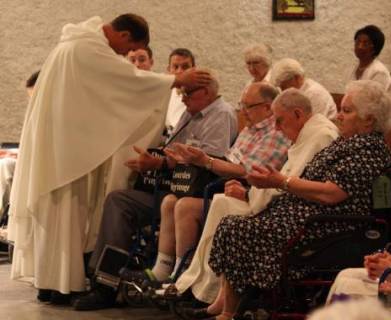
The anointing of the sick, another action of Christ the mediator.

The anointing of the sick, another action of Christ the mediator.

So the liturgy is actually quite extensive. In the West, we have had a tendency to shorten and narrow what we mean by the liturgy, as I mentioned above. This has some problematic effects. The good news, however, is that recovering the richness of the liturgy can be a life-altering project, a real point of foundational renewal for the Church, and the basis any genuine ecumenical effort. As I mentioned in the last post, the corporal works of mercy are not therefore dispensable. They will be efficacious, I would suggest, to the extent that those ministering in this way are clearly grounded in the liturgy. The acts of healing and love, the active life, will be seen to be the work of Christ Himself and not simply that of human do-gooders. In fact, we can throw ourselves into all kinds of activities, without fear of falling into Pelagianism, if our source of energy and strength is Christ Himself, uniting us to Him and to each other in the liturgy, He “Who has made the two one.”

From this standpoint again, we have a way of understanding the Church’s traditional teaching on the centrality of the consecrated life, especially the contemplative life. Contemplatives have the duty to live the liturgical life to the fullest, to invite others to the vision of the liturgy, and to give witness to Christ’s triumph and mission of reconciliation. “A monk is he who directs his gaze towards God alone, and who, being at peace with God, becomes a source of peace,” said St. Theodore the Studite. Christ made peace by the blood of His Cross [Colossians 1: 20], that is, by the unique sacrifice which is extended and re-presented at every liturgical event. And immersion in this reality changes us into eschatological persons. 

Mass is often seen merely as an obligation, and the notion that even the laity would benefit from regular attendance at yet more of the liturgy is, in my experience, often shrugged off as an inconvenience, taking them away from more pressing concerns. From the perspective that I am outlining here, I hope that it is clear that this dismissal is skewed somewhat. Yes, Mass is obligatory for a baptized Catholic, but if we knew the gift of God that is the liturgy, we would welcome opportunities to participate more frequently, as our state in life permits. We would also learn to connect all of our prayer to the liturgical celebrations, to the vocabulary, priorities, and sentiments of the “work of God.” Then all of our prayer would be transforming us into women and men of Christ, into saints. Thus it is that the liturgy is the foundation for one of the most crucial insights of Vatican II, the universal call to holiness.
The Hermeneutic of Love

April 10, 2016

I would like to propose an extension to Pope Emeritus Benedict’s “Hermeneutic of Continuity:” a Hermeneutic of Love.

Here’s my working definition: I will not pretend to understand any text I read until I can be sure that I am striving to love the author and treat the author as a real person, potentially my brother, my eternal friend.

The Hermeneutic of Suspicion was needed, to learn to interpret texts as human things (as distinguished from the Word), to pull the veil back from a Hermeneutic of Credulity. To interpret texts based merely on some posited authority is to engage in power.

The problem with Nietzsche’s insights, and those of Marx, Freud and the rest, is that the interpretation is still based in power. And the power is shifting: away from the Church, away from Western culture, at the “sagging end and chapter’s close [David Jones].” But to some extent, we Churchmen are simply getting what we dished out first.

It will perhaps take a very long time for Western culture to identify all of the evasive half-truths that the habit of empire has planted in us. Love will speed this up.

Today, Progressives take great care not to act imperiously toward other cultures, except toward our own, and especially our own in the past. So Progressivism escapes one type of imperialism but engages instead in a temporal imperialism, empowering its adherents to consider everything that happened yesterday as done by enemies worthy of spite or even silencing.

You can attend Catholic Masses that make use of five different languages from four continents.

But Ecclesiastical Latin is frequently verboten. Isn’t this just a type of exclusion, of silencing those who cannot defend themselves? Isn’t the rejection of the past, of continuity, simply an exercise of brute power over the utterly powerless?

What if the use of Ecclesiastical Latin could be an act of love, akin to the courtesy we show the speakers of Polish, Tagalog and Vietnamese?

Love your enemies. This makes you like God.

Who Is Running the Renewal?

August 28, 2015

I’ve been trying to figure out what it is about George Weigel’s recent post “Catacomb Time?” doesn’t sit right with me. I suspect that it is first of all due to an accumulation of fuzzy complaints with someone-or-other not quite specified. Who inhabit those “Catholic circles” who have “a passion for writing Build-It-Yourself Catacomb manuals”? I honestly have no idea who is meant by this. I suppose that he is referring to the Benedict Option, for which there is no shortage of critics, despite the fact that no one seems to know what it is exactly. The reference to “lukewarm, pick-and-choose” Catholics is always a dangerous one. Who of us doesn’t fall into the “pick-and-choose” category from time to time, even often?

Then there is this larger quote, expressing what seems to me a common enough sentiment, but one I just can’t get behind personally:

This same judgment—Catholicism by osmosis is dead—and this same prescription—the Church must reclaim its missionary nature—are at the root of every living sector of the Catholic Church in the United States: parish, diocese, seminary, religious order, lay renewal movement, new Catholic association.

George Steiner in my dream study. He proposes "cortesia" (courtesy) as a mode of mutuality as a partial antidote to a critical and wordy discourse that empties language of its theological import.

George Steiner in my dream study. He proposes “cortesia” (courtesy) as a mode of mutuality as a partial antidote to a critical and wordy discourse that empties language of its theological import. In this, he comes remarkably close to Benedictine “hospitality” as a mode of encounter, and perhaps a way to reinterpret “mission” away from the excessive freight of unidirectional conquest toward a humble acknowledgement of the potential contributions of potential converts.

“Every living sector” of the Church in a country of almost 70 million Catholics? That’s a big claim. I think what troubles me most about this sort of language is the absence of any feint in the direction of the work of the Holy Spirit in animating the Church. Then there is the question of whether my own religious community qualifies as a “living sector” and whether we actually share that judgment and prescription. One reason I balk at that way of phrasing the “judgment” that “Catholicism by osmosis is dead,” is that it privileges what Mary Douglas refers to as “elaborated speech code” (the language of academia, personal commitment and conviction, related to what George Steiner calls out at the beginning of Real Presences) at the expense of “restricted speech code,” the more passive communicative modes of ritual and symbol. Much of what we learn in the Church is at least somewhat osmotic. Yes, we should pay attention at the liturgy, but often times it takes all kinds of exposure at various levels of awareness and engagement before connections are made. Perhaps I sense here, fairly or unfairly, a neglect of the fundamentally receptive nature of faith, prior to any genuine engagement in mission. St. Paul, the greatest missionary of all, spent well over a decade anonymously living the life of a Christian before the Holy Spirit set him apart as the Apostle of the Gentiles. During that time, what was he doing? Praying? Re-reading the Scriptures? I don’t know, but it was certainly a life of withdrawal, maybe not to the catacombs, but a withdrawal nonetheless.

And then let us not forget who is the patroness of the Church’s missions.

Behind the Church's missionary activity is St. Therese's little way of complete faith in all things.

St. Therese, patroness of the missions. Behind the Church’s missionary activity is St. Therese’s hidden little way of complete faith in all things.

I will leave it to reader to think about the connections between the contemplative life and missionary effectiveness.

Let me end with a little more explanation from Mary Douglas. In the first chapter of Natural Symbols, she relates asking her progressive clerical friends (in 1970) why they think it’s a good idea to move away from the Friday abstinence to more personally meaningful acts of charity–like working in a soup kitchen on Friday.

I am answered by a Teilhardist evolutionism which assumes that a rational, verbally explicit, personal commitment to God is self-evidently more evolved and better than its alleged contrary, formal, ritualistic conformity.

I will admit to nitpicking here a bit, but I think that it is worth watching our language very carefully on these points, lest we saw off the branch upon which we sit. The overall tone of the article supports an individualistic and activist mode of Church life that has the potential to undermine the communal, receptive, gratuitous, gracious, and humble life of faith and hope. Surely one of the points of the young Josef Ratzinger’s “Future Church” article is precisely that we are being called away from “edifices…built in prosperity,” as part of an invitation to leave behind triumphalism. Weigel comes uncomfortably close to a triumphalism-minus-edifices. It is striking that after the long quote from the future pope, a quote that ends with an emphasis on “faith in the triune God, in Jesus Christ, the son of God made man, in the presence of the Spirit until the end of the world,” Weigel never again mentions faith, Jesus Christ, or even God. Again, I will admit that finding such lacunae in a blog post runs the risk of straining justice. But as a monk, I am inclined to be watchful on these counts.

More than anything, this serves as an introduction to Mary Douglas, whose work I have put off writing about for long enough…

UPDATE: Recall that the relationship between mission and contemplative life is the crux at which our community began. Also, that while it is hard not to agree that practicing one’s faith will require great resolve and strength in the coming years, maybe decades, this must be a practice rooted in repentance and joyful humility, grounded in the sacrifice of Calvary, celebrated daily in the liturgy. Finally, while Fr. Ratzinger did say that the future Church will make “bigger demands on the initiative of her individual members,” [emphasis added] this mention of individual members needs to be read in the context of the future pope’s voluminous writings on the liturgy and the Church. The initiative he is calling for surely must be greater fidelity to the reality of the ongoing Incarnation in the local church (including a high mystical “Ignatian” vision of the bishop as Christ and priests as the bishops’ vicars). Otherwise, Weigel might be heard to be inviting individuals to greater creativity, initiative in a maverick kind of sense, rather than in a sense of responsive answerability toward the gospel. And the first step may well be admitting that I’m part of the problem with the contemporary Church.

On the Impermanence of Institutions and the Permanence of Virtue

August 17, 2016

I wrote several days ago something to the effect that “things are worse in the Church than people think.” This sentiment is worth qualifying and examining.

Mainly, I’d like to distinguish what I mean from what Rod Dreher means when he writes similar things. As I understand him, he sees Christian institutions under imminent attack from secularizing forces. He fears that Christians are oblivious to the seriousness of the threat. In my experience, Christians are plenty aware that demographics trends and political developments do not bode well for the Church in the immediate future. What he perhaps is responding to is the fact that few Christians make this their first concern. I don’t think that this is necessarily complacency in many cases. To explain this, let me say something about institutions.

Alasdair MacIntyre, whose famous St. Benedict quote is the inspiration for Dreher’s “Benedict Option,” is a man whose comprehensive thinking on modernity, morality, and faith deserves as much attention as one can afford. He spends almost an entire chapter on institutions in his seminal book After Virtue. Institutions are important, but should always be secondary to practices. An institution like a chess club brings together persons interested in playing chess and fostering its proper enjoyment. The club itself is not a substitute for the actual practice of playing chess. We all know that institutions tend to have their own internal logic that can often interfere with the practices they are meant to foster and protect. Therefore institutions can only function well and in proper subordination to practices if the members are virtuous. And, as MacIntyre makes clear elsewhere, virtues are learned in practices, not in the bylaws of institutions.

In my opinion, most Christians are aware that longstanding institutions are endangered. And I would agree that many of us Christians are not spending lots of time worrying about it. Ambivalence in this regard has two sources. The first is a recognition that our current institutional arrangements are often unable to surface the right kinds of virtuous leadership, and so tend to be self-defeating. The response of American bishops to the sexual abuse scandal demonstrated (and continues to demonstrate) that the institutional arrangement (meaning the current structure and operating modes) of the bishops’ conference is faulty. This is to be distinguished from the theological necessity of the episcopacy or even the virtue of individual members. Bishops could choose to organize themselves differently, but this would require hard thinking about the precise practices that the bishops’ conference is meant to foster and protect. The Council documents that encouraged the formation of these institutions are somewhat vague on this point and were, perhaps, slightly naive about how institutions can corrupt practices.

The second source of ambivalence stems from the typical Christian concentration on real practices. This is to say that the average Christian is more concerned about the practice of virtue at ground level than the institutional backing that supposedly is undergirding it. Another way to look at this is to say that Christians are already developing their own local, ad hoc institutions (which is what the Benedict Option is supposed to encourage). The collapse of larger structures that provide tax shelter for a religious soup kitchen may or may not impact the soup kitchen itself. But Christians will, in one way or another, find a way to feed the hungry. It’s what we do. And I see so much of this in my everyday life, even from the relative obscurity of the cloister, that it seems ungrateful to fret about difficulties to come, even while I do see the need to prepare for them. I’d rather point to the exercise of faith around me and encourage the Christians I know to continue the work of virtue than worry about something that hasn’t happened yet, and may or may not in fact happen. This work is being done by the laity, a visible fruit of the teaching of Vatican II.

Last of all, the mention of virtue brings me at last to explain what I mean when I say that things are worse than people might think. What I mean by this is that our Western culture, especially in America, has been somewhat less-than-fully-Christian for many generations now, and that reviving a genuine, thoroughgoing practice of Christian virtue is a lot more difficult than the average person might think. This is something I can vouch for firsthand. I am a cradle Catholic who has mostly practiced by faith all my life. And yet, I am continually amazed at how far I have to go to be genuinely holy. Now, putting it that way illustrates that this is not pessimism or frustrating, or even necessarily cause for great fear. If you read the lives of the saints, you will discover that most saints had this same experience (which does not make me a saint, by the way). Love of a transcendent God means, in the words of Fr. Michael Casey, being perpetually out of one’s depth. Where I think there is some naivete is in our American optimism that “most people are basically good.” This is a nice, generous sentiment. But it does not help us to gain a lot of energy in the spiritual battle, in which we must first notice that in every heart there are large swaths of unevangelized heathendom. These are, of course, open to hearing the Good News! Which makes them, in their way, “good,” if broken and in need of healing. This healing is what we must first be about, and only if this happens will institutional reform follow in any meaningful way. In the short term, this may mean the tottering and elimination of many institutions. Some may be sad to see them go. But the long-term needs of the Faith may require this purification.

The Presidency and the Will to Power

November 13, 2016

On Friday, I said that I would write something about why “emotivism leads us to court political power.” What is emotivism?

It’s not simply that we act on feelings when we should use our brains. We do fall into this trap, but the reason for this is not that we are childish or bad people. There is a history to our predicament. In what follows, it is important that you keep in mind that I believe that there is also a way out of our predicament.

We’ve all experienced futility in certain types of arguments. Many friends of mine in recent weeks have expressed their belief that supporters of Donald Trump are “irrational.” We experience others as “unreasonable,” unable to give reasons for acting as they do, believing what they do. When this gap appears, fruitful discussion evaporates. What we are confronting is the outworking of incompatible principles, or at least first principles for which we have no way of judging priority. Is it worse that Donald Trump’s rhetoric fuels racism, or is it worse that Hillary Clinton favors a permissive abortion policy (a question that confronted conservative voters)? How do we make judgments between free trade, job creation, health care, and all the rest when we can’t find any kind of bedrock on which we can all agree?

This is what I mean when I say that we are incapable, at present, of having a rational discussion about politics. Persons living in places as different as rural Mississippi, Portland, and Detroit have, unsurprisingly, espoused multiple first principles, and together we have no obvious way of negotiating between their rival claims on us. As philosopher Alasdair MacIntyre points out (actually pointed out, already back in 1981), the situation is even worse than that. The problem with first principles is that by definition, we can’t give reasons for holding them. Don’t we reason from first principles and not to them? But if so how does it come about that we seem to know what they are? And how in the world can I argue with someone who holds first principles that seem wrong to me?

The answer is that we don’t argue, for the most part. We pretend to argue, but what we are usually doing is trying to manipulate other people into changing their first principles, or at least into giving way and letting us follow our principles. This hidden power play of manipulation was already noticed by a much earlier philosopher, Friedrich Nietzsche. He made the very strong claim that what appears to be moral reasoning in our public and private lives is really the expression of a desire for power. We then dress up this “Will to Power” with a respectable front of reasoned argument. In other words, when I say something like, “we should raise taxes on the wealthy and redistribute the money to the poor,” it is not completely off the wall to ask what my real motives are. Am I resentful of rich people, and want to see them taken down a notch? Will some of this money come to me? Do I get to enjoy feelings of moral superiority for apparently altruistic aims? Do I want the gratitude of poor people, so that they won’t be a potential nuisance for me? I could go on.

I’m not sure that I was aware of the extent to which Nietzsche was right until I entered the monastery, oddly enough. I’ve always liked Nietzsche, or perhaps felt that he was the primary thinker who needed to be answered if we were to have anything like a flourishing civil order. And to be honest about it, I suspected other people of emotivism, but assumed that my arguments and first principles were unassailable. Monastic life is about conversion, and one of the more surprising aspects of my own conversion (and if it’s real conversion, much of what we discover will come as a surprise, welcome or unwelcome), is the realization that I’m more a part of the emotivist problem than I wanted to admit.

So what have I done about it? Answering that will have to wait for now. Here, I want to finish off the modest point at the heart of this post.

If we have no way (yet) to resolve our moral disagreements rationally, and if our attempts to do so turn out to be assertions of power rather than reason, an important consequence follows. If, in a debate, we recognize that we lack the power to silence opposition and push through our moral agenda, we will try to enlist a more powerful third party who can do this for us. The very interesting sociologist Jonathan Haidt notices this very trend in the campus culture of microagresssion and victimization. Various strategies include organizing protests, public shaming on social media, and so on. But the election of a president is the big prize. He or she has the most power of all, and I suspect that one of the reasons that we have, over the past century, continually added to the power of the presidency, is that we’ve sensed at some level that we need a strong person to enforce policies that we can’t agree on as a people. Note that a major factor in this drift is the original sin of the American republic, that of slavery. We solved the problem of slavery by force, the force of the presidency no less. In contemporary life, when we have a president who shares our first principles, we tend to have a certain sense that good will has a chance of prevailing in the world, and when the president is someone who does share our first principles, history seems to be against us, evil prevailing, and so on. At some level we sense that it depends on power. “Q.e.d.” quoth Nietzsche from the grave.

The presidency is not the only example. Catholics are tempted by the same kind of whiplash. Conservatives who felt that we were finally righting the ship under Pope Benedict XVI feel like we are quite suddenly and astonishingly weak under Pope Francis. Liberals who despaired of seeing the fruits of Vatican II realized because of the traditionalist leaning of the same Pope Benedict XVI, suddenly find blossoming of goodness and love everywhere under the same Pope Francis.1405002171232_wps_6_pope_francis_meeting_with The apparent rapport of the two of them doesn’t seem to affect this perception, which should lead us to believe that something other than a Manichean struggle between good and evil is going on, or at least that we have not characterized the struggle between good and evil properly, as one that goes through our own hearts and not through the conservative/liberal divide that we have inherited from the French Revolution. In the Catholic case, this over-reliance on the Holy Father is especially irritating to me, given that one of the best ideas, in my opinion, to come from the Council is that of subsidiarity. This means learning to solve problems at a local level without constantly appealing to higher-up third parties. To some extent, this implicates the project of Benedictine monasticism, properly understood.

Upcoming:
1) The problem of morality as a thing.
2) Will talking about it help? Or not?
3) Nietzsche (almost) right again: truth as relationship.

Liturgy as Everyday Life

May 13, 2018

[The following is from the program notes from our last celebration of Solemn Vespers.]

The Sixth Sunday of Easter is not the flashiest of liturgical events. We’re a good ways out from the euphoria of Easter, but not quite at the Ascension yet. It seems like a good time to step back at think about the liturgy in general.

Read More »

Anxiety as Byproduct of the Rejection of Natural Law

October 14, 2018

Saturday, my host family took me to visit the town of Ely, which is near Cambridge where I’m enjoying a short sabbatical. Much of the medieval cathedral and its monastic buildings are still in existence. While I was there, the Worchester Cathedral Chamber Choir offered a short concert of pieces by Elgar, Handel, John Ireland, and others. Afterward, we all had tea. It was a splendid day.

Read More »

Lex orandi, lex credendi…hoc credimus?

April 28, 2015

In a recent post, I suggested that we can learn how to pray by listening attentively to the prayers of the liturgy. I used the example of the long, and quite beautiful closing prayer of the Major Rogation. The idea of learning prayer from the liturgy is not at all new; I’m stealing it from the Church Fathers. It’s just their thinking can be remote from us. There has been a linguistic drift over the centuries, and traditional words have slowly taken on slightly different meanings, making it more difficult to understand traditional teachings.

Let me give an example. Many Catholics have heard the phrase ‘lex orandi lex credendi‘, which means ‘the law of worship is the law of belief’. This fifth-century saying hold that we believe what we believe because we celebrate the liturgy in the way we do. This seems to suggest that changes in the liturgy should be approached with extreme caution. More than that, to reorient the liturgy based on the latest ideas in theology is precisely to put the cart before the horse, to found the law of worship on the law of belief.

When someone tries to clarify what we believe, that person is doing theology. Theology is one word that I’d like to focus a bit more on, since its meaning has drifted quite a bit. Another famous saying from the ancient church comes from the great monk Evagrius of Pontus. “He who prays is a theologian.” In the last century, Hans Urs von Balthasar gave renewed expression to this idea by urging that theology be done ‘on one’s knees’. I am grateful that von Balthasar (who was a scholar of Evagrius, among many other subjects), brought back the notion that perhaps theology is best practiced in the milieu of prayer rather than in the academy. Nevertheless, he misses an important part, I think. Really to pray requires that we have clear ideas of the God Whom we address (especially as we get older and face challenges to our faith; the prayer of a child can be very lovely and theological astute, as children tend to trust naturally, but as we age, we need to learn to pray as adults). From where comes these clear ideas? From the liturgy, Lex orandi lex credendi.

The decline of the liturgy in the West I would place in parallel to the rise of the philosophical ideas of voluntarist nominalism. I won’t try to demonstrate that here, since I’d like to wrap up for now. But one of the great insights of Laszlo Dobszay, the recently deceased dean of musical liturgists, makes this more plausible. Most people date the decline of liturgical observance to the reforms that followed Vatican II. Dobszay claims something else quite startling: that the reforms of Trent were already driven by a kind of expedience, by a centralized bureaucratic mindset that sensibly prevailed in the halls of the Roman curia, but was somewhat tone-deaf to the rich, local traditions that had been the warp and woof of liturgy since the Early Church. Thus the liturgy, as traditionally practiced, was already ceasing to make clear sense, even to sixteenth-century bishops. And this is, I would argue, because they were all formed, to a large extent, by the university system of the day, one that stressed voluntarism at the expense of a more integrated Thomism. I have to ask you to trust me on this one for now, and obviously I’ve got a bunch more posting to do to fill in the blanks.

My main point in this last paragraph is this: when we think of the decline of belief that has correlated with confusion in the liturgy since Vatican II, those who think that we’ve gone the wrong direction tend to look back to Trent for guidance. What if the Tridentine Fathers (affected by more than two centuries of nominalism) were already suffering from a slightly problematic understanding of the relationship between theology, prayer and liturgy? What if we need to return, not to 1950, but to 1150? Or 650? Obviously Benedictines will have a certain preference for the latter two years. Something to think about.
God’s blessings to you!

Prior Peter

  • « Go to Previous Page
  • Go to page 1
  • Go to page 2
  • Go to page 3
  • Go to Next Page »

Blog Topics

  • Beauty (22)
  • Contemplative Prayer (61)
  • Contra Impios (2)
  • Culture (33)
  • Discernment (32)
  • Formation (16)
  • General (43)
  • Going to the Father (18)
  • Gregorian Chant (5)
  • Holy Spirit (7)
  • Jottings (27)
  • Liturgy (99)
  • Meditations on Heaven (4)
  • Monastic Life (59)
  • Moral Theology (53)
  • Music (18)
  • Scripture (60)
  • Silence (1)
  • The Cross (3)
  • Vatican II and the New Evangelization (21)

Blog Archives

  • April 2026 (3)
  • March 2026 (4)
  • February 2026 (3)
  • January 2026 (2)
  • December 2025 (6)
  • November 2025 (4)
  • October 2025 (2)
  • September 2025 (2)
  • August 2025 (3)
  • July 2025 (4)
  • June 2025 (4)
  • May 2025 (3)
  • April 2025 (4)
  • March 2025 (4)
  • February 2025 (3)
  • January 2025 (5)
  • December 2024 (8)
  • November 2024 (3)
  • October 2024 (9)
  • September 2024 (8)
  • August 2024 (9)
  • July 2024 (9)
  • June 2024 (8)
  • May 2024 (9)
  • April 2024 (4)
  • November 2023 (1)
  • April 2023 (1)
  • December 2022 (1)
  • October 2022 (1)
  • March 2022 (1)
  • February 2022 (1)
  • August 2021 (2)
  • June 2021 (1)
  • May 2021 (1)
  • April 2021 (1)
  • February 2021 (2)
  • January 2021 (1)
  • December 2020 (1)
  • August 2020 (4)
  • June 2020 (1)
  • May 2020 (4)
  • April 2020 (9)
  • March 2020 (4)
  • February 2020 (1)
  • January 2020 (1)
  • December 2019 (1)
  • July 2019 (2)
  • June 2019 (1)
  • May 2019 (1)
  • April 2019 (2)
  • March 2019 (1)
  • February 2019 (3)
  • January 2019 (1)
  • December 2018 (1)
  • November 2018 (2)
  • October 2018 (2)
  • September 2018 (2)
  • August 2018 (1)
  • July 2018 (2)
  • June 2018 (4)
  • May 2018 (7)
  • April 2018 (1)
  • March 2018 (1)
  • February 2018 (1)
  • January 2018 (2)
  • November 2017 (1)
  • October 2017 (1)
  • September 2017 (1)
  • August 2017 (1)
  • July 2017 (2)
  • June 2017 (2)
  • March 2017 (1)
  • February 2017 (2)
  • December 2016 (1)
  • November 2016 (3)
  • August 2016 (2)
  • May 2016 (2)
  • April 2016 (5)
  • March 2016 (2)
  • December 2015 (1)
  • November 2015 (2)
  • October 2015 (3)
  • August 2015 (10)
  • July 2015 (12)
  • June 2015 (17)
  • May 2015 (2)
  • April 2015 (7)
 
© 2026 Monastery of the Holy Cross
  • Accessibility
Web Design by ePageCity