Monastery of the Holy Cross

  • Home
  • About
    • Benedictine Life
    • History
    • Video Gallery
    • Et Incarnatus Est - The Prior's Blog
  • Visit Us
    • Guesthouse
    • Prayer Schedule
      • Christmas 2025
    • The Catholic Readers Society
  • Vocations
    • Monastic Experience Weekend
    • Formation
    • Oblates
      • Oblate Podcast
  • Solemn Vespers
    • Chant
  • Contact
  • Donate

Articles under Moral Theology

American Demons and the Ghost of Calvin

November 17, 2016

Some years ago, at community recreation, we watched the movie “Selma.” It happened that at the same time, we had been reading together a biography of Lyndon Johnson, and we were in the midst of reading about his role in the passage of the Civil Rights Act. One young monk grew frustrated with conflicting portrayals of President Johnson. “I don’t get it!” he said at one point, “Was he good or not?”

The temptation to divide people neatly between good and evil, to separate the sheep from the goats as it were, is a perennial one. It tends to be stronger, however, in certain eras. In my opinion, this desire for black-and-white moral categories is stronger in times of social instability. Two highly influential, and more or less institutionalized versions of this dualism, are Manichaeism and Calvinism. A strong version of Calvin’s doctrine of predestination, in which persons are destined either for heaven or hell, continues to exert a strong cultural influence in America, even post-Christian America. [See Joseph Bottum’s excellent book “An Anxious Age: The Post-Protestant Ethic and the Spirit of America, to see how a peculiar brand of American Christianity morphed into today’s liberal ideals, for example.] I experienced a kind of awakening to this aspect of American culture while watching Clint Eastwood’s (violent) masterpiece “Unforgiven,” and discussing it with a devout Protestant friend. It is interesting to consider Eastwood’s own development from the unforgivable crimes of the Wild West to the redemptive death of Walt Kowalski in the more recent “Gran Torino.” Kowalski becomes a champion and defender of the Hmong families whom he had disliked and mistrusted at the beginning of the film. Was Kowalski good or evil? A lot depends on when we ask the question.

I sense a certain lingering Calvinism in the contemporary American tendency to demonize. Labels like “racist,” “misogynist,” “xenophobe,” are useful and often descriptive of actual behaviors and institutional structures. I would not deny that. But we should use caution when applying them to persons. Let me return to Lyndon Johnson.

Was he good or not? Was he a racist? Like all of us, Johnson was complex, a mixture of good, even magnanimous impulses, along with resentments and weaknesses, especially when positions of power afforded him the license to indulge himself at the expense of, say, women who happened to be nearby. What I am saying, however, is not that we need to resign ourselves to a muddle-along world with good and bad in everyone. The mixture of the good and the bad is in part a side-effect of the fact that we are all unfinished. The dynamic and dramatic arc of a human life is what both (strong) Calvinism and Manichaeism deny. Walt Kowalski changed from being a person with suspicion and hatred toward others based on race to someone who was a friend and defender of the same persons. President Johnson also changed. As a white southerner, he did and said things, especially in his earlier life, that fit with the racist ethos of the circles in which he walked. But he also came from intense poverty, and had a feisty protectiveness for hard-luck cases that could mature into a zeal against injustice. So he also underwent a kind of conversion that made him a champion of civil rights. Other limitations, it seems he never overcame, which will be true for most of us.

Persons can also change for the worse, of course. My point here is that a label such as “racist,” when applied to specific persons, can have the effect of fixing that person in one moral location and foreclosing the possibility of growth. It reminds me of a friend I had growing up whose mother continued to accuse her of being on drugs…even though she wasn’t at first (she was highly creative and goofily energetic by temperament). Well, eventually she decided, “Why not use drugs, if I’m pegged that way anyway?” Literally damned if you do and damned if you don’t. That’s the danger of dualism. It tends to reinforce and bring about the very evil its adherents wish to combat, in addition to blinding those who are lobbing the accusations as to the dynamism of human life.

What I’m saying should not be taken to mean that we shouldn’t name injustices and their causes for what they are. When, however, we recognize that we and others have the capacity to change, we can set about to effect this change through rational argument and action. This is a painstaking process. Impatience with the process can tempt us to fall back on the expedient of power, as I wrote on Sunday. And the difficulty we have in believing that others can change is rooted in our experience of others as irrational, about which I wrote in the same post. When we perceive someone as irrational, another temptation is to despair, for we have no hope of rationally persuading that person to change.

Eastwood as Walt Kowalski. Is there any hope for this man? Is he good?

Eastwood as Walt Kowalski. Is there any hope for this man? Is he good?

In “Gran Torino,” Eastwood draws on explicitly Christian language of repentance and forgiveness. So for the benefit of non-Christian readers whom I’ve been inviting to read the blog this past week, I should explain that this notion of personal change is not limited at all to Christian vocabulary. Aristotle and the classical tradition that followed him (in pagan Greece and Rome, Judaism, Christianity and Islam) understood human beings as possessing potential. Human infants are amazingly helpless compared to the offspring of other animals. But they also have greater potential. Morality is more or less a question of how we end up developing that potential, whether we become the sorts of persons that we aspire to, or fall short of this goal. As the example of Walt Kowalski suggests, we can’t know for certain how to characterize a life until it has reached its end. In the meantime, even my enemies and others who hold political opinions completely opposite of mine can change. So can I. Colonialists and slave owners of the past denied full human potential and rationality in slaves and in the colonized. But we risk doing the same when we deny rationality and potential in others.

[Disclaimer: I can only claim some expertise in the theology of the Catholic Church. I’ve tried to indicate that my take on Calvinism here is focusing on a specific strand within a complex historical tradition. I hope that I have not mischaracterized Calvinist theology in general by doing so.]
The Presidency and the Will to Power

November 13, 2016

On Friday, I said that I would write something about why “emotivism leads us to court political power.” What is emotivism?

It’s not simply that we act on feelings when we should use our brains. We do fall into this trap, but the reason for this is not that we are childish or bad people. There is a history to our predicament. In what follows, it is important that you keep in mind that I believe that there is also a way out of our predicament.

We’ve all experienced futility in certain types of arguments. Many friends of mine in recent weeks have expressed their belief that supporters of Donald Trump are “irrational.” We experience others as “unreasonable,” unable to give reasons for acting as they do, believing what they do. When this gap appears, fruitful discussion evaporates. What we are confronting is the outworking of incompatible principles, or at least first principles for which we have no way of judging priority. Is it worse that Donald Trump’s rhetoric fuels racism, or is it worse that Hillary Clinton favors a permissive abortion policy (a question that confronted conservative voters)? How do we make judgments between free trade, job creation, health care, and all the rest when we can’t find any kind of bedrock on which we can all agree?

This is what I mean when I say that we are incapable, at present, of having a rational discussion about politics. Persons living in places as different as rural Mississippi, Portland, and Detroit have, unsurprisingly, espoused multiple first principles, and together we have no obvious way of negotiating between their rival claims on us. As philosopher Alasdair MacIntyre points out (actually pointed out, already back in 1981), the situation is even worse than that. The problem with first principles is that by definition, we can’t give reasons for holding them. Don’t we reason from first principles and not to them? But if so how does it come about that we seem to know what they are? And how in the world can I argue with someone who holds first principles that seem wrong to me?

The answer is that we don’t argue, for the most part. We pretend to argue, but what we are usually doing is trying to manipulate other people into changing their first principles, or at least into giving way and letting us follow our principles. This hidden power play of manipulation was already noticed by a much earlier philosopher, Friedrich Nietzsche. He made the very strong claim that what appears to be moral reasoning in our public and private lives is really the expression of a desire for power. We then dress up this “Will to Power” with a respectable front of reasoned argument. In other words, when I say something like, “we should raise taxes on the wealthy and redistribute the money to the poor,” it is not completely off the wall to ask what my real motives are. Am I resentful of rich people, and want to see them taken down a notch? Will some of this money come to me? Do I get to enjoy feelings of moral superiority for apparently altruistic aims? Do I want the gratitude of poor people, so that they won’t be a potential nuisance for me? I could go on.

I’m not sure that I was aware of the extent to which Nietzsche was right until I entered the monastery, oddly enough. I’ve always liked Nietzsche, or perhaps felt that he was the primary thinker who needed to be answered if we were to have anything like a flourishing civil order. And to be honest about it, I suspected other people of emotivism, but assumed that my arguments and first principles were unassailable. Monastic life is about conversion, and one of the more surprising aspects of my own conversion (and if it’s real conversion, much of what we discover will come as a surprise, welcome or unwelcome), is the realization that I’m more a part of the emotivist problem than I wanted to admit.

So what have I done about it? Answering that will have to wait for now. Here, I want to finish off the modest point at the heart of this post.

If we have no way (yet) to resolve our moral disagreements rationally, and if our attempts to do so turn out to be assertions of power rather than reason, an important consequence follows. If, in a debate, we recognize that we lack the power to silence opposition and push through our moral agenda, we will try to enlist a more powerful third party who can do this for us. The very interesting sociologist Jonathan Haidt notices this very trend in the campus culture of microagresssion and victimization. Various strategies include organizing protests, public shaming on social media, and so on. But the election of a president is the big prize. He or she has the most power of all, and I suspect that one of the reasons that we have, over the past century, continually added to the power of the presidency, is that we’ve sensed at some level that we need a strong person to enforce policies that we can’t agree on as a people. Note that a major factor in this drift is the original sin of the American republic, that of slavery. We solved the problem of slavery by force, the force of the presidency no less. In contemporary life, when we have a president who shares our first principles, we tend to have a certain sense that good will has a chance of prevailing in the world, and when the president is someone who does share our first principles, history seems to be against us, evil prevailing, and so on. At some level we sense that it depends on power. “Q.e.d.” quoth Nietzsche from the grave.

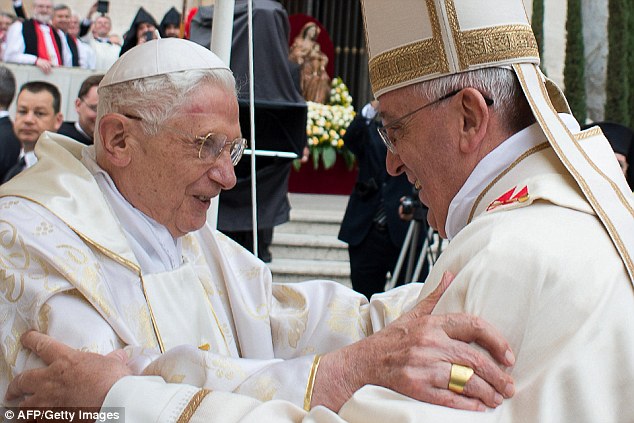
The presidency is not the only example. Catholics are tempted by the same kind of whiplash. Conservatives who felt that we were finally righting the ship under Pope Benedict XVI feel like we are quite suddenly and astonishingly weak under Pope Francis. Liberals who despaired of seeing the fruits of Vatican II realized because of the traditionalist leaning of the same Pope Benedict XVI, suddenly find blossoming of goodness and love everywhere under the same Pope Francis.1405002171232_wps_6_pope_francis_meeting_with The apparent rapport of the two of them doesn’t seem to affect this perception, which should lead us to believe that something other than a Manichean struggle between good and evil is going on, or at least that we have not characterized the struggle between good and evil properly, as one that goes through our own hearts and not through the conservative/liberal divide that we have inherited from the French Revolution. In the Catholic case, this over-reliance on the Holy Father is especially irritating to me, given that one of the best ideas, in my opinion, to come from the Council is that of subsidiarity. This means learning to solve problems at a local level without constantly appealing to higher-up third parties. To some extent, this implicates the project of Benedictine monasticism, properly understood.

Upcoming:
1) The problem of morality as a thing.
2) Will talking about it help? Or not?
3) Nietzsche (almost) right again: truth as relationship.

Love of Neighbor, Love of Enemies

November 11, 2016

Several persons have contacted me and asked me to share some thoughts on the election and its meaning and aftermath. What are our responsibilities as Americans, as Christians and Catholics? If anything, Tuesday’s results and the response of those who opposed Mr. Trump have crystallized in my mind certain ideas in moral philosophy that the brothers and I have been hammering out together for many years. I have found it difficult to convey these ideas in other fora, especially on-line discussions such as take place on Facebook. Our ideas tend to get distorted by the typical political and cultural narratives that pervade the internet and other media. Last year, I began to write out a systematic outline on this blog, but I think it’s worth going through the exercise again, with newer insights from Nietzsche, Max Scheler, James Alison, and William Cavanaugh. Not only that, but much of our work turns out to be applicable to the present political situation.

But this first post is meant to establish the context for everything else that is to be said, lest the rest of what I write appear as an irresponsible escape into navel-gazing.

We are still a nation of laws

…or at least we have always aspired to be. When political rhetoric of any kind is used as an excuse to perpetrate bodily harm or issue threats, this should be met not only with disapproval but with the full force of the laws against such behavior. Those of us who denounce violence will make our own insistence on this point more credible by our own principled respect for the law. There are multiple reports of violent incidents that are being connected to the election results. Most of what appears in the media (and, plausibly, most of what has actually taken place) is violence directed against persons such as Muslims and Mexicans, whose religious and ethnic identities are bound up not only in Mr. Trump’s rhetorical gestures, but in his stated policies. Some of the violence has been against Trump supporters. All violence is out of bounds and deserves the condemnation of every American.

Christian discipleship is authenticated by love of enemies

This past political campaign was demoralizing in its constant ratcheting up of the language of demonization. This happened on both sides, and neither side seems to see its own demonization for what it is. This makes civil discourse impossible. Or, perhaps the gradual breakdown of civil discourse has left us with no way of engaging in truly rational discussions (see Alasdair MacIntyre, After Virtue, chapter 2). Without the possibility of rational argument, the temptation is to resort to demonizing those who disagree. In many cases, we have no way of making common cause, even with those inclined to agree with us, without scapegoating someone (this Girardian insight has been inverted and made into a conscious political tool by Saul Alinsky). Christians cannot settle for this state of affairs, and certainly ought not to demonize those who hold divergent ideas from our own. Pope Saint John Paul II, while an archbishop in Poland, used the strategy of holding the communist regime to account for the gap between their official rhetoric and the actual state of affairs. Václav Havel followed a similar strategy in the former Czechoslovakia.

The simplest way of stating this is that we are commanded to love our enemies and not to meet violence with violence.

Christian social thought is grounded in love of neighbor

Who is my neighbor? The rise of Bernie Sanders and Donald Trump was an indication of a widespread sense in communities blue and red that the general drift of American politics has been at the expense of a great many Americans. Trump’s hope to “make America great again,” and Sanders’s “political revolution,” need to be seen in the long-range context of a failed war in Iraq, the ongoing symbiotic relationship between the federal government and defense contractors, banks, et al,  5.5 million home foreclosures, with virtually no repercussions for those responsible for this widespread suffering. The Washington and media elites are widely understood to belong to a utopian (i.e. “no-place”) globalist class that has forgotten the responsibility they have for their fellow Americans. Instead of seeing fellow Americans as neighbors with a common cause, elites unthinkingly deride the suffering as the irresponsible “47 percent” or lob them into the bucket of deplorables.

Again, I will have much more to say about how we got here, and what sort of strategies are needed to recover a sense of solidarity between Americans. In various ways, the healing follows from the principle of love of neighbor. The priest and the Levite, political insiders and beneficiaries of political power, were afraid to show compassion to the man left for dead on the way to Jericho. Perhaps we need to become outsiders, like the Samaritan, in order to see the suffering in front of us for what it is. Through the strengthening of local networks of concern, we can bring to bear a properly political pressure to bear upon government leaders, most of whom, after all, are chosen by us and work for us.

Love of God, love of neighbor, love of enemies. These are the measure of Christian witness, which is needed now.

Next: Why emotivism leads us to court political power.


On the Impermanence of Institutions and the Permanence of Virtue

August 17, 2016

I wrote several days ago something to the effect that “things are worse in the Church than people think.” This sentiment is worth qualifying and examining.

Mainly, I’d like to distinguish what I mean from what Rod Dreher means when he writes similar things. As I understand him, he sees Christian institutions under imminent attack from secularizing forces. He fears that Christians are oblivious to the seriousness of the threat. In my experience, Christians are plenty aware that demographics trends and political developments do not bode well for the Church in the immediate future. What he perhaps is responding to is the fact that few Christians make this their first concern. I don’t think that this is necessarily complacency in many cases. To explain this, let me say something about institutions.

Alasdair MacIntyre, whose famous St. Benedict quote is the inspiration for Dreher’s “Benedict Option,” is a man whose comprehensive thinking on modernity, morality, and faith deserves as much attention as one can afford. He spends almost an entire chapter on institutions in his seminal book After Virtue. Institutions are important, but should always be secondary to practices. An institution like a chess club brings together persons interested in playing chess and fostering its proper enjoyment. The club itself is not a substitute for the actual practice of playing chess. We all know that institutions tend to have their own internal logic that can often interfere with the practices they are meant to foster and protect. Therefore institutions can only function well and in proper subordination to practices if the members are virtuous. And, as MacIntyre makes clear elsewhere, virtues are learned in practices, not in the bylaws of institutions.

In my opinion, most Christians are aware that longstanding institutions are endangered. And I would agree that many of us Christians are not spending lots of time worrying about it. Ambivalence in this regard has two sources. The first is a recognition that our current institutional arrangements are often unable to surface the right kinds of virtuous leadership, and so tend to be self-defeating. The response of American bishops to the sexual abuse scandal demonstrated (and continues to demonstrate) that the institutional arrangement (meaning the current structure and operating modes) of the bishops’ conference is faulty. This is to be distinguished from the theological necessity of the episcopacy or even the virtue of individual members. Bishops could choose to organize themselves differently, but this would require hard thinking about the precise practices that the bishops’ conference is meant to foster and protect. The Council documents that encouraged the formation of these institutions are somewhat vague on this point and were, perhaps, slightly naive about how institutions can corrupt practices.

The second source of ambivalence stems from the typical Christian concentration on real practices. This is to say that the average Christian is more concerned about the practice of virtue at ground level than the institutional backing that supposedly is undergirding it. Another way to look at this is to say that Christians are already developing their own local, ad hoc institutions (which is what the Benedict Option is supposed to encourage). The collapse of larger structures that provide tax shelter for a religious soup kitchen may or may not impact the soup kitchen itself. But Christians will, in one way or another, find a way to feed the hungry. It’s what we do. And I see so much of this in my everyday life, even from the relative obscurity of the cloister, that it seems ungrateful to fret about difficulties to come, even while I do see the need to prepare for them. I’d rather point to the exercise of faith around me and encourage the Christians I know to continue the work of virtue than worry about something that hasn’t happened yet, and may or may not in fact happen. This work is being done by the laity, a visible fruit of the teaching of Vatican II.

Last of all, the mention of virtue brings me at last to explain what I mean when I say that things are worse than people might think. What I mean by this is that our Western culture, especially in America, has been somewhat less-than-fully-Christian for many generations now, and that reviving a genuine, thoroughgoing practice of Christian virtue is a lot more difficult than the average person might think. This is something I can vouch for firsthand. I am a cradle Catholic who has mostly practiced by faith all my life. And yet, I am continually amazed at how far I have to go to be genuinely holy. Now, putting it that way illustrates that this is not pessimism or frustrating, or even necessarily cause for great fear. If you read the lives of the saints, you will discover that most saints had this same experience (which does not make me a saint, by the way). Love of a transcendent God means, in the words of Fr. Michael Casey, being perpetually out of one’s depth. Where I think there is some naivete is in our American optimism that “most people are basically good.” This is a nice, generous sentiment. But it does not help us to gain a lot of energy in the spiritual battle, in which we must first notice that in every heart there are large swaths of unevangelized heathendom. These are, of course, open to hearing the Good News! Which makes them, in their way, “good,” if broken and in need of healing. This healing is what we must first be about, and only if this happens will institutional reform follow in any meaningful way. In the short term, this may mean the tottering and elimination of many institutions. Some may be sad to see them go. But the long-term needs of the Faith may require this purification.

Of Solitude and Contemplation

May 31, 2016

In my previous post, I noted that behind the Rule of Saint Benedict, there lies hidden the influence of the Desert Fathers. Benedict recommends that the monk eager for advanced pursuits in monastic spirituality should read the “Institutes” and the “Conferences.” Universal tradition as well as common sense asserts that he is referring to St. John Cassian, who spent nearly two decades in the Egyptian desert learning the monastic life. You can find indices to Cassian’s two most important works, the Institutes and the Conferences at the Order of Saint Benedict website.

What I wish to emphasize here, and in keeping with my aim to write brief and manageable posts, is one key connection between these two books and the two-fold path to spiritual maturity. I wrote last time that Saint Benedict is primarily concerned with the correction of behavior in his Rule for monks, but that he also acknowledges, in quiet ways, that beyond the cultivation of virtue and the elimination of vice, there is the further contemplative aspect of monastic (and Christian) life, what Benedict calls “wisdom of doctrine.” The Institutes correspond to the “active” life of conversion, and the Conferences are concerned with the “contemplative” life of adepts.

The first stage of spiritual growth, the correction of behavior, is therefore the primary concern of Cassian’s Institutes. Note that Cassian does not give us what we would consider “morality.” Rather, he is interested in teaching the times of prayer, the style of dress for monks, and the organization of communal life. This is exactly parallel to Saint Benedict’s Rule.  The connection is not just one of a common culture. The Rule of the Master, an Italian monastic rule from the generation before Benedict, and Benedict’s primary source, cribs from Cassian’s Institutes, so that we can say that St. Benedict’s Rule is a kind of grandchild to the Institutes. Cassian goes somewhat beyond communal organization, and spends the last eight books of the Institutes on the eight vices and how to identify the thought patterns that go with them. So again, we are not so much in the realm of morality as moderns understand it. Cassian is interested in psychology, how our thoughts influence our behavior.

This emphasis on psychology is the link between the active and contemplative stages of Christian spiritual growth. Before we can properly understand doctrine, we must first work against behaviors that are not consonant with Christian doctrine, but then we must also go after the thought patterns that underlie wrongful behavior. This cleansing of the mind of wrongful thinking allows us to receive true “theology,” knowledge of God. This is the focus of Cassian’s Conferences.

In the next several short posts, I hope to walk with you through the two stages with more attention to the particular battles with behaviors and thoughts, along with recommended reading in monastic spirituality.

The Desert Background to the Rule

May 27, 2016

Saint Benedict composed his Rule for Monks some time around 540 A.D. Egypt, the cradle of Christian monasticism, had been drastically reduced in the previous 150 years from its high point at the end of the fourth century. Saint Benedict makes explicit reference to the “desert” only once, when describing the anchorites in the first chapter, on the kinds of monks. Since his Rule is written, however, not for anchorites but for “cenobites,” monks who live in communities, we might imagine that this off-hand reference to the desert is a mere nod in the direction of Egypt, without any further thread of connection to the ancient tradition.

There are important hints that Benedict knew the Egyptian tradition well and incorporated it seamlessly into his own proto-European style of monasticism. Finding these clues requires a bit of excavation. The place I would like to begin is in a perhaps unlikely spot, in chapter 64, On the Constituting of an Abbot. The abbot, Saint Benedict tells us, should be chosen “vitae…merito et sapientiae doctrina,” for the merit of his life and the wisdom of his doctrine. This sounds common sensible enough, but in fact it encapsulates an entire way of thinking about the spiritual quest in Christian monasticism. It also justifies Fr. Terence Kardong’s contention that the abbot is to be the “perfect” monk.

Merit of life corresponds to the presence of virtue and absence of vice. It is the first step in monastic conversion, a change of outward behavior. One learns to act…as a monk acts. When monks promise “conversion of life” (conversatio morum) according to the formula invented by Saint Benedict in chapter 58, they are promising to change their way of living. This is not a matter of mere “morals” but is implicated in all kinds of habits, preferences, and in personal comportment. This is the minimum observance “for beginners” [RB 73]. For those who are striving for greater advancement, however, as Benedict goes on to show us in chapter 73, there is the inward transformation of doctrine, new habits of thought about the cosmos and insight into God’s ways. It is not enough for the abbot to be worthy by his exterior actions; he must also have the interior virtues that allow him to give spiritual counsel and make wise decisions about the community’s welfare. It is noteworthy that one of the primary sources of doctrine, according to RB 73, is St. John Cassian, the primary link between European and Egyptian monasticism.

In future posts, I hope to demonstrate Saint Benedict’s direct dependence on the Egyptian desert fathers for this two-fold description of monastic spirituality. What the great monastic theologian Evagrius (354-399 A.D.) described as the practical (or “active”) life followed by the theoretical ( or “contemplative”) life is the best way of understanding Benedict’s emphasis on merit of life and wisdom of doctrine.

How to Keep from Being a Cult

October 31, 2015

My blog isn’t particularly about the Benedict Option, but I have paid attention to the discussion that blogger and journalist Rod Dreher has occasioned by his efforts to unpack the last page of Alasdair MacIntyre’s important book After Virtue. He’s linked to me again (thank you!), and so I need to put out some more product. Years ago, I resisted reading MacIntyre, mostly because I didn’t have a lot of confidence in cultural conservatives to instigate a genuine moral reform of society, much as I felt that we needed it. And I figured that MacIntyre’s book was part of the conservative virtue brigade, a la William Bennett (it’s not). I’ve never been keen to the liberal/conservative divide that is woven into the general fabric of the modern world since the French Revolution. I’ve often felt about conservatism as I do about classical music (much as I like it). Whatever the merits of Mozart–and there are many, many of these–repeating Mozart over and over again will not revive the ancien regime. We may even distort our minds and waste valuable time pining for something totally imaginary, and not all that desirable in the end.

The social world that made Mozart possible is gone, and this is not entirely a bad thing. The social world that made the composition of Gregorian chant possible is almost gone, and this is definitely not a good thing.

How to revive monasteries? This is the question that Benedictines and others have been scrambling to answer since the suppressions of the Reformation and the Revolution. Just as we seemed to have answered it, as vocations were pouring into monasteries in the 1950’s, we discovered that the Western social milieu, that seemed so open to deep religious sentiment and observance, turned out not to have the goods after all. Large proportions of those vocations left the monasteries once the glow wore off and the 70’s got going.

The two options usually held out for religious life parrot the conservative/liberal divide: either return to strong, traditional observances (usually ones from the 1950’s, which were the same ones that failed to win the hearts of the droves who left in the 1970’s), or figure out ways to accommodate to a new cultural situation. Let me examine each option using the tools that Mary Douglas offers us in Natural Symbols.

First, let’s dismiss the accommodation possibility. Accommodate to what? Douglas begins her book with a withering review of the attempts of English bishops after the Second Vatican Council to update Friday abstinence and replace its dense symbolism (participation in the Passion, clear social demarcation from non-Catholics) with something more internal, “moral,”–perhaps we might say “sincere.” I will have a lot more to say about the social conditions that determined the bishops’ preferences for dumbing-down ritual and hyping up “heart religion.” Let me just note here that Dame Mary misses no opportunity gently to chide those who imagine that this heart religion is more advanced and progressive than the magical world of the lower-class “Bog Irish” for whom Friday abstinence was a matter of fidelity to a beleaguered homeland and the grandeur that was Rome. Anthropologists of the 1950’s could provide myriad examples of “primitive” African pygmy societies whose religion played more or less the same tune as the highly educated clerics who imagined themselves on the cutting edge.

What accommodation amounts to, If Prof. Douglas is correct, is the willing, albeit unwitting, suicide of the sacramental cosmic worldview of traditional Catholicism and Orthodoxy. So it’s not a road we can take if we are serious about belonging to a Mystical Body that includes Saint Paul, St. Basil, St. Benedict, St. Gertrude the Great, St. Hildegard of Bingen, Dante, St. Symeon the New Theologian, etc.

But what does non-accommodation look like? Critics of the Benedict Option challenge advocates to demonstrate that communities opting out will not become ingrown and cultish. Dame Mary has advice on this score, too.

In social arrangements that she calls “small group,” we see just these characteristics: strong boundaries separating the group from the external world, and fear of contamination by a world dominated by maleficent forces lurking everywhere outside and threatening to infect the group. She doesn’t spend a lot of time on these groups, but what she has to say contains more than enough information to know how to avoid becoming a cult (or, for that matter, how to become one, if that’s what you’re gunning for).

The small group is one in which the numbers are genuinely low. More importantly, authority is weak, and therefore internal structure is confused. Because authority is weak and structure is confused, the group is in constant danger of disintegrating, and generates for itself a fear of evil influences and a high premium on internal purity (both in terms of the group and the individual). This is a congregation of the saved, and they are saved by their own efforts of purification and prophylactic measures against a corrupted world.

I’ve pointed out to the brothers that the Rule of the Master gives us a perfect description of “small group.” And it is part of Saint Benedict’s great genius and sanctity that he corrects these tendencies of the Master in order to produce a community structure that it clear, articulated by ritual and symbol, discerningly open to the world, flexible and sure of itself (because based in Christ, the Logos, whose ordering principles are seen to inhere in the cosmos daily redeemed in the Holy Eucharist and Divine Office). Here is an example of the counter-intuitive fruits of taking Mary Douglas seriously: when a brother is struggling with thoughts, his first attempts to deal with them often involves an attempt to purify himself inwardly by an effort of will, coupled with a feeling of shame and guilt for having this inward impurity. My advice: definitely work against the thought, but often enough these troubling thoughts are a product of an unwillingness to observe clear roles within community life, to confuse structure and therefore to act inadvertantly as if we were a cult obsessed with internal purity. We desire internal purity, but we achieve it by accepting joyfully the roles that Providence has given us through the medium of the Church. So: keep your place in rank, honor those senior to you, love those junior to you, show up for things on time, follow Benedict’s Rule as literally as you can. This takes the heat off of the spiritual battle and involves the whole structure of the Church in the fight, and it offers the brothers the confidence of having a special place within the Church, a confidence that our spiritual foes really can be overcome by the power of Christ animating His Body.

Mary Douglas offered this advice to millennial movements: learn to organize! She died before she could watch movements like the Tea Party and Occupy Wall Street get undermined because of their steadfast refusal to organize. Benedictine Option pioneers should work to avoid the related fate of the irrelevant sectarian movements by learning to organize. There is a direct connection between the kind of social body we live in and the beliefs that we hold and behaviors that we legitimate. The connections between these three levels of 1) mind, 2) body, and 3) society I hope to explore in the next post on Natural Symbols.

Natural Symbols-Introduction

October 16, 2015

[P]eople at different historic periods are more or less sensitive to signs as such. Some people are deaf or blind to non-verbal signals.–Mary Douglas

I’m back after a long layoff owing to travels and recuperation after our major building project this summer. And I have been promising for some time to write some things about Mary Douglas. I’ve begun here with one of many important quotes from what I consider to be her most important book, Natural Symbols. This book is not as famous as her breakthrough (and perennial classic) Purity and Danger. If you are looking to read her work, I’d start either with Purity and Danger or with one of her excellent Biblical commentaries, probably Leviticus as Literature.

But let’s look at this quote. She is saying that human sensitivity to “signs” depends on one’s historical situation. This quotation appears early in Natural Symbols, a book she wrote in response to the widespread rejection of ritual and symbol in the late 1960’s. She was also writing as a concerned Catholic, for whom ritual was a a life-affirming part of her experience. Finally, she wrote as an anthropologist, who had the opportunity to witness the use of ritual in other cultures, and to reflect on the purpose and effect of ritual in building social ties and shared meaning. Natural Symbols is a book that attempts to demonstrate the connection between three levels of experience (listed here from most to least general and abstract): 1) our system of belief about the world, society, God, and evil; 2) the way in which belief is communicated by and shapes society and the control it exercises (or fails to exercise) over us; 3) our experience of being a body, and the ways in which we use our bodies to communicate our shared (or unique) beliefs about the world and our place in it.

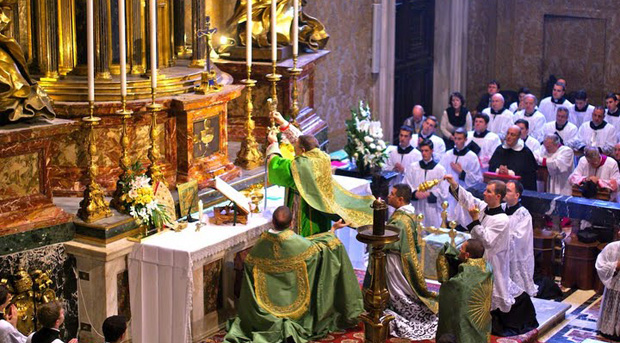
Super-dense symbols at Latin high Mass. Note the strict bodily postures of the participants, their orientation, etc.

Super-dense symbols at Latin high Mass. Note the strict bodily postures of the participants, their orientation, etc.

Let me unpack that last sentence with a concrete example. This will help to explain why I consider the book so important for understanding the malaise afflicting religious life in particular, and the Church in general. In a Catholic monastery, we say that we believe in the Mystery of the Incarnation. This implies that Christ is incarnate in the men with whom we live, and therefore regulate the ways in which brothers relate to one another. As the Prior, I am understood to hold the place of Christ (properly speaking) in the community. This means that brothers don’t refer to me as “Pete,” or sit in my place at table, in choir, or in chapter. Brothers act out, in their own bodies, symbols of the Incarnation. Thus we all genuflect when we enter the church, recognizing Christ’s Real Presence in the tabernacle. We bow to one another to acknowledge Christ in each brother. We discipline our bodies in accord with the social demands that communicate a system of belief.

But what if we happen to enter the monastery as part of an unlucky group that is “less sensitive” or even “deaf or blind,” to symbolic expressions like places of honor, genuflections, pectoral crosses, bows….even habits, tonsures, icons, candles, holy water, etc? I could go on and on. The point is that monastic life as such is as life that is based upon a belief system that is strongly tied to an intricately detailed set of symbolic observances. What if we enter such a life lacking the faculty to see and interpret the symbols?

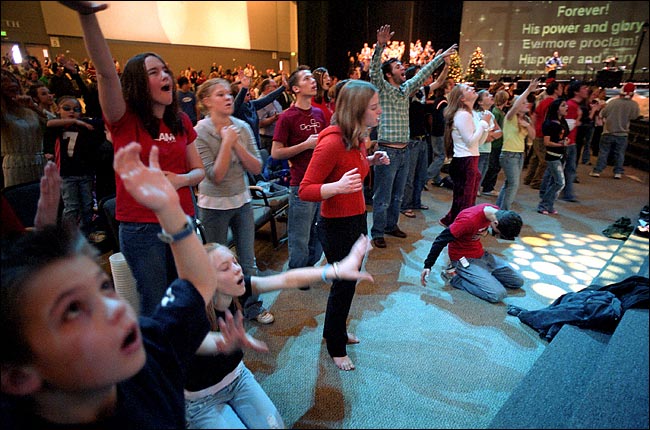
A less ritually rigorous approach to worship. Note the varying postures, vesture (wink), and lack of identifiable architectural context.

A less ritually rigorous approach to worship. Note the varying postures, vesture (wink), and lack of identifiable architectural context.

After many years in monastic life, I have some to the conviction that most young men and women entering religious life today do so without the ability to understand the meaning of the symbols of the traditional life. Furthermore, I think that it is quite possible to engage in these symbolic behaviors without ever really grasping what they mean.

What makes me think this? Before Vatican II, the Church in general was governed by massive amounts of rule-bound behaviors that were intended to communicate a certain theology. Strong social disciplines regulated what bishops, priests, religious, and laity could and could not do. When the reforms of the Council began to take hold, huge percentages of Western Catholics quickly gave up all kinds of symbolic behaviors and social disciplines without any apparent grief (for others, obviously, these changes were devastating; Mary Douglas is very sensitive to their suffering, and in some ways this book is an anthropologist’s effort to help redress the wrongs that were just unfolding in 1970 when Natural Symbols was published). This suggests that there were large portions of the Catholic Church for whom, in 1960, the symbols and disciplines already were more or less meaningless, that their importance had been forgotten, despite the fact that everyone continued to engage in them.

In my experience, young men entering a traditional monastic life such as our is reputed to be are looking for the structure that ritual and discipline provide. But I have also observed that for many of these same men, the real meaning of these rituals can be easily misunderstood. I will attempt to explain what I think is actually going on in a later post. Here, since I must wrap up, let me just point out that an effort to put her ideas into effect in our monastery has had surprising consequences (good ones, so far). And Professor Douglas’s concerns turn out to have a lot in common with the diagnoses of Alasdair MacIntyre, Rene Girard, Fr. Henri de Lubac, George Steiner, Pope Benedict XVI, and others writing from a variety of disciplinary backgrounds. Those who are interested in the so-called “Benedict Option” would do well to pay close attention to Mary Douglas, if they really wish to avoid becoming sectarian pariahs. More than that, Douglas helps to explain why MacIntyre and de Lubac seem to be often misunderstood even by their own strongest supporters. Changing my belief requires me to change my social experience and to change the way I use and experience my body. Without social structure and asceticism (the disciplining of the body), philosophical and theological ideas will, in our world, tend to float free and remain largely inconsequential beyond the tempest-in-teapot-blog-combox skirmishes. I hope to show why this is the case in the coming weeks.

You might be an emotivist if…

August 24, 2015

…you use intention to trump action.

What do I mean by that? When I began as Prior, I noticed that when some brothers failed to do something I had asked, they would reply with a chuckle or confused look at say something like, “Oh, I didn’t mean to do that…” or “I had intended to do that, but then I thought…” The expectation was that if a monk’s heart is in the right place, then if he sins or fails in his duties, I should be quick to forgive. What was often missing was a genuine apology. I don’t write this to shame my brothers; I think that this is the default mode of many people today. Certainly it’s a temptation for me.

If we believe the great sociologist Mary Douglas, this appeal to an inner state (good intention) and lackadaisical approach to formal, external actions (duties to one’s superiors), is a product of a certain kind of social organization. If my place in society is very clear and determined, when I am connected by ties of blood and marriage, hierarchical chains of binding authority, and so on, then external ritual (including obligatory actions mandated by authority, apologies, formal recognition of persons, etc) becomes more important. If I am free to change jobs, move around, lose touch with cousins, and keep my options open, then internal states become more important.

It is common today for people to claim that a focus on internal states is a more advanced form of religion, but Mary Douglas demonstrates that the Congolese pygmies had a similar approach to religious matters, when ethnographers studied them in the early 20th century.  This has more to do with the mobility of a hunting and harvesting group than with any kind of cultural advancement or primitivism.

It is common today for people to claim that the more advanced the form of religion, the more its adherents focus on internal (“emotional”) states. Mary Douglas demonstrated that the Congolese pygmies had a peculiarly “modern” approach to religious matters, when ethnographers studied them in the early 20th century. They used no discernible ritual or magic and were more interested in a feeling of personal well-bring or joy. This preference has more to do with the mobility of a hunting and harvesting group than with any kind of cultural advancement or primitivism.

When brothers enter our monastery, they come from a very loose culture in terms of stability, mutual obligations, and so on. An entry into a monastery from this perspective might seem to be a personal choice, a way to maximize internal joy and freedom. And the monastic life can, at times, serve these purposes if we choose to pursue them. Most monks in a contemplative community have very little contact with the outside world, and what contact they do have tends to be with devout, supportive persons who are often inclined to praise our way of life. Which of course feels good if we’re looking for that kind of thing. When a superior corrects or criticizes, it’s tempting to think, “Who is this guy? Everybody thinks I’m pretty swell. I don’t know why he’s picking on me for failing–in his eyes–in jobs that aren’t that important anyway.” And the rest.

Mary Douglas notes a major problem with the attempt to import this loose structure into the monastery. Loose communities lose the ability to understand the heavy ritual component that makes sense of the monastic life and the Christian life in general. “The perception of symbols in general, as well as their interpretation, is socially determined. [Natural Symbols (1996), p. 9]” She goes on to show that loosely articulated social structures make it impossible to understand the full range of meanings of symbols that were at home in a more clearly articulated structure. Monastic life has always been highly regimented, based in clear lines of authority and obligation, and therefore has generated a wealth of symbols. Men entering today, however, usually can’t read them correctly right away, and part of our conversion of life involves learning how to do this. And this in turn requires us to discover our new identity through the roles that are given to us in the life: novice, junior, priest, cantor, prior, cook.

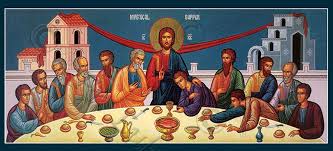
In an icon, every detail fits into an elaborate cosmology. Touch one point of Catholic or Orthodox doctrine, and you set the whole vibrating. Von Balthasar had something like this in mind when he described truth as "symphonic."

In an icon, every detail is symbolic and fits into an elaborate cosmology. Touch one point of Catholic or Orthodox doctrine, and you set the whole vibrating. Von Balthasar had something like this in mind when he described truth as “symphonic.”

Now the Catholic liturgy is also the product of a highly articulated social body, the Church. The world being what it is today, most of us struggle to make sense of dense symbols like the Eucharist, the priesthood, a church building, an icon, and papal vestments. If Prof. Douglas is correct (and there is good reason to suppose that her general theses in Natural Symbols are correct), then the cure for our liturgical mystification is something like commitment. We must make our own the roles suggested (or even given) to us by the Church and by the locale we happen to inhabit. This means getting involved in a parish, treating one’s pastor like a pastor, as someone who has authority over one’s spiritual life. It might mean recommitting to certain formal structures in one’s family (and explicitly in a climate of faith): common meals with assigned seating, traditional celebrations of holidays. It might mean taking more seriously days of abstinence and fast, holy days of obligation, and so on,–anything that requires us to order our internal experience by the external ritualized and moral demands of Church discipline, and, importantly, not letting ourselves off the hook by appeal to good intentions.

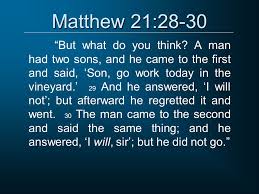
Which one did his father's will? Talk and intentions are easy to come by; deeds can be hard and may require a change of heart.

Which one did his father’s will? Talk and intentions are easy to come by; deeds can be hard and may require a change of heart.

The Experience of Emotivism, Virtue, and Rationality

August 22, 2015

What d’ya say? Let’s move the discussion about emotivism out of the abstract and into the concrete. What is it like being an emotivist? How do I know when I’m acting like one?

I decided to take up this topic once again because of three separate instances in the past week or so. The first one directly involves me. I was preparing to go to the sacrament of confession. During my examination of conscience, I came upon an old, all-too-familiar sin. I’m tired of battling against it, occasionally discouraged by my inability to make much apparent progress. But what happened next was interesting. I noticed that there was a very subtle stirring inside that suggested to me that what I needed to do was feel worse about this sin. And feeling really, really sorry, really upset with myself…well, I suppose the idea is that my behavior will magically change if I change my feelings.

Well, it doesn’t actually work for me. Does it work for you?

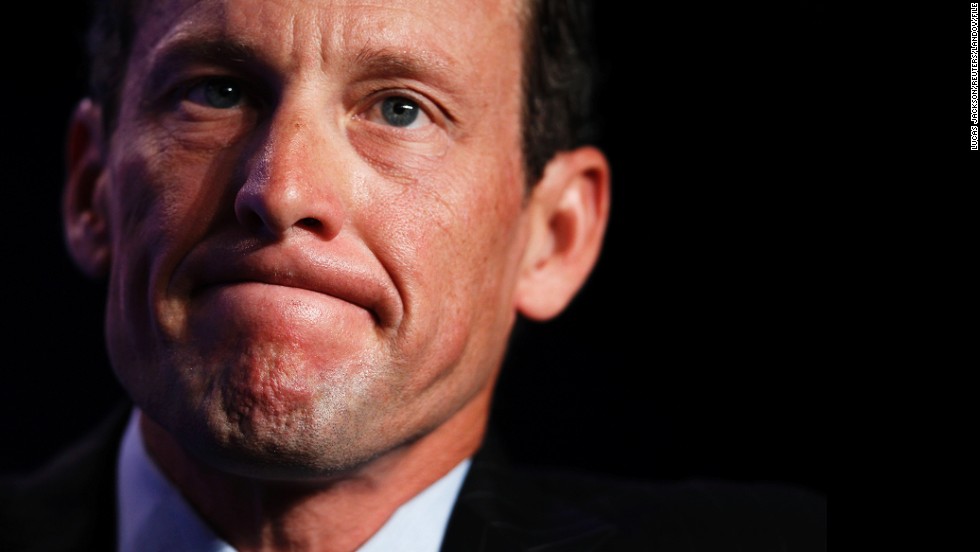
One of the looks of ritualized contrition.

One of the looks of ritualized contrition.

Once you start thinking about this meme, you find it all over. We try to convince each other of our sincerity (especially when we let each other down) by furrowing our brow, biting our lip, getting bleary-eyed. The template for this in my world will always be President Clinton. This is not a criticism of the ex-President. When he felt our pain and acknowledged “not feeling contrite enough,” he was doing what a leader should do–in an emotivist world. Media figures and fellow politicians wanted to make sure that he felt bad, and he needed to make sure that we knew that he felt bad. And it’s become something of a public ritual ever since. When a celebrity (Lance Armstrong, Tiger Woods, Paula Deen) messes up, he or she is expected to go on camera and exhibit signs of sorrow.

What other route might there be? Keep in mind that contrition is a condition of absolution in the sacrament of penance. So there is nothing wrong with the feeling itself. It can be a sign of a healthy conscience. The difficulty is that these feelings may or may not actually have an effect on future behavior. If you’ve ever dealt with (or are an) an alcoholic, you know this. Caught lying, the addict may well feel completely miserable and sorry. But the lure of alcohol and drugs typically overrides the feelings eventually. So generating correct feelings is insufficient for changing behavior.

What I recommend instead is truth and preparation. By truth, I mean what twelve-step programs mean by steps four and five: making a searching and fearless moral inventory of ourselves and stating the exact nature of our wrongs. By preparation, I mean that we learn what situations trigger our disobedience, and make a decision to act contrary to our inclinations when temptation presents itself.

Let me give another concrete example of emotivism.

A common complaint about liturgy is that those attending “don’t get anything out of it.” This sort of rhetoric tempts pastors to make the liturgy more interesting, to see it as a service that they provide to consumers whose desires need to be accounted for. And what are the consumers hoping “to get out of” the liturgy? I can’t say for certain in every instance, but I can speak from my own youthful experience. I thought that church ought to make me feel better about myself, others and the world, that it should inspire me to be a better person. I should walk away from the liturgy with different feelings. This is how many of us gauge the effectiveness of many, if not most, public and private encounters. Success means feeling good, and feeling crummy means that we are doing something wrong.

But does it? This is a highly questionable idea.

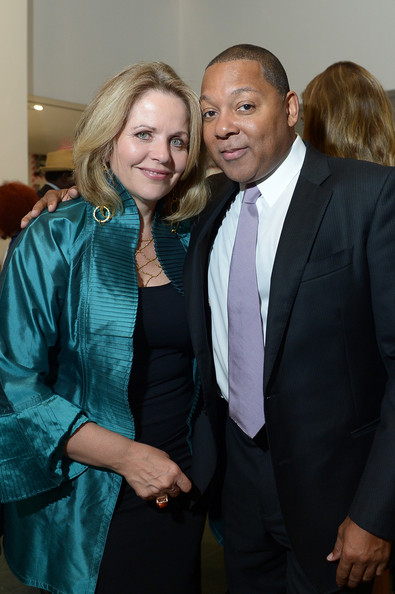
Marsalis with another consummate pro, Renee Fleming. There are many hours of dull, hard work behind their effortless musicality.

Marsalis with another consummate pro, Renee Fleming. There are many hours of dull, hard work behind their effortless musicality.

When I was studying to be a professional musician, I typically practiced three or four hours at the piano every day by myself. I did not enjoy this for the most part. Wynton Marsalis likes to refer to practice as The Monster. Every day, musicians have to get out of bed and confront the monster and slay it. The payoff comes when, after years of slaying monsters, one plays the trumpet like Wynton Marsalis or sings like Renee Fleming. In the meantime, though, one must act contrary to one’s feelings, rather than taking feelings as any kind of objective measure of one’s moral state.

Similarly, in a marriage, when a spouse becomes debilitatingly ill or a child develops a major behavioral issue, dealing with this situation will often require mastering one’s immediate feelings of disgust at sickness, resentment at having to set aside personal goals, and fear that things may spiral out of control. These feelings must be opposed because to give in to them would be to act wrongly, to fail in one’s duties and responsibilities to others. Nursing an ailing loved one can be exhausting, no fun at all. But it is beautiful. When we witness this kind of sacrifice, we recognize it as true and good as well. But to accomplish this sacrifice, we must be prepared to act contrary to our feelings, rather than having our feelings somehow demand of others some kind of compliance (as is the case when we want to “get something out of the liturgy”).

These kinds of routine decisions to act in accord with the truth, with the demands of beauty and goodness, change us into different persons. Our identities become completely wrapped up in the repeated good action, and we become virtuoso trumpeters or faithful spouses, beloved brothers. We have become virtuous, having the ability (Latin: virtus) to choose the truly good, the truly beautiful even when others can’t see it. Here’s the hitch. As we are changing, we are likely at times, perhaps often, to feel “inauthentic.” That is to say, we will miss our old selves. What it’s actually like to be a virtuoso or a faithful spouse is at first an unfamiliar experience and requires us to act in ways that feel insincere.

In an emotivist world, the great sins are inauthenticity and insincerity, the great virtues sincerity and authenticity. Thus, it is difficult for an emotivist to make any headway in any kind of human excellence. Let me end with a quote from Lionel Trilling on what this might mean [emphasis added]:

“At the behest of the criterion of authenticity, much that was once thought to make up the very fabric of culture has come to seem of little account, mere fantasy or ritual, or downright falsification. Conversely, much that culture traditionally condemned and sought to exclude is accorded a considerable moral authority by reason of the authenticity claimed for it, for example, disorder, violence, unreason.”


  • « Go to Previous Page
  • Go to page 1
  • Go to page 2
  • Go to page 3
  • Go to page 4
  • Go to page 5
  • Go to page 6
  • Go to Next Page »

Blog Topics

  • Beauty (22)
  • Contemplative Prayer (60)
  • Contra Impios (2)
  • Culture (32)
  • Discernment (32)
  • Formation (16)
  • General (42)
  • Going to the Father (18)
  • Gregorian Chant (5)
  • Holy Spirit (7)
  • Jottings (27)
  • Liturgy (97)
  • Meditations on Heaven (4)
  • Monastic Life (58)
  • Moral Theology (53)
  • Music (18)
  • Scripture (59)
  • The Cross (2)
  • Vatican II and the New Evangelization (21)

Blog Archives

  • March 2026 (4)
  • February 2026 (3)
  • January 2026 (2)
  • December 2025 (6)
  • November 2025 (4)
  • October 2025 (2)
  • September 2025 (2)
  • August 2025 (3)
  • July 2025 (4)
  • June 2025 (4)
  • May 2025 (3)
  • April 2025 (4)
  • March 2025 (4)
  • February 2025 (3)
  • January 2025 (5)
  • December 2024 (8)
  • November 2024 (3)
  • October 2024 (9)
  • September 2024 (8)
  • August 2024 (9)
  • July 2024 (9)
  • June 2024 (8)
  • May 2024 (9)
  • April 2024 (4)
  • November 2023 (1)
  • April 2023 (1)
  • December 2022 (1)
  • October 2022 (1)
  • March 2022 (1)
  • February 2022 (1)
  • August 2021 (2)
  • June 2021 (1)
  • May 2021 (1)
  • April 2021 (1)
  • February 2021 (2)
  • January 2021 (1)
  • December 2020 (1)
  • August 2020 (4)
  • June 2020 (1)
  • May 2020 (4)
  • April 2020 (9)
  • March 2020 (4)
  • February 2020 (1)
  • January 2020 (1)
  • December 2019 (1)
  • July 2019 (2)
  • June 2019 (1)
  • May 2019 (1)
  • April 2019 (2)
  • March 2019 (1)
  • February 2019 (3)
  • January 2019 (1)
  • December 2018 (1)
  • November 2018 (2)
  • October 2018 (2)
  • September 2018 (2)
  • August 2018 (1)
  • July 2018 (2)
  • June 2018 (4)
  • May 2018 (7)
  • April 2018 (1)
  • March 2018 (1)
  • February 2018 (1)
  • January 2018 (2)
  • November 2017 (1)
  • October 2017 (1)
  • September 2017 (1)
  • August 2017 (1)
  • July 2017 (2)
  • June 2017 (2)
  • March 2017 (1)
  • February 2017 (2)
  • December 2016 (1)
  • November 2016 (3)
  • August 2016 (2)
  • May 2016 (2)
  • April 2016 (5)
  • March 2016 (2)
  • December 2015 (1)
  • November 2015 (2)
  • October 2015 (3)
  • August 2015 (10)
  • July 2015 (12)
  • June 2015 (17)
  • May 2015 (2)
  • April 2015 (7)
 
© 2026 Monastery of the Holy Cross
  • Accessibility
Web Design by ePageCity