Monastery of the Holy Cross

  • Home
  • About
    • Benedictine Life
    • History
    • Video Gallery
    • Et Incarnatus Est - The Prior's Blog
  • Visit Us
    • Guesthouse
    • Prayer Schedule
      • Christmas 2024
    • The Catholic Readers Society
    • Caskets
  • Vocations
    • Monastic Experience Weekend
    • Formation
    • Oblates
      • Oblate Podcast
  • Solemn Vespers
    • Solemn Vespers for Christ the King
    • Chant
  • Contact
  • Donate

Articles tagged with Cross

Triumph of the Holy Cross

September 13, 2025

Tonight, we begin our fourteenth season of Solemn Vespers at 5:15 p.m. Here are my program notes:

“If you want peace, work for justice.”

This was the title of an address given by Pope Saint Paul VI at the Vatican on the World Day for Peace in 1972. The backdrop for this address was the Vietnam War and the Cold War. The United States had been undergoing unrest internally, with radical groups carrying out bombings and assassinations. It made sense to examine the idea of peace and to discover the means to obtain it. It makes sense for us to do so right now.
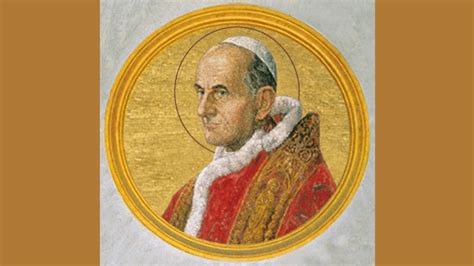
The mosaic of Pope Saint Paul VI at the Basilica of Saint Paul-Outside-the-Walls

In his address, the Holy Father was at pains to make sure that peace is correctly understood. It is not something that arises spontaneously. It requires effort and vigilance, and right relationships between people and nations. These right relationships make up what the Catholic tradition calls justice. Saint Augustine defined peace as tranquillitas ordinis, the tranquility that arises from a well-ordered society. Our efforts to make the world more just will increase the likelihood of a peaceful world. By contrast, injustice breeds discord, resentment, and, eventually, violence.

There is one additional factor that the pope knew well, though he did not make it explicit in his address. In this world, peace cannot be fully attained by mere human effort and good will. The years after the Second Vatican Council fostered a kind of humanist optimism that unfortunately overshadowed the reality that our world is fallen. This unsettling fact does not mean that we are completely helpless to achieve peace, however. The New Testament offers a different way:

“For in [Jesus Christ] all the fulness of God was pleased to dwell, and through him to reconcile to himself all things…making peace by the blood of his Cross [Colossians 1: 19-20].”

“For he is our peace, who has made us both one…that he might create in himself one new man in place of the two, so making peace, and might reconcile us to God in one body through the Cross [Ephesians 2: 14-16].”

In other words, true and enduring peace is possible because of the rescue mission of the Son of God. He was sent by the Father to become incarnate in our human flesh. That very flesh was to be nailed a Cross, to suffer the gravest injustice one can imagine. Is there a better illustration of man’s inability to attain peace by his own powers? When presented with the one innocent man in history, we violently put an end to His life…by judicial murder!
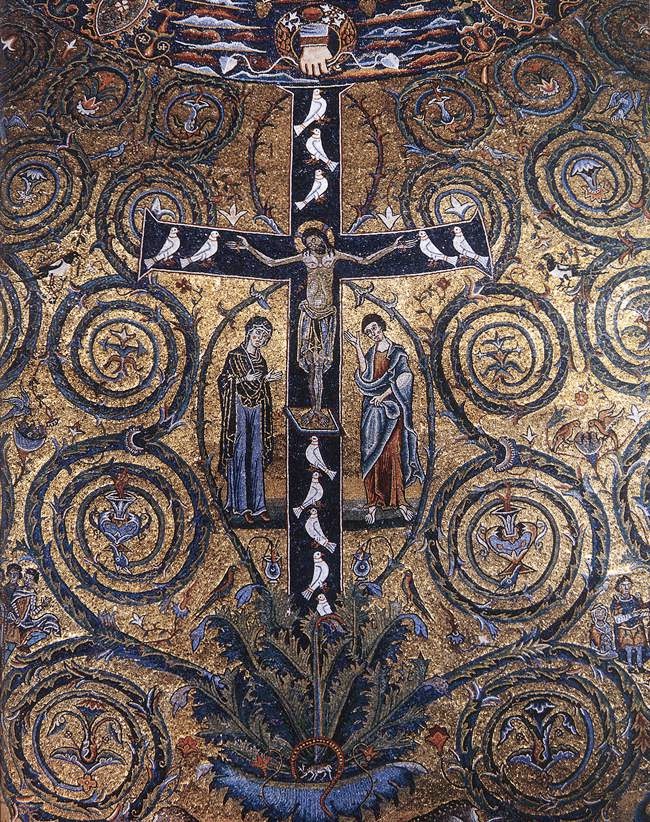
Through the Holy Cross, Jesus gives us the gift of peace. To expand the thought of Saint Paul VI, we might say, “If you want justice, receive first the peace of Christ.” This is a peace from a different place: “Not as the world gives do I give peace [cf. John 14: 27].” All worldly peace is a (pale) reflection of the “peace of God which passes all understanding [Philippians 4: 7].” And there is no way to arrive at this peace that bypasses the Holy Cross, whose triumph we celebrate tonight.

It is significant that the evangelists Luke and John record Jesus, after the Resurrection, greeting His Apostles with the words, “Peace be with you.” To my knowledge, Jesus does not use this greeting before His death. The peace that Jesus gives, He gives because He has already reconciled us to each other and to the Father.

There is one more connection worth noting, this time between justice and the Cross. In tonight’s responsory, we will sing, “The sign of the Cross will appear in heaven when God comes to judge.” Thus, the definitive establishment of justice will happen at the judgment, under the sign of the Cross. The barbaric symbol of man’s injustice will be transformed into a sign of God’s love and Christ’s triumph. The Cross has become our standard, under which we fight against the injustices in the world.

Will we accept this gift of peace along with the Cross and its inverted triumph? That is a question that we Christians should always be asking ourselves, especially in our tumultuous times. If we fail to do this, we will be unwitting conspirators with the forces that would usher in an era of enforced, false peace (which is in fact fearful silence) by means of violence and the threat of violence. As we celebrate Christ’s victory tonight, let us earnestly entreat God to renew in us a commitment to “seek peace and pursue it [Psalm 34: 14]!” Let us take up our share in the Cross of Christ that we may one day share in His triumph.
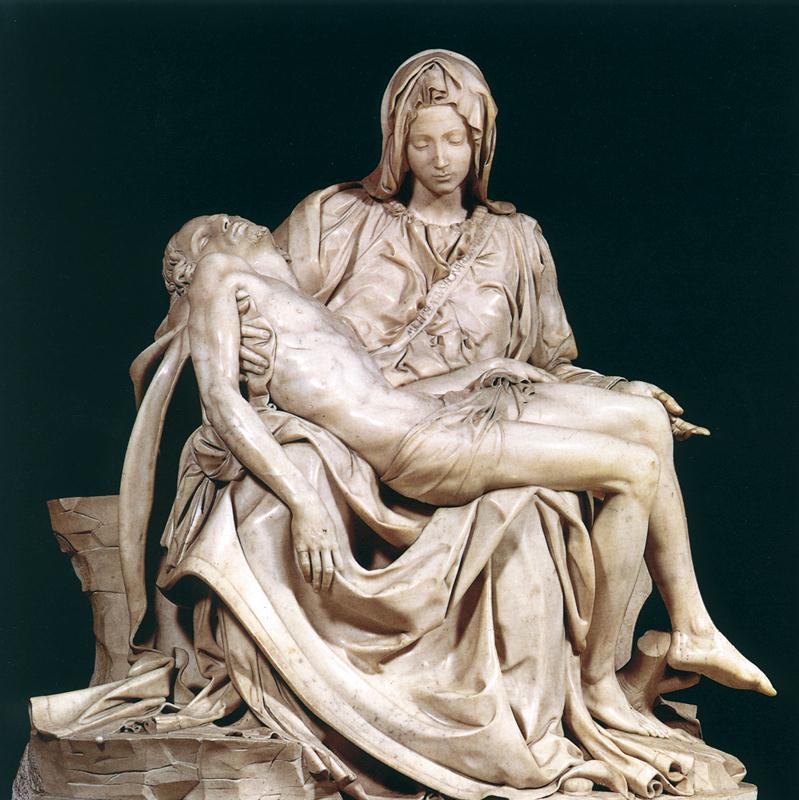


Homily for Good Friday

April 10, 2020

Genesis tells us that man and woman are made in the image and likeness of God. Perhaps surprisingly, we read later in the same book that Adam and Eve wished to be “like” God in another way, gaining knowledge of good and evil. And this temptation to know what God knows led them to stretch out their hands to the forbidden fruit. The unhappy consequences of this action illustrate something that all of us know, that knowledge is often acquired by painful experience.

We are going through the very painful experience of relearning something that we easily forget, that there are real limitations to our knowledge. This is easy to forget because as our knowledge of the natural world has grown, we have been able to break through many barriers thought impassible.

Fifty years ago, many predicted that by 2020, we would not be able to feed everyone in the world. Yet, discoveries of high-yield technologies, better-quality fertilizers and other techniques allow us to feed almost eight billion people today more effectively than we fed three billion people in 1960.

With the click of a mouse, I can copy an electronic version of Saint Augustine’s City of God where it once took a scribe years to do the same work, at great cost to his eyesight.

But there are two dangers that accompany this increase in knowledge.

The first we all know. The human heart being what it is, any knowledge that can be used for good can almost certainly be used for destructive purposes. If we so wish, we can inflict more harm more efficiently than ever before.

The second danger is more elusive. With increased knowledge comes a sense of increased responsibility.

As we struggle to face the threat of COVID-19 together, it is tempting to point fingers. Someone should have known that this was coming, and they should have known how to stop it.

This isn’t the only example, just the one most ready to hand. We can point to other anxieties that come with increased knowledge. A hundred years ago, expecting mothers paid quite a bit less attention to diet, alcohol consumption, and other behaviors that potentially affect prenatal development. Today, mothers are sometimes reluctant to trust their own instincts and experiences when rearing a child, when there is so much literature on child development to be sifted through.

Even the doctors dealing with COVID-19 can face a similar problem. How responsible are you to stay on top of the fast-developing literature on treatment of COVID patients while dealing with the already-stressful situation of present patients? In the direction of this thinking, which is a kind of second-guessing, we start down that old path, desiring to possess the foreknowledge that only God enjoys, wanting to be like God in a way of our own desiring. However well-intentioned, however much we wish to protect ourselves, those whom we love, and our way of life, this attempt to control the world will eventually bring us to grief, a return to thorns and thistles.

Today upon the Cross, we see a different image. We see a man, but a man who is not merely the image and likeness of God, but is God. The contrast between Christ and Adam is one that continually exercised Saint Paul. In the chant that we sang just before the Passion (Christus factus est pro nobis obediens), we see Christ undoing the disobedience of Adam by his own obedience. Christ became obedient even to the point of death. This passage, from the second chapter of the letter to the Philippians points out that Jesus did not deem equality with God something to be grasped at. Instead he emptied himself and took the form of a servant.

This is what God looks like.

If we were to have the mind of Christ, if we were to consent to this self-emptying, we would become more godlike than we do with our efforts to control the world through our knowledge. In fact, we are all being invited to this today, to empty ourselves. Not only are we suffering the uncertainty of dealing with a novel disease, but we must confront this without being able to gather together as a Church, another hollowing out. If we can accept these invitations to self-emptying in faith, then we will be practicing the faith of Jesus Christ, the faith that brings true salvation—an eternal salvation.

This invitation is offered to us anew and in an especially poignant way this Pascal Triduum. It is extended to all the faithful, and to all humankind, in the example of Christ crucified. Let us then have the mind of Christ, to become truly like God, like the Son of God, in our willingness to entrust ourselves to the Father. And “let us confidently approach the throne of grace to receive mercy and to find grace for timely help [Hebrews 5: 9].”


Blog Topics

  • Beauty (21)
  • Contemplative Prayer (52)
  • Contra Impios (2)
  • Culture (26)
  • Discernment (25)
  • Formation (12)
  • General (42)
  • Going to the Father (18)
  • Gregorian Chant (5)
  • Holy Spirit (5)
  • Jottings (27)
  • Liturgy (89)
  • Meditations on Heaven (4)
  • Monastic Life (51)
  • Moral Theology (46)
  • Music (18)
  • Scripture (54)
  • The Cross (1)
  • Vatican II and the New Evangelization (21)

Blog Archives

  • November 2025 (4)
  • October 2025 (2)
  • September 2025 (2)
  • August 2025 (3)
  • July 2025 (4)
  • June 2025 (4)
  • May 2025 (3)
  • April 2025 (4)
  • March 2025 (4)
  • February 2025 (3)
  • January 2025 (5)
  • December 2024 (8)
  • November 2024 (3)
  • October 2024 (9)
  • September 2024 (8)
  • August 2024 (9)
  • July 2024 (9)
  • June 2024 (8)
  • May 2024 (9)
  • April 2024 (4)
  • November 2023 (1)
  • April 2023 (1)
  • December 2022 (1)
  • October 2022 (1)
  • March 2022 (1)
  • February 2022 (1)
  • August 2021 (2)
  • June 2021 (1)
  • May 2021 (1)
  • April 2021 (1)
  • February 2021 (2)
  • January 2021 (1)
  • December 2020 (1)
  • August 2020 (4)
  • June 2020 (1)
  • May 2020 (4)
  • April 2020 (9)
  • March 2020 (4)
  • February 2020 (1)
  • January 2020 (1)
  • December 2019 (1)
  • July 2019 (2)
  • June 2019 (1)
  • May 2019 (1)
  • April 2019 (2)
  • March 2019 (1)
  • February 2019 (3)
  • January 2019 (1)
  • December 2018 (1)
  • November 2018 (2)
  • October 2018 (2)
  • September 2018 (2)
  • August 2018 (1)
  • July 2018 (2)
  • June 2018 (4)
  • May 2018 (7)
  • April 2018 (1)
  • March 2018 (1)
  • February 2018 (1)
  • January 2018 (2)
  • November 2017 (1)
  • October 2017 (1)
  • September 2017 (1)
  • August 2017 (1)
  • July 2017 (2)
  • June 2017 (2)
  • March 2017 (1)
  • February 2017 (2)
  • December 2016 (1)
  • November 2016 (3)
  • August 2016 (2)
  • May 2016 (2)
  • April 2016 (5)
  • March 2016 (2)
  • December 2015 (1)
  • November 2015 (2)
  • October 2015 (3)
  • August 2015 (10)
  • July 2015 (12)
  • June 2015 (17)
  • May 2015 (2)
  • April 2015 (7)
 
© 2025 Monastery of the Holy Cross
  • Accessibility
Web Design by ePageCity