Monastery of the Holy Cross

  • Home
  • About
    • Benedictine Life
    • History
    • Video Gallery
    • Et Incarnatus Est - The Prior's Blog
  • Visit Us
    • Guesthouse
    • Prayer Schedule
      • Christmas 2025
    • The Catholic Readers Society
    • Caskets
  • Vocations
    • Monastic Experience Weekend
    • Formation
    • Oblates
      • Oblate Podcast
  • Solemn Vespers
    • Solemn Vespers for the 5th Sunday in Ordinary Time
    • Chant
  • Contact
  • Donate

Articles under Liturgy

Homily for the Easter Vigil

April 11, 2020

[The following is Father Brendan’s homily for Holy Saturday.]

Do you remember where you were or what you were doing on St. Valentine’s Day, February 14 1990?  I would be surprised if you did.  I don’t.  It may be a strange question to ask, but it’s related to an event that took place August 20, 1988.

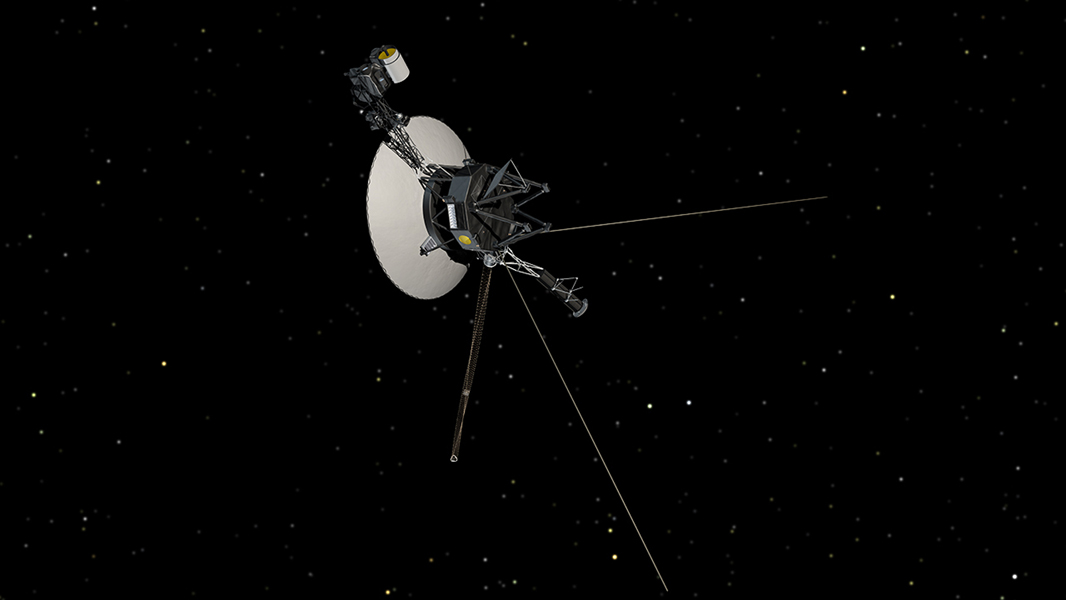
Voyager 1

That was the day NASA launched the Voyager 1 spacecraft.  Its mission was to study Jupiter, Saturn and the moons of these two planets. Thirteen years later, Voyager was 4 billion miles from Earth and on the verge of leaving our solar system.  It would be the first manmade object to go into interstellar space.

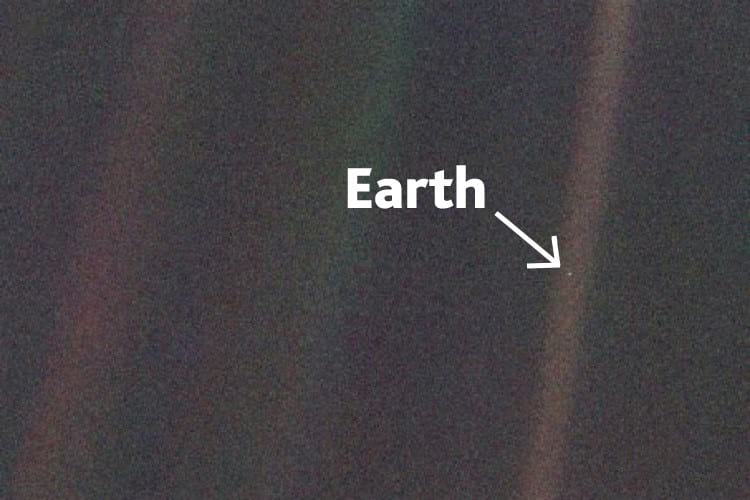
That was when the astronomer Carl Sagan, who had a part in planning the project, asked NASA to turn Voyager’s cameras around and snap a goodbye photo of planet earth way in the distance.

The photo became famous as “The pale blue dot”. Caught in the center of a single beam of light from the sun, Earth appears as a tiny blue orb in a vast, dark void.  Just a speck in the immense cosmic ocean.  Somewhere on that speck, the third rock from the sun, you and I were going about our daily lives.  The photo of our planet turning around a medium sized star, in a nondescript neighborhood of the Milky Way galaxy, brings to mind the words of Psalm 8:

“what is man that you are mindful of him,

the son of man that you care for him?

You made him a little less than a god,

and crowned him with glory and honor”.


We seldom think of it, but there is a cosmic dimension to Easter.  A dimension hinted at in the first reading from Genesis and again in the Easter Gospel.  In the beginning was the first Creation.  The resurrection of Christ was the beginning of the new creation.

First creation, new creation.  Why did God create the world in the first place?  Carl Sagan had no answer.  He told us that every week, for 13 weeks from September to December on PBS.  The program, “Cosmos” was the most widely watch tv series of its time winning two Emmy Awards.

I watched it faithfully back then. It provoked wonder and melancholy in equal amounts. Sagan explored the architecture of space and time, dark matter and dark energy, how galaxies form, why stars implode, how everything began, and how it’s all going to end.

But he also told us that the physical cosmos was all that existed: it was just the result of a series of chance occurrences.  It has no meaning or purpose.  We were all destined for extinction.  In all its mystery and vastness, he said, there was no hint that help could come from elsewhere to save us.

Fortunately, there are other are other answers to the question “why creation?”.  One of those is found in the writings of the early Church Father St. Irenaeus of Lyon.

Irenaeus reassures us that the Cosmos is not a meaningless, statistical accident.  He taught that Christ is a savior by his very nature.  The world and human beings in it were created to give him something to save.  What’s the good of being a lifeguard if there’s a beach and water, but no swimmers.

What we celebrate in Easter is the revelation of a hidden plan for the salvation of the fallen human race.  Irenaeus invented a term for this plan:  he called it the “divine economy of salvation”.

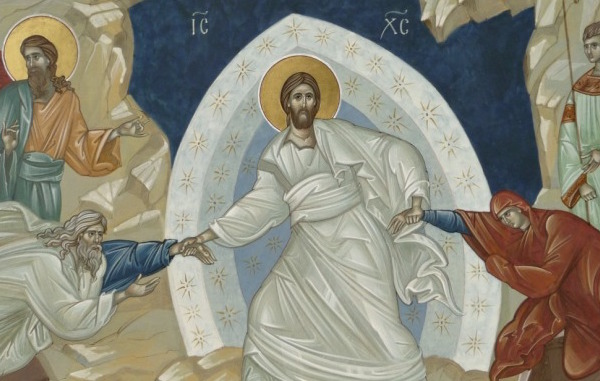
This economy is first revealed in Genesis, progressively unveiled in the Law and the Prophets, and reaches full disclosure in the passion, death and resurrection of Jesus Christ.  His return from the dead as a glorified human body tells us that God has directly entered his creation to rescue us from our fallen nature.

Easter is not merely a date on the calendar, it is the beginning of a new way of understanding of the world and how we should be living in it.  Not as those who have no hope, no purpose or goal to their existence.

Voyager 1 is zipping along at 38,000 miles per hour in deep space 14 billion miles from earth.  It has an appointment with Alpha Centuri, our nearest neighbor, 90,00 years from now.

When it took the photo of earth 20 years ago those without faith saw a pale blue dot in a meaningless void.  The vastness of it all made human life look trivial.  For those with eyes awake to the meaning of Easter, the world is charged with the glory of God.

On this night, the Divine Liturgy reminds us that baptism sacramentally inducted us into Christ’s saving death and resurrection.  We now bear the full weight of Christ’s risen glory.  And on the day of his return we will shine like the stars in the cosmos.


Homily for Good Friday

April 10, 2020

Genesis tells us that man and woman are made in the image and likeness of God. Perhaps surprisingly, we read later in the same book that Adam and Eve wished to be “like” God in another way, gaining knowledge of good and evil. And this temptation to know what God knows led them to stretch out their hands to the forbidden fruit. The unhappy consequences of this action illustrate something that all of us know, that knowledge is often acquired by painful experience.

We are going through the very painful experience of relearning something that we easily forget, that there are real limitations to our knowledge. This is easy to forget because as our knowledge of the natural world has grown, we have been able to break through many barriers thought impassible.

Fifty years ago, many predicted that by 2020, we would not be able to feed everyone in the world. Yet, discoveries of high-yield technologies, better-quality fertilizers and other techniques allow us to feed almost eight billion people today more effectively than we fed three billion people in 1960.

With the click of a mouse, I can copy an electronic version of Saint Augustine’s City of God where it once took a scribe years to do the same work, at great cost to his eyesight.

But there are two dangers that accompany this increase in knowledge.

The first we all know. The human heart being what it is, any knowledge that can be used for good can almost certainly be used for destructive purposes. If we so wish, we can inflict more harm more efficiently than ever before.

The second danger is more elusive. With increased knowledge comes a sense of increased responsibility.

As we struggle to face the threat of COVID-19 together, it is tempting to point fingers. Someone should have known that this was coming, and they should have known how to stop it.

This isn’t the only example, just the one most ready to hand. We can point to other anxieties that come with increased knowledge. A hundred years ago, expecting mothers paid quite a bit less attention to diet, alcohol consumption, and other behaviors that potentially affect prenatal development. Today, mothers are sometimes reluctant to trust their own instincts and experiences when rearing a child, when there is so much literature on child development to be sifted through.

Even the doctors dealing with COVID-19 can face a similar problem. How responsible are you to stay on top of the fast-developing literature on treatment of COVID patients while dealing with the already-stressful situation of present patients? In the direction of this thinking, which is a kind of second-guessing, we start down that old path, desiring to possess the foreknowledge that only God enjoys, wanting to be like God in a way of our own desiring. However well-intentioned, however much we wish to protect ourselves, those whom we love, and our way of life, this attempt to control the world will eventually bring us to grief, a return to thorns and thistles.

Today upon the Cross, we see a different image. We see a man, but a man who is not merely the image and likeness of God, but is God. The contrast between Christ and Adam is one that continually exercised Saint Paul. In the chant that we sang just before the Passion (Christus factus est pro nobis obediens), we see Christ undoing the disobedience of Adam by his own obedience. Christ became obedient even to the point of death. This passage, from the second chapter of the letter to the Philippians points out that Jesus did not deem equality with God something to be grasped at. Instead he emptied himself and took the form of a servant.

This is what God looks like.

If we were to have the mind of Christ, if we were to consent to this self-emptying, we would become more godlike than we do with our efforts to control the world through our knowledge. In fact, we are all being invited to this today, to empty ourselves. Not only are we suffering the uncertainty of dealing with a novel disease, but we must confront this without being able to gather together as a Church, another hollowing out. If we can accept these invitations to self-emptying in faith, then we will be practicing the faith of Jesus Christ, the faith that brings true salvation—an eternal salvation.

This invitation is offered to us anew and in an especially poignant way this Pascal Triduum. It is extended to all the faithful, and to all humankind, in the example of Christ crucified. Let us then have the mind of Christ, to become truly like God, like the Son of God, in our willingness to entrust ourselves to the Father. And “let us confidently approach the throne of grace to receive mercy and to find grace for timely help [Hebrews 5: 9].”


Homily for Holy Thursday

April 9, 2020

[The following is the text preached by our deacon Brother Joseph at the Holy Thursday Mass of the Lord’s Supper.]

On a late November morning in 2004, I got up at 5 a.m., stopped at Starbucks for coffee and a pumpkin scone just as they opened, and blazed my way up the winding ascent of the Ute Pass into the Front Range of Colorado, where I was living at the time.  I spent several hours hiking up to the snowy, wind-scoured heights of Bison Peak in the Lost Creek Wilderness, seeing no one until almost halfway back down the mountain.  On the way home, I picked up a take-and-bake pizza from Papa Murphy’s, which I ate alone in my apartment.  And that was how I celebrated Thanksgiving.  It was not a Norman Rockwell slice of Americana with generations of family members gathered around a table groaning under a roast turkey and all the trimmings.  Neither was it a despondent, lonely day.  It was the fourth consecutive Thanksgiving I had spent in Colorado, and in previous years I had celebrated with friends who were also unable to make it back home.  But I was moving back to Michigan in just over a month to be closer to my family, and Thanksgiving alone was not the most lonely option.  I knew where I was from, where I was going, and where I belonged, even if I wasn’t actually there.  And while I was still eating a mediocre pizza by myself, I knew that 1500 miles away there was a table in my father’s house with a place for me.  I expect that we all have had these experiences of gatherings that were incomplete, whether we were the one absent or it was someone else.

We are gathered tonight to celebrate the institution of the Eucharist, the great festal family banquet of the Church.  But this year is different.  The church is decorated as usual and ablaze with light.  The brothers have entered with incense and chant.  But I stand here at the ambo and look out over empty pews, and I know the doors of the church remain locked.  It threatens to cast a pall over the celebration.

But this overlooks the important fact that we only miss what ought to be present.  We don’t miss strangers who aren’t at Thanksgiving dinner with us: we miss our absent family members.  The very sense of absence and loss we feel tonight is proof that we all have been called to the Supper of the Lamb.  We all belong here, where God has prepared a place for us, his beloved children.  It is a place that was created for us from before time began, that became ours in baptism, and has become ever more our own by our past participation in the Mass.

We can also overlook the reality that at times God withdraws from us, not to punish us, but because in his love he desires to rekindle and stir up our longing for him.  “Familiarity breeds contempt,” says the proverb, but “absence makes the heart grow fonder.”  This is a time of absence and spiritual hunger, but even that proves that our true food is in Christ.

And while to the disciples the Last Supper was complete in their small group, Jesus saw beyond to all those who would ever be members of the Church.  In that small gathering he saw everyone who would ever come to believe through the message they would proclaim, a message that would spread and bear fruit throughout the whole world, across all time.  Even there in the upper room he saw you and prayed to the Father for you, even as tonight be sees you and prays for you, for he sees not only what is, but what will be, when he has gathered us all to himself in heaven.  The words of Shakespeare’s sonnet could be our Lord’s own when he says, “Thyself away are present still with me, For thou not farther than my thoughts canst move, And I am still with them, and they with thee.”

The Presentation

January 29, 2020

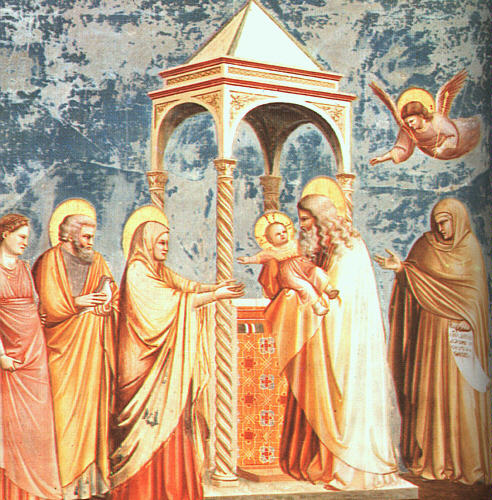
About twenty years ago, when I was a junior monk, Abbot Lawrence O’Keefe, a noted scripture expert, preached our annual retreat. At one point, he made a curious remark. The fifth Joyful Mystery is the Presentation, but he said that it really ought to be classified as a Sorrowful Mystery. Understanding why requires a bit of excavating of this interesting episode from Luke’s gospel.

The tenth plague, the one that finally convinced Pharaoh to allow the Israelites to flee Egypt, was the killing of the first-born. All throughout Egpyt, all offspring that “opened the womb,” including those of livestock, fell prey to the Angel of Death. God made a distinction, however, between the Egyptians and the Israelites, and spared the first-born of the enslaved people. Before that fateful night, God gave an indication about one important consequence. Since God spared the first-born of the Israelites, these all belonged to Him. “Whatever is first to open the womb…is mine [Exodus 13: 2].” Later, at Mount Sinai, God’s claim becomes even stronger: “The first-born of your sons you shall give to me [Exodus 22: 29].” As the great Jewish scripture scholar Jon Levenson has pointed out, this is clearly a commandment to sacrifice the first-born son, after the pattern of Abraham’s testing in Genesis 22. Later still, God mitigates the harshness of this command, allowing first-born sons to be redeemed rather than sacrificed. “All the first-born of your sons you shall redeem [Exodus 34: 20].”

Saint Luke is actually combining several events in his recounting of the Presentation (this is the reason that feast was previously known as the Purification of the Virgin; mothers underwent a period of ritual impurity after childbirth). Let me return to focus on the “sorrowful” aspect of this mystery. Jesus Christ is not only the Virgin Mary’s first-born Son; He is God the Father’s first-born Son. From His conception, He belongs to God, and the redemption that Joseph and Mary offer merely delays the final gift that Jesus will make to Father by offering His life on the Cross. Today’s celebration foreshadows Christ’s Passion and Crucifixion and consecrates the child Jesus to the Father.

Let’s turn to another aspect of this mystery. When the Babylonians captured Jerusalem in 587 B.C., the ark of the covenant, the sign of God’s presence, was removed from the temple. What happened to it remains an unsolved riddle–Indiana Jones notwithstanding. When the temple was rebuilt, the ark was no longer in the Holy of Holies (when the Roman general Pompey entered the Holy of Holies after taking Jerusalem in 63 B.C., he was puzzled to find it empty of any idols or statues). God was not entirely absent; nor had He fully returned after His dramatic departure narrated at the beginning of Ezekiel’s prophecy, dating from the Babylonian captivity. The prophet Malachi, writing perhaps in the fifth century B.C., indicated the God would suddenly appear in the temple. In the arrival of the Virgin Mary and the boy Jesus, the early Church saw the return of the true Ark of the Covenant (the Mother of God, whose womb was God’s resting place for nine months), and the sudden arrival of God in His temple. The long exile of the chosen people was finally ended, that moment that holy Simeon and Anna had awaited with such love for God.

The Wedding of the Lamb

In the first antiphon of First Vespers,* this arrival is seen as the consummation of the marriage covenant into which God had entered with Israel. Now, if we remember back to the Exodus, and God’s claim on all first-born sons, we see that this espousal is intimately connected with Christ’s self-offering on the Cross. He returns to claim His bride, at the cost of His own blood. There is indeed a certain sorrow to this, but it is that of those who sow in tears, only to reap in joy. In the Presentation is encapsulated the whole of the story of salvation. God the Father, in receiving back the Son of Mary, liberates not only Israel, but through her all humanity, and not from political slavery in Egypt, but from spiritual slavery to sin. It is significant that, at Mass tomorrow, we will bear candles in procession, just as we will at the Easter Vigil. It is one and the same Passover that we celebrate, from differing perspectives. As such, today’s feast marks the perfect nodal point between the Incarnation and Christmas, and the Paschal Triduum that looms in the future.


* This antiphon begins (in translation): “Adorn your bridal chamber, O Zion, and receive Christ the king…”

The Mother of God and the Incarnation

December 31, 2019

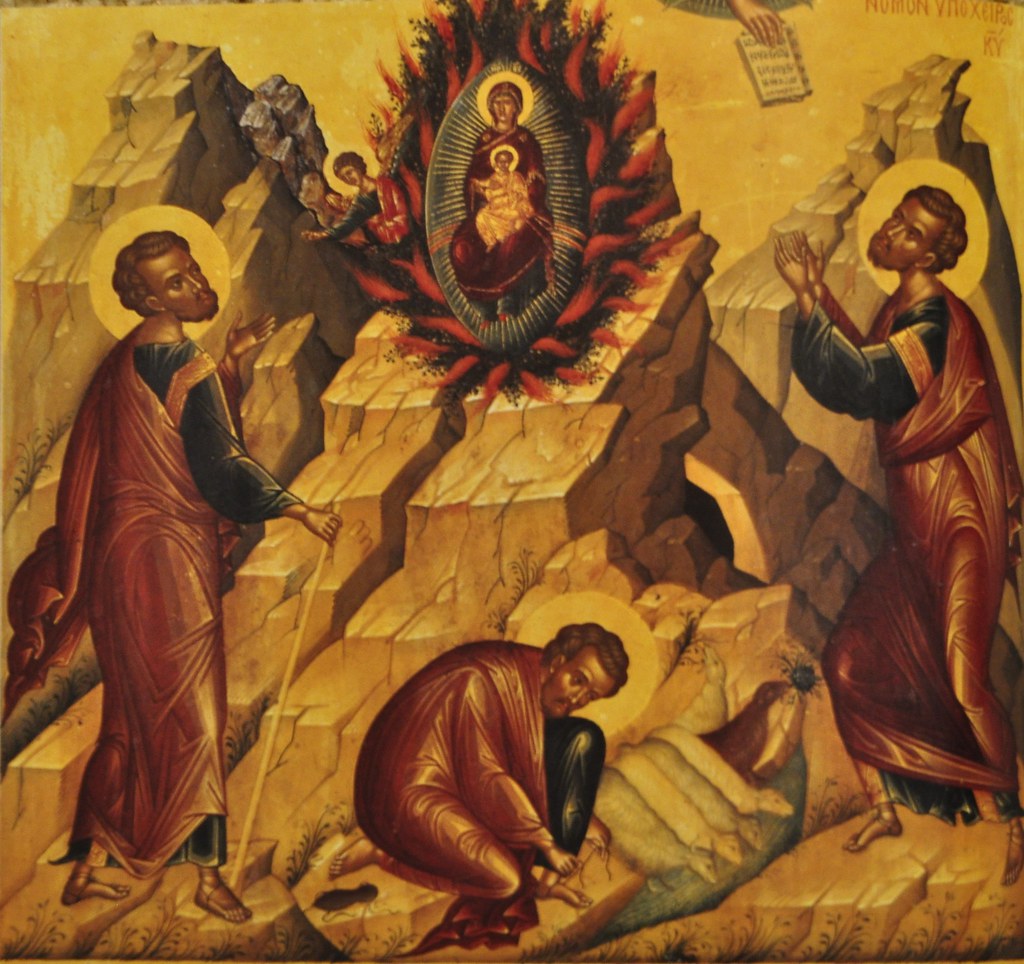
It is common to use evergreen boughs to decorate for the Christmas season. Like the image of the Burning Bush, the evergreen points us toward a mysterious source of life, a current just beneath the surface of our world, bursting through like a hidden spring at certain moments. Amid the entropy of our deciduous (Latin decidere, to fall into ruin, to die) world, signs point us toward this inexhaustible font. The contrast between the autumnal coloring of leaves and the steady greenery of needles, like the contrast between the sidereal firmament and plummeting meteors, speaks to us of a contrast between a permanent world, as yet only hinted-at, and the restless burgeoning and decay of the palpable.

The signs of permanence and stability, the evergreens, the stars, the Burning Bush, appear very much within our world of flux. This is itself significant, for it suggests that our salvation is not so much a separation from the material as it is a rejuvenation of the very cosmos itself. So says Saint Paul:

“Creation was subjected to futility, not of its own will but by the will of him who subjected it in hope; because the creation itself will be set free from its bondage to decay and obtain the glorious liberty of the children of God.”
—Romans 8: 20-21

It is because of this link between our salvation and the liberation of creation that the prophecies of the Old Testament have retained their value. Even after the Fall, creation has borne traces of its lost transparency as well as its destined rebirth. This is to say that creation itself has continued to point toward God its boundless Source. “Ever since the creation of the world [God’s] invisible nature, namely, his eternal power and deity, has been clearly perceived in the things have been made [Romans 1: 20].”

Danger enters from the darkening of our intelligence that followed on the loss of trust in God. The Tree of the Knowledge of Good and Evil lost its sign value as a marker of God’s love and guardianship of Adam and Eve and became (falsely, by the trickery of the serpent) a counter-sign of a supposed arbitrary tyranny. Once faith has been broken by this kind of mistrust, creation ceases to speak lucidly. We ourselves are tempted to be entrapped by the disintegrative forces unleashed by sin, to try and hold on to creatures whose decay is meant to warn us to return to the source of life.

According the Wisdom of Solomon, our predicament can be thus summarized:

“From the greatness and beauty of created thing comes a corresponding perception of their Creator….as [the pagans] live among his works…they trust in what they see, because the things that are seen are beautiful….But [they are] miserable, with their hopes set on dead things.”
—Wisdom 13: 6-7; 10

Even the chosen people of Israel needed constant reminding of the invisible and immaterial God Who communicates through the visible and material. It is significant (another “sign-being-made”) that in Hebrew, the same word, dabar, means “word” and “thing”—a commingling of the spiritual and the perceptible. The prophets communicated not only by speaking, but by proto-sacramental actions and objects. All of these point to the mystery that we celebrate this night, the sudden illumination, not of a lowly shrub on the side of Mount Horeb, but of the human race and all creation by the Motherhood of the Virgin Mary.

We can describe in minute detail how conception takes place, in terms of the mingling of genetic material and the implantation of an embryo in the tissue of its mother’s womb. But can we perceive how a human life, consciousness, the whole mystery of personhood is set in motion by these intricate biological events? Once more we are brought to the boundary between contingent materiality, and the mysterious Source of life itself. This Source has been at work since the beginning of time. Moses and the prophets, culminating in John the Baptist, pointed to its manifestations, celebrated in tonight’s antiphons. We the baptized have the joy of partaking in it:

“For in the mystery of the Word made flesh/a new light of your glory has shone upon the eyes of our mind,/so that, as we recognize in [Christ] God made visible,/we may be caught up through him in love of things invisible.”
—Preface I of the Nativity

May your New Year be filled with the illumination of the Son of God and His immaculate Mother! May we learn anew how to live sacramentally, pointing others to God’s manifestations in our world today.

Merry Christmastide!

The Incarnation, Joachim and Anne

July 17, 2019

How did Saint Anne, not mentioned in the Bible, become one of the most important saints of the Church’s second millennium? The answer has to do with the shifting role of the laity since the high Middle Ages and the central pivot point of the Incarnation in this shift. Let me begin with a personal anecdote.

Read More »

Solemn Vespers for the Easter Octave

April 27, 2019

[The following is from the program notes from our last celebration of Solemn Vespers.]

The resurrection of Jesus Christ from the dead was more than a new event within the old, tired world, laboring under sin and death.  In fact, it was the end of that world and the inauguration of a new creation.  All who are baptized into Christ belong to this new creation, and our lives “are hidden with Christ in God.”  As the first creation was made in six days, with God resting on the seventh, the new creation required a new day, the ‘eighth day’, a day outside of the closed cycle of the broken world.

Read More »

Form Focuses and Releases Energy

April 1, 2019

Today is Debbie Reynolds’s birthday. She is the most energetic woman I’ve ever seen on screen. What strikes me whenever I’ve watched her dance is this: her mastery of technique is what makes her energy so intense and infectious. Her poise and carriage are never tense nor slack; she is an icon of the (apparently) effortless channeling of the potential into the kinetic.

Read More »

The Virgin Martyrs

January 21, 2019

The feast days of the four Virgin Martyrs of the early Roman church frame the celebration of Christmas. St. Cecilia starts us off on November 22, and she is followed by the feast of St. Lucy (December 13), St. Agnes (January 21), and St. Agatha (February 5). On each of these feast, the hymn at the morning office of Lauds uses this text for the fourth verse:

Read More »

Solemn Vespers Monday night!

December 29, 2018

[The following are the program notes for First Vespers of the Solemnity of Mary, the Mother of God, to be celebrated Monday, December 31 at 5:15 p.m. We hope that many of you can join us and ring in the new year with this beautiful celebration!]

Read More »
  • « Go to Previous Page
  • Go to page 1
  • Interim pages omitted …
  • Go to page 3
  • Go to page 4
  • Go to page 5
  • Go to page 6
  • Go to page 7
  • Interim pages omitted …
  • Go to page 10
  • Go to Next Page »

Blog Topics

  • Beauty (22)
  • Contemplative Prayer (55)
  • Contra Impios (2)
  • Culture (27)
  • Discernment (28)
  • Formation (14)
  • General (42)
  • Going to the Father (18)
  • Gregorian Chant (5)
  • Holy Spirit (5)
  • Jottings (27)
  • Liturgy (93)
  • Meditations on Heaven (4)
  • Monastic Life (55)
  • Moral Theology (49)
  • Music (18)
  • Scripture (57)
  • The Cross (1)
  • Vatican II and the New Evangelization (21)

Blog Archives

  • January 2026 (2)
  • December 2025 (6)
  • November 2025 (4)
  • October 2025 (2)
  • September 2025 (2)
  • August 2025 (3)
  • July 2025 (4)
  • June 2025 (4)
  • May 2025 (3)
  • April 2025 (4)
  • March 2025 (4)
  • February 2025 (3)
  • January 2025 (5)
  • December 2024 (8)
  • November 2024 (3)
  • October 2024 (9)
  • September 2024 (8)
  • August 2024 (9)
  • July 2024 (9)
  • June 2024 (8)
  • May 2024 (9)
  • April 2024 (4)
  • November 2023 (1)
  • April 2023 (1)
  • December 2022 (1)
  • October 2022 (1)
  • March 2022 (1)
  • February 2022 (1)
  • August 2021 (2)
  • June 2021 (1)
  • May 2021 (1)
  • April 2021 (1)
  • February 2021 (2)
  • January 2021 (1)
  • December 2020 (1)
  • August 2020 (4)
  • June 2020 (1)
  • May 2020 (4)
  • April 2020 (9)
  • March 2020 (4)
  • February 2020 (1)
  • January 2020 (1)
  • December 2019 (1)
  • July 2019 (2)
  • June 2019 (1)
  • May 2019 (1)
  • April 2019 (2)
  • March 2019 (1)
  • February 2019 (3)
  • January 2019 (1)
  • December 2018 (1)
  • November 2018 (2)
  • October 2018 (2)
  • September 2018 (2)
  • August 2018 (1)
  • July 2018 (2)
  • June 2018 (4)
  • May 2018 (7)
  • April 2018 (1)
  • March 2018 (1)
  • February 2018 (1)
  • January 2018 (2)
  • November 2017 (1)
  • October 2017 (1)
  • September 2017 (1)
  • August 2017 (1)
  • July 2017 (2)
  • June 2017 (2)
  • March 2017 (1)
  • February 2017 (2)
  • December 2016 (1)
  • November 2016 (3)
  • August 2016 (2)
  • May 2016 (2)
  • April 2016 (5)
  • March 2016 (2)
  • December 2015 (1)
  • November 2015 (2)
  • October 2015 (3)
  • August 2015 (10)
  • July 2015 (12)
  • June 2015 (17)
  • May 2015 (2)
  • April 2015 (7)
 
© 2026 Monastery of the Holy Cross
  • Accessibility
Web Design by ePageCity