Monastery of the Holy Cross

  • Home
  • About
    • Benedictine Life
    • History
    • Video Gallery
    • Et Incarnatus Est - The Prior's Blog
  • Visit Us
    • Guesthouse
    • Prayer Schedule
      • Christmas 2025
    • The Catholic Readers Society
  • Vocations
    • Monastic Experience Weekend
    • Formation
    • Oblates
      • Oblate Podcast
  • Solemn Vespers
    • Chant
  • Contact
  • Donate

Articles tagged with contemplation

Who Is Running the Renewal?

August 28, 2015

I’ve been trying to figure out what it is about George Weigel’s recent post “Catacomb Time?” doesn’t sit right with me. I suspect that it is first of all due to an accumulation of fuzzy complaints with someone-or-other not quite specified. Who inhabit those “Catholic circles” who have “a passion for writing Build-It-Yourself Catacomb manuals”? I honestly have no idea who is meant by this. I suppose that he is referring to the Benedict Option, for which there is no shortage of critics, despite the fact that no one seems to know what it is exactly. The reference to “lukewarm, pick-and-choose” Catholics is always a dangerous one. Who of us doesn’t fall into the “pick-and-choose” category from time to time, even often?

Then there is this larger quote, expressing what seems to me a common enough sentiment, but one I just can’t get behind personally:

This same judgment—Catholicism by osmosis is dead—and this same prescription—the Church must reclaim its missionary nature—are at the root of every living sector of the Catholic Church in the United States: parish, diocese, seminary, religious order, lay renewal movement, new Catholic association.
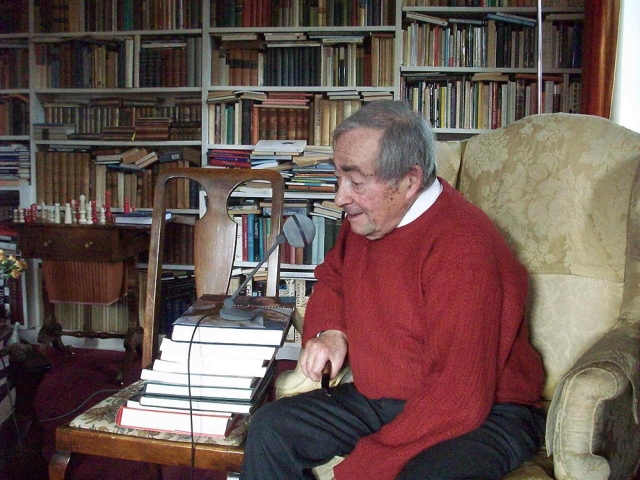
George Steiner in my dream study. He proposes "cortesia" (courtesy) as a mode of mutuality as a partial antidote to a critical and wordy discourse that empties language of its theological import.

George Steiner in my dream study. He proposes “cortesia” (courtesy) as a mode of mutuality as a partial antidote to a critical and wordy discourse that empties language of its theological import. In this, he comes remarkably close to Benedictine “hospitality” as a mode of encounter, and perhaps a way to reinterpret “mission” away from the excessive freight of unidirectional conquest toward a humble acknowledgement of the potential contributions of potential converts.

“Every living sector” of the Church in a country of almost 70 million Catholics? That’s a big claim. I think what troubles me most about this sort of language is the absence of any feint in the direction of the work of the Holy Spirit in animating the Church. Then there is the question of whether my own religious community qualifies as a “living sector” and whether we actually share that judgment and prescription. One reason I balk at that way of phrasing the “judgment” that “Catholicism by osmosis is dead,” is that it privileges what Mary Douglas refers to as “elaborated speech code” (the language of academia, personal commitment and conviction, related to what George Steiner calls out at the beginning of Real Presences) at the expense of “restricted speech code,” the more passive communicative modes of ritual and symbol. Much of what we learn in the Church is at least somewhat osmotic. Yes, we should pay attention at the liturgy, but often times it takes all kinds of exposure at various levels of awareness and engagement before connections are made. Perhaps I sense here, fairly or unfairly, a neglect of the fundamentally receptive nature of faith, prior to any genuine engagement in mission. St. Paul, the greatest missionary of all, spent well over a decade anonymously living the life of a Christian before the Holy Spirit set him apart as the Apostle of the Gentiles. During that time, what was he doing? Praying? Re-reading the Scriptures? I don’t know, but it was certainly a life of withdrawal, maybe not to the catacombs, but a withdrawal nonetheless.

And then let us not forget who is the patroness of the Church’s missions.
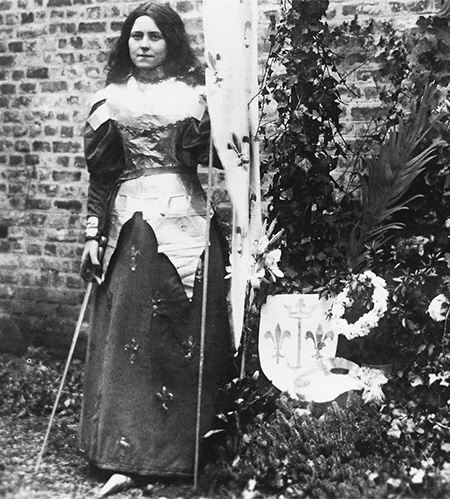
Behind the Church's missionary activity is St. Therese's little way of complete faith in all things.

St. Therese, patroness of the missions. Behind the Church’s missionary activity is St. Therese’s hidden little way of complete faith in all things.

I will leave it to reader to think about the connections between the contemplative life and missionary effectiveness.

Let me end with a little more explanation from Mary Douglas. In the first chapter of Natural Symbols, she relates asking her progressive clerical friends (in 1970) why they think it’s a good idea to move away from the Friday abstinence to more personally meaningful acts of charity–like working in a soup kitchen on Friday.

I am answered by a Teilhardist evolutionism which assumes that a rational, verbally explicit, personal commitment to God is self-evidently more evolved and better than its alleged contrary, formal, ritualistic conformity.

I will admit to nitpicking here a bit, but I think that it is worth watching our language very carefully on these points, lest we saw off the branch upon which we sit. The overall tone of the article supports an individualistic and activist mode of Church life that has the potential to undermine the communal, receptive, gratuitous, gracious, and humble life of faith and hope. Surely one of the points of the young Josef Ratzinger’s “Future Church” article is precisely that we are being called away from “edifices…built in prosperity,” as part of an invitation to leave behind triumphalism. Weigel comes uncomfortably close to a triumphalism-minus-edifices. It is striking that after the long quote from the future pope, a quote that ends with an emphasis on “faith in the triune God, in Jesus Christ, the son of God made man, in the presence of the Spirit until the end of the world,” Weigel never again mentions faith, Jesus Christ, or even God. Again, I will admit that finding such lacunae in a blog post runs the risk of straining justice. But as a monk, I am inclined to be watchful on these counts.

More than anything, this serves as an introduction to Mary Douglas, whose work I have put off writing about for long enough…

UPDATE: Recall that the relationship between mission and contemplative life is the crux at which our community began. Also, that while it is hard not to agree that practicing one’s faith will require great resolve and strength in the coming years, maybe decades, this must be a practice rooted in repentance and joyful humility, grounded in the sacrifice of Calvary, celebrated daily in the liturgy. Finally, while Fr. Ratzinger did say that the future Church will make “bigger demands on the initiative of her individual members,” [emphasis added] this mention of individual members needs to be read in the context of the future pope’s voluminous writings on the liturgy and the Church. The initiative he is calling for surely must be greater fidelity to the reality of the ongoing Incarnation in the local church (including a high mystical “Ignatian” vision of the bishop as Christ and priests as the bishops’ vicars). Otherwise, Weigel might be heard to be inviting individuals to greater creativity, initiative in a maverick kind of sense, rather than in a sense of responsive answerability toward the gospel. And the first step may well be admitting that I’m part of the problem with the contemporary Church.

The Desert Background to the Rule

May 27, 2016

Saint Benedict composed his Rule for Monks some time around 540 A.D. Egypt, the cradle of Christian monasticism, had been drastically reduced in the previous 150 years from its high point at the end of the fourth century. Saint Benedict makes explicit reference to the “desert” only once, when describing the anchorites in the first chapter, on the kinds of monks. Since his Rule is written, however, not for anchorites but for “cenobites,” monks who live in communities, we might imagine that this off-hand reference to the desert is a mere nod in the direction of Egypt, without any further thread of connection to the ancient tradition.

There are important hints that Benedict knew the Egyptian tradition well and incorporated it seamlessly into his own proto-European style of monasticism. Finding these clues requires a bit of excavation. The place I would like to begin is in a perhaps unlikely spot, in chapter 64, On the Constituting of an Abbot. The abbot, Saint Benedict tells us, should be chosen “vitae…merito et sapientiae doctrina,” for the merit of his life and the wisdom of his doctrine. This sounds common sensible enough, but in fact it encapsulates an entire way of thinking about the spiritual quest in Christian monasticism. It also justifies Fr. Terence Kardong’s contention that the abbot is to be the “perfect” monk.

Merit of life corresponds to the presence of virtue and absence of vice. It is the first step in monastic conversion, a change of outward behavior. One learns to act…as a monk acts. When monks promise “conversion of life” (conversatio morum) according to the formula invented by Saint Benedict in chapter 58, they are promising to change their way of living. This is not a matter of mere “morals” but is implicated in all kinds of habits, preferences, and in personal comportment. This is the minimum observance “for beginners” [RB 73]. For those who are striving for greater advancement, however, as Benedict goes on to show us in chapter 73, there is the inward transformation of doctrine, new habits of thought about the cosmos and insight into God’s ways. It is not enough for the abbot to be worthy by his exterior actions; he must also have the interior virtues that allow him to give spiritual counsel and make wise decisions about the community’s welfare. It is noteworthy that one of the primary sources of doctrine, according to RB 73, is St. John Cassian, the primary link between European and Egyptian monasticism.

In future posts, I hope to demonstrate Saint Benedict’s direct dependence on the Egyptian desert fathers for this two-fold description of monastic spirituality. What the great monastic theologian Evagrius (354-399 A.D.) described as the practical (or “active”) life followed by the theoretical ( or “contemplative”) life is the best way of understanding Benedict’s emphasis on merit of life and wisdom of doctrine.

The Transfiguration

August 3, 2017

“He did not know what to say, for they were exceedingly afraid [Mark 9: 5].” With this little detail, Saint Mark reveals quite a bit about the character of Saint Peter and the human condition in general. Under normal circumstances, we are unprepared to behold the full glory of God, and when suddenly God’s grandeur “flame[s] out, like shining from shook foil,”  it can be a terrifying, disorienting experience.

We have many testimonies of this encounter. One early, telling encounter was that of the prophet Isaiah. Isaiah was a priest and probably had entered God’s temple countless times to offer sacrifice. One day, he suddenly saw in reality what he had been celebrating in shadowy, symbolic ways. “I saw the Lord sitting upon a throne, high and lifted up….And I said, “Woe is me! For I am lost; for I am a man of unclean lips…for my eyes have seen the King, the LORD of hosts [Isaiah 6: 1, 5]!” Isaiah is rendered voluntarily speechless until his lips are cleansed by a coal from the altar.

Similarly, Saint Thomas Aquinas, toward the end of his earthly life, was celebrating the Eucharist as he had many times before. This time was different. Like Isaiah, he glimpsed something of the reality that he had celebrated in the half-veil of sacramental mystery. The author of the Summa Theologica, perhaps the greatest intellectual achievement of all time, wrote no more after this, leaving the Summa unfinished. “All that I have written seems as so much straw,” he confided to a friend.

Saint Peter suffers no such scruples. Beholding Christ transfigured, he was properly afraid. Not knowing what to say, however, he said whatever came to mind. In this, he seems to be of a kindred mindset to modern man. Is it not the case that our incessant talking, the swarming proliferation of words, is so much nervous chatter to cover over our anxiety and alienation? We hardly know what to say, yet we can’t stop talking. In our case, I suspect that silence doesn’t occur to us because our fear is not the result of an encounter with the living God, but with the dreadful possibility of His utter absence.

I began by saying that we are not normally prepared to meet God in the unmitigated power of His limitless Being. What the Transfiguration begins to teach us is that, under the dispensation of grace, in the afterglow of the Resurrection and Pentecost, we live under a “new normal.” We live in the in-between time, the time of the holy Liturgy, after the shadows of animal sacrifice but not yet at the full consummation of the world. The Kingdom of God is breaking into the world that itself is passing away. The baptized, as God’s adopted children, are being trained to “see [God] as He is [1 John 3: 2].” The training of our senses and their elevation to the spiritual realm takes place in the liturgy.

This past June, we were blessed to be able to unveil our two newest icons, the Archangels Michael and Gabriel, flanking the Mother of God and John the Baptist. Gradually, our sanctuary is being populated with the communion of the saints. Icons are not mere representations of model believers. The iconographer truly receives the image from the inbreaking realm of heaven. Iconography is, therefore, an ascetical craft, a discipline of visual listening and receptivity, a training of the interior vision to see beyond the sacramental into the reality of God’s holy court. At the same time, icons train the worshipper to attune his or her senses to this new reality. The icons are a central part of the liturgical act, and as conduits of grace, help to elevate the sense of sight to its proper spiritual register.

Similarly, sacred music is much more than pleasing ornamentation of holy words. As Kevin Allen and I have discussed at various time in our decade of collaboration, the composer of sacred music must, like the iconographer, exercise a discipline of spiritual listening. The aim is, through purification of hearing, to catch something of the overwhelming beauty of the perpetual song of heaven. At Solemn Vespers this coming Saturday evening (August 5, 5:15 p.m.), the First Vespers of the feast of the Transfiguration, Kevin and I humbly offer two new motets in this spirit. We pray that our double motet will be a similar conduit of grace, to prepare our hearts to hear God’s Word in its fullest transformative power.

A Crisis of Symbolism

June 9, 2018

Ten years ago, an old friend, now a committed atheist, invited me to participate in an online discussion between atheists and Christians. As rancorous as some of the “discussions” were, I miss the tough back-and-forth probing of my own positions.

Read More »

The Path to Contemplation

February 23, 2020

[I was invited by the Lumen Christi Institute to lead a discussion on contemplation with a group of students on Saturday night. I composed this text to begin the conversation.]

Human beings have typically made use of metaphors when thinking about the mind. In the last two or three generations, we have tended to imagine the human mind as a computer, a storer of information. The mind certainly is this, but this metaphor is part of a myopic turn in human thought, perhaps begun with Descartes, that has brought about many misunderstandings of the ancient idea of contemplation. Let us note here that a computer, at least as we have built them so far, is not capable of having desires, intentions, or insights into the meaning of things. And this is the heart of contemplation.

I listed desire first because desire is necessarily a trait of an embodied, limited, incomplete being…with intimations of fulfillment. The second quality of human minds that separate us from computers is that of intention, which is another quality that admits of fulfillment. The concept of fulfillment itself is central to the proclamation of the gospel: Christ comes to fulfill the Scriptures and the hopes of God’s people Israel. Internalizing this fulfillment is one way of understanding the Christian tradition of contemplation. There is thus an important continuity between desire, intention, and meaning that leads the human mind properly toward contemplation.

Desire and intention–where we begin–belong to a life of action, and it is significant that the active and contemplative life are often paired together. Unfortunately, this pairing is frequently one of opposition, rather than sympathy. The monastic tradition harkens back to a time when these two types of activity were seen not as exclusive, but linked in an important hierarchy. The active life, or–as I would prefer that we call it, the practical life–is the necessary condition for the contemplative life. We see this hierarchy in the thinking of Plato and Aristotle in their distinction between practical reason and theoretical reason. Practical reason is aimed at goals, the satisfaction of desires. As rational beings, many of our desires partake of a higher type of fulfillment than that of simpler bodily desires. In addition to desiring bodily nourishment, we desire understanding. Each of these desires is connected to different types of practical responses, that is to say, different sets of practices.

Let me offer an example of how practices lead naturally into contemplation. To do this, I would like to use a concept related to that of practices. Instead of speaking about practices, which tend to denote simple types of activities, let me introduce a word that denotes a somewhat more complex set of activities, the notion of a craft.

As a former musician, the idea of craft interests me, and it is something familiar. For my illustration, however, let me use a rather different craft, that of accounting.

The active life of an accountant requires a rigorous training in double-entry techniques, learning from masters of the craft how to interpret human action in quantifiable terms, how to prepare different types of reports, how to maintain proper files for audits. In other words, there are standards of excellence in the craft, but these only become clear to the student of accounting after she has learned how to carry out many routine actions internal to the craft itself. At a certain point, the mind is freed from earlier misconceptions about what accounting is. This is the transition from student (or disciple) to master, and it parallels the transition from active to contemplative practice.

At the point of transition, the newly minted accounting professional may begin to notice ways to characterize human behavior that are more accurate than previous standards of the craft. She may realize that certain practices pose a danger to ethical standards, and so need to reflect on how to train future accountants to identify those dangers and deal with them in a way that upholds the important ethical component of the craft. She may also begin to see more correlations between the work of accounting and the work of management, or of distribution, marketing, and so on. In other words, the master accountant begins to see how her craft fits into a larger and larger perspective.

It is this reason that the contemplative life is traditionally characterized as higher, but not separate from the active life. Contemplation makes possible the perception of necessary connections between crafts, how to understand their contributions to the common good. But this understanding and wisdom is only available after one has apprenticed in some disciplined activity, which serves as an induction into a set of practices by which one can come to understand the commonly held standards of excellence, have one’s mind changed and formed by these standards of excellence, and so have the mind freed more and more from a merely local and subjective set of concerns.

Before I conclude, I would like to make a few last suggestive remarks. First of all, I introduced the notion of “standards of excellence” as something desirable within a craft, something toward which we intend. Excellence, as you may well know, is an acceptable translation of the Greek word arete, which is more normally translated as “virtue.” Thus the practical life is a training in virtue, and once again, Plato and Aristotle, not to mention Saint Paul, assume that there is no rational life without a prior training in virtue.

Second, the ancient monastic tradition included a third term in our ascent to contemplation proper. Between praktike, the practical life, and theoretike, or the “theoretical” or contemplative life, was physike or “natural contemplation.” This notion has been almost entirely lost, and I believe it to be of some importance that we recover its meaning.

We are hampered in this recovery by a novel meaning of the word “nature.” Most people today, when using the word “nature,” tend to mean our earthly environment as a whole, perhaps the material world considered as separate from “spirit” or “the supernatural.” This distinction is entirely modern, with roots in the break from Aristotle that took place gradually throughout the fifteenth century and definitively in the sixteenth. What Aristotle meant by nature is physis, the set of characteristics specific to actual species of things. So humans have a nature determined by our animality, political organization, and rationality. We are, by nature, rational and political animals. A dog has a different nature, as does a starfish. Clouds, stars, nebulae, and quarks have natures in their own domains. Natural contemplation is a deepening understanding of the natures of different species of creatures, seen more and more from the perspective of the Creator Himself. What I am suggesting here is that actual human practices initiate us into understanding the natures of things, by seeing their interconnections. We climb the ladder of significations by making a kind of scaffolding of these interconnected concepts in our own minds and hearts, and gradually the face of God is revealed in His creatures. And by habituation to His presence in created things, we come to know God as God is in Himself. This is the practice of contemplation in its deepest meaning. While there are practices specific to this highest level of contemplation, we must prepare for it by a grounding in the cardinal virtues, gained from our participation in craft, and by a training in wisdom by an initial contemplation of natures. We partake of contemplation proper at each step of the way, by our initial desire for the goal and our intention to reach it, so any of us can begin now on this road, if we so desire.

Dante and Natural Contemplation

April 29, 2015

For the medievals, God was not distant and separate from the material world. To the mind of the Middle Ages, everything that exists has meaning, everything is a sign pointing to God, and everything is mystically connected.  –Rod Dreher, How Dante Can Save Your Life

I would go even further, or perhaps simply draw out the implication of this observation in Dreher’s most recent book. Everything in the universe is a message from God, teaching us how to live with Him in love. Can we learn to understand this message? Can we learn the ‘language’ of creation? Or is this just a dream? After all, isn’t it possible that every person simply reads his own meaning into things? Isn’t this idea of the cosmos having an inherent meaning just a romantic, childish fancy that sober modern men and women have left behind?

Dreher underlines the fact that the meaning really was objective in his following sentence: “The point of life…is to let go of one’s ego and live in harmony with God and the cosmos.” Again, I agree with his observation of the medieval mind. If this is true, however, it would seem that merely personal interpretations of the cosmos would risk reinforcing the ego (and for Dreher, hell is “a dark and loveless place of absolute egotism”), and that harmony with more or less brute objects within the cosmos would require a degree of acceptance of how things are. This idea is profoundly at odds with the modern scientific view. But this modern view is at best incomplete, at worse completely erroneous, as I hope to demonstrate in future posts.

So how does one go about learning the language of the cosmos? Can we learn to say with St. Antony the Great, “My book, O Philosopher, is the nature of created things, and any time I want to read the words of God, the book is before me?” Perhaps we should ask instead, “How did St. Antony come to this knowledge of the language of God?”

Antony learned this language within the monastic world of the third and fourth centuries. In this world, there are two disciplines required to learn the language of the Creator. The first discipline is the acquisition of virtue. Without virtue, our desires distort the meaning of things. For the temperate man, food is a sign of God’s love and constant sustenance of our life. For the glutton, food is there to serve the ego’s craving for pleasure. For the chaste person, sexuality is a wondrous and mysterious gift for building up the human family through mutual self-giving. For the unchaste, it is for personal enjoyment and domination of others.

The second discipline is the training of the mind in God’s language through meditation on the Scriptures, especially as explained in the liturgy and the homiletic writings of the saints. The Church Fathers made a great effort to read creation in the new light of the Resurrection of Christ. There is really very little arbitrary about this, and the persistence of certain kinds of reading support the idea that there is a kind of objective reading of things. This work is what the first systematic theologian of the spiritual life called ‘natural contemplation’. For the great monk Evagrius of Pontus, natural contemplation was about finding the ‘reasons’ for things. All things came to be through God’s Word, and therefore contain in them a message from God, a rationality and purpose. We are invited to decode this message.

And as Dreher so aptly puts it, the recognition of God’s loving presence in all things makes Him astounding near.

In most writings on the spiritual life since Evagrius, natural contemplation is left out. His system lists three stages of the spiritual life: the practical or active life of moral purification from the distorting passions; the acquisition of knowledge of the reasons for things, or natural contemplation; and then finally contemplation proper, the knowledge of God as God is, no longer mediated by created things. In simplifying this into the two stages of ‘active’ and ‘contemplative’ (and further distorting this ancient distinction by turning it into the canonical description of two types of religious life), we have lost the idea of natural contemplation.

When you speak of contemplation in religious circles today, most people are going to think of a withdrawal from created things to one’s inner world and direct converse with God. Contemplatives are sometimes criticized for disengagement with the world, for a kind of navel-gazing self-absorption. What the contemplative claims to experience as God is, I think, rightly called into question. Aren’t we just inventing an idea of God? Or confusing our feelings with God?

Natural contemplation undercuts the accusation of egotism and solipsism in the larger work of contemplation (so does the active life of acquiring virtue, but I will save that for a later day). Acquiring an understanding of God through His prolific ‘writings’ in the natural world requires us to be attentive to the reality of things. This was the insight that revolutionized the world of the poet, Gerard Manley Hopkins. “There lives the dearest freshness deep down things…” The living God has arranged every molecule, continually sustains each whirling electron and gives pattern to all manner of charged inscapes. When we attend with care to His works, reading them like the love letter to humanity that they are, we come to know the very mind of God. And then, when we close the doors of our senses and pray to God in secret, it is that God, not a wishful projection of our own insecurities, that we encounter.
God’s blessings to you!
Prior Peter

  • « Go to Previous Page
  • Go to page 1
  • Go to page 2

Blog Topics

  • Beauty (22)
  • Contemplative Prayer (60)
  • Contra Impios (2)
  • Culture (32)
  • Discernment (32)
  • Formation (16)
  • General (43)
  • Going to the Father (18)
  • Gregorian Chant (5)
  • Holy Spirit (7)
  • Jottings (27)
  • Liturgy (98)
  • Meditations on Heaven (4)
  • Monastic Life (58)
  • Moral Theology (53)
  • Music (18)
  • Scripture (60)
  • The Cross (3)
  • Vatican II and the New Evangelization (21)

Blog Archives

  • April 2026 (2)
  • March 2026 (4)
  • February 2026 (3)
  • January 2026 (2)
  • December 2025 (6)
  • November 2025 (4)
  • October 2025 (2)
  • September 2025 (2)
  • August 2025 (3)
  • July 2025 (4)
  • June 2025 (4)
  • May 2025 (3)
  • April 2025 (4)
  • March 2025 (4)
  • February 2025 (3)
  • January 2025 (5)
  • December 2024 (8)
  • November 2024 (3)
  • October 2024 (9)
  • September 2024 (8)
  • August 2024 (9)
  • July 2024 (9)
  • June 2024 (8)
  • May 2024 (9)
  • April 2024 (4)
  • November 2023 (1)
  • April 2023 (1)
  • December 2022 (1)
  • October 2022 (1)
  • March 2022 (1)
  • February 2022 (1)
  • August 2021 (2)
  • June 2021 (1)
  • May 2021 (1)
  • April 2021 (1)
  • February 2021 (2)
  • January 2021 (1)
  • December 2020 (1)
  • August 2020 (4)
  • June 2020 (1)
  • May 2020 (4)
  • April 2020 (9)
  • March 2020 (4)
  • February 2020 (1)
  • January 2020 (1)
  • December 2019 (1)
  • July 2019 (2)
  • June 2019 (1)
  • May 2019 (1)
  • April 2019 (2)
  • March 2019 (1)
  • February 2019 (3)
  • January 2019 (1)
  • December 2018 (1)
  • November 2018 (2)
  • October 2018 (2)
  • September 2018 (2)
  • August 2018 (1)
  • July 2018 (2)
  • June 2018 (4)
  • May 2018 (7)
  • April 2018 (1)
  • March 2018 (1)
  • February 2018 (1)
  • January 2018 (2)
  • November 2017 (1)
  • October 2017 (1)
  • September 2017 (1)
  • August 2017 (1)
  • July 2017 (2)
  • June 2017 (2)
  • March 2017 (1)
  • February 2017 (2)
  • December 2016 (1)
  • November 2016 (3)
  • August 2016 (2)
  • May 2016 (2)
  • April 2016 (5)
  • March 2016 (2)
  • December 2015 (1)
  • November 2015 (2)
  • October 2015 (3)
  • August 2015 (10)
  • July 2015 (12)
  • June 2015 (17)
  • May 2015 (2)
  • April 2015 (7)
 
© 2026 Monastery of the Holy Cross
  • Accessibility
Web Design by ePageCity