As we gather this morning, four astronauts are sailing toward the moon. Right now they are over 200,000 miles away from earth. The Artemis II mission is scheduled to circle around the moon tomorrow and begin the long return home. NASA has a real-time mission tracker website, where you can look at video feeds from four cameras attached to the solar array wings. There is also a computerized diagram of the flight of the Orion spacecraft that allows you view the path to and from the moon from different angles, seeing the relative positions of earth, moon, and sun.
I thought of this last night at the Easter Vigil when we heard about God, at the beginning of creation bringing forth dry land from chaos and creating the two great lights. I came of age in the wake of the first lunar missions and and when I was around ten years old an uncle of mine gave me Isaac Asimov’s Foundation trilogy, a classic of science fiction, which I read and re-read. My father and I watched reruns of the original Star Trek series. I was enchanted by the mysterious music of the opening, with the famous monologue that begins, “Space: the final frontier.”
These were words that would have resonated with Americans, for whom, in the 1960s, the frontier still meant the wild west. The show’s creator, Gene Roddenberry, wrote scripts for Westerns before conceiving Star Trek, and he modeled the show after the great naval exploratory novels of C.S. Forester.
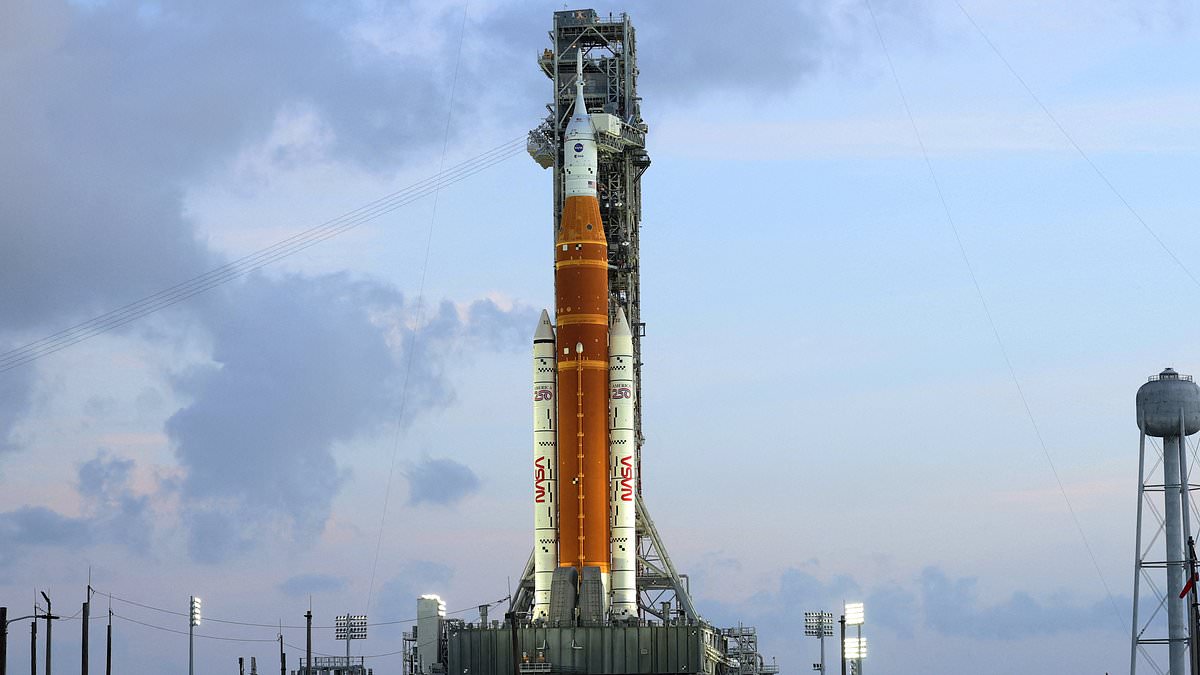
Artemis II countdown
But Roddenberry was also and atheist, and I believe that he spoke too conclusively about space being the final frontier. He was right about something in the human spirit that craves discovery, that is impelled to “boldly go where no man has gone before.” But is space all there is?
When I got older, I fell in love with music, and this, for me, was also a kind of exploration, but of the mind and heart and community rather than of the physical cosmos. The world of art and music seemed to have truly endless possibilities, being unbound by time or space. But as you can see, I pursued neither the life of an astronaut nor of a musician. And that’s because, in the end, the final frontier for all of us is death.
In the words of Hamlet, the afterlife is the “undiscovered country,” though Hamlet, like Roddenberry, surely spoke a bit too hastily. That’s because we do have reports from beyond the grave.
We celebrate that first reconnaissance today, the day that Jesus rose from the dead after descending into hell, preaching to the captives in prison and liberating those who had been held captive to death. Not only has the undiscovered country been scouted out, it has been conquered, and we are free to move in and explore.
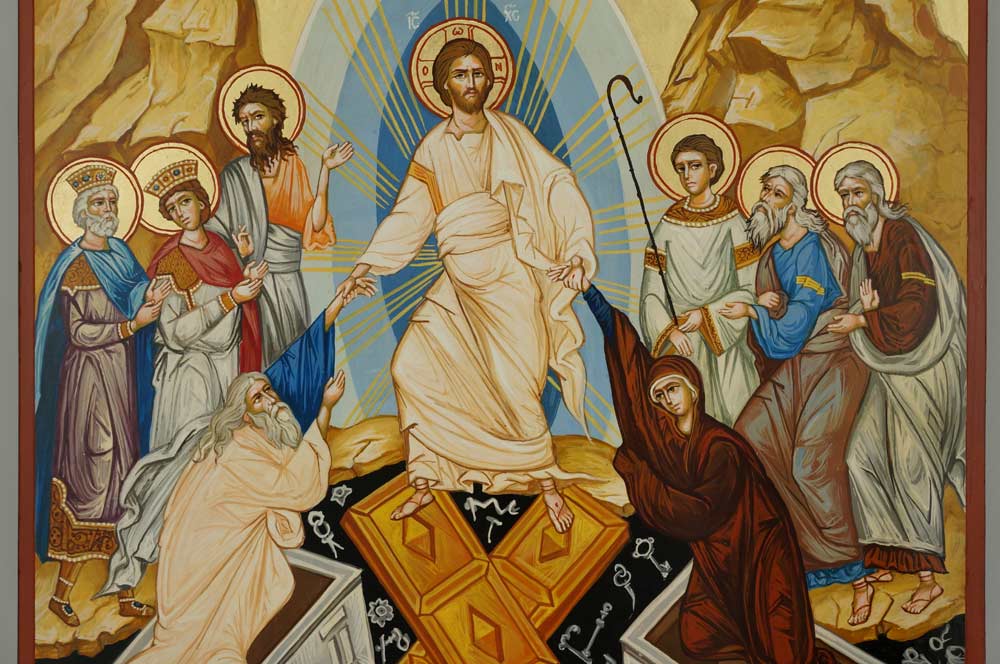
The Harrowing of Hell
For those of you who heard my homily on Good Friday, I hope that you mind me excavating a bit more a theme I introduced then. If this new world of the afterlife is now open for colonization as it were, how exactly do we get there? Do we just simply wait until we die? No; again, not in the physical sense. Rather, the entryway is baptism.
We were baptized into Christ’s death, Saint Paul says, so that “as Christ was raised from the dead…we too might walk in newness of life.” Right now, in the present tense, we are invited by God to live no longer by the flesh but by the Holy Spirit. This is the fulfillment of the distinctive human yearning for the beyond, the urge that impels us to venture into space and to plumb the depths of the heart. What we have been searching for all along is Jesus Christ, the Risen Christ, the God of love and infinite creativity.
So where do we go to explore this new country? In today’s second reading, Saint Paul says, “Seek what is above, where Christ is seated at the right hand of God.” Indeed, the very fact of the empty tomb is an invitation to seek Christ, but to do so spiritually, not physically.
The new world opened up for us by Jesus Christ is the spiritual life. And I don’t mean this in the sense of a boutique “spirituality,” where we choose a spiritual lifestyle that suits us. The spiritual life is the life of the unique Holy Spirit, God’s gift to us in baptism, the Spirit of Truth who will lead us into all truth. A personal “spirituality” limits us to what is comfortable. The Spirit of God makes us true explorers of what is real, what is given by God. And we discover this previously undiscovered country first of all in our own hearts.
Saint Macarius of Egypt said this of the human heart: “The heart itself is only a small vessel, yet dragons are there, and lions, there are poisonous beasts, and all the treasures of evil, there are rough and uneven roads, there are precipices; but there too is God and the angels, life is there, and the Kingdom, there too is light, and there the apostles and heavenly cities, and treasures of grace. All things lie within that little space.”
Do you see that he is, like Saint Paul, urging us to seek what is above? God and angels, the apostles and heavenly cities and treasures. Yes, we must take up arms against the dragons and lions and poisonous beasts, that is our sins and vices, but victory is absolutely assured if only we cling to the Lord with all the love of our hearts and fight unwearied at His side.
He is risen indeed, and in His unsurpassed love for you, his sisters and brothers, He has invited us where truly no one had gone before, but now where await all the saints and angels at the eternal heavenly banquet.