Monastery of the Holy Cross

  • Home
  • About
    • Benedictine Life
    • History
    • Video Gallery
    • Et Incarnatus Est - The Prior's Blog
  • Visit Us
    • Guesthouse
    • Prayer Schedule
      • Christmas 2025
    • The Catholic Readers Society
  • Vocations
    • Monastic Experience Weekend
    • Formation
    • Oblates
      • Oblate Podcast
  • Solemn Vespers
    • Solemn Vespers for the Sixth Sunday of Easter
    • Chant
  • Contact
  • Donate

Articles under General

Remember Beauty: God Is Near

August 2, 2020

Beauty is an epiphany. Encountering someone or something beautiful opens a sudden abyss before me. The arrestingly beautiful object arrives as an answer to a question I had not thought to ask. And yet the answer is not the end, but the door into a cascade of mysteries. In other words, the right kind of aesthetic experience is theological.

Our first experiences of the beautiful are always embodied. They are encounters with real objects: sunsets, the Milky Way, Lake Michigan, forests, cardinals, orchids. Artists use their inspiration and ingenuity to craft beauty in artifacts: paintings, music, cathedrals, gardens, vestments. By a process of abstraction, we can think of ideas as beautiful. For example, I find a number of mathematical equations strikingly beautiful. But this “disembodied” version of beauty is always analogous to the embodied version of beauty.

So we are presented with an important paradox involving beauty. It is, on the one hand, theological and mysterious. At the same time, beauty is embodied and real. I opened by saying that beauty is an epiphany. An epiphany happens when a material object reveals a spiritual meaning. We see the object, and then we also see “beyond” it to significance. Beautiful objects are bridges between the material world and the infinite.

The Fibonacci sequence present in the interior of a sunflower.

For several reasons, I am planning a series of posts on beauty, particularly beautiful music. The goal is not to distract, but to model ways in which we can redirect our focus from the virtual to the real. This idea began with a request from a friend who was encouraging me to write more after my posts of April and May. Then, last week, a pastor from a non-denominational church addressed the brothers on various topics relating to his ministry in a neighborhood that faces challenges of poverty and violence. The two of us briefly discussed the role of anxiety in outbreaks of violence, and he urged me to write more on this topic. I will do that, and one way into this topic is through what the ancient monks called natural contemplation, and what I might call “beauty and the real.”

Beauty is often thought to be a luxury of a leisured wealthy class, irrelevant, say, to a community dealing with with poverty. To me, this sidelining of beauty is a major mistake. Beauty is a patrimony, even a right, of all human beings. More importantly, the loss of beauty produces anxiety and despair, the very ingredients that continue the cycle of violence and poverty.  

Now let me tie a few things together. The visiting pastor shared a number of very helpful insights. He noted that the uptick in violence in Chicago has been fueled, in no small part, by the increase in social media use during the coronavirus lockdown. A key source of harm of the lockdown has been the retreat by larger and larger groups from the real into the virtual.

The Garden of the Phoenix in Chicago’s Jackson Park, a gift of the people of Osaka, Japan.

Remembering beauty can help to bring us back to the real, to ground us. Moreover, beauty can reawaken in us a desire for a genuine life of the spirit. Beauty reminds us that we are made for a life that transcends insipid materiality. Beauty awakens hope, a very important theological virtue for us to cultivate at the moment.

In follow-up posts, I am going to be speaking more about “natural contemplation.” This practice, seemingly forgotten in recent centuries, consists in the habit of seeing things as God intended them to be seen. Since all things were created through God’s Word, all things reveal God, if we learn to view them properly. This would further imply that all things that exist are beautiful at some level, and that the experience of beauty can be a reliable indicator of God’s nearness and the soundness of our best intuitions. Once again, the created world needn’t be reduced to pedestrian materiality, but should instead, through faith and hope, be elevated and “sacramentalized.”

For today, I would invite each of my readers to take time to notice beautiful things around us. Take a few moments to contemplate the beautiful persons you’ve known and the beautiful experiences that you have had. Perhaps you could go further and think about the eternal beauty that the faithful believe awaits us in heaven, a beauty that breaks through even now when we gather to pray and celebrate God in the holy liturgy.
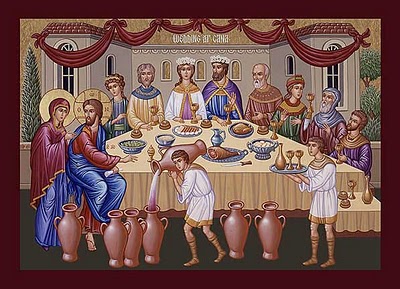
Jesus first manifested His glory by the gift of fine wine at Cana.

Reason and Faith

May 21, 2020

I was a big science fiction fan as a kid. I read everything I could find by Isaac Asimov, and I memorized episodes of Star Trek. In high school, I subscribed to Asimov magazine, and it was from reading the short stories and novellas therein that I came to the realization that the Golden Age of science fiction was long gone. So I was somewhat prepared to be cynical when Star Trek: The Next Generation debuted my senior year.

“The saddest aspect of life right now is that science gathers knowledge faster than society gathers wisdom.”–Isaac Asimov

On the whole, I enjoyed the show, but a comparison between the two Star Treks at the time confirmed for me that the adventure, mystery, and humanity of the original was losing out to militarism, expertise, and a kind of bureaucratic stuffiness in the new series. Later seasons managed to fix many of the glaring problems of the early seasons, but I had lost interest by then, and was devoting my creative energies to music and Shakespeare.

One episode summarized the problems for me. All I can remember about it was that some kind of tear had opened up in the space-time continuum (!), and if the Starship Enterprise couldn’t get there and knit it up somehow, that reality would cease to exist. No pressure! Beneath the surface of this implausible plot device, it would appear that human beings have become responsible for literally everything. 

And isn’t this how we all feel sometimes? We are urged to feel simultaneously responsible for:

Reducing global temperatures
Every questionable thing the President says or Tweets
Making sure people in Michigan don’t die of COVID-19
Figuring out how to get our two-year-olds into Stanford
Ending terrorism (or evil itself, if George W. Bush is to be heeded)
Getting the bishops to be more disciplined
Making sure no kids anywhere get bullied
Donating to groups fighting cancer, Alzheimers, et al
Ending poverty
Murder Hornets

Now I assume that, most of the time, our conscious minds understand that we can’t do everything. But the cumulative effect of the impulse to solve every problem is chronic anxiety. As I wrote in the previous post, this is, in fact, a recipe for irrationality. To assume responsibility for all of the world’s problems is fundamentally unreasonable, but we rarely permit ourselves to admit this squarely. The result is a worldview with a large, false supposition built in.

According to family systems therapy, stress is not produced by overwork. Rather, overwork is one symptom of stress that has its roots in being overly responsible. Our present stressed-out overfunctioning is further fueled by a simplistic notion that our American political system is a democracy. It’s not, in fact. We live in a representative democracy, more formally called a republic. The reason I point this out is that a flat ideology of “democracy,” suggests that we are all responsible for everything in our country, and that the only way to address this responsibility is through constant monitoring of the news and constant argument. And it’s exhausting!

What if we’re not responsible for all that other stuff? Who might be? What if we felt that, behind it all, the maintenance of the space-time continuum was God’s prerogative and not ours? I often find that God raises up ingenious and courageous helpers at fortuitous moments. These helpers see the same problems I see, but have the intelligence, experience, and resources that I lack. It’s always possible, too, that a problem can’t be solved immediately. I will return to that possibility below.

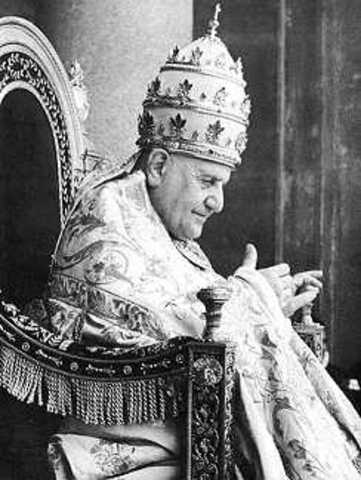
“We feel that we must disagree with those prophets of doom who are always forecasting disaster.”–Pope Saint John XXIII

Pope Saint John XXIII offered this prayer each night before bed: “Well Lord, it’s your Church, you take care of it; I’m going to sleep.” Similarly, when Napoleon Bonaparte confronted Cardinal Consalvi and threatened to destroy the Catholic Church, the Cardinal’s response was, “Your majesty, we, the Catholic clergy, have done our best to destroy the church for the last 1,800 years. We have not succeeded, and neither will you.”

These are quotes by men of deep faith, but they are also clear-eyed realists. There’s nothing childish about this faith. It’s an acknowledgement that there are powers at work in the world well beyond what we can touch. Our task is to figure out our assignment and then resolve to stay at our posts. The pagan heroes of old understood that fate was not something that they could determine. It was, however, theirs either to reject or to accept nobly and graciously. By accepting fate, heroes also accepted the relatively confined spheres of action in which it is enacted. Beowulf died slaying the dragon that was threatening his native Geatland (southern Sweden), but the dragon never was a serious threat to the lands of most other contemporary peoples. Peruvian dragons were, presumably, for Peruvian heroes to deal with. And in heaven, the great band of dragon-slayers will have its own special space at the bar where they will hang out and share stories from every corner of the globe.

Realism is central to thinking rationally about our options for acting. Hyper-responsibility inclines us either to grandiose, impossible projects, or to paralysis. Bipolar disorder happens when someone oscillates between these two unrealistic options. Some choose to escape this oscillation by a strategic retreat into chronic complaint. None of these approaches are reasonable, nor are they mature. Hidden fears are continuing to contaminate our thinking.

Faith is a gift from God. This gift frees us from fear, and it frees us to risk the good even when we might suffer for it. In our present climate, I suspect that many of us are tempted to choose lesser goods because, in a highly polarized environment, we fear failure, rejection, and ostracization. If we remember that our Leader leads by way of the Cross, we can let go of the notion that the suffering we experience is a sign of God’s rejection or our failure. Nor is it our responsibility even to change those who cause us suffering, any more than Christ felt it important to win over Pilate and the Sanhedrin.

Faith is often presented as the opposite of reason, but this is a mistake. The opposite of reason is reactive fear. Faith is the friend of reason. In fact, it is the precondition for the full flowering of reason.

Fear and Reason

May 18, 2020

Fear is a part of our bodily constitution. It comes with being a member of the animal family. In evolutionary terms, it has served us and our fellow animals well. Fear rapidly mobilizes our energies to face down danger or to flee from it. Both reactions give us a better chance of surviving immediate danger. This means that natural selection has favored the cultivation of the fear-response in us.

“Nothing resembles an angry cat…more than an angry cat.”–Anthony Storr, “Aggression” The breakdown of distinctions caused by fear, anger, and violence makes reasoning impossible.

For us rational animals, however, fear also presents specific dangers of its own. When I was in high school, my family had a beautiful but terrifying dog, a black Labrador/German Shepherd mix. She was a great guard-dog for a single-mother family, but her attack instincts were sometimes, let’s say, inappropriate. Once, when one of my mother’s piano students came for her lesson and rang the doorbell, our dog shattered the glass of the front door in warding off this thirteen-year-old girl student. Our dog frequently would get very upset about the presence of my male friends, though once she decided you were safe, she was as devoted afterward as she had been suspicious before. The difficulty for us is that there were few things that we could say to our dog to convince her that her responses were irrational. This is why Aristotle refers to humans as rational animals; among the members of the animal kingdom, we have learned how to temper the fear response by muting it, thinking through the situation, and then deciding whether fear is warranted. If it is, we have a larger repertoire of responses than fight or flight. We can make a plan that takes into account potential long-term effects of any hypothetical actions. Dogs, intelligent as they are, lack most of what makes this possible for humans.

In Catholic moral theology, we speak of the “age of reason.” Very young children do not yet have the full faculty of reason, and, as a result, tend to act on the promptings of feelings. One of the responsibilities of parents is to respond to the emotions of children in such a way as to facilitate the emergence of reason in the child. As parents know, the ongoing achievement of rationality is directly linked to an ability to manage one’s emotions, especially fear. Maturity is marked by rational reflection and reason-based decision making. Immaturity is marked by impulsivity and emotional reactivity. Another shorthand way to summarize this would be to say that the mature adult tends to respond to life, whereas the immature person tends to react.

When we permit ourselves to react, or even to overreact, we move in the direction of immaturity and even infantilization at times. Adult temper tantrums are no different than kid temper tantrums.

Mature persons are not therefore unfeeling, however. We will still have the immediate bodily responses to typical stimuli: fear, joy, anger, hunger, and sexual arousal. What will change about us is that we will know how to anticipate the trajectory of these feelings. We will know how to step back from immediate engagement, especially from those emotions that are most likely to lead to trouble if acted upon. The stimulus and its initial emotional response, in other words, will just become more information. That first impulse of fear, or perhaps more often, a sense of something being not quite right, is often a signal. Perhaps we need to pay attention to our surroundings a bit more perceptively in order to judge correctly what is going on. Some of us are better at making these detections in personal relationships, accurately reading body language, for example, to gauge what is being left unsaid. Others tend to excel in situational awareness, the ability to spot potential dangers before they arise, and to sense the presence of danger by knowing how to interpret inconsistencies in large-scale spatial arrangements. This is a good, mature use of initial emotional responses or “gut feelings.”

All of the above helps to explain some difficulties facing us as we try to make prudential responses to the pandemic. The worst-case scenarios present significant dangers to our whole way of life. As I wrote earlier, fear is not an unreasonable response to a number of possible futures. But if we allow fear to become chronic, if we continually marinate ourselves in the scariest projections, we run the risk of making our response less mature and less rational. In point of fact, we have, as we all know, lots of time to decide how to deal with the pandemic. We are not faced with a saber-toothed tiger ready to devour our children, a danger that requires a decisive, forceful response.

The quarantine that most of us are experiencing ratchets up chronic fear in another way. Every fellow human being is to be treated indefinitely as a potential vector and danger. That means that grocery shopping has suddenly been transformed into a dangerous activity. Every single action that requires us to come into proximity with someone else, we are told, is dangerous. This itself seems like a recipe for chronic fear and, therefore, unfortunately, immature responses to the actual threat.

George Orwell warned about the dangers of a breakdown in trust between fellow citizens, and the relation of this breakdown to the breakdown of reason.

This situation is clearly unsustainable and poses, in my view, much more dangerous long-term consequences. If we continue to treat all social interactions as fearful, we run the very real risk of infantilizing ourselves and making rational discourse impossible. When reason is not an available option, we are left only with power and force. Totalitarian governments know this, and so the cultivation of fear is an ineliminable feature of all dictatorships. Mind you, I am not saying that we are living in such an environment—yet. But at the very least, it seems important to me to treat the resumption of social interactions as a necessary goal, and to find ways to discuss with others in our extended families, neighborhoods, and workplaces, goals for making this happen as safely as possible. This will work most effectively if, in our personal lives, we are taking steps to cultivate our own rationality and maturity by reflecting regularly on what kind of information we really need (rather than letting hyperlinks lead us by the nose into what an anonymous person wants you to read, perhaps for motives of advertising revenue) to make informed decisions, and finding ways to identify the sources of fear and to assess them as we would any other threat.

Last of all, we should aim to hold before our minds eye the examples of heroes whose lives we wish to imitate. This is one reason that I urge our monks to read the lives of the saints frequently, and to make friends with them. The saint is a person of “heroic virtue,” and therefore, courage. In my next post, I would like to share with you my thoughts about why the saints are also models of rationality.  

Homily for Good Friday

April 10, 2020

Genesis tells us that man and woman are made in the image and likeness of God. Perhaps surprisingly, we read later in the same book that Adam and Eve wished to be “like” God in another way, gaining knowledge of good and evil. And this temptation to know what God knows led them to stretch out their hands to the forbidden fruit. The unhappy consequences of this action illustrate something that all of us know, that knowledge is often acquired by painful experience.

We are going through the very painful experience of relearning something that we easily forget, that there are real limitations to our knowledge. This is easy to forget because as our knowledge of the natural world has grown, we have been able to break through many barriers thought impassible.

Fifty years ago, many predicted that by 2020, we would not be able to feed everyone in the world. Yet, discoveries of high-yield technologies, better-quality fertilizers and other techniques allow us to feed almost eight billion people today more effectively than we fed three billion people in 1960.

With the click of a mouse, I can copy an electronic version of Saint Augustine’s City of God where it once took a scribe years to do the same work, at great cost to his eyesight.

But there are two dangers that accompany this increase in knowledge.

The first we all know. The human heart being what it is, any knowledge that can be used for good can almost certainly be used for destructive purposes. If we so wish, we can inflict more harm more efficiently than ever before.

The second danger is more elusive. With increased knowledge comes a sense of increased responsibility.

As we struggle to face the threat of COVID-19 together, it is tempting to point fingers. Someone should have known that this was coming, and they should have known how to stop it.

This isn’t the only example, just the one most ready to hand. We can point to other anxieties that come with increased knowledge. A hundred years ago, expecting mothers paid quite a bit less attention to diet, alcohol consumption, and other behaviors that potentially affect prenatal development. Today, mothers are sometimes reluctant to trust their own instincts and experiences when rearing a child, when there is so much literature on child development to be sifted through.

Even the doctors dealing with COVID-19 can face a similar problem. How responsible are you to stay on top of the fast-developing literature on treatment of COVID patients while dealing with the already-stressful situation of present patients? In the direction of this thinking, which is a kind of second-guessing, we start down that old path, desiring to possess the foreknowledge that only God enjoys, wanting to be like God in a way of our own desiring. However well-intentioned, however much we wish to protect ourselves, those whom we love, and our way of life, this attempt to control the world will eventually bring us to grief, a return to thorns and thistles.

Today upon the Cross, we see a different image. We see a man, but a man who is not merely the image and likeness of God, but is God. The contrast between Christ and Adam is one that continually exercised Saint Paul. In the chant that we sang just before the Passion (Christus factus est pro nobis obediens), we see Christ undoing the disobedience of Adam by his own obedience. Christ became obedient even to the point of death. This passage, from the second chapter of the letter to the Philippians points out that Jesus did not deem equality with God something to be grasped at. Instead he emptied himself and took the form of a servant.

This is what God looks like.

If we were to have the mind of Christ, if we were to consent to this self-emptying, we would become more godlike than we do with our efforts to control the world through our knowledge. In fact, we are all being invited to this today, to empty ourselves. Not only are we suffering the uncertainty of dealing with a novel disease, but we must confront this without being able to gather together as a Church, another hollowing out. If we can accept these invitations to self-emptying in faith, then we will be practicing the faith of Jesus Christ, the faith that brings true salvation—an eternal salvation.

This invitation is offered to us anew and in an especially poignant way this Pascal Triduum. It is extended to all the faithful, and to all humankind, in the example of Christ crucified. Let us then have the mind of Christ, to become truly like God, like the Son of God, in our willingness to entrust ourselves to the Father. And “let us confidently approach the throne of grace to receive mercy and to find grace for timely help [Hebrews 5: 9].”


Obergefell v. Hodges: Second Thoughts

June 30, 2015

In my “first thoughts,” I suggested that Christians interested in upholding the Church’s view of marriage might be better off letting go of a language of rights, since rights divide a coercive power from a class of victims. Turning this around we can also say that appealing to rights is a way of claiming the mantle of a victim and casting the Other as a victimizer. Either way, I think that it is clear that any sense of a genuine common good is undermined, subtly, by naked appeals to rights. Catholic social teaching depends on a clear sense of a common good, and a disciplined determination to live by it.

from Georges Rouault, Miserere

from Georges Rouault, Miserere

Here is where quite a bit of “Benedict Option” language also seems counterproductive, probably unintentionally. It sets the Opting party against the world. The language of separation tends toward a language of rejection. Now of course there are many attitudes in today’s dominant culture that a disciple of Jesus Christ must reject, and sometimes this rejection calls for disengagement from particular social structures. Repentance and conversion require new ways of living, and this means that behaviors must change. Conversion might require me to stop going to bars, or to movies, to the Freemason meetings, to my mistress’s apartment, and even to my place of employment. But the point of this is not to say, “Too bad for you, I’m outta here.” Rather, the penitent is aiming at identifying personal behaviors that are harmful and eliminating them.

If we actually believe in a common good, one of the best things that any one of us can do for others is to live a truly penitent and evangelical life. For when any one of us begins to live more vibrantly in Christ, all will benefit. Right?

And the inverse holds as well. When someone lives in contradiction to the truth, all suffer in some way.

Here is where I get to the Supreme Court ruling from three days ago. It is important to understand that what I am going to write needs to be read from a position of weakness (see my last post for an explanation).

This week’s Collect reads, in part:

grant, we pray,
that we may not be wrapped in the darkness of error
but always be seen to stand in the bright light of truth.

The bright light of truth! What a gift to know the Truth Who sets us free.

How deeply do we believe in the truth of the Church’s revelation? One of the dangerous habits of mind generated by our cultural emotivism is the assumption that any supposed statement of truth is in fact a statement of personal preference. From this perspective, all claims to truth are actually strategic claims, manipulating the hearer to feel obliged to accept what’s being stated. In other words, emotivism makes us all nihilists to some extent, perhaps a larger extent than we realize.

This conclusion, that many of us are closet nihilists, seems to me borne out by the fear, anger, and anxiety that I’ve encountered over the years when contemporary mores are discussed among Catholics. When, aided by the Church’s teaching, we identify actions as good or bad and we identify statements as true or false, how we happen to feel about the action or judgment makes no difference. Jesus Christ rose from the dead, and nothing changes about that if I happen to feel overjoyed about it or flatly unemotional. When we communicate the truth of the Faith, there is a tendency to add zest or urgency to our statements of truth by smiling, showing enthusiasm or worry or whatever. We act as if the Truth needs some goosing up, that it doesn’t stand on its own. But if the truth can’t stand on its own, it’s probably not true. [Digression: I personally see this as a weakness in the otherwise entertaining opinions penned by Justice Scalia.]

The other problem with emoting too much in discussions of truth is that the focus tends to be on ourselves and our feelings too much of the time. Thus many conservative responses to Obergefell v. Hodges that I’ve seen have focused on the dangers to Christians in the coming extension of the Culture War. Mind you, I think that these dangers are real, but again this reality isn’t going to be altered by me fulminating about it.

St. John Chrysostom, patron of preachers, champion of St. Paul

St. John Chrysostom, patron of preachers, champion of St. Paul

But the curious things about the Supreme Court ruling is this: if the resulting deformation of marriage really is about a false understanding of the nature of marriage, then the Court’s ruling will also harm precisely the persons that it is intended to help. This is just an inference from everything I’ve said so far. How will it hurt them? I have no clear idea at the moment. Nor do I wish to cook up a prophecy about what sort of harm is coming. But if this is true, then my concern should also be for my fellow Americans, providentially given to me by God for our mutual salvation, who embrace this new reality, even when they have the for the best possible intentions. Again, I would not attempt to walk up to a gay couple and baldly assert this and use it as grounds for them to renounce their marriage. I merely raise the issue to point out that it is possible to broaden our thinking about the situation in such a way as to keep from falling into the same adversarial stances that typify American public debates.

And even if it should come about that we suffer in some way for our beliefs, even this is more harmful, from the standpoint of faith, to the aggressor than to the victim. Here’s Saint John Chrysostom, the Golden-Tongued Wonder.

This is more than any one thing the cause of all our evils, that we do not so much as know at all who is the injured, and who the injurious person.

In focusing on the potential harm coming to those who oppose the redefinition of marriage, that is, to one segment of our world, we are liable to lose sight of the harm that we are all suffering together. Thus Pope Francis, “When our hearts are authentically open to universal communion, this sense of fraternity excludes nothing and no one.” [Laudato si, 92]

The Heart of Prayer is Thanksgiving

April 26, 2016

In a word, if we wish to pray, we will want to cultivate a habit of thankfulness. A thankful person sees the same things as an ungrateful person, but the two focus on different aspects of what they see. When we are ungrateful, it is often because we focus on what we wish we had and do not have. When we are grateful, it is often because we notice what we have, and what is often overlooked. Finally, when we reflect on the fact that we have been created, and that God has promised us eternal joy and backed this promise by the gift of His only Son, even when we are deprived of the things that we need in life, there is still scope for gratitude.

This cultivation of a thankful spirit finds beautiful expression in the last words of the great Fr. Alexander Schmemann: “Everyone capable of thanksgiving is capable of salvation and eternal joy.”

All of this is to say that the heart of our life is Eucharist.

On the Renunciations, Part 2

March 14, 2016

In the first post in this series, we noted that any desire to advance in a practice or craft required renunciations. Professional pianists must refrain from woodworking and gardening, since this will adversely affect their ability to use their hands. Great athletes avoid certain foods, and certain social situations. Clearly, it is important to renounce unhealthy behaviors and attitudes, but sometimes we must also renounce even good things for the sake of better. The shape of such renunciations depends on the goal.

So when St. John Cassian writes of the renunciations, he does so in his third Conference. These renunciations appear in a context. What is the goal that gives shape to these renunciations? What are they meant to make possible?  We will fill this in with more detail as we go along, but the primary goal for Cassian is the Kingdom of God. There are many ways to interpret this, and in fact, looking at the renunciations will allow us to understand better what God has planned for us in His kingdom.

Let me mention something surprising. The word “renunciation,” or abrenuntio in Latin, does not appear in the Bible. Cassian quotes the Bible something nearly two thousand times in  The Conferences, and makes reference to an astonishing 61 of the 72 books of the Bible. He is also noted for using Biblical terms where his monastic predecessors used Greek philosophical terms.

Cassian is a consummate traditionalist of his time. So his use of the word renunciation in such a prominent place in the third of his Conferences requires us to look elsewhere for this word. And indeed, we discover it in the ancient baptismal rite. The catechumen, having learned to correct his vices and how to grow in virtue, comes before the gathered Church at the Easter Vigil, and he is asked by the priest a three-fold question: “Do you renounce Satan? And all his works? And all his empty show?” Cassian’s renunciations are also three-fold, even though he himself doesn’t refer to the baptismal rite.

There is a second place where three renunciations take place, this time in the Bible, though the word “renunciation” is not used. On the First Sunday of Lent, from the earliest years of the Church, we have listened to the story of Christ’s temptations in the desert. Three times, Jesus says, “No” to the suggestions of Satan. Thus it is that Lent begins and ends with three renunciations.

Three Renunciations, Three Sources

Cassian Temptation in the Desert Baptismal Liturgy
Country/Wordliness Vainglorious Ambition Satan’s “pomp”
Kindred/Vices Gluttony=Gateway to Vice Satan’s works
Father’s House/Idolatrous Images Submission to the Demonic Satan


Instead, Cassian uses the call of Abraham as his template for the three renunciations. When God calls Abraham, still known as Abram at this point, in Genesis 12, he says, “Go from your country and your kindred and your father’s house to the land that I will show you.” Cassian then goes on to explain to us what is to be meant by 1) your country, 2) your kindred, and 3) your father’s house. I would like to discuss each of these three renunciations in my three talks. Keep in mind, however, that Cassian’s idea of the three renunciations is progressive, which is to say that each renunciation is more difficult and profound.

We should note that progress for ancient people did not necessarily mean a step-by-step growth whereby one stage was completely left behind as another was begun. Rather, all three renunciations will require a certain doubling back. I will deal with this reality, how the spiritual life is full of stops and starts, circling back, and leaps of insight, in the second talk.

Even so, it was generally acknowledged that human beings had purposes or goals. That we do not appear in the world randomly, but were made for a certain reason, and that this reason could be discovered. This was true for pagans such as Socrates as well as for monotheists like King David or Saint Paul. As the purpose of our life is gradually revealed, as we come to understand it with greater clarity, we make progress toward realizing that goal. That is to say, the achievement of our life’s goal moves from being a potential reality or a merely envisioned reality to being real.


For the purposes of this series of posts, I would like to define the Kingdom of God this way:

Joyfully receiving my life at every moment from God through others.

Notice the passive constructions. This is something that we must learn to allow to happen. The initiative is God’s. Our job is to clear away the blockages from our receptivity toward God. This is not as simple as it seems. This is because we discover what needs to be renounced after and as we discover ourselves loved and forgiven by God. The Apostles received the strength fully to renounce their lives only after Pentecost, only imperfectly before. Jesus taught them during His earthly life, but the full implications of His teaching were revealed only after He returned to them, offering them forgiveness.

We recently installed a new high altar and choir stalls. We had known for a long time that we needed the old ones replaced. But the impetus for the change was the gift of three beautiful icons by a good friend of ours. And this gift opened our imaginations to discover potential in our church building that we might not have thought of otherwise. Had we set out to put in a new altar and then add icons, we probably would have reduced our imaginations to the somewhat run-down church that we already knew. It took a gift from someone else to produce in us monks an awareness of just how run-down our church actually was! And this in turn helped us to notice where we could make real improvements to the building, rather than just patches.

So it is with Christ. When Christ dies on the Cross and returns to us, what He invites us to is not simply a patch on our old life, but an invitation to a completely new kind of life. But just as the beautiful icon suggested to us that it was time to start over in a sense with our church building, so too, the new life that Christ offers us is an invitation to die to the old self. To do this requires renunciations, laying aside our old ways of being, and allowing ourselves to be led into the land that God will show us.

***

You can find an index to all of the posts in this series here.

On the Renunciations, Part 1

March 11, 2016

This past week, I was invited to offer a day of reflection at St. Mary’s parish in Greenville, SC. The entire event was an edifying one, with beautiful liturgies and Stations of the Cross on Friday evening. Here, I plan to reproduce and perhaps expand a bit on the talk. This first post will serve as an introduction, as well as an index for future posts (See the very bottom of this page to see an updated listing of the installments in this series.)

greenville interior

The beautiful interior of St. Mary’s, designed by Fr. Michael McInerney, OSB, from Belmont Abbey

The organizer of the event suggested that I break my talk into three parts. Being of a neo-Medieval mindset, I immediately began to ask myself which triad of topics I should choose. The Holy Trinity? The Paschal Triduum? The theological virtues? Since it is Lent, and since I thought it important to touch upon monastic spirituality, I decided to reflect on the three renunciations, according to St. John Cassian. We are all familiar with the idea of “giving up” something for Lent. Why do we do this? Is there something to this other than a temporary regime of self-improvement?

I will mainly focus on Cassian’s third Conference, but a fuller explanation of the renuciations requires that we touch on other monastic literature. The whole text of the Conferences is on-line and can be found here. To find the third Conference, follow this link.

As we will see a bit further on, Cassian was a kind of spiritual grandfather to Saint Benedict, the founder of our order. Saint Benedict says that the entire life of a monk should be like a continual Lent. If this is so, perhaps we can turn this around and say that Lent for the laity should be a taste of monastic life. In other words, the renunciations that we will examine, while intended originally for monks and nuns, should be adaptable to those outside the cloister, if we give them a bit of effort. And I believe that making this effort will help us to enter more fervently into this year’s celebration of Easter.

It is worth noting at the outset that Benedict also mentions “joy” twice in his brief chapter on Lent. Therefore the renunciations are not meant to plaster gloomy looks on our faces, but to give us renewed clarity of purpose in our lives by clearing out everything harmful or even unnecessary to flourishing.

The truth that we all make renunciations in all walks of life. This is a matter of prioritizing and schematizing life. Renouncing certain possibilities does not mean that they are evil. Marrying one man does not make all other men bad; but it does require renouncing certain types of relationships with them. Choosing a college requires renouncing attendance at others, but does not render all other colleges deficient.

As a composer, I take inspiration from something that the great Igor Sravinsky once wrote, in The Poetics of Music. It is worth quoting at length:

The creator’s function is to sift the elements he receives from [imagination], for human activity must impose limits on itself. The more art is controlled, limited, worked over, the more it is free.

As for myself, I experience a sort of terror when, at the moment of setting to work and finding myself before the infinitude of possibilities that present themselves, I have the feeling that everything is permissible to me….Igor_Stravinsky_original

Will I then have to lose myself in this abyss of freedom? To what shall I cling in order to escape the dizziness that seizes me before the virtuality of this infinitude? … Fully convinced that combinations which have at their disposal twelve sounds in each octave and all possible rhythmic varieties promise me riches that all the activity of human genius will never exhaust… I am always able to turn immediately to the concrete things that are here in question. I have no use for a theoretic freedom. Let me have something finite, definite–matter that can lend itself to my operation only insofar as it is commensurate with my possibilities. And such matter presents itself to me together with its limitations. I must in turn impose mine upon it….

My freedom thus consists in my moving about within the narrow frame that I have assigned myself for each one of my undertakings.

I shall go even farther: my freedom will be so much the greater and more meaningful the more narrowly I limit my field of action and the more I surround myself with obstacles. Whatever diminishes constraint diminishes strength. The more constraints one imposes, the more one frees oneself of the chains that shackle the spirit.

If this is true in music, how much more in the Christian life! What are we doing to shackle the Holy Spirit. In our next post, we will hear from Cassian on this important question.

Below are links to the other posts in this series:

Part 2

Happy Thanksgiving

November 26, 2015

“O Lord, refresh our sensibilities. Give us this day our daily taste. Restore to us soups that spoons will not sink in, and sauces which are never the same twice. Raise up among us stews with more gravy than we have bread to blot it with, and casseroles that put starch and substance in our limp modernity. Take away our fear of fat and make us glad of the oil which ran upon Aaron’s beard. Give us pasta with a hundred fillings, and rice in a thousand variations. Above all, give us grace to live as true men – to fast till we come to a refreshed sense of what we have and then to dine gratefully on all that comes to hand. Drive far from us, O Most Bountiful, all creatures of air and darkness; cast out the demons that possess us; deliver us from the fear of calories and the bondage of nutrition; and set us free once more in our own land, where we shall serve Thee as Thou hast blessed us – with the dew of heaven, the fatness of the earth, and plenty of corn and wine. Amen.”

–Robert Farrar Capon, The Supper of the Lamb: A Culinary Reflection

Socrates vs. Nietzsche

August 31, 2015

[Note: The following is the first entry in my new category of “jottings.” These are totally random observations based in my reading for larger projects. They will probably be, for the most part, either technical or expansively allusive in character and unapologetically so. Regular readers might choose to skip these, but they are intended to provide background for what I hope will be more popular writing in the main posts of this blog.]

Plato and Aristotle, the central figures in "The School of Athens."

Plato and Aristotle, the central figures in “The School of Athens.”

Studies in classical philosophy often contrast Plato with Aristotle. Raphael’s School of Athens shows Plato pointing up toward transcendent reality, the realm of the forms, more real than what senses can perceive. Aristotle, while not exactly pointing down, does appear to be tethering the conversation to what “common sense” can perceive of the only world that we can be confident of sharing with other rational beings. Students of these two philosophers often take sides, preferring one to the other, as though Plato’s greatest student, Aristotle, either refuted or strongly corrected his teacher, or, on the contrary, sadly eliminated all transcendent reference from the joy of philosophizing.

The truth is more complex. What I would like to note is that champions of Aristotle, who use the great man’s teachings against Plato and Socrates, surely do so unjustly. Let me focus on the figure of Socrates, as he is known to us from Plato’s writings about him. When Socrates came on the scene in Athens, he posed himself as an opponent of “common sense.” Yes. But why? I think there were two related reasons. First of all, he opposed a complacent, unexamined use of what passed as common knowledge. This was highly problematic in the quickly changing political atmosphere of his time. Outdated and worn-out ideas lazily copped from Homer’s two masterpieces, The Iliad and The Odyssey did not fit the reality of a budding urban empire.

Socrates also recognized that such complacency in the world of ideas left the people of Athens open to manipulation by demagogues. Such manipulation was openly practiced by the Sophists, the loose school of rhetoricians who “made the worse appear the better reason.” Now, so as not to be too hard on the Sophists, let us note that among the changes in Athenian culture from the heroic age of Homer to the progressive world of Socrates’s day, was a growth in the use of impersonal law to settle disputes. The problems with the legal culture will be a later target of Plato’s, in one of his non-Socratic dialogues. In Socrates’s immediate context, he saw that this reliance upon customary law was not conducive to any attempt to examine truth itself. Many of Plato’s dialogues rehearse Socrates’s method: pick a fight with a Sophist and demonstrate that the Sophist can’t produce a coherent explanation of the actual meaning of the words he is using. In other words, demonstrate that the Sophist tendency is to use words as tools for the achievement of personal goals by using them to manipulate his hearers.

Now let me note here that the theme of manipulation is of a piece with emotivism. Alasdair MacIntyre says that emotivism entails that there be no distinction between manipulative and non-manipulative relationships. That is to say, in our world, sophistry has returned largely unopposed, though we are not often aware of it.

Back to my narrative: Plato recorded and inherited Socrates’s technique and attempted to further the pursuit of truth in his own way. His painstaking accounts of the drama of Socrates’s life and the drama of Athenian society did much to clear away the fog of fuzzy, self-serving, manipulative reasoning. Perhaps he faltered a bit when trying to pin the idea of truth to the transcendent realm of forms. But his work made possible Aristotle’s astounding success in generating a durable realism, or at least something like a technique for separating specious claims about the world from more verifiable claims.

Thus began the arc of Western philosophy, and it apparently continued until the advent of Friedrich Nietzsche. He set the tone for the dismantling of Western philosophy with his remarkable work The Birth of Tragedy. Historians criticize his handling of materials, but he was astute enough to vilify Socrates and locate a turning point in Socrates’s Athens. In Nietzsche’s understanding, Socrates’s thirst for genuine truth was either pie-in-the-sky naivete or perhaps a cynical manipulation that claimed for itself the mantle of truth–which at least the Sophists generally had the good taste to avoid. For Nietzsche, Socrates inaugurated a long desert in which Western culture imagined itself bound by truth, but in fact deluded by this claim into a hideous blindness.

I believe that Nietzsche was perceptive in this claim, though not in the way that he intended. His “Hermeneutic of Suspicion” and “unmasking” of the hidden motives behind appeals to “truth” accurately described, not Western philosophy as such, but rather the particular situation of late nineteenth-century European academe. In other words, Nietzsche was, quite against his intentions, calling attention to the fact that European philosophy had fallen away from its traditional vocation of furthering the durable realism that the founders–Socrates, Plato, and Aristotle–had initiated. And desiring to call a spade a spade, Nietzsche proposed that we go back to acknowledging that rhetorical manipulations are all that we have.

As I suggested, my belief is that Nietzsche perceived that claims to truth by his contemporaries in philosophy really were infected with the complacency that Socrates opposed. How did this happen? It was a slow process, but my own biases lean toward pinpointing the nominalist revolution of the fourteenth century as the beginning. I would also note that this has its roots in the thinking of William of Ockham, who is generally considered to be one of the originators of nominalism. This was at a time when the connection between the liturgical life and the university life was considerably weakened. I don’t exactly like to blame William, since he inherited a number of tricky problems that resulted from institutionalized in-fighting between Dominicans and Franciscans in the early fourteenth-century university. But it does seem here that the first break between words and durable meaning is introduced.

Leo XIII

Leo XIII

It is worth noting that Pope Leo XIII seemed to have a similar intuition as Nietzsche, and perhaps a more accurate awareness of the reality of the breakdown in philosophy. In his encyclical Aeterni Patris, he insisted that seminary education return to Thomas Aquinas, two or more generations before Ockham. This set the stage for the amazing insights of the “New Theology” of the early twentieth century. Alas, just as we were reaping the fruits of this greater theological realism, seminary educators turned their back again on Thomas (who is regarded even by the non-theologically inclined, as one of the greatest, if not the greatest, of the interpreters of Aristotle). I am not advocating freezing philosophy in one thinker or time period; ironically what Socrates, Plato, Aristotle, and Aquinas offer, if correctly understood, is not a complacent position of authoritative power, but a humble method for uprooting the false and lazy assumptions that steer us from the truth. And lazy thinking leaves us open yet again to manipulation by potentially unfriendly powers.

  • « Go to Previous Page
  • Go to page 1
  • Go to page 2
  • Go to page 3
  • Go to page 4
  • Go to page 5
  • Go to Next Page »

Blog Topics

  • Beauty (22)
  • Contemplative Prayer (61)
  • Contra Impios (2)
  • Culture (33)
  • Discernment (32)
  • Formation (16)
  • General (43)
  • Going to the Father (18)
  • Gregorian Chant (5)
  • Holy Spirit (7)
  • Jottings (27)
  • Liturgy (99)
  • Meditations on Heaven (4)
  • Monastic Life (59)
  • Moral Theology (53)
  • Music (18)
  • Scripture (60)
  • Silence (1)
  • The Cross (3)
  • Vatican II and the New Evangelization (21)

Blog Archives

  • April 2026 (3)
  • March 2026 (4)
  • February 2026 (3)
  • January 2026 (2)
  • December 2025 (6)
  • November 2025 (4)
  • October 2025 (2)
  • September 2025 (2)
  • August 2025 (3)
  • July 2025 (4)
  • June 2025 (4)
  • May 2025 (3)
  • April 2025 (4)
  • March 2025 (4)
  • February 2025 (3)
  • January 2025 (5)
  • December 2024 (8)
  • November 2024 (3)
  • October 2024 (9)
  • September 2024 (8)
  • August 2024 (9)
  • July 2024 (9)
  • June 2024 (8)
  • May 2024 (9)
  • April 2024 (4)
  • November 2023 (1)
  • April 2023 (1)
  • December 2022 (1)
  • October 2022 (1)
  • March 2022 (1)
  • February 2022 (1)
  • August 2021 (2)
  • June 2021 (1)
  • May 2021 (1)
  • April 2021 (1)
  • February 2021 (2)
  • January 2021 (1)
  • December 2020 (1)
  • August 2020 (4)
  • June 2020 (1)
  • May 2020 (4)
  • April 2020 (9)
  • March 2020 (4)
  • February 2020 (1)
  • January 2020 (1)
  • December 2019 (1)
  • July 2019 (2)
  • June 2019 (1)
  • May 2019 (1)
  • April 2019 (2)
  • March 2019 (1)
  • February 2019 (3)
  • January 2019 (1)
  • December 2018 (1)
  • November 2018 (2)
  • October 2018 (2)
  • September 2018 (2)
  • August 2018 (1)
  • July 2018 (2)
  • June 2018 (4)
  • May 2018 (7)
  • April 2018 (1)
  • March 2018 (1)
  • February 2018 (1)
  • January 2018 (2)
  • November 2017 (1)
  • October 2017 (1)
  • September 2017 (1)
  • August 2017 (1)
  • July 2017 (2)
  • June 2017 (2)
  • March 2017 (1)
  • February 2017 (2)
  • December 2016 (1)
  • November 2016 (3)
  • August 2016 (2)
  • May 2016 (2)
  • April 2016 (5)
  • March 2016 (2)
  • December 2015 (1)
  • November 2015 (2)
  • October 2015 (3)
  • August 2015 (10)
  • July 2015 (12)
  • June 2015 (17)
  • May 2015 (2)
  • April 2015 (7)
 
© 2026 Monastery of the Holy Cross
  • Accessibility
Web Design by ePageCity