Monastery of the Holy Cross

  • Home
  • About
    • Benedictine Life
    • History
    • Video Gallery
    • Et Incarnatus Est - The Prior's Blog
  • Visit Us
    • Guesthouse
    • Prayer Schedule
      • Christmas 2025
    • The Catholic Readers Society
  • Vocations
    • Monastic Experience Weekend
    • Formation
    • Oblates
      • Oblate Podcast
  • Solemn Vespers
    • Solemn Vespers for Corpus Christi
    • Chant
  • Contact
  • Donate

Articles under Liturgy

Homily for Corpus Christi

June 10, 2026

What goes into preparing the food that we eat?

Ten years ago, a man named Andy George decided to try and find out by making a chicken sandwich completely from scratch. This meant growing, harvesting and grinding wheat, slaughtering a chicken, collecting salt water to extract salt, growing and pickling cucumbers, pressing sunflower seeds to extract the oil to make mayonnaise, and, last but not least, milking a cow and making his own butter and cheese.

This process took a mere six months and cost Mr. George $1500.00. Even worse than the cost: the sandwich didn’t taste all that good, at least according to his less-than-amused family members, who shared it.

And of course, there still was quite a bit of work that predated Andy George’s foray into deep agriculture. He didn’t have to domesticate a cow or a chicken. He used an electric fan to winnow his grain and an electric blender to grind it.

What all of this says is that we are very dependent on a whole series of systems in order to eat well. In fact, it’s a kind of miracle that we can go to the store at all and buy bread, deli chicken slices, pickles and onions, mayonnaise, and cheese.

Every meal is a faint glimpse of human unity and cooperation, and unconscious yearning of men and women for a common, shared life.

By calling it a miracle, I mean to imply that behind it all is a mysterious God Who has made the human race in such a way that we can cooperate and provide for one another, with systems too complex for anyone to fully understand…except God Himself.

Every meal is a sign of God’s bountiful love. But since everything happens so routinely, we can easily miss out on the wonder of it all.

It is a good practice to take a moment before we eat to ask God to bless all the persons whose work made the meal possible: from the farmers to the cheese and bread factories, meat processing plants or butchers, truck drivers and grocers.

The Israelites, after they left Egypt, suffered a bit from the myopia that often afflicts us when it comes to eating. Egypt was one of the most sophisticated civilizations of the day, and this meant that they could provide a variety of foods for delectable consumption. The Israelites forgot that much of this luxury was produced on the backs of foreign slaves. We all have selective memories sometimes.

The bigger problem was their inability to trust that if God were to lead them forth, that He would know how to provide nourishment for them. He did this through the miracle of the manna, the bread that came down from heaven.

And Moses tells us that this sign was about more than making regular provision for the people. It was a visible reminder that we depend on God for everything. We live by God’s Word.

This is the same Word through Whom all things were made, and the same Word that became flesh to walk among us. The Greek term for Word is logos, and like the Hebrew word for Word, davar, it has a much broader meaning than simply “word”. Our English term “logic” derives from logos, so that when we say that through the word of God all things were made, we are saying that God’s creatures participate in a king of logic, a rationale, a purpose.

This is why things like food distribution can work in spite of the complexities being beyond human comprehension. All things are governed by God’s Word.

God oversees and underwrites our lives. I’ve already said that the fact that we are able to eat each day because of the manifold activities given by God for men and women to carry out is a kind of miracle. This is the case for the sustenance of our natural life. What we celebrate today is the sustenance of our supernatural life. The life given to us in baptism is now nourished and grows by the gift of the Holy Eucharist.

No longer do we discern God’s Word through the insights we get into the complex interaction of God’s creatures. Rather the Word comes to us very directly, Body, Blood, Soul, and Divinity under the appearance of bread and wine. We discern His presence by faith rather than by deduction.

It has long interested me that the elements consecrated at the Eucharist are not “natural” in the sense of being directly taken from the fields or vineyards. They are the product of human artifice, just like our everyday food. Someone harvests the grain, someone grinds it, someone adds water and bakes it until it becomes bread, a symbol of the entire human cooperative project. And then God receives and blesses this offering. Our project is no longer human only, but all of our natural human projects have now been taken up into the divine project of salvation, the reclamation of humanity from sin and dispersion.

Many grains and many grapes go into the production of the bread and wine that become the Body and Blood of the Only-Begotten Son of God. He is bringing unity out of our diversity, showing what true unity and cooperation are, and not only unity with our fellow men and women, but unity and cooperation with God Himself.

And today, we will take this message out quite literally to the world, maybe just a small portion of our neighborhood, but the symbolism is that of a grand cosmic vision. As we process with Jesus, we are a sign of His desire to gather all peoples into one. We will be a silent invitation to everyone we meet to return to God, to discover in Jesus Christ the answer to our deepest longings for life and love.

The one who feeds on me, says the Lord, will have life because of me.
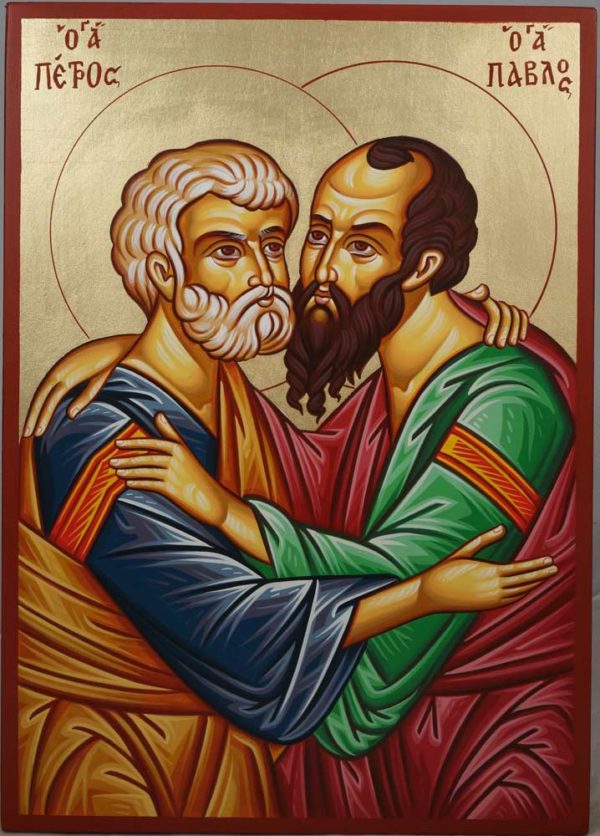
Homily for the Fifth Sunday of Easter

May 6, 2026

Every human being that ever lived was created for eternity with the God of infinite love. This is part of the Good News that Christians need to share with the world. And that’s because without the Gospel, this infinite longing that we have is easily converted into infinite suffering. Why is this? Because we seek to satisfy this longing with finite things. These can bring us a certain amount of joy, temporary satisfaction and comfort, but soon we begin longing again. As finite creatures ourselves, we cannot obtain the infinite on our own. As Cistercian Father Michael Casey has put it, seeking transcendence sounds great until you realize that it leaves you perpetually out of your own depth.

There are several common secular solutions to this human dilemma, our desire for transcendence and our utter inability to achieve it. There is the tragic option, to recognize the longing as real, and our intimations of transcendence are real. This is the Stoic or philosophical solution. The Stoic purifies his mind and heart and may even rejoice at the beauty of truth. But he knows that eventually it all comes to an end and he must surrender himself to death. His is a life without hope.

To such persons, Jesus says, “I am the Way. Be baptized into my Body, and I will carry you to heaven, to the eternal dwelling with My Father. For there are indeed many dwelling places there, and there is one for you. You cannot reach it on your own, but I have been sent by the Father to be the bridge, the Mediator. No one can come to the Father except through Me, and here I am, and I offer myself to you in the Bread of eternal salvation.”

This is the Way of Hope.

There is a second solution, that of transhumanism, as we call it today. Transhumanists want to use human intelligence and creativity to crack the code of human morality, to rewrite our genetics to reverse aging, to live forever in this world with no need of God. There is something desperate about this approach, and oddly, something anti-human, since to be human simply is to be a finite creature. Nor will it truly address the desire for transcendence, for the transhumanist will only extend biological life, remaining very much a human being, and therefore mortal, prone to accidents and the like.

To these persons, Jesus says, “I am the Truth. Before my Incarnation, you desired to be like God, but because you did not know the truth about yourselves, you attempted to grasp at divinity by eating of the forbidden fruit. In my Body, see the Truth of humanity, that your nature is compatible with the divine. This Truth unlocks every other truth, explains the universe, even the invisible world of spirits. The Truth is that you are my most precious creature. If only you would trust in me, you would have more than you even know how to desire.”

This is Truth that is sought by Faith.

There is a third attempt to deal with the aspiration for transcendence. I will call this strategy the aesthetic. This one appealed to me when I was younger because I was a musician. Several times in performance, I had the sense of being lifted up into some different realm of experience. Time slowed down. Interestingly, after those performances, I discovered that my fellow musicians had a similar experience, expressed in similar ways. There was a sense that we lived for those experiences, an experience of tranquility amidst change, a sensation of harmony with not only the other musicians, but with the audience and with nature itself. It was a feeling of being unusually alive.

But inevitably, the music ended. We would pack up our instruments and go home, rejuvenated for a while. We could perform the same piece a few days later with no particular effect. The poet and the prophet see the beyond and report it to the rest of us. If only we had the strength and acuity to reach it!

To these Jesus says, “I am the Life. Receive Me and receive true life, a spring of water welling up to eternal life. You have seen traces of Me in all things beautiful in all things harmonious, but I have come to give you Myself, the Life that can never be taken away, that never grows weary or dull.”

This is the Life of Love.

Whatever causes us restlessness is a sign of our thirst for God. Let us then take to heart what Christ is teaching us today: to know Him as the Way, the Truth, and the Life. Jesus, in rising from the dead and ascending to the Father has opened up a Way for us to cross over to our true homeland. Not only that, but in sending us the Holy Spirit, He has opened the eyes of our minds and hearts to see the Truth of all things, a Truth that had been obscured by human sin. And this Spirit is also the Giver of Life, Who desires to be the spark and inspiration of all that we do, that the True Transcendent Life of Christ may shine through our words and actions and bring many others to the rest that only God can give.

Silence (and Noise) in the City

April 22, 2026

As the weather warms up, we tend to keep our windows open, as we only have air conditioning in a few areas of the Monastery. This lets in more of the typical noise of the city. This time of year, more people are outdoors, so there’s more sound to start with. Sometimes I’ve been asked whether the noise causes problems for prayer. This question isn’t as easy to answer as it appears. Many “problems” in life are so only because we don’t have the insight to handle them properly. Perhaps if I were fully a man of prayer the noise wouldn’t be an obstacle at all.

As a general rule, I don’t find the noise to be distracting. Chicagoans are famous for being able to stop mid-sentence when the El trains pass by, then pick up where they left off. Noise is the baseline background to everything one does in the city. But more than that, noise is a sign of life. It happens because people are in motion, engaged in activity (admittedly not all of it edifying). We monks are here to serve just these people by our prayer and our witness to the joy of the Gospel. In a quiet way, literally, we offer an alternative vision of community and invite those around us to see the difference that Christ makes. The fact that our habits are radically different from the world around us is exactly what draws attention.

Homily for Good Friday

April 3, 2026

We have no king but Caesar.

The Gospel of John is full of irony. Sometimes the irony is amusing; sometimes it’s profound; sometimes it’s depressing. One of the more depressing ironies is the cry of the chief priests when Pilate presents them with Jesus after finding Him not guilty. They say, “We have no king but Caesar.”

To grasp the depth of the irony, it is helpful to return to the Book of Judges and the First Book of Samuel, which form one narrative together, giving us the story of Israel a thousand years before Christ. The Book of Judges ends with this statement: “In those days there was no king in Israel; every man did what was right in his own eyes.”

This is not a celebration of political freedom.

The people of Israel had reeled from one crisis to another, with God regularly intervening to save her. At the opening of the First Book of Samuel, the dangerous Philistines are becoming powerful. The people of Israel are growing increasingly fearful of this new political threat, and they demand that God give them a king, a strongman to fight their wars for them. The prophet Samuel warns the people that they will lose their freedom were they to submit to a king. A king would levy burdensome taxes, conscript their sons, build up a huge government bureaucracy. Perennial human problems!

In spite of Samuel’s warnings, God Himself agrees to appoint a king, eventually settling on David. Samuel’s predictions, however, quickly come true. On the whole, the kings of Israel found it impossible to avoid compromising entanglements with the gods of other nations. Israel was never the most powerful nation, and the world powers of the time dominated them, even exiling them. After God brought them back from exile, they became client states of the Persians, Greeks, and then the Romans, which is the background situation for the life and death of Jesus, Son of David.

The kingship in Judea had been suppressed for five hundred years at this point. But there were prophecies about a return of the King, the anointed one, who would free God’s people from domination by the Gentiles. And just last Sunday, Jesus allowed Himself to be identified as this Messiah, by riding into Jerusalem, the capital city founded by David himself, on a donkey, according to a prophecy of Zechariah the prophet.

And in fact, this is the closing of the circle.

When God agreed to appoint a king, He told Samuel that the people “have rejected me from being king over them.” In Jesus, we not only have a legitimate descendant of David, and therefore a legitimate heir to the throne, but we have God Himself, ready to take up His rightful place as the King of the people whom He had, time and again, delivered from her enemies.

Will they reject Him as king again?

The emotional background to this drama is fear. The chief priests fear the Romans. They also fear the mob and the consequences of a riot. Pilate is afraid of divine nemesis of some kind, which accounts for his reaction on hearing that Jesus claims to be the Son of God. He also fears the Emperor if things get out of hand. The disciples fear getting captured and punished by one authority or another, and so they run away.

When we are afraid, we are easily manipulated. This, by the way, is one reason the news is always negative. It serves a political purpose to keep large portions of the population anxious.

The choice that we all face at some point is here before Pilate, the authorities, and the mob. When we find ourselves anxious, will we choose God? Or will we demand a powerful man or ideology or movement to attack whatever is making us anxious? And what does it look like, exactly, to choose God?

Let’s admit that this can be a challenge. Because what God looks like on Good Friday is a condemned criminal humiliated by the powers of the world. Serving this God might not be quote-unquote “safe” in the normal sense of that term. But this is to limit ourselves to too narrow a field of vision. Jesus suggests this to Pilate when He says, “My kingdom is not of this world.”

Turning to God will not necessarily give us things that world deems desirable: fame, prosperity, power, comfort, safety. Still, trusting God will give us something much, much greater: victory over death itself. Fame, prosperity, and power will not deliver anyone from death, nor can any worldly power achieve it.

In conclusion, let’s close another circle.

For the chief priests to say, publicly, before Pilate, “We have no king but Caesar” is willingly to adopt the position of a slave—or at best a client serving the interests of a pagan power. My purpose here is not to assign blame, but to present frankly the temptation that we all face in this life.

I said that God will deliver us from death. What does this look like? Is this something that we wait around for, trying to build up credits with God in the time we have left? Where is this kingdom of God, and how do we get there to avoid slavery to the world?

Well, first of all, we have our Lord’s assurance that His kingdom is among us and within us. It is not far at all. On the Cross, He is showing us how to get there. He is opening the path through death to the Kingdom.

We follow, first of all, by being conformed to His death in baptism, by taking up our Crosses daily and following Him through death to life. This requires the eyes of faith, but it has palpable results. It gives us the freedom to live without fear, to accept whatever sufferings come our way, with peace and indeed joy, for they conform us to Christ and lead to His Kingdom.

As we celebrate the mysteries of Jesus’s Passion, Death, and Resurrection, let us ask God to open the eyes of our spirits to see anew the great love Jesus showed in becoming man for us and suffering for us. May it free us to let go of fear and find true joy in the Lord.

A Joyful Mystery in Lent

March 25, 2026

Today’s feast of the Annunciation can seem, at first glance, to be incongruous, falling as it does in the last weeks of Lent. While we are meditating on Jesus’ Passion, does it make sense joyfully to celebrate the Incarnation?

In fact, there are good reasons why this celebration falls precisely around the time of Holy Week each year. First of all, we might notice that in the Creed, the words “[He] became man,” are followed immediately by these words: “For our sake, He was crucified under Pontius Pilate. He suffered death and was buried.” Nothing is said about his teaching or healing ministry. We go directly from His birth to His death.

Medieval Christians had a lively sense that the purpose of the Incarnation was precisely that it allowed Christ to suffer for the forgiveness of our sins. And indeed, historians of the liturgy believe that March 25 was chosen as the date of the Annunciation because it was also believed to be the date of Good Friday. This followed a belief in the early Church that Jesus’s conception and crucifixion happened on the same date, nicely demonstrating their interrelation.

Homily for the Third Sunday of Lent

March 11, 2026

Human beings, like all animals, are creatures of desire. We desire food and drink, and we have this desire because we need nourishment to stay alive. And again, this makes us akin to other animals. While plants also need nourishment, they lack desire, properly understood, because they lack awareness of their need. Animals not only hunger but deliberately set off to find food.

In this area, what distinguishes us from other animals is that we can use our reason to determine how to satisfy our natural desires. We can even deliberately not eat, enduring hunger pains for some greater goal such as fasting or dieting. We can also use our intelligence to alter the food we get by cooking it, mixing ingredients, and so on, to produce something that tastes good.

We go even further, using meals to symbolize other desires. For example, we desire companionship and community. A decision to eat together is a decision to satisfy that higher desire. What the philosopher Aristotle discovered is that we have a tendency to rank our desires. He explained this at the beginning of his book on ethics.

When we see someone carrying out an action, and we ask him, “What are you doing?”, we expect that the reason he gives will point to a desire that he is attempting to satisfy.

“Why do you get up at 5:00 a.m.?”

“To get to work on time.”

Aristotle then points out that we can continue to ask, “Why?” to the answer.

“Why do you want to get to work on time?”

“Because I want to get paid and not laid off.”

“Why do you want money?”

And so on.

These chains of questions will always terminate at the one thing that Aristotle says we seek for its own sake, which is happiness. We don’t normally ask people, “Why do you desire happiness? What good is it?”

We all recognize this is a sufficient answer to any question about someone’s motive. If it makes you happy, go ahead!

Aristotle’s theory is pretty sound, but I also think that it requires some filling out. For example, he did not deal with an interesting phenomenon that we find in the Old Testament.

I’m thinking of the prophets. If we were to ask Jeremiah why he was continually criticizing the rulers of Jerusalem, it would be a stretch to show that he did this because he thought somehow it would make him happy. What he desired was something more like proper worship of God. If I could use the words of the Beatitude, he hungered and thirsted for justice.

Alright, with that as background, we look at today’s gospel. We see that, from one perspective, it is all about desire. Both the Samaritan woman and Jesus desire water. Both Jesus and the disciples desire food. And Saint John the Evangelist shows us how these desires point to a higher yearning in the human soul.

Jesus says to the woman, “If you knew the gift of God and who is saying to you, ‘Give me a drink,’ you would have asked him and you living water.” In other words, if we knew the gift of God, we would desire it.

What is God’s gift?

It is the Holy Spirit. Before the Son of God came into the world, would we even have suspected that it was possible to receive God’s Holy Spirit? I think yes and no.

There are stories from many ancient cultures in which a divine spirit enters a human being, making him or her capable of particular impressive deeds, such as the writing of poetry or the invention of writing itself. We say of the Holy Spirit that He has spoken through the prophets, that in some way, they were conduits of the Holy Spirit.

But what Jesus is promising to the woman at the well is something more profound, a permanent union of ourselves with God. This promise reveals to us that our desires for truth, justice, and beauty are in fact different ways of longing for God. That only God can satisfy, and He intends to do this for us in a way surpassing anything we can imagine.

How are we to respond to this offer from God?

Let’s go back to the gospel reading. When the woman is persuaded that Jesus has something of value to offer, she asks for it outright. And so we, too, should ask. Here, though, we should bear in mind that the gift that Jesus is offering will only be available after His death.

What Jesus does next is surprising: He gently talks the Samaritan woman into an admission of her own serial relationship failures. Is Jesus saying that He will only give the Spirit once she’s fixed all her problems?

No, the Catholic Church doesn’t teach that.

Also bear in mind that the woman still thinks that they are talking about water. Things change, however, when she realizes that Jesus is a prophet. This suddenly prompts her to speak about proper worship of God, a point of sharp dispute between Jews and Samaritans at the time.

Jesus says that God the Father seeks people to worship Him in spirit and truth. This is where God’s invitation points, that we learn to worship Him properly. What this means in the context of this homily is, once again, that God is the final terminus of desire, God is what we crave in our heart of hearts, whether we are aware of it or not.

And the expression of this desire is literally worship. The word worship is derived from the same root as the word “worth.” Worship is then that activity in which we acknowledge that which has highest value, God Himself.

This is what I said that the prophets like Jeremiah were desiring rather than earthly happiness. And it was, in some sense, the Holy Spirit that both satisfies that desire and inflames it. The reason that Jesus brings up the ex-husbands of the Samaritan woman is to help us see that we can’t obtain satisfaction of this desire for God without correcting our lower desires.

The longing for love that the Samaritan woman manifested in her many marriages was a sign that could have pointed to God but did not. At some level that is why the marriages didn’t work.

Jesus is healing her and recalibrating this desire, and it truly changes the woman. She goes from being someone avoiding the eyes of others to speaking directly and persuasively to them.

As we move toward the middle of Lent, what desires of ours point away from God, and how can we redirect them? Is there a hidden sin that I’m keeping from God and from my own scrutiny out of shame? And if so, how might Jesus’s gentle example move me to re-examine and heal my own past?

As we cooperate with God’s grace in this process of healing, the Holy Spirit will become more of a conscious companion. And what more could we ask for than that?

Dealing with the Lenten malaise

February 25, 2026

The opening days of Lent are often filled with enthusiasm, a sense of purpose and newness. But Lent is a long season. After a week or two, my own resolutions start to appear more difficult than I had anticipated. What I have found helpful in dealing with this typical Lenten malaise is to focus on simply carrying out the fast, or whatever other resolution I made, without much regard to any tangible “result.”

Aiming at a result is a temptation of Lent. The truth is that we are seeking to grow closer to God, a God who is infinitely greater than anything we can imagine. We can’t really know what a better relationship with God is like. Instead of tracking my weight when I fast, I simply abstain from a meal, or from meat, without asking what it’s for, other than that I pledged to do this for God. Similarly, we can’t know for certain how any alms that we give will be used. Most of all, we can’t know ahead of time what results will come from prayer.

Once we have made the simple resolution to carry out our Lenten penance, we can take a more objective view of how these practices, recommended by Jesus Himself, subtly change us. They challenge me to identify and renounce a tendency toward complaint or victimhood. They help me to discover faults that I hide by eating nice food, buying nice things, and enjoying entertainments instead of prayer. Here is where the real work of conversion takes place. Let’s not waver in our resolutions!

Now Is the Acceptable Time!

February 18, 2026

“Behold! Now is the acceptable time; behold, now is the day of salvation! [2 Corinthians 6: 2]” We sing this text from Saint Paul every Sunday morning during Lent. Paul’s impassioned exhortation reminds me of the words of another Apostle. Saint Peter, in his first “homily” on Pentecost morning, says to the crowd, “Let all the house of Israel therefore know assuredly that God has made him both Lord and Christ, this Jesus whom you crucified [Acts 2: 36].”

In both cases, the Apostles Peter and Paul speak with great urgency. An immeasurable change has just occurred. A man has been raised from the dead and taken up into heaven. Now is the time to act: for Saint Paul, “We beseech you on behalf of Christ, be reconciled to God [2 Cor. 5: 20]”; for Peter, “Repent and be baptized [Acts 2: 38]!” This is our chance to make things right with God.

Can we find this urgency in Lent? Lest we think that the acceptable time has come and gone,we might first note that Paul is writing the Corinthians perhaps twenty-five years after the Resurrection. The acceptable time is always now. The Church dramatically and starkly moves us to action in the liturgy of Ash Wednesday. To dust we shall return, at a time that we cannot yet know. There is no time like the present to repent. In just over six weeks, we will re-energize our baptisms by renewing our promises to serve God and reject evil. What if, in the intervening time, we were able to welcome God’s grace so as to be more saint-like when we pass through the darkness of Good Friday to the light of Easter?

There is another reason for urgency. We are discovering more and more each day, perhaps to our dismay, just how badly in need our world is of moral and spiritual renewal. The extent of evil in the world can be demoralizing. This Lent is a good time to offer our own acts of self-denial for the reparation of the harms done. The power of two billion Christians doing acts of penance and praying fervently is a good place to start tipping the scales back. We are living anew the need to “repent and be baptized,” to be reconciled to God, not for our sake only, but for the sake of the whole world. May God grant us all a holy Lent!

The Epiphany: God shines forth

January 8, 2026

In the Catholic Church, the season of Christmas extends through the Feast of the Baptism of the Lord, which we will celebrate this coming Sunday. The Baptism, in turn, is connected with the Epiphany, which most Catholics celebrated last Sunday.

We might mistakenly think that Epiphany just happens to be the time to commemorate the long trek of the Magi to Bethlehem: a touch of exoticism, perhaps even multiculturalism. Certainly we have multiple reminders in this week’s liturgy that the Epiphany marks the revelation of the mystery of the inclusion of the Gentiles.  But Church tradition sees in it something more profound, a truth indicated by the very name Epiphany, or “shining forth.”

Imagine that someone deposited a million dollars in your checking account. You would suddenly become a millionaire, but if this benefactor didn’t tell you he was doing this, you wouldn’t know. At some point or other, a lawyer or banker would share with you this good news. Suddenly, you would have the opportunity to live like a millionaire, which you couldn’t really do if you didn’t know you had the money.

At the Incarnation, the Divine Logos, by becoming man, by consenting to our mortal state, really and truly redeemed us. But we could not participate in this regeneration if Christ’s divine nature had not
been revealed to us. We could naturally believe that God is everywhere, we could trust God and hope in God, but in the Epiphany we have something greater than this: we see directly what God is doing, for He appears in our human form.

Much of what He does is what any person does: He’s born, learns to walk and talk under the guidance of His parents, learns a trade, makes friends, eats and sleeps, reads, works, recreates. But now we see God doing all these things, and in turn, all of these human activities become means of sanctification and union with God.

This shining forth extends into the liturgy. We can now observe all aspects of the liturgy and see God at work, using architecture, iconography, song, poetry, vesture, ritualized movements and gestures, bells, incense, wood, marble, silk, wax, oil, water, wine, and bread.

These have all been imbued with spiritual depth because of the Incarnation. But it is the mystery of the Epiphany that unlocks these depths, that invites us to use our senses to mount heavenward upon material scaffolding.

The third traditional mystery of the Epiphany is the changing of water in wine at Cana. Within the water all along was the potency to be wine, but until our Lord responded to Mary’s plea, we couldn’t see it. Now all of the formerly pallid and mundane circumstances of the world can suddenly leap to life, like an old black and white film colorized.

Anyone could have followed the star to Bethlehem. In other words, this appearance and shining forth was not yet like the Second Coming, like lightning flashing across the sky. It was possible to miss the signs.

The Magi, it is often said, were probably astronomers, those tasked with mapping the heavens and predicting the movements of the planets, sun, and moon, and of noting disturbances like comets. These signs were understood to be communications from the gods.

So the Magi were already watching, seeking a sign and communication. And when they received it, they responded by reverent worship and pilgrimage.

How much time do we spend watching for God and listening for His instructions? It is possible that my own distractions have caused me to miss the star, or perhaps my own attachments have kept me from setting off to see where it leads.

That you are reading this suggests you are trying to be attentive. May God send forth His light and truth into our hearts today, that our awareness of His love and salvation may change our lives.

Homily for Christmas Eve

December 27, 2025

The entrance of the Son of God into the world is the most consequential event in all of history. Whatever we previously thought it meant to be human is fundamentally changed—very much for the better—by the discovery that our nature is completely compatible with God’s nature. Whatever we thought it meant to be God is also changed—and again, this change is for the better—because we now know that God is love, that God is communion. And of course, these discoveries about the two natures of God and man are an improvement over whatever went before simply because they are also true.

We often say that Jesus became like us in every way except for sin. And this is undoubtedly true, well-attested in the Scriptures and in the Tradition. But this qualification about sin obscures something of earth-shattering importance: sin is not natural to human beings; sin is a corruption of human nature. I will return to this in a moment, but for now, let us note that human nature is compatible with the divine nature, so long as that human nature is freed from sin.

When I said a moment ago that the Incarnation changes our knowledge of God, we should note that it is a change foreshadowed by God’s history with the human race. There are two aspects of this history, at least as I would like to tell it to you this evening. The first is the gradual realization of human beings that God is utterly transcendent. This realization was quite an achievement; most cultures are content to have a provincial idea of God. Ancient peoples were fine with there being multiple gods, and were apt to switch allegiances when one god seemed more powerful than another. It is the genius of two different cultures, the Jewish and the Greek, that they gradually came to understand that for God to be truly godlike, there could only be one, and this God must be somehow greater than the universe. When I mention Greek culture, really mean a small, radical subculture of Greek philosophers who derived the notion of monotheism.

Such a God is terribly powerful, and yet both the Jews and Greeks intuited that God is also just and true and therefore is not given to arbitrary displays of power. Here, though, is where the two cultures diverge. For Greeks like Aristotle, God withdraws into an inaccessible solitary bliss. For the Jews, God is puzzlingly close to the downtrodden, exiles, widows and orphans. They knew this because they experienced it. The Jews were conquered in turn by the Babylonians, the Macedonians (after being liberated by the Persians), then by the Romans. We hear this evening that Joseph and Mary needed to travel to Bethlehem to satisfy the
taxing strategy of Caesar Augustus. They are an occupied people at the moment that God appears as a child of a Jewish woman.

Throughout all of these tragedies and disappointments, God did not abandon His people, and this suggested that God was somehow a God of love. This was abhorrent to the Greeks. Love makes us vulnerable, and gods by apparent definition, can never be weak or vulnerable, and certainly not the supreme God. Love seems to imply that we need someone else, and God cannot need anything.

And so when we peer into the manger tonight and see God, the Son of God, as a vulnerable infant, dependent utterly on His Mother for sustenance and nurturing, this is a radical discovery about God, that He really loves us so much that He is willing to offer Himself to us, to placed in our arms, on our tongues. This is, strangely, who God is, and yet when we think of it, it rings true. It somehow confirms what we had not dared to hope, that all of creation, good as it is, beautiful as it is, is yet gratuitous, a grace a gift from a God Who loves us, and made us for Himself. He is not a God Who dominates, Who pulls rank. He is not first of all a scold, a gaslighter Who claims to love us while pointing out our every flaw. He is love pure and simple, vulnerable and waiting for us to say, “Yes, I love you, too.”

All of these insights we could derive from the Christmas story. But what about our response? Is the Incarnation something we celebrate today because it happens to be the anniversary of Jesus’s birth? Is it something that God did once upon a time, and now He no longer Incarnates Himself? Clearly this isn’t the case, and here is where I return to a thread I left off a few minutes ago. I said that sin is a corruption of human nature, and we know this because the perfect union of the human and the divine is in a sinless man. Jesus is not an isolated example of sinlessness. He is the beginning of our sinlessness, our union with God. In the words of Saint Athanasius, “God became man so that man might become God.” We are invited to follow the example of the Virgin Mary, and by the invitation He gives to us in baptism, to welcome the life of Christ in our hearts, to be transformed by love, and, let’s be honest by vulnerability, that sin might be rooted out of us, that we might die to ourselves so as to live the divine life of Christ. This can be a scary proposition for sure, but this night we have this assurance from God: He loves humankind so much that entered completely into our human world, with all its typical concerns, struggles, joys, heartaches,
boredom, insight, whatever we experience as human beings, Christians experience with God as our eternal partner in love.

  • Go to page 1
  • Go to page 2
  • Go to page 3
  • Interim pages omitted …
  • Go to page 11
  • Go to Next Page »

Blog Topics

  • Beauty (23)
  • Contemplative Prayer (67)
  • Contra Impios (2)
  • Culture (37)
  • Discernment (36)
  • Formation (20)
  • General (43)
  • Going to the Father (18)
  • Gregorian Chant (5)
  • Holy Spirit (7)
  • Jottings (27)
  • Liturgy (101)
  • Meditations on Heaven (4)
  • Monastic Life (63)
  • Moral Theology (57)
  • Music (18)
  • Scripture (62)
  • Silence (1)
  • The Cross (4)
  • Vatican II and the New Evangelization (21)

Blog Archives

  • June 2026 (2)
  • May 2026 (4)
  • April 2026 (3)
  • March 2026 (4)
  • February 2026 (3)
  • January 2026 (2)
  • December 2025 (6)
  • November 2025 (4)
  • October 2025 (2)
  • September 2025 (2)
  • August 2025 (3)
  • July 2025 (4)
  • June 2025 (4)
  • May 2025 (3)
  • April 2025 (4)
  • March 2025 (4)
  • February 2025 (3)
  • January 2025 (5)
  • December 2024 (8)
  • November 2024 (3)
  • October 2024 (9)
  • September 2024 (8)
  • August 2024 (9)
  • July 2024 (9)
  • June 2024 (8)
  • May 2024 (9)
  • April 2024 (4)
  • November 2023 (1)
  • April 2023 (1)
  • December 2022 (1)
  • October 2022 (1)
  • March 2022 (1)
  • February 2022 (1)
  • August 2021 (2)
  • June 2021 (1)
  • May 2021 (1)
  • April 2021 (1)
  • February 2021 (2)
  • January 2021 (1)
  • December 2020 (1)
  • August 2020 (4)
  • June 2020 (1)
  • May 2020 (4)
  • April 2020 (9)
  • March 2020 (4)
  • February 2020 (1)
  • January 2020 (1)
  • December 2019 (1)
  • July 2019 (2)
  • June 2019 (1)
  • May 2019 (1)
  • April 2019 (2)
  • March 2019 (1)
  • February 2019 (3)
  • January 2019 (1)
  • December 2018 (1)
  • November 2018 (2)
  • October 2018 (2)
  • September 2018 (2)
  • August 2018 (1)
  • July 2018 (2)
  • June 2018 (4)
  • May 2018 (7)
  • April 2018 (1)
  • March 2018 (1)
  • February 2018 (1)
  • January 2018 (2)
  • November 2017 (1)
  • October 2017 (1)
  • September 2017 (1)
  • August 2017 (1)
  • July 2017 (2)
  • June 2017 (2)
  • March 2017 (1)
  • February 2017 (2)
  • December 2016 (1)
  • November 2016 (3)
  • August 2016 (2)
  • May 2016 (2)
  • April 2016 (5)
  • March 2016 (2)
  • December 2015 (1)
  • November 2015 (2)
  • October 2015 (3)
  • August 2015 (10)
  • July 2015 (12)
  • June 2015 (17)
  • May 2015 (2)
  • April 2015 (7)
 
© 2026 Monastery of the Holy Cross
  • Accessibility
Web Design by ePageCity