Inevitably, mission within the Church will require making an offering of ourselves to God. The Virgin Mary presents the child Jesus in the Temple in order to fulfill the requirement of the Torah that each first-born son must be given to God. This is a reminder that God spared the first-born of the Israelites, ransoming them from Pharaoh. In Christ, then, the Church makes each of us an offering to God. This is perhaps best experienced when the precepts of the Church prove difficult, when fasting or tithing or adhering to moral teachings gives us reasons to ‘go where we do not choose to go’. This act of faith, the interior oblation of the will, is the ‘obedience and not sacrifice’ that is acceptable to God.
Articles under Contemplative Prayer
Incarnational Meditations on the Rosary: The Nativity
Obviously, Christ’s birth corresponds in one clear way to baptism again; but in the images that I have offered so far, we see that a time comes when we are no longer nourished passively within the Church. We must venture out into the world, still as children, perhaps, but with an eye toward mission. As the Father sent Christ into the world, so does Christ send us. This mission does not mean that we are separated from Christ, but it does mean fully accepting our responsibility for the Church, for spreading the faith and giving witness to God’s love.
Incarnational Meditations on the Rosary: The Visitation
This is perhaps the easiest mystery to interpret ‘ethically’. Meditations on the Visitation typically offer Mary as a model of selfless service to others in need, even when our own needs are real. That surely makes for an edifying reflection. In this series, however, I would like to go to a mystical level. Where is Jesus Christ in the Visitation, and how do I recapitulate His life?
If we are always being nourished in the womb of Mother Church, do we consent to be carried along with her? To be identified with her, not only in good works, but even when it seems to be at cost to ourselves? When others, in the role of Elizabeth and John the Baptist, see us, do they point to us as examples of the Church’s gifts and nourishment? Or do we merely give the impression of belonging to a voluntary organization, one that perhaps takes the man Jesus as a role model, but does not actually make Christ present?
Incarnational Meditations on the Rosary: The Annunciation
Mary, hearing the Word of God as spoken by Gabriel, said, “Yes,” and the result was the Incarnation of the Word within her. We participate in this mystical reality when, in our baptisms, we say, “I believe.” The life of Christ is conceived mystically in our hearts, and we are conceived in the womb of the Church. Like the life of an unborn child, our spiritual life needs the nourishment of the Church’s sacraments and teaching, so that we will eventually grow to maturity in faith. How does my life change when I truly and inwardly consent to the gift of faith? How do my actions change when I recognize the presence of Christ within?
Incarnational Meditations on the Mysteries of the Rosary: Introduction
[Today I am embarking on what I hope will be a series of meditations on the mysteries of the rosary, from an ‘incarnational’ viewpoint. This first post will serve as an introduction to the series.]
What do I mean by an ‘incarnational’ meditation?
In fact, I mean to communicate several interlocking ideas, with the intention of countering a root difficulty in modern spirituality, our struggle with the concept of communion. We bristle—at some level, at least—at the notion of communion these days, whether it be with God or with the Church. There are many reasons for this. I suspect that a main problem is fear: fear that communion will mean losing ourselves, opening ourselves to ‘inauthenticity’ or, worse, being used by those who would claim to desire communion with us but in fact seek to dominate, to stamp out the uniqueness that each of us possesses by divine grace.
What does this leave us with, spiritually speaking? Well, there is a tendency to reduce Christian spirituality to a kind of ‘do-gooderism’, a series of ethical exhortations and practices and prayers. The purpose of these things—when they really do take place—is for God to communicate (just enough?) grace to allow us to do some good in the world, or at least be assured that we are not completely depraved.
Now, good works are not to be disparaged, and Christians are obliged to practice them. But we stumble when we notice that there are many persons in the world who achieve good works without being Christian. So if Christianity consists in showing that we are nicer and kinder than others, we founder on the empirical reality that this is, alas, often enough not the case. Here I should insert, in keeping with the overall goal of this proposed series of posts, that meditations on the mysteries of the rosary tend, in my experience, exactly toward an ethical model: we imitate Christ or Mary in order to become ‘better people’. This, in itself, has much to recommend it, but at some point this tack will, I believe, reveal its limitations in bringing us closer to the mystery of what it means to be Christian. What, then, does actually separate us as Christians from others in the world?
The answer is baptism: in baptism, we receive the very gift of God’s own life. In this communion of the divine and human in our own hearts, we recapitulate the reality of the Incarnation of God’s Word in the womb of the Virgin Mary, and indeed all the mysteries of the Life of Christ. We do not merely ‘imitate’, if we mean by this an effort (often conceived of as our own effort) to do things that we think Jesus would do. Imitation, in modern parlance, has something of a bad name. ‘Imitation’ wool or leather means ‘inauthentic’, a rip-off of something of superior quality. But when St. Paul exhorts us to “become imitators of me, as I am of Christ” [1 Cor 11: 1], we might hear that we are two steps down on the ladder of sanctity even before we begin. But Paul’s own imitation of Christ was so intense that he was able to become alter Christus, another Christ. Let me allow St. Gregory of Nyssa to emphasize this point for me:
“[Paul imitated Christ] so brilliantly that he revealed his own Master in himself, his own soul being transformed [my emphasis] through his accurate imitation of his prototype, so that Paul no longer seemed to be living and speaking, but Christ Himself seemed to be living in him. As this astute perceiver of particular goods says: ‘Do you seek a proof of the Christ who speaks in me?’ [2 Cor 13: 3] and: ‘It is now no longer I that live but Christ lives in me. [Gal. 2: 20]’”
—On Perfection, FOTC 58, trans. by Virginia Woods Callahan
What we have the privilege of being, already in this life, is the very Body of Christ alive and sanctifying the world. To do this, good works are necessary, but we also must be ‘renewed in mind’, not that we might be the only persons in the world who do good, but that we “may prove what is the will of God, what is good and acceptable and perfect.” [cf. Rom 12: 2] Being renewed in mind requires meditation, training the mind to see reality in a way different than we do by the sloth of habit. The Mysteries of the rosary have proven over many centuries to be a most efficacious means of meditation, especially for the laity. But meditate we must, not only on what we ought to do to improve ourselves with God’s grace, but to come to the understanding of the hidden growth of Christ within us. In living out the life of Christ in our imaginations, guided by the tutelage of His glorious Mother, the Virgin Mary, we attune ourselves to the quiet unfolding of grace in our lives, and are thus able to cooperate with grace more readily and gratefully. We no longer carry out good works to justify ourselves or salve troubled consciences, but truly as co-operators with Jesus Christ, alive in our hearts and present to the world in our actions.
The Holy Triduum
We have arrived again at the holiest time of the Church’s Year, the annual celebration of the Paschal Mystery, our Lord’s Passover. It’s hard for me to believe that this will be my 27th Triduum at the monastery. The liturgy for this holy time can be bewildering when we first encounter it, but also exhilarating–and for the same reason. Everything is new, slightly disorienting. Time is suspended. Melodies and rituals suddenly appear that remind us of our first childhood memories of Easter.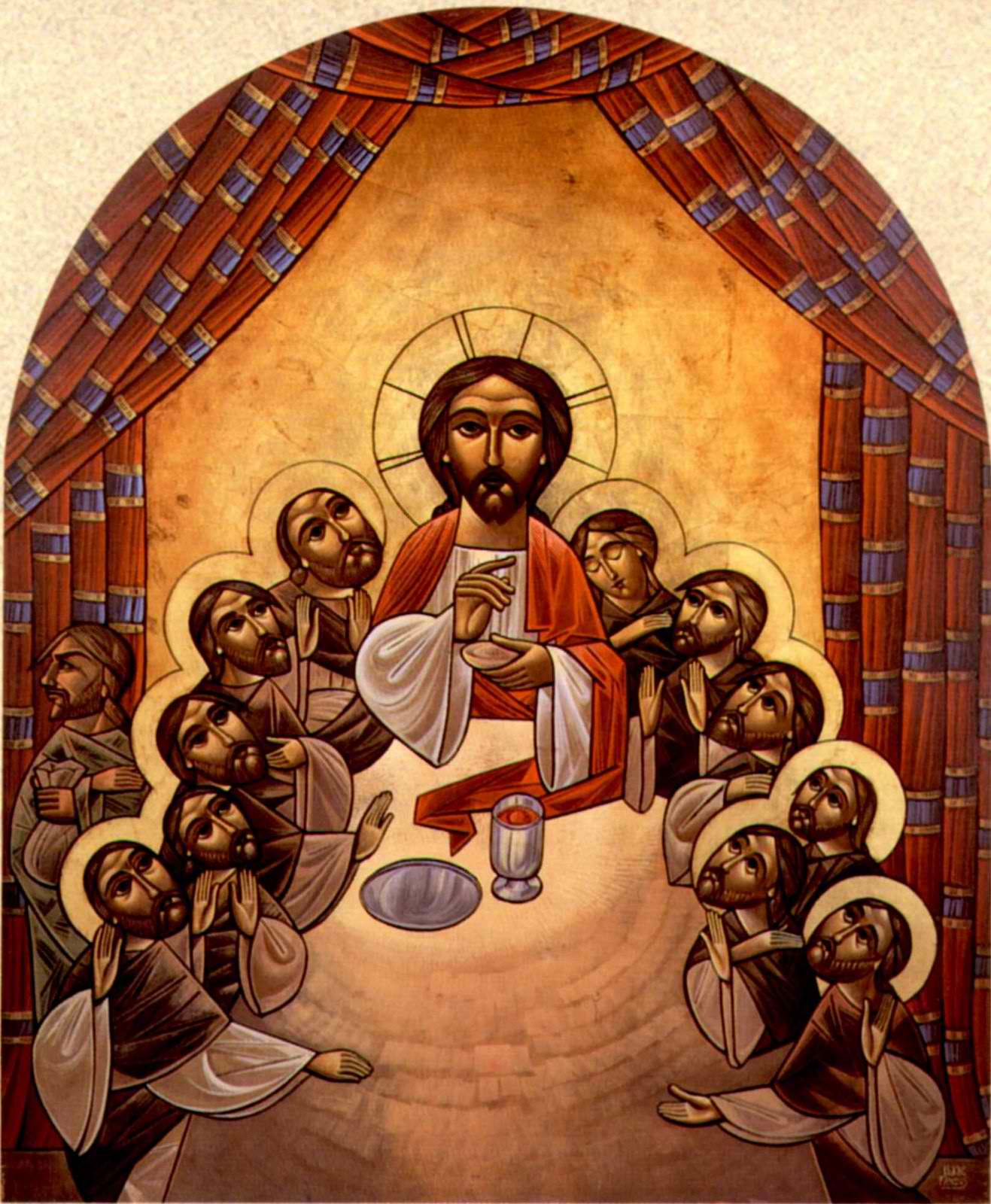
Over time—and this is especially true for monks who must study the liturgy and practice it regularly—the ceremonies become more familiar, even if they remain special to this time of year. For some of us, there is a temptation to a bit of boredom—the old feelings no longer emerge with the same intensity. Every Triduum features a liturgical blunder or two–sometimes the same one many years running, and this can tempt us to cynicism. But these temptations should be dealt with in the same way that we deal with every temptation: with resistance. When we begin to understand the liturgy, not as a prompt for good and edifying feelings, appropriate as these might be, but as central to our permanent identity as children of God, we can transition into a deep sense of belonging to Jesus Christ and His Church. This identification and belonging will remain with us and inform the rest of our lives as Catholics throughout the year.
Once again, this applies especially to monks and nuns, who have espoused themselves to Christ. The transition of which I am speaking is analogous to one that we see in certain married couples. They begin their lives together with excitement, expectation, even a kind of infatuation with each other, and the joy of having been loved and accepted. There are new experiences of owning a home, of pregnancy, childbirth, school, in-laws, new family rituals at Christmas, and so on and so forth. This gives way eventually to routines, and as the new and exciting becomes the familiar and dull, there is a risk of each spouse focusing on the small annoyances of any relationship with inherently limited and even flawed persons. There are heartaches with children who suffer health problems, disappointments with careers and there are compromises. The temptation is to boredom and even a sense of resentment. But if this temptation is resisted, what emerges is the beauty of belonging to one’s spouse, of totally identifying with that person with whom I have made a lasting covenant, and struggled to live those vows in fidelity. These are the couples who can sit together for long periods of silence, simply content to be with their “better half,” appreciating the presence of the long-beloved.
The Holy Triduum is like the Church’s wedding anniversary, the annual reminder that we have been espoused by the great Bridegroom Who laid down His life for us, Who poured out His Blood to cleanse us and make the Church a worthy Bride for Himself, spotless and beautiful. When this reality is newly embraced, it can move us to great torrents of emotion. It can so move us even after many years. But it can also carry us away to a different kind of experience, that of profound and peaceful contemplation, the silent adoration of the Holy Trinity, to Whom be glory and honor forever. Amen.
The Mystery of Christmas
I have received many positive comments about the article that led our newsletter for Advent, so I would like to share it with a slightly different readership. I will preface this with a few more thoughts of Christmas, and why this celebration led me to my vocation. What gives coherence to the meaning of Christmas for me is the deep mystery of life itself. How is it that we–each of us a self, an “I”–observing the world and “All things counter, original, spare, strange; [Hopkins]” see things similarly, see things differently, see and understand anything at all? How often do we stop and wonder at it all? Something about Christmas always stopped me in my tracks and forced these questions upon me. The answer to this mystery is not the solution to a puzzle, but the sheer gift of love, of shared life and wonder. At the center of all that it, is a God Who wishes to be included in all things with us, our joys, sufferings, our boredom, weariness, excitement, community, loneliness, the whole labyrinth of life that each of us experiences. And in sharing the beauty of all that He created, He does so in most unprepossessing way possible, as a poor child of poor parents in a poor village, but rich in wonder and observation (read any of Christ’s parables and see how He never outgrew the child’s power of noticing things). We need not cross the sea to discover mystery–it is right in front of us and opens the way to participation in the Source of life.
Merry Christmas!
[The article from our newsletter, entitled “Christmas and Everyday Life”]
One of the brothers recently asked me if there was a particular Christmas song that evoked strong memories for me. I couldn’t really answer the question because there are many such carols, in addition to the sublime arias and choruses of Handel’s Messiah and the magical dances of Tchaikovsky’s ballet The Nutcracker. I eventually settled on one carol, not because it is my favorite, but because it somehow summarizes the importance of Christmas to me: O Little Town of Bethlehem.
With a bit of imagination, the music of this lovely carol takes me back to decorating the house in preparation for the holidays. I always wanted to help set out the traditional nativity scene as well as the Christmas “village,” a tradition picked up from my father’s Polish family. We had pieced together this village over several years, and it included tiny houses, into the backs of which were inserted bulbs from strings of lights that would shine through the colored film windows. Miniature cars drove down snowy streets and sat in the parking lot next to the village church (which had a detachable steeple that occasionally was knocked over by our Labrador retriever). A mirror served as a skating rink, and a model train traversed the circumference of the town.
And of course, the were the tiny people there to celebrate winter by skating and skiing. In setting them up, we had to thread a tiny “rope” attached to a sled through the mittened hand of a bundled-up and straining adult. And then there were two blanketed children to be perched upon the sled. A thumb-sized collie ran alongside the family.
Perched behind all of this activity was, incongruously, the thatched barn giving shelter to the Christ child in the manger, adored by Mary and Joseph, and a motley band of shepherds. A variety of beasts kept the watch. To my eye, there was nothing quite as beautiful as these figurines, especially the shiny apparel of the Wise Men, the haughty camels, and the one poor shepherd, kneeling and offering a few coins resting in a cap in his hand.
Not only were these scenes separated by two millennia; they were not to scale. And yet, somehow, the ensemble spoke perfectly to me of the mystery of Christmas. The Son of God came, not only for the salvation of persons of the first century, but for every human being, for every human community. Not everyone in the Christmas village was in the church at that moment, but the church was there, its steeple pointing the way to heaven, or, in our humble tableau, to the angels singing above the newborn King.
Bethlehem was much like any other village, with its public spaces, rows of homes, families, children, pets, and other animals. When God sent His Son to redeem us, He came, not with spectacular show of “shock and awe,” but quietly, into a small home, beneath the same stars that we see today in the midnight sky. God thereby demonstrated that to be His child, it is enough to be human like anyone else.
The celebration of Christmas eventually had a profound effect on my own vocation. The beauty of God as a child, as an adolescent and young man, making friends, attending family weddings (I attended many weddings, as best man and as a musician)—the whole lot of everyday human life—made Christ especially present to me and made me want to respond by offering my life to Him as best I could, with the hope that perhaps others could experience what I had intuited: that into the darkness and obscurity of our quotidian existence, has shone the everlasting light. Now all the humble details of human life, the joy and tears, the sweat and rest, sowing and harvest, are illuminated from within by God’s Word. And that Word is Love.
Our Lady of the Rosary
My mother taught me to pray the rosary. In her family, they had the old custom of praying a decade nightly on their knees, with my grandfather leading the prayer. While that lovely custom didn’t continue into my generation, the rosary continued to be the primary mode of prayer. It was definitely what we turned to when life became anxious for any reason.
The rosary developed over many centuries and through many twists and turns. The pious legend that Our Lady gave it directly to Saint Dominic has helped to cement the connection between the “Domini Canes” (the “hounds of the Lord” as the Dominicans have been playfully nicknamed) and Our Lady as the Vanquisher of All Heresies. The deep history is in the lay spirituality of the high medieval period, when lay brothers in monastic communities used beads to count 150 Paternosters in place of the 150 Psalms that were required weekly of the choir monks (who could read, and thus were expected to digest these extensive texts).
Eventually, these 150 beads came to represent 150 Ave Marias, and these were further divided into 15 decades, to which were assigned the familiar Joyful, Sorrowful, and Glorious Mysteries. Connecting the prayers to the Mysteries seems to have been another monastic innovation, this time from the Carthusian Dominic of Prussia. Confraternities of the rosary became popular in the late 15th and early 16th centuries.
But it was the clash of civilizations that culminated in the great Battle of Lepanto on October 7, 1571 that cemented today’s feast into the liturgy. As the Ottoman fleet prepared to square off against the Holy League of Catholic states, led by the soon-to-be famous Don John of Austria, Pope Saint Pius V urged all Catholics to pray the rosary in defense of Christendom, already tottering in the wake of the Reformation. The League’s decisive victory was attributed to Our Lady’s intercession, and effectively ended the Ottoman threat for another century and a half.
While the contemplative dimension has never been absent from the rosary, this more “militant” aspect also became more typical of the devotion. It is a part of spiritual warfare, as I discovered as a child, learning to ask Our Lady fervently for her protection under duress. The addition of the Fatima Prayer (…Lead all souls into heaven, especially those most in need of Thy mercy) strengthened the sense of prayer as battle. Pope Leo XIII, in his 1883 encyclical Supremi Apostolatus Officio, urged Catholics again to take up the rosary in battle, this time a more clearly spiritual battle than at Lepanto, against the incursions of particular evils into modern society.
More recently, Pope Saint John Paul II wrote his own apostolic letter, Rosarium Virginis Mariae, in which he extolled the contemplative dimensions of this devotion, even adding five new Luminous Mysteries. While I have heard some criticism of these additions (they disrupt the parallel between the 150 Ave Marias and Psalms), they are very much in line with another important document from his papacy, issued by the Congregation for Divine Worship and the Discipline of the Sacraments. In this directory, pastors were urged to help the faithful to draw the connections between popular lay devotions and the liturgy. The 15 original Mysteries of the rosary corresponded to the most important mysteries of the Liturgical Year. John Paul’s introduction of the Luminous Mysteries fills out the traditional mysteries of Epiphany (adding the Baptism of Jesus and the Wedding at Cana), adds the central feast of the Transfiguration and the solemnity of Corpus Christi, and invites us to meditate on the feasts of the Apostles in the third of the Luminous Mysteries.
We happen to live in a most perplexing moment when, as in the times of Pius V and Leo XIII, the demonic spirit of deceit, division, and violence is visibly attacking the Church and humanity. In 2018, Pope Francis issued his own call to Catholics to engage anew the spiritual battle under the banner of the Virgin Mary, “asking the Holy Mother of God and Saint Michael Archangel to protect the Church from the devil, who always seeks to separate us from God and from each other.” It is not a coincidence that the rosary has recently been in the news, albeit with a certain amount of misinterpretation, as a symbol of (spiritual) militancy.
May our celebration this evening be pleasing to Almighty God, and may the Virgin Mother of God once again crush the head of the Serpent, that we may spend our days in peace and conversion of life. And may Christ lead us all to everlasting life. Amen.
Saint Scholastica: a model of prayer and charity
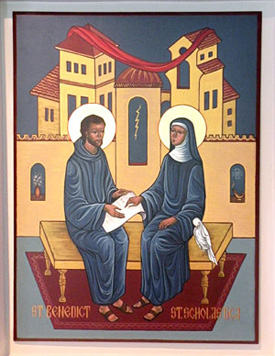
Benedict and Scholastica, at their annual meeting outside of Monte Cassino.
Today’s liturgical celebration, the feast of Saint Scholastica, holds an important place in Benedictine monasteries. Scholastica was Saint Benedict’s sister, and, according to Benedict’s biographer, Saint Gregory the Great, she was distinguished as having “greater love” than even our holy patriarch himself. It is a special day for all Benedictine sisters throughout the world—over 20,000 of them, in the “black” Benedictine federations alone—as we honor a woman whose prayer is known to be very powerful. (She once convinced God to send a thunderstorm when her brother was being slightly obstinate…)
In the Benedictine world, there is a sense that Benedict and Scholastica represent something like the “Petrine” and “Marian” aspects of the church as a whole. While the Petrine service of pastoring, legislative, and governing is extremely important (Benedict is often celebrated as our “Lawgiver”), the Marian service of the hidden life of prayer is the true heart of the Church’s secret fecundity. By prayer and contemplation, we open our hearts to experience God’s healing and loving presence within, and we open our minds to discover God’s sanctifying presence in all creation. A life of prayer truly puts God first, gives God the initiative (all prayer starts with the Holy Spirit!), and frees us from the burden of solving problems by our own powers.
The gospel for today’s feast, if you happen to be at Mass in a Benedictine monastery, is the famous passage about Mary and Martha. Our Lord gently chides Martha for being anxious about many things, and perhaps for being slightly annoyed with her sister Mary, sitting at the Lord’s feet and listening. It’s a shame that this story has come to represent the distinction between the active and contemplative life in religious orders. All of us need to be Marys at certain times, and Marthas at other times. But we should all seek to enshrine in our hearts the primacy of the “better part” of Mary.
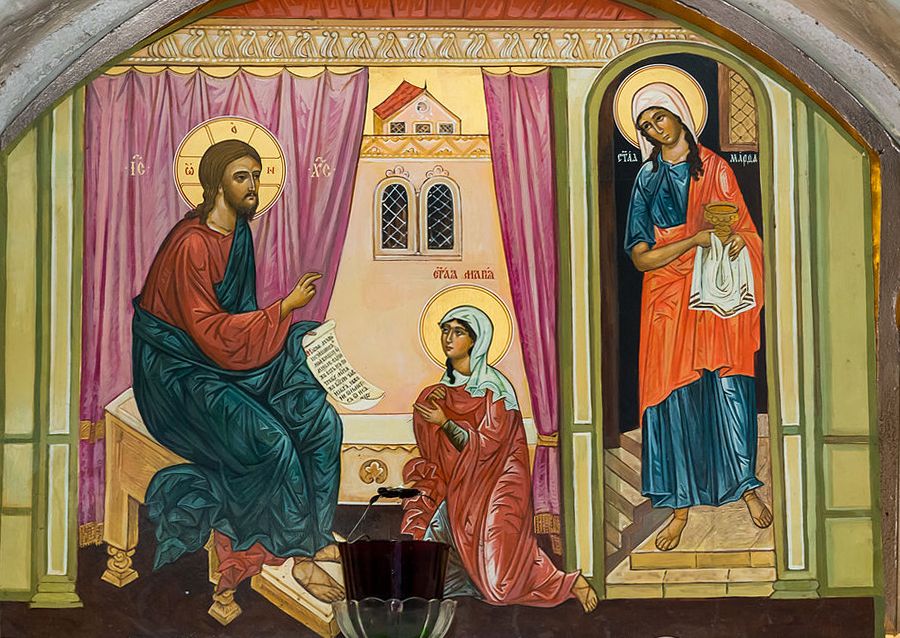
Jesus in the home of Mary, Martha, and Lazarus
I realize how difficult it is for many of us to get going on the life of prayer. Let me conclude by suggesting that it is a habit like any other habit. When you are trying to form a new habit, it is difficult and even painful at first, as we battle against other habits that need changing. Start small with prayer, and then try to expand from there. As you pray regularly, it will get easier, and as it does, it can be helpful to add a little more prayer. Soon, it will be a part of our day that we can’t do without. I was thinking this morning at lectio divina of the old saying of the virtuoso Vladimir Horowitz: “If I skip one day of practice, I notice; if I skip two, my friends notice; if I skip three, the audience notices.” I can tell when I have been lax at prayer for whatever reason, legitimate or not. My sense of God’s presence gets a bit opaque, and my sense of the sacredness of the people I meet becomes occluded. All it takes is to reengage with prayer, and these spiritual sense begin returning.
Gregory the Great tells us that Scholastica and Benedict used to spend days at a time discussing spiritual mysteries. How many of us could actually do such a thing for an hour, much less a whole day? Yet, I know from the great saints of the past and today’s spiritual masters that we can aspire to this spiritual fluency, but only if we pray.
Saint Scholastica, teach all of us, Benedictines and others, to pray as you prayed, that our souls may take flight and follow you on your heavenly journey to Christ!
What to do…
Amid much uncertainty in the world at the moment, we have gone about our monastic business quietly, praying for the nation, our city, the world. We’ve tried to keep our corner of the Bridgeport neighborhood, quiet, safe, and where possible, beautiful. Our garden has been quite fruitful, providing raspberries, blackberries, chard, beans, peppers, tomatoes. The deep green of trees gently waves outside my office window and elsewhere. The cats, domestic and stray, lounge about and are eager to eat when the food is brought out.
When we arrived thirty years ago, our properties featured a lot more concrete and less greenery. This meant, perhaps, less work cutting grass, weeding, and trimming trees. But the quiet reminder of God’s plentifulness that we see in the slow and sure maturation of the plants, fed by the rhythm of life-giving rain and sun, is worth a little extra work. So much anxiety comes of forgetting that reality does not depend on us. All that we receive in this world from God is a sign of His love and a pledge of the greater and permanent gifts He has promised. Are we watching for the clues He is leaving us each day?
I should add that I am in no way an isolationist or a fideist, advocating a willful ignorance of the challenges that we face at the moment, seemingly on all fronts. But in any action we might take to encourage one another, to right wrongs and seek justice, for this to be more than desperate bluster, we should want it to spring from an authentic encounter with Truth, Goodness, and Beauty. First of all, this will this mean that we are not reactively engaging out of pressurized fear and anxiety, but out of a sense of calling or vocation. This will help us avoid be manipulated by circumstances. We will tend to address problems that we know that we can solve, or at least ones to which we can offer competent pieces of a solution. But more importantly, we will be reminded of what the goal is. Like Sam Gamgee calling up sweet pictures of the Shire and Rosie Cotton amid the industrialized evil of Mordor, we will be fortified against bitterness and blind anger when our actions have the purpose of cooperating with, and restoring truth, goodness, and beauty.
More to come.