Monastery of the Holy Cross

  • Home
  • About
    • Benedictine Life
    • History
    • Video Gallery
    • Et Incarnatus Est - The Prior's Blog
  • Visit Us
    • Guesthouse
    • Prayer Schedule
      • Christmas 2025
    • The Catholic Readers Society
  • Vocations
    • Monastic Experience Weekend
    • Formation
    • Oblates
      • Oblate Podcast
  • Solemn Vespers
    • Solemn Vespers for the Sixth Sunday of Easter
    • Chant
  • Contact
  • Donate

Articles under Discernment

Who Is Running the Renewal?

August 28, 2015

I’ve been trying to figure out what it is about George Weigel’s recent post “Catacomb Time?” doesn’t sit right with me. I suspect that it is first of all due to an accumulation of fuzzy complaints with someone-or-other not quite specified. Who inhabit those “Catholic circles” who have “a passion for writing Build-It-Yourself Catacomb manuals”? I honestly have no idea who is meant by this. I suppose that he is referring to the Benedict Option, for which there is no shortage of critics, despite the fact that no one seems to know what it is exactly. The reference to “lukewarm, pick-and-choose” Catholics is always a dangerous one. Who of us doesn’t fall into the “pick-and-choose” category from time to time, even often?

Then there is this larger quote, expressing what seems to me a common enough sentiment, but one I just can’t get behind personally:

This same judgment—Catholicism by osmosis is dead—and this same prescription—the Church must reclaim its missionary nature—are at the root of every living sector of the Catholic Church in the United States: parish, diocese, seminary, religious order, lay renewal movement, new Catholic association.

George Steiner in my dream study. He proposes "cortesia" (courtesy) as a mode of mutuality as a partial antidote to a critical and wordy discourse that empties language of its theological import.

George Steiner in my dream study. He proposes “cortesia” (courtesy) as a mode of mutuality as a partial antidote to a critical and wordy discourse that empties language of its theological import. In this, he comes remarkably close to Benedictine “hospitality” as a mode of encounter, and perhaps a way to reinterpret “mission” away from the excessive freight of unidirectional conquest toward a humble acknowledgement of the potential contributions of potential converts.

“Every living sector” of the Church in a country of almost 70 million Catholics? That’s a big claim. I think what troubles me most about this sort of language is the absence of any feint in the direction of the work of the Holy Spirit in animating the Church. Then there is the question of whether my own religious community qualifies as a “living sector” and whether we actually share that judgment and prescription. One reason I balk at that way of phrasing the “judgment” that “Catholicism by osmosis is dead,” is that it privileges what Mary Douglas refers to as “elaborated speech code” (the language of academia, personal commitment and conviction, related to what George Steiner calls out at the beginning of Real Presences) at the expense of “restricted speech code,” the more passive communicative modes of ritual and symbol. Much of what we learn in the Church is at least somewhat osmotic. Yes, we should pay attention at the liturgy, but often times it takes all kinds of exposure at various levels of awareness and engagement before connections are made. Perhaps I sense here, fairly or unfairly, a neglect of the fundamentally receptive nature of faith, prior to any genuine engagement in mission. St. Paul, the greatest missionary of all, spent well over a decade anonymously living the life of a Christian before the Holy Spirit set him apart as the Apostle of the Gentiles. During that time, what was he doing? Praying? Re-reading the Scriptures? I don’t know, but it was certainly a life of withdrawal, maybe not to the catacombs, but a withdrawal nonetheless.

And then let us not forget who is the patroness of the Church’s missions.

Behind the Church's missionary activity is St. Therese's little way of complete faith in all things.

St. Therese, patroness of the missions. Behind the Church’s missionary activity is St. Therese’s hidden little way of complete faith in all things.

I will leave it to reader to think about the connections between the contemplative life and missionary effectiveness.

Let me end with a little more explanation from Mary Douglas. In the first chapter of Natural Symbols, she relates asking her progressive clerical friends (in 1970) why they think it’s a good idea to move away from the Friday abstinence to more personally meaningful acts of charity–like working in a soup kitchen on Friday.

I am answered by a Teilhardist evolutionism which assumes that a rational, verbally explicit, personal commitment to God is self-evidently more evolved and better than its alleged contrary, formal, ritualistic conformity.

I will admit to nitpicking here a bit, but I think that it is worth watching our language very carefully on these points, lest we saw off the branch upon which we sit. The overall tone of the article supports an individualistic and activist mode of Church life that has the potential to undermine the communal, receptive, gratuitous, gracious, and humble life of faith and hope. Surely one of the points of the young Josef Ratzinger’s “Future Church” article is precisely that we are being called away from “edifices…built in prosperity,” as part of an invitation to leave behind triumphalism. Weigel comes uncomfortably close to a triumphalism-minus-edifices. It is striking that after the long quote from the future pope, a quote that ends with an emphasis on “faith in the triune God, in Jesus Christ, the son of God made man, in the presence of the Spirit until the end of the world,” Weigel never again mentions faith, Jesus Christ, or even God. Again, I will admit that finding such lacunae in a blog post runs the risk of straining justice. But as a monk, I am inclined to be watchful on these counts.

More than anything, this serves as an introduction to Mary Douglas, whose work I have put off writing about for long enough…

UPDATE: Recall that the relationship between mission and contemplative life is the crux at which our community began. Also, that while it is hard not to agree that practicing one’s faith will require great resolve and strength in the coming years, maybe decades, this must be a practice rooted in repentance and joyful humility, grounded in the sacrifice of Calvary, celebrated daily in the liturgy. Finally, while Fr. Ratzinger did say that the future Church will make “bigger demands on the initiative of her individual members,” [emphasis added] this mention of individual members needs to be read in the context of the future pope’s voluminous writings on the liturgy and the Church. The initiative he is calling for surely must be greater fidelity to the reality of the ongoing Incarnation in the local church (including a high mystical “Ignatian” vision of the bishop as Christ and priests as the bishops’ vicars). Otherwise, Weigel might be heard to be inviting individuals to greater creativity, initiative in a maverick kind of sense, rather than in a sense of responsive answerability toward the gospel. And the first step may well be admitting that I’m part of the problem with the contemporary Church.

The Experience of Emotivism, Virtue, and Rationality

August 22, 2015

What d’ya say? Let’s move the discussion about emotivism out of the abstract and into the concrete. What is it like being an emotivist? How do I know when I’m acting like one?

I decided to take up this topic once again because of three separate instances in the past week or so. The first one directly involves me. I was preparing to go to the sacrament of confession. During my examination of conscience, I came upon an old, all-too-familiar sin. I’m tired of battling against it, occasionally discouraged by my inability to make much apparent progress. But what happened next was interesting. I noticed that there was a very subtle stirring inside that suggested to me that what I needed to do was feel worse about this sin. And feeling really, really sorry, really upset with myself…well, I suppose the idea is that my behavior will magically change if I change my feelings.

Well, it doesn’t actually work for me. Does it work for you?

One of the looks of ritualized contrition.

One of the looks of ritualized contrition.

Once you start thinking about this meme, you find it all over. We try to convince each other of our sincerity (especially when we let each other down) by furrowing our brow, biting our lip, getting bleary-eyed. The template for this in my world will always be President Clinton. This is not a criticism of the ex-President. When he felt our pain and acknowledged “not feeling contrite enough,” he was doing what a leader should do–in an emotivist world. Media figures and fellow politicians wanted to make sure that he felt bad, and he needed to make sure that we knew that he felt bad. And it’s become something of a public ritual ever since. When a celebrity (Lance Armstrong, Tiger Woods, Paula Deen) messes up, he or she is expected to go on camera and exhibit signs of sorrow.

What other route might there be? Keep in mind that contrition is a condition of absolution in the sacrament of penance. So there is nothing wrong with the feeling itself. It can be a sign of a healthy conscience. The difficulty is that these feelings may or may not actually have an effect on future behavior. If you’ve ever dealt with (or are an) an alcoholic, you know this. Caught lying, the addict may well feel completely miserable and sorry. But the lure of alcohol and drugs typically overrides the feelings eventually. So generating correct feelings is insufficient for changing behavior.

What I recommend instead is truth and preparation. By truth, I mean what twelve-step programs mean by steps four and five: making a searching and fearless moral inventory of ourselves and stating the exact nature of our wrongs. By preparation, I mean that we learn what situations trigger our disobedience, and make a decision to act contrary to our inclinations when temptation presents itself.

Let me give another concrete example of emotivism.

A common complaint about liturgy is that those attending “don’t get anything out of it.” This sort of rhetoric tempts pastors to make the liturgy more interesting, to see it as a service that they provide to consumers whose desires need to be accounted for. And what are the consumers hoping “to get out of” the liturgy? I can’t say for certain in every instance, but I can speak from my own youthful experience. I thought that church ought to make me feel better about myself, others and the world, that it should inspire me to be a better person. I should walk away from the liturgy with different feelings. This is how many of us gauge the effectiveness of many, if not most, public and private encounters. Success means feeling good, and feeling crummy means that we are doing something wrong.

But does it? This is a highly questionable idea.

Marsalis with another consummate pro, Renee Fleming. There are many hours of dull, hard work behind their effortless musicality.

Marsalis with another consummate pro, Renee Fleming. There are many hours of dull, hard work behind their effortless musicality.

When I was studying to be a professional musician, I typically practiced three or four hours at the piano every day by myself. I did not enjoy this for the most part. Wynton Marsalis likes to refer to practice as The Monster. Every day, musicians have to get out of bed and confront the monster and slay it. The payoff comes when, after years of slaying monsters, one plays the trumpet like Wynton Marsalis or sings like Renee Fleming. In the meantime, though, one must act contrary to one’s feelings, rather than taking feelings as any kind of objective measure of one’s moral state.

Similarly, in a marriage, when a spouse becomes debilitatingly ill or a child develops a major behavioral issue, dealing with this situation will often require mastering one’s immediate feelings of disgust at sickness, resentment at having to set aside personal goals, and fear that things may spiral out of control. These feelings must be opposed because to give in to them would be to act wrongly, to fail in one’s duties and responsibilities to others. Nursing an ailing loved one can be exhausting, no fun at all. But it is beautiful. When we witness this kind of sacrifice, we recognize it as true and good as well. But to accomplish this sacrifice, we must be prepared to act contrary to our feelings, rather than having our feelings somehow demand of others some kind of compliance (as is the case when we want to “get something out of the liturgy”).

These kinds of routine decisions to act in accord with the truth, with the demands of beauty and goodness, change us into different persons. Our identities become completely wrapped up in the repeated good action, and we become virtuoso trumpeters or faithful spouses, beloved brothers. We have become virtuous, having the ability (Latin: virtus) to choose the truly good, the truly beautiful even when others can’t see it. Here’s the hitch. As we are changing, we are likely at times, perhaps often, to feel “inauthentic.” That is to say, we will miss our old selves. What it’s actually like to be a virtuoso or a faithful spouse is at first an unfamiliar experience and requires us to act in ways that feel insincere.

In an emotivist world, the great sins are inauthenticity and insincerity, the great virtues sincerity and authenticity. Thus, it is difficult for an emotivist to make any headway in any kind of human excellence. Let me end with a quote from Lionel Trilling on what this might mean [emphasis added]:

“At the behest of the criterion of authenticity, much that was once thought to make up the very fabric of culture has come to seem of little account, mere fantasy or ritual, or downright falsification. Conversely, much that culture traditionally condemned and sought to exclude is accorded a considerable moral authority by reason of the authenticity claimed for it, for example, disorder, violence, unreason.”


Becoming a Different Kind of Person

July 28, 2015

When God singles out a person for a special task, He often changes his or her name. Abraham, Sarah, and Israel in the Old Testament, and Peter in the New take on a different identity when God calls them forth. Von Balthasar has this lovely reflection on this phenomenon:

Hans Urs von Balthasar, 1905-1988. Made a cardinal by Pope Saint John Paul II.

Hans Urs von Balthasar, 1905-1988. Pope Saint John Paul II intended to create him as a cardinal, but he died prior to the ceremony.

Simon the fisherman could have explored every region of his ego prior to his encounter with Christ, but he would not have found “Peter” there….Then Christ confronts him with [his mission], unyielding, demanding obedience, and it will be the fulfillment of everything that, in Simon, vainly sought a “form” that would be ultimately valid before God and eternity. —Prayer

God can confront each of us with a mission that we ourselves could not have predicted or discerned by “casting round our comfortless” interior, exploring every region of our ego. This is a radical idea. Our more typical notion of authenticity is based precisely in seeking for clues in the corners of our inner psychological Simons. Simon needed the man Jesus of Nazareth to say to him, “Come, follow me, and I will make you a fisher of men.” Otherwise, he would never have become Peter. He needed to be “made” by Christ anew, and the old man, the fallen man Simon, had to die so that this Peter, who is capable of things that Simon would never have imagined himself capable of, might begin to flower and put forth fruit.

Wax on; wax off....The Karate Kid can't understand the utility of waxing cars until he becomes proficient at it.

Wax on; wax off….The Karate Kid can’t understand the utility of waxing cars until he becomes proficient at it. He must make an act of trust in mysterious Mr. Miyagi.

I wrote yesterday that in order to become proficient in a tradition, one must undergo a kind of conversion. One must become a different kind of person. And this conversion depends on an act of faith in a teacher, who may ask me to do things that I don’t understand. Obedience need not be “blind,” but will be more effective when it is accompanied by love and devotion to the teacher. After all, what we are seeking is not only self-fulfillment, but sympathy with the master. “It is enough for the disciple to be like his teacher [Matthew 10: 25].” The goal of Christian conversion is to mature into our “Christ-self,” to become members of Christ, to put on Christ, and this requires us to be called out of ourselves.

Most dedicated Christian know all of this. Where it becomes truly demanding is when we recognize that the calling really must come from outside, and therefore may well be more authentic when opposed to our inclinations and preferences. When we think of discerning God’s will, is it not the case that we often equate God’s voice with some interior conviction? Obedience to another person is a real undoing of the self, because it prevents us from confusing our own wishful thinking with God’s plans. And it comports with the notion that we must become different kinds of persons, rather than simply developing what we ourselves identify as our latent talents. “Consent merits punishment; constraint wins a crown,” Saint Benedict teaches [RB 7: 33]. He is quoting from the acts of the martyr Anastastia. In this connection we see how even allowing for obedience under unjust circumstances can be more fruitful than following our own inner light, for this docility allows God to act and conforms us more closely to Christ Himself.

Vocation and Community

October 9, 2018

A friend asked me an important question yesterday. How does one form men in a monastery into a common cause, if a vocation is addressed uniquely to an individual? We might be tempted to a short cut in answering such a question. Obviously, one might say, God calls the individual to a community, and it is the individual’s responsibility to make the goals of the community his or her own. This is true, but such a simple and direct answer papers over a number of challenges.

Read More »

Jordan Peterson and the Life of Faith, Part 2

May 20, 2018

A less-than-favorable review of Dr. Peterson’s recent book Twelve Rules for Life called it a “self-help book from a culture warrior.” Were this an accurate summary, I doubt that I would have finished chapter one, much less the entire book. This description is inaccurate in two ways, both of which expose the corrosive cultural narrative (one that, I think, the Right and Left hold, for the most part, in common) that distorts what Peterson is saying. Let me deal with the idea of a “culture war” first. I propose to do this by comparing Dr. Peterson to one of the West’s most influential authors whom you’ve (probably) never read, Peter Lombard. This comparison will illuminate the reasons why I consider Dr. Peterson’s appearance on the scene to be mainly a hopeful development.

Read More »

Thoughts Determine Our Lives

July 31, 2017

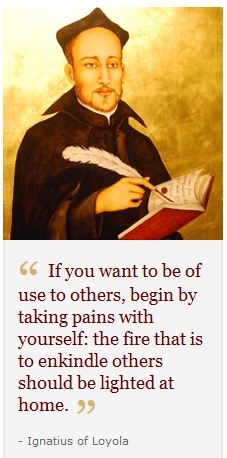
St. Ignatius of Loyola died on this date 561 years ago. He did not set out at first to be a saint, but a soldier. Then Providence intervened. A cannonball shattered his leg, and as he was recovering from this terrible compound fracture, he underwent this remarkable experience:

He asked for some of these books [of knight-errantry] to pass the time. But no book of that sort could be found in the house; instead they gave him a life of Christ and a collection of the lives of the saints written in Spanish….When Ignatius reflected on worldly thoughts, he felt intense pleasure; but when he gave them up out of weariness, he felt dry and depressed. Yet when he thought of living the rigorous sort of life he knew the saints had lived, he not only experienced pleasure when he actually thought about it, but even after he dismissed these thoughts, he still experienced great joy. Yet he did not pay attention to this, nor did he appreciate it until one day, in a moment of insight, he began to marvel at the difference. Then he he understood his experience: thoughts of one kind left him sad, the others full of joy.

Ignatius’s circumstances didn’t change. His joy and sadness did not depend on the healing of his leg, or on his future prospects as a soldier and a dandy. In other words, our contentment in life, or lack thereof, is not, primarily, a function of the external circumstances of our lives. What determines the emotional shape of our lives (and therefore, that aspect of our lives that really matters!) is our thinking.

This profound insight of Saint Ignatius comports with ancient monastic wisdom, both in Christian and Buddhist forms. The difference between Christianity and Buddhism, in this regard at least, is that traditional Christianity does not aim at avoidance of suffering by the elimination of the ego. Rather, the Gospel allows the newly, intentionally reborn self [in the image of Christ] to embrace joyfully the suffering that comes from standing out to the full, which is to say, the suffering that comes with sainthood. Our suffering is embraced “for the sake of the joy that was set before” us [Hebrews 12: 2]. We do this by changing the way we think, by the “renewal of our minds [Romans 12: 2].” How is this done? By, among other things, faith in God’s promises.

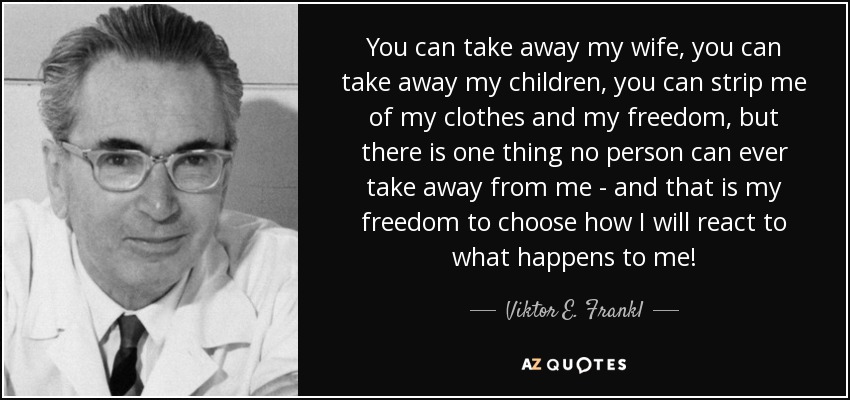
This future-oriented, eschatological thinking finds yet another interesting corroboration in the insights of Jewish psychotherapists Viktor Frankl and Rabbi Edwin Friedman. Both men asked this question: “Why is it that, under experiences of extreme stress, some persons not only continue to function but even thrive?” It’s good to note that Frankl himself was a Holocaust survivor. Both men experienced quasi-Ignatian moments of insight. Frankl’s very language echoes the experience of Ignatius [my emphases in bold]:

Hiding his mouth behind his upturned collar, the [prisoner] marching next to me whispered suddenly: “If our wives could see us now! I do hope they are better off in their camps and don’t know what is happening to us.”

That brought thoughts of my own wife to mind. And as we stumbled on for miles, slipping on icy spots, supporting each other time and again, dragging one another up and onward, nothing was said, but we both knew: each of us was thinking of his wife. Occasionally I looked at the sky, where the stars were fading and the pink light of the morning was beginning to spread behind a dark bank of clouds. But my mind clung to my wife’s image, imagining it with an uncanny acuteness. I heard her answering me, saw her smile, her frank and encouraging look. Real or not, her look was then more luminous than the sun which was beginning to rise.

A thought transfixed me: for the first time in my life I saw the truth as it is set into song by so many poets, proclaimed as the final wisdom by so many thinkers. The truth – that love is the ultimate and the highest goal to which Man can aspire. Then I grasped the meaning of the greatest secret that human poetry and human thought and belief have to impart: The salvation of Man is through love and in love. I understood how a man who has nothing left in this world still may know bliss, be it only for a brief moment, in the contemplation of his beloved. In a position of utter desolation, when Man cannot express himself in positive action, when his only achievement may consist in enduring his sufferings in the right way – an honorable way – in such a position Man can, through loving contemplation of the image he carries of his beloved, achieve fulfillment. For the first time in my life I was able to understand the meaning of the words, “The angels are lost in perpetual contemplation of an infinite glory.”

Frankl and Friedman both challenge us to change our thoughts, to substitute thoughts of love, hope, purpose, and meaning for thoughts of hatred, anxiety, frustration, and resentment. I will be returning to Friedman, whose overall insights are especially counter-intuitive in our present world (which, from the perspective I’m adopting here makes them actually more persuasive). For today’s feast of Saint Ignatius, let me offer one more example of a change of thinking, this time a literary one. As Sam Gamgee and Frodo Baggins trudge their way through the soul-killing terror of Mordor, Sam experiences this moment of insight. It changes nothing of the external horror to which he and Frodo have been consigned. But it does something quieter, yet more radical. It changes Sam’s heart, and, in Tolkien’s story, this small, hidden change of heart changes the world.

There, peeping among the cloud-wrack above a dark tor high up in the mountains, Sam saw a white star twinkle for a while. The beauty of it smote his heart, as he looked up out of the forsaken land, and hope returned to him. For like a shaft, clear and cold, the thought pierced him that in the end the Shadow was only a small and passing thing: there was light and high beauty for ever beyond its reach. His song in the Tower had been defiance rather than hope; for then he was thinking of himself. Now, for a moment, his own fate, and even his master’s, ceased to trouble him. He crawled back into the brambles and laid himself by Frodo’s side, and putting away all fear he cast himself into a deep untroubled sleep.

Our thoughts determine our lives.

Celebrating the Unmaking of the One Ring; a Homily for Annunciation

March 26, 2020

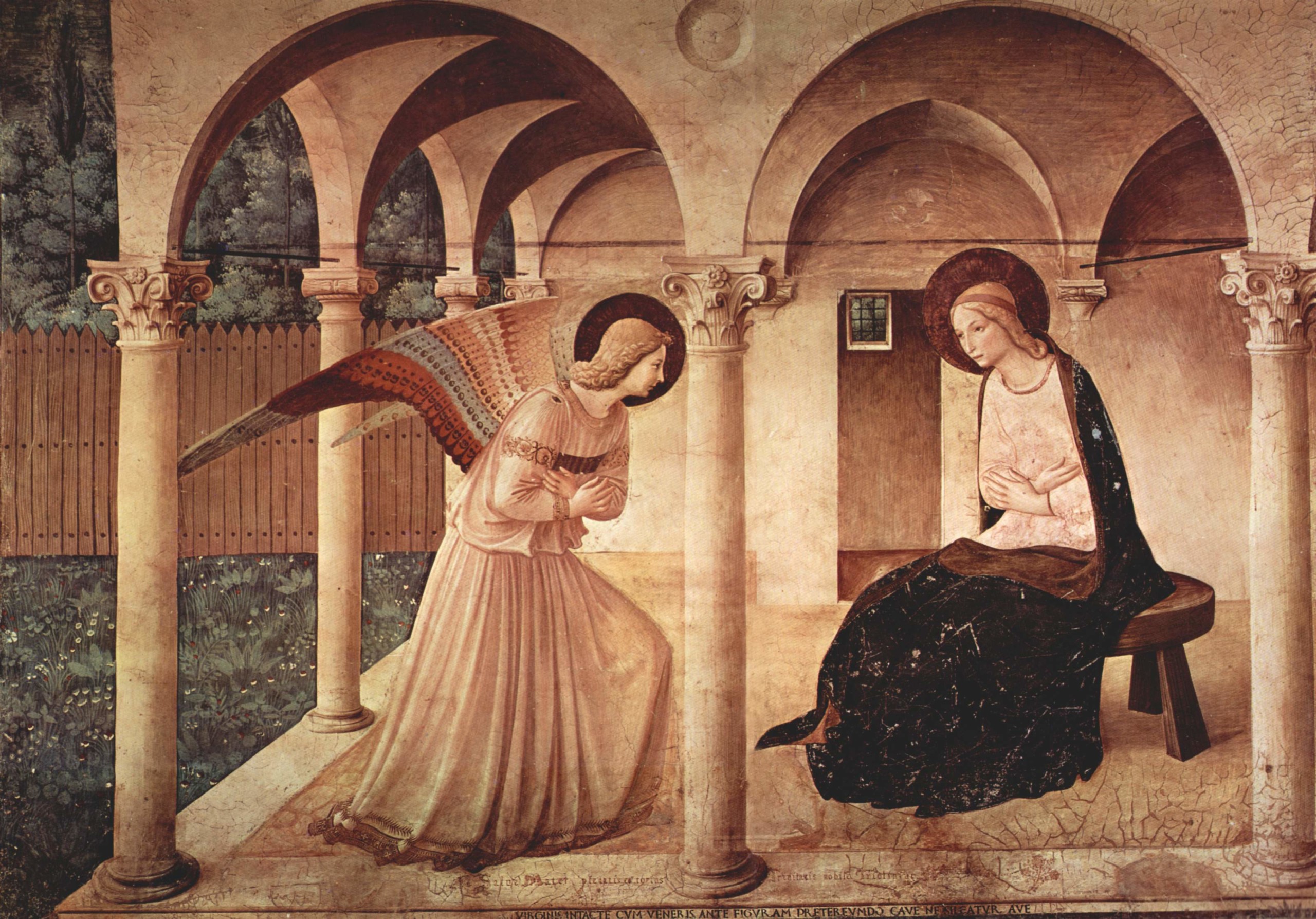
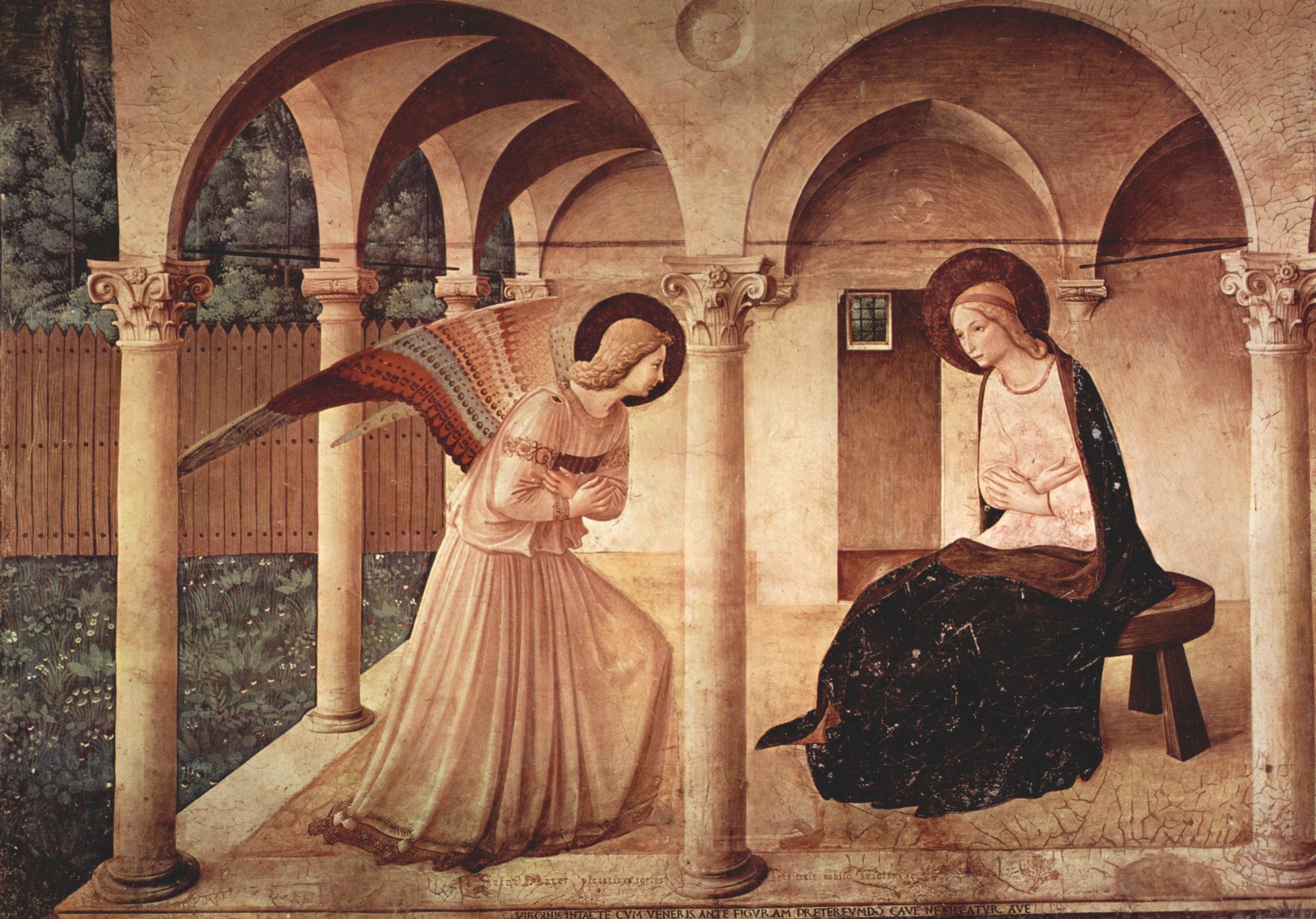
[The following is the edited text of my homily for March 25, 2020. This is the traditional date of Good Friday and of the Annunciation, and it is the date that J.R.R. Tolkien gives as the date upon which Gollum fell into the fires of Mount Doom, thereby destroying the One Ring and ending the terror of Sauron.]

In our scientific age, atheists demand evidence for the existence of God. For me, among the weightiest bits of evidence is simply the prevalence of belief. Many persons claim not only to believe in God, but to know Him. This requires an explanation. And it’s not enough, I think, just to claim it as some mass delusion—that’s simply kicking the can down the road. Why this particular mass delusion?

A scientist such as Richard Dawkins may well answer that ancient persons were trying to explain the natural world and lacked science, and so posited gods as causes of natural phenomena like lightning. In other words, ancient persons were failed versions of himself. Other more political versions of this attempt at explanation claim that the invention of the gods was a cynical ploy by authority to consolidate power over an awestruck populace.

Contemporary atheists are hardly the first to speculate on this. The Biblical book of Wisdom already gives other explanations for the origin of the gods–or what the author would call “idols.” He notes a longing for beauty in all peoples, and that the beauty of the cosmos moves the observer to imagine that the mysteriously remote magnificence of the stars betokened divinity; or that the power of fire or water signified the presence of the divine [see Wisdom 13: 1-3]. Elsewhere, the Biblical author speculates that a grieving father would make a statue of a recently lost young child, and that his attachment to this statue would grow into a kind of piety, and that the dead child would undergo a kind of apotheosis, a divinization [Wisdom 14: 15-16].

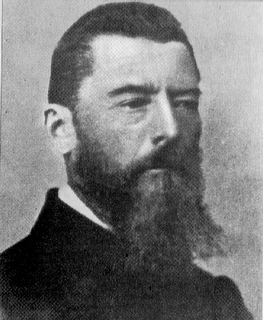
“Christianity set itself the goal of fulfilling man’s unattainable desires”–Ludwig Feuerbach (1804-1872)

In the last two hundred years, learned explanations have become more and more sophisticated (though, alas, I must exclude Mr. Dawkins from any claim to sophistication on this point). In the early nineteenth century, Ludwig Feuerbach saw God as an outward projection of humanity’s inward nature, in some sense representing the infinite desire for order, meaning, and goodness that we observe in human nature. Later, Emile Durkheim applied this insight anthropologically so that God becomes a representation of collective society. The most ambitious, and, to me, the profoundest attempt to account for the origin of the gods is that of René Girard (1923-2015). Girard, whose work drew him back to his childhood Catholic faith, noted not only the widespread belief in the gods, but the near-universal connection of the gods and violence, encoded in the ubiquitous practice of sacrifice in the ancient world. He drew attention to the catharsis that takes place when a tense and fearful community focuses its anxiety and violence unanimously on a victim, that is, when a community chooses a scapegoat. The killing or banishment of this scapegoat brings about peace and restores order to the community. Since peace and order are desirable for both the community and the individual, the scapegoated victim paradoxically becomes a benefactor to the community and gradually becomes a god in the community’s mythological imagination. The connection with authority comes about because kings and others in positions of governance are extremely convenient scapegoats, easy to blame for everyone’s problems. There is an important exception to this mechanism. The prophets of Israel, that fiercely monotheistic nation, are constantly alerting the people to the arbitrary injustice at the heart of human society, this need to generate peace and order by generating victims. Because of God’s championing of the victim, the idea of a true God begins to distance itself from the “gods.”

“Religion is in a word the system of symbols by means of which society becomes conscious of itself.”–Emile Durkheim (1858-1917)

Now I bring all of this up, and I hope that it’s interesting, because the constant in all of this is human desire. We all have desires, some of them not so good, but all of them leaving us in need of fulfillment in some way. Unfulfilled desire leaves us vulnerable, even anxious and fearful. Perhaps worst of all, the noblest things that we desire: justice, truth, beauty, are always just out of reach. This is that infinite desire that Feuerbach rightly noted.

What we proclaim today is that the Great Desire of earth [cf. Haggai 2: 6-7), what all human beings long for in some way, is no longer out of reach. Not because we have figured out finally how to attain the truth, but because the Truth Himself came to us. The Son of God validates the best of human desire by becoming human, sharing these desires with us. Jesus hungers and thirsts, has friends, attends wedding banquets and public festivals. He restores children to bereaved parents, he feeds the multitude, he quiets threatening waves, he relieves lepers of “social distancing” by cleansing them. But profoundest of all, he desires to do His Father’s will as the one thing necessary; he desires justice for all; he desires that all men see in the beauty of the cosmos God’s great love for those made in His image and likeness. He desires that all be set free by knowing the Truth. In the Incarnation, which we celebrate today, Truth Himself has come down from heaven, and in taking human nature to Himself, has made justice spring up from the earth [see Psalm 85: 10-11].

The idols of the nations are an image of distorted desire, stuck in the infernal logic of “the world.” Jesus is recognized, even in His lifetime, as the true fulfillment of all that is best in what we desire. The Apostle Philip found Nathanial and said, “We have found him of whom Moses in the law and also the prophets wrote [John 1: 45].” After the Resurrection, the two disciples on the road to Emmaus unwittingly said to Jesus himself, “We had hoped that he would be the one to redeem Israel [Luke 24: 21].” In other words, we hoped that he would vindicate the one true, transcendent God and the devotion to the true God shown by His chosen people Israel–which He has by His resurrection in our nature.

My brothers, what is it that we desire? How has our Lord Jesus Christ offered us fulfillment or purification of this desire in His Incarnation? How has he invited us to be patient in awaiting this fulfillment by learning to be his Cross-carrying disciples? In this moment of anxiety, how can we follow the prophets in pointing to Jesus and away from the danger of choosing scapegoats for our suffering? Let us, like Mary and her Son, begin by saying to our common Father, “Thy will be done.”

On Community Practices

June 4, 2015

One of the ‘great books’ that most University of Chicago undergraduates have to read is Thomas Kuhn’s The Structure of Scientific Revolutions.  If you’ve ever used the phrase, “paradigm shift,” you’re trading with Kuhn’s coinage. His notion is that normal science is done under conditions of a dominant paradigm. This contains all of the theories that everyone takes for granted and provides the background for research and further extensions of knowledge. Newton’s physics provided an amazingly powerful paradigm for three centuries. But by the late nineteenth century, researchers were discovering holes in it. The perceived problems in Newton’s paradigm led Albert Einstein and others to propose a paradigm shift, a new set of theories that today (along with the seemingly incompatible particle physics) are mostly taken for granted as the background for current research and practice.

Kuhn’s idea has been subjected to a lot of criticism. But his basic insight is vindicated by the amount of fertile thinking that has ensued in dialog with his book. One of the better refinements of Kuhn’s theory was made by Imre Lakatos, who moved away from general paradigms to more local ‘research programs’.

I begin with this excursus on science because science is, for moderns like ourselves, the dominant practice in life. Science is successful. It sells. It works. More than that, because we are all somewhat familiar with how it works, it provides a good model for other types of human practices and disciplines. In After Virtue, Alasdair MacIntyre’s proposals to reinstate a traditional Aristotelian morality depend heavily on what he calls ‘practices’. I will spare you his difficult definitions. These practices have a lot in common with Lakatos’s research programs (MacIntyre, in a separate essay, indicates his debt to Kuhn and Lakatos).

Yesterday I asked what tools a community needs if it wishes to engage in a kind of recovery of tradition. From the opening of this post, you can see that what is involved is something like a research program into the common good. I offer the following in the context of writing about the Benedict Option, and doing so from the standpoint of genuine Benedictine life, but also from the standpoint of someone who is intimately familiar with MacIntyre’s writings. He’s the inspiration for this project, after all, as I indicated in the first post in this series.

After Virtue doesn’t make clear what concrete qualities such a community will need. So I will use a boiled-down version of some insights from Three Rival Versions of Moral Enquiry, one of his follow-up books. As I read MacIntyre, here is what a community needs, if the members wish to engage in some kind of disciplined pursuit of the common good: 1) a canon; 2) legitimate authority; 3) practical boundaries; and 4) modes of engagement. There are probably plenty of other things that such a community will need, but these are important and easy to overlook.


Canon: This is some kind of record of the best results of the practice so far, usually reference texts. For physicists, this would include Einstein and Heisenberg and the records of experiments of various kinds. For a monk, this includes Scripture, the Rule of Saint Benedict, the writings of the Fathers (Benedict himself names Basil and Cassian), the marytrology, Canon Law, etc. Studying the canon gives the participants common imagery, shared goals and a common vocabulary. It helps to solidify common commitments. Of course, texts, especially theological texts, can issue in disputes about interpretation. Therefore, authority and boundaries are necessary, as are proper modes of engagement. For the Benedict Option, I imagine that the usual Church documents will be in play, as well as the writings, say, of Pope Saint John Paul II, Benedict XVI, and the like. I will be offering copious suggestions for supplementing such a canon.

Authority: The role of authority in such a practice is not so much to boss people around. But someone must be responsible enough and well-versed enough in the practice to identify when an interpretation of the canon is out of bounds. Thus in science again, we have peer-reviewed journals (alas, these are becoming less authoritative), and academic hiring committees. In monasteries, we have the abbot. In the Church at large we have the bishops. Authority facilitates the ongoing argument about the common goal of everyone involved. Sometimes this requires authority to correct a participant, even to censure in some way. Sometimes it even requires a participant to get kicked out, which is why we need:

Boundaries: It is important to know who exactly is qualified to engage in the debates about the common good. Scientists usually don’t oversee original research until they have achieved a diploma indicating some level of expertise. In monastic life, only monks in solemn vows are allowed a vote in the community Chapter meetings. Part of the goal of formation is to bring the new monk into the discussion by teaching him the canon and teaching him how properly to respond to and engage with authority. When a scientist is caught faking data, his or her career can quickly come to an end, as institutional funding will dry up, effectively ruling the person out of further research. We don’t excommunicate monks anymore, as far as I know, but the principle is clearly sound (the canonical penalty of excluding a monks from Chapter is still used): monks who cease to base their decisions on the canon and abide by the community authority pose a grave risk to the community’s existence. It is up to authority to make this call. It seems to me that authority and boundaries are potential sticking points for serious efforts at the Benedict Option. Noah Millman has already helpfully issued this challenge: ‘any conscious program to implement a “Benedict Option” would be concerned, first and foremost, with questions of communal organization.’ Yes.

Engagement: I’m not completely satisfied with this word, but here is the basic idea. There has to be some kind of institutional support for serious discussions about how the group is going to act and how it is going to understand itself. There must be ways to alert authority to issues that need careful discernment. Again, in science, this is the publication of study results in accredited journals and the methods of peer review. In a monastery, engagement mainly takes place in Chapter meetings and other stylized settings. What is important about these engagements is that they are above-board and involve everyone in some fashion or other (in a monastery, different monks have different capabilities in terms of being able to engage in practical decision-making, but somehow everyone needs to be included). So Benedict Option pioneers should be wary of any sort of engagement that is too informal, too dependent on personalities, and so on.

Keep in mind that how community membership is defined, how authority is determined and exercised, what rules of engagement are allowed and institutionalized…all of these will probably require regular negotiation at some level, especially among the leadership of the group. Benedictine monasticism has never been static. We’ve constantly debated the role of priors versus abbots, sleeping arrangements (dormitories versus cells), expressions of poverty, which texts novices are to read, how to celebrate the liturgy properly, and on and on. As long as there is a way for legitimate members to be heard, as long as arguments derive from canonical sources in some way, and as long as authority can issue decisions that are binding on everyone, these debates will strengthen the communal project and provide for course correction even when things go awry. Communities break down when authority and authoritative texts become too diffuse, when members are allowed entry but lack the proper formation, and when legitimate members feel excluded from decisions that affect their participation.

Our monastery has been consciously attempting to put these insights into practice. What sort of results have we had? Which texts have become canonical in our work to engage the broad tradition of Catholic and Orthodox monasticism? We will sally next into that fray.

Renewal of Your Mind: Launch

June 5, 2015

Christians first engage the surrounding culture in their own hearts and minds.

This is important to grasp. Well meaning people misunderstand Benedictine withdrawal from the world as a lack of engagement with culture. Not so.

Read More »

Disengagement? Or Discernment?

June 3, 2015

One of the criticisms of the so-called Benedict Option that comes up regularly in discussions is the fear that those who take it will turn their backs on society, drop out of political engagement and so on. And this at a time when our current Pontiff is urging Catholics to go out, not to remain, much less make a deliberate choice to be, narcissistic and inward-turning.

Our monastery would seem to be a contradiction in this case. We discerned a call to live the Benedictine life, but in the heart of the modern city. We can hardly avoid all sorts of interaction with the world. And indeed, we’ve heard mutters from the other side on this point. Some years ago a young man made a retreat with us while we was preparing for vows in another contemplative-leaning religious order. As he was leaving, rather than saying, “Thank you,” he told us that contemplation was not possible in the city.

This would have been news for Basil the Great, one of the primary influences on Benedictine monasticism. He generally wanted his monasteries in cities, connected to important parishes, in places where the bishop could keep an eye on things. Moreover, the idea that monks turn their backs on the world is completely refuted by any knowledge of the first evangelization of Europe. If you’d like your worldview altered (I think in the best possible way) by great historical writing, I can recommend to you The Barbarian Conversion: From Paganism to Christianity, by Richard Fletcher, a book that demonstrates just how important monastic evangelization was in establishing the Church in mission areas from the fourth through the thirteenth centuries. Not bad work for a bunch of guys and gals turning their back on everybody.

So why have we decided to come to the city? The short answer is already indicated above: this was a discernment by our three founders, who were greatly assisted by Bishop Victor Balke and Joseph Cardinal Bernadin, who, as representatives of the Apostles, could help to clarify this call through their listening and prudent action. We thought we knew then why God called us to the city. The city was the great urban desert, a place of alienation, crime, and so on. Well, this sounded alright until we moved into an actual city and lived with real people in a real neighborhood and so on. We couldn’t really know what sort of mission we would encounter until we put down roots here. And part of our ongoing work is listening to the promptings of the Holy Spirit to discern what His mission is for us.

So we’ve been discerning the community’s goal all along. In conclusion, let me make a connection with Alasdair MacIntyre’s ideas about traditions. One of his key insights is that tradition is not, as commonly held, a fixed, immobile set of practices and formulas. Rather, it is an extended inquiry by a group of persons committed to one another, and it is carried out in arguments, disputations, corrections, abridgments, extensions, and whatever other means available in rational debate. This doesn’t mean that everything is up for grabs all the time, either. There do have to be common commitments to certain base-level principles. So let me apply this now to our discernment about the monastic life lived in a giant modern city.

As I wrote above, we thought we knew what it would mean to plant ourselves in a city. We had a fairly good idea of what a good urban monastery might look like and might do. Then we encountered reality, and our vision began slowly to change. It changed because of intense community discussions prompted by new information: homeless persons at the door, invitations by local universities to give talks, benefactors wanting to buy us things, and so on. Every time we made a response to these circumstances, our vision was clarified or muddied, and so altered in some nearly imperceptible way. Sometimes the stimuli were more bracing. The single biggest decision we made was to become Benedictines in 1997. To do this, we needed to enter into a relationship with the Abbey of Christ in the Desert. And to do that meant to accept their authority, especially that of Abbot Philip Lawrence. When he would come to visit, he might say something like, “You should end such-and-such a practice,” and we would do it. And with the adoption of new practices and the end of old ones, our sense of mission again was slightly changed.

All that said, this kind of change was possible only because we had the more stable foundation of Church teaching and discipline. The Benedictine Rule added another layer of authoritative agreement. Not that we can’t make prudential decisions about how to interpret the Rule–but in discussions, whatever the Rule does say tends to carry greater weight than someone’s opinion, or a minority practice in, say, the Eastern monastic tradition.

The good news for the Benedict Option: if you are quite sure what the goal is at this point, that might well be just fine. But in order to discern the goal, certain things will be necessary. Tomorrow: what is required of a community that wishes to engage in a tradition?

  • « Go to Previous Page
  • Go to page 1
  • Go to page 2
  • Go to page 3
  • Go to page 4
  • Go to Next Page »

Blog Topics

  • Beauty (22)
  • Contemplative Prayer (60)
  • Contra Impios (2)
  • Culture (32)
  • Discernment (32)
  • Formation (16)
  • General (43)
  • Going to the Father (18)
  • Gregorian Chant (5)
  • Holy Spirit (7)
  • Jottings (27)
  • Liturgy (98)
  • Meditations on Heaven (4)
  • Monastic Life (58)
  • Moral Theology (53)
  • Music (18)
  • Scripture (60)
  • The Cross (3)
  • Vatican II and the New Evangelization (21)

Blog Archives

  • April 2026 (2)
  • March 2026 (4)
  • February 2026 (3)
  • January 2026 (2)
  • December 2025 (6)
  • November 2025 (4)
  • October 2025 (2)
  • September 2025 (2)
  • August 2025 (3)
  • July 2025 (4)
  • June 2025 (4)
  • May 2025 (3)
  • April 2025 (4)
  • March 2025 (4)
  • February 2025 (3)
  • January 2025 (5)
  • December 2024 (8)
  • November 2024 (3)
  • October 2024 (9)
  • September 2024 (8)
  • August 2024 (9)
  • July 2024 (9)
  • June 2024 (8)
  • May 2024 (9)
  • April 2024 (4)
  • November 2023 (1)
  • April 2023 (1)
  • December 2022 (1)
  • October 2022 (1)
  • March 2022 (1)
  • February 2022 (1)
  • August 2021 (2)
  • June 2021 (1)
  • May 2021 (1)
  • April 2021 (1)
  • February 2021 (2)
  • January 2021 (1)
  • December 2020 (1)
  • August 2020 (4)
  • June 2020 (1)
  • May 2020 (4)
  • April 2020 (9)
  • March 2020 (4)
  • February 2020 (1)
  • January 2020 (1)
  • December 2019 (1)
  • July 2019 (2)
  • June 2019 (1)
  • May 2019 (1)
  • April 2019 (2)
  • March 2019 (1)
  • February 2019 (3)
  • January 2019 (1)
  • December 2018 (1)
  • November 2018 (2)
  • October 2018 (2)
  • September 2018 (2)
  • August 2018 (1)
  • July 2018 (2)
  • June 2018 (4)
  • May 2018 (7)
  • April 2018 (1)
  • March 2018 (1)
  • February 2018 (1)
  • January 2018 (2)
  • November 2017 (1)
  • October 2017 (1)
  • September 2017 (1)
  • August 2017 (1)
  • July 2017 (2)
  • June 2017 (2)
  • March 2017 (1)
  • February 2017 (2)
  • December 2016 (1)
  • November 2016 (3)
  • August 2016 (2)
  • May 2016 (2)
  • April 2016 (5)
  • March 2016 (2)
  • December 2015 (1)
  • November 2015 (2)
  • October 2015 (3)
  • August 2015 (10)
  • July 2015 (12)
  • June 2015 (17)
  • May 2015 (2)
  • April 2015 (7)
 
© 2026 Monastery of the Holy Cross
  • Accessibility
Web Design by ePageCity