Christians first engage the surrounding culture in their own hearts and minds.
This is important to grasp. Well meaning people misunderstand Benedictine withdrawal from the world as a lack of engagement with culture. Not so.
Christians first engage the surrounding culture in their own hearts and minds.
This is important to grasp. Well meaning people misunderstand Benedictine withdrawal from the world as a lack of engagement with culture. Not so.
One of the ‘great books’ that most University of Chicago undergraduates have to read is Thomas Kuhn’s The Structure of Scientific Revolutions. If you’ve ever used the phrase, “paradigm shift,” you’re trading with Kuhn’s coinage. His notion is that normal science is done under conditions of a dominant paradigm. This contains all of the theories that everyone takes for granted and provides the background for research and further extensions of knowledge. Newton’s physics provided an amazingly powerful paradigm for three centuries. But by the late nineteenth century, researchers were discovering holes in it. The perceived problems in Newton’s paradigm led Albert Einstein and others to propose a paradigm shift, a new set of theories that today (along with the seemingly incompatible particle physics) are mostly taken for granted as the background for current research and practice.
Kuhn’s idea has been subjected to a lot of criticism. But his basic insight is vindicated by the amount of fertile thinking that has ensued in dialog with his book. One of the better refinements of Kuhn’s theory was made by Imre Lakatos, who moved away from general paradigms to more local ‘research programs’.
I begin with this excursus on science because science is, for moderns like ourselves, the dominant practice in life. Science is successful. It sells. It works. More than that, because we are all somewhat familiar with how it works, it provides a good model for other types of human practices and disciplines. In After Virtue, Alasdair MacIntyre’s proposals to reinstate a traditional Aristotelian morality depend heavily on what he calls ‘practices’. I will spare you his difficult definitions. These practices have a lot in common with Lakatos’s research programs (MacIntyre, in a separate essay, indicates his debt to Kuhn and Lakatos).
Yesterday I asked what tools a community needs if it wishes to engage in a kind of recovery of tradition. From the opening of this post, you can see that what is involved is something like a research program into the common good. I offer the following in the context of writing about the Benedict Option, and doing so from the standpoint of genuine Benedictine life, but also from the standpoint of someone who is intimately familiar with MacIntyre’s writings. He’s the inspiration for this project, after all, as I indicated in the first post in this series.
After Virtue doesn’t make clear what concrete qualities such a community will need. So I will use a boiled-down version of some insights from Three Rival Versions of Moral Enquiry, one of his follow-up books. As I read MacIntyre, here is what a community needs, if the members wish to engage in some kind of disciplined pursuit of the common good: 1) a canon; 2) legitimate authority; 3) practical boundaries; and 4) modes of engagement. There are probably plenty of other things that such a community will need, but these are important and easy to overlook.
Canon: This is some kind of record of the best results of the practice so far, usually reference texts. For physicists, this would include Einstein and Heisenberg and the records of experiments of various kinds. For a monk, this includes Scripture, the Rule of Saint Benedict, the writings of the Fathers (Benedict himself names Basil and Cassian), the marytrology, Canon Law, etc. Studying the canon gives the participants common imagery, shared goals and a common vocabulary. It helps to solidify common commitments. Of course, texts, especially theological texts, can issue in disputes about interpretation. Therefore, authority and boundaries are necessary, as are proper modes of engagement. For the Benedict Option, I imagine that the usual Church documents will be in play, as well as the writings, say, of Pope Saint John Paul II, Benedict XVI, and the like. I will be offering copious suggestions for supplementing such a canon.
Authority: The role of authority in such a practice is not so much to boss people around. But someone must be responsible enough and well-versed enough in the practice to identify when an interpretation of the canon is out of bounds. Thus in science again, we have peer-reviewed journals (alas, these are becoming less authoritative), and academic hiring committees. In monasteries, we have the abbot. In the Church at large we have the bishops. Authority facilitates the ongoing argument about the common goal of everyone involved. Sometimes this requires authority to correct a participant, even to censure in some way. Sometimes it even requires a participant to get kicked out, which is why we need:
Boundaries: It is important to know who exactly is qualified to engage in the debates about the common good. Scientists usually don’t oversee original research until they have achieved a diploma indicating some level of expertise. In monastic life, only monks in solemn vows are allowed a vote in the community Chapter meetings. Part of the goal of formation is to bring the new monk into the discussion by teaching him the canon and teaching him how properly to respond to and engage with authority. When a scientist is caught faking data, his or her career can quickly come to an end, as institutional funding will dry up, effectively ruling the person out of further research. We don’t excommunicate monks anymore, as far as I know, but the principle is clearly sound (the canonical penalty of excluding a monks from Chapter is still used): monks who cease to base their decisions on the canon and abide by the community authority pose a grave risk to the community’s existence. It is up to authority to make this call. It seems to me that authority and boundaries are potential sticking points for serious efforts at the Benedict Option. Noah Millman has already helpfully issued this challenge: ‘any conscious program to implement a “Benedict Option” would be concerned, first and foremost, with questions of communal organization.’ Yes.
Engagement: I’m not completely satisfied with this word, but here is the basic idea. There has to be some kind of institutional support for serious discussions about how the group is going to act and how it is going to understand itself. There must be ways to alert authority to issues that need careful discernment. Again, in science, this is the publication of study results in accredited journals and the methods of peer review. In a monastery, engagement mainly takes place in Chapter meetings and other stylized settings. What is important about these engagements is that they are above-board and involve everyone in some fashion or other (in a monastery, different monks have different capabilities in terms of being able to engage in practical decision-making, but somehow everyone needs to be included). So Benedict Option pioneers should be wary of any sort of engagement that is too informal, too dependent on personalities, and so on.
Keep in mind that how community membership is defined, how authority is determined and exercised, what rules of engagement are allowed and institutionalized…all of these will probably require regular negotiation at some level, especially among the leadership of the group. Benedictine monasticism has never been static. We’ve constantly debated the role of priors versus abbots, sleeping arrangements (dormitories versus cells), expressions of poverty, which texts novices are to read, how to celebrate the liturgy properly, and on and on. As long as there is a way for legitimate members to be heard, as long as arguments derive from canonical sources in some way, and as long as authority can issue decisions that are binding on everyone, these debates will strengthen the communal project and provide for course correction even when things go awry. Communities break down when authority and authoritative texts become too diffuse, when members are allowed entry but lack the proper formation, and when legitimate members feel excluded from decisions that affect their participation.
Our monastery has been consciously attempting to put these insights into practice. What sort of results have we had? Which texts have become canonical in our work to engage the broad tradition of Catholic and Orthodox monasticism? We will sally next into that fray.
One of the criticisms of the so-called Benedict Option that comes up regularly in discussions is the fear that those who take it will turn their backs on society, drop out of political engagement and so on. And this at a time when our current Pontiff is urging Catholics to go out, not to remain, much less make a deliberate choice to be, narcissistic and inward-turning.
Our monastery would seem to be a contradiction in this case. We discerned a call to live the Benedictine life, but in the heart of the modern city. We can hardly avoid all sorts of interaction with the world. And indeed, we’ve heard mutters from the other side on this point. Some years ago a young man made a retreat with us while we was preparing for vows in another contemplative-leaning religious order. As he was leaving, rather than saying, “Thank you,” he told us that contemplation was not possible in the city.
This would have been news for Basil the Great, one of the primary influences on Benedictine monasticism. He generally wanted his monasteries in cities, connected to important parishes, in places where the bishop could keep an eye on things. Moreover, the idea that monks turn their backs on the world is completely refuted by any knowledge of the first evangelization of Europe. If you’d like your worldview altered (I think in the best possible way) by great historical writing, I can recommend to you The Barbarian Conversion: From Paganism to Christianity, by Richard Fletcher, a book that demonstrates just how important monastic evangelization was in establishing the Church in mission areas from the fourth through the thirteenth centuries. Not bad work for a bunch of guys and gals turning their back on everybody.
So why have we decided to come to the city? The short answer is already indicated above: this was a discernment by our three founders, who were greatly assisted by Bishop Victor Balke and Joseph Cardinal Bernadin, who, as representatives of the Apostles, could help to clarify this call through their listening and prudent action. We thought we knew then why God called us to the city. The city was the great urban desert, a place of alienation, crime, and so on. Well, this sounded alright until we moved into an actual city and lived with real people in a real neighborhood and so on. We couldn’t really know what sort of mission we would encounter until we put down roots here. And part of our ongoing work is listening to the promptings of the Holy Spirit to discern what His mission is for us.
So we’ve been discerning the community’s goal all along. In conclusion, let me make a connection with Alasdair MacIntyre’s ideas about traditions. One of his key insights is that tradition is not, as commonly held, a fixed, immobile set of practices and formulas. Rather, it is an extended inquiry by a group of persons committed to one another, and it is carried out in arguments, disputations, corrections, abridgments, extensions, and whatever other means available in rational debate. This doesn’t mean that everything is up for grabs all the time, either. There do have to be common commitments to certain base-level principles. So let me apply this now to our discernment about the monastic life lived in a giant modern city.
As I wrote above, we thought we knew what it would mean to plant ourselves in a city. We had a fairly good idea of what a good urban monastery might look like and might do. Then we encountered reality, and our vision began slowly to change. It changed because of intense community discussions prompted by new information: homeless persons at the door, invitations by local universities to give talks, benefactors wanting to buy us things, and so on. Every time we made a response to these circumstances, our vision was clarified or muddied, and so altered in some nearly imperceptible way. Sometimes the stimuli were more bracing. The single biggest decision we made was to become Benedictines in 1997. To do this, we needed to enter into a relationship with the Abbey of Christ in the Desert. And to do that meant to accept their authority, especially that of Abbot Philip Lawrence. When he would come to visit, he might say something like, “You should end such-and-such a practice,” and we would do it. And with the adoption of new practices and the end of old ones, our sense of mission again was slightly changed.
All that said, this kind of change was possible only because we had the more stable foundation of Church teaching and discipline. The Benedictine Rule added another layer of authoritative agreement. Not that we can’t make prudential decisions about how to interpret the Rule–but in discussions, whatever the Rule does say tends to carry greater weight than someone’s opinion, or a minority practice in, say, the Eastern monastic tradition.
The good news for the Benedict Option: if you are quite sure what the goal is at this point, that might well be just fine. But in order to discern the goal, certain things will be necessary. Tomorrow: what is required of a community that wishes to engage in a tradition?
In the preface to After Virtue, Alasdair MacIntyre makes a curious admission:
Ever since the days when I was privileged to be a contributor to that most remarkable journal The New Reasoner, I had been preoccupied with the question of the basis for the moral rejection of Stalinism.
Wait–what’s there to be preoccupied with here? Rejecting Stalinism should be easy, shouldn’t it? Could there be anything simpler, less risky, than soundly denouncing Stalinism? What could he possibly mean?
Have you heard of the “Benedict Option?” If not, you may hear a lot more about it soon. Rod Dreher is working on a new book that will presumably help to explain the concept that he coined. But even before the book comes out, important blogosphere voices have been engaging in spirited discussion of it.
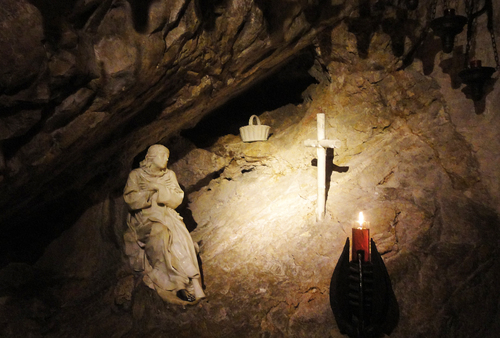
Sacro speco–the holy cave where young Benedict of Nursia went to escape the corrupting influence of Roman university life
What is it?
Fr. Joseph Koterski, S.J., in his Great Courses CD’s on the Nichomachean Ethics of Aristotle comments that new readers of Aristotle’s ethics are frequently surprised that he spends almost no time discussing rules of behavior. What is right behavior, then, if not obedience to rules? Don’t we have the Ten Commandments? And a host of other rules? Aren’t Jesuits supposed to be jesuitical and concerned about minimal applications of rules and maximal excpetions? What’s with Fr. Koterski and Aristotle?
St. John Cassian demonstrated that he is in the Aristotelian tradition when, in his first Conference, he asks “What is the goal of a monk?” And he answers this by saying that monks choose their actions based on a calculation of what is most likely to bring about the Kingdom of God in their lives. The word ‘calculation’ might sound odd here. All I mean by this is a reference to the cardinal virtue of prudence. And by mentioning prudence as a virtue, I’ve indicated what is different about Aristotle and Cassian versus modern ideas about ‘morality’ or ethics. Aristotle and Cassian are interested in achievement of a goal: happiness for Aristotle*, the Kingdom of God for Cassian. Good actions move us closer to our goal and evil actions move us away. Rules can help us in important ways: they tend to condense the hard-earned wisdom of those who have been in the quest before us. But they can almost never be adopted naively. The second Conference makes this clear. There are many stories of monks who failed to achieve the Kingdom because of an over-reliance on a limited number of hard and fast rules.
But what about the Rule of Saint Benedict? The translation of the Latin Regula as ‘Rule’ is another example of what I all ‘linguistic drift’. We no longer easily sense what is meant by regula, and our word ‘rule’ only gets at a small part of it. A regula is a guide to behavior, a framework, a template. It doesn’t do your thinking for you; it provides the contours of the arena in which the spiritual battle is to be fought by monks. Saint Benedict is very clear that he does not wish to legislate a series of rules, and throughout the Regula, he gives the local abbot the discretion to dispense with virtually any particular rule. This is why the abbot should be a man learned in divine things; he must know how to assess the particular situation and adapt himself to many different characters and temperaments.
When Saint Paul writes that the letter of the law kills and the spirit gives life, he is teaching in this vein. The danger with rules, as the monks of old discovered, is that they tend to deceive those who put too much trust in them. The legalistic monk is tempted by vainglory and pride, and is tempted to judge his fellow monks who seem to fail at keeping the rules strictly enough. Self-justification through the keeping of rules is far from the justification that we receive unmerited from the love of God in Jesus Christ. Preoccupation with rules leaves uninspected the deeper questions of the heart.
None of this is to say that no laws are necessary, or that sin is no big deal. Rather, it is to alert us to a particular modern problem we have, living as we do in liberal democracies where laws are paramount. Laws in our political system are there to allow individuals to pursue their own personal goals, rather than teaching us how to pursue common goals, like eternal life with God. The teachings of Christ are meant to bring us into communion with God and with neighbor.
God’s blessings to you!
Fr. Peter, OSB
* It is important to specify that for Aristotle happiness is not mere pleasure, but knowing how to take pleasure in truly noble, good things, even Goodness itself. In this case, he is quite close to Cassian, for whom Goodness would simply be God. And to delight in God, to seek the face of God, is to seek His Kingdom.
In a recent post, I suggested that we can learn how to pray by listening attentively to the prayers of the liturgy. I used the example of the long, and quite beautiful closing prayer of the Major Rogation. The idea of learning prayer from the liturgy is not at all new; I’m stealing it from the Church Fathers. It’s just their thinking can be remote from us. There has been a linguistic drift over the centuries, and traditional words have slowly taken on slightly different meanings, making it more difficult to understand traditional teachings.
Let me give an example. Many Catholics have heard the phrase ‘lex orandi lex credendi‘, which means ‘the law of worship is the law of belief’. This fifth-century saying hold that we believe what we believe because we celebrate the liturgy in the way we do. This seems to suggest that changes in the liturgy should be approached with extreme caution. More than that, to reorient the liturgy based on the latest ideas in theology is precisely to put the cart before the horse, to found the law of worship on the law of belief.
When someone tries to clarify what we believe, that person is doing theology. Theology is one word that I’d like to focus a bit more on, since its meaning has drifted quite a bit. Another famous saying from the ancient church comes from the great monk Evagrius of Pontus. “He who prays is a theologian.” In the last century, Hans Urs von Balthasar gave renewed expression to this idea by urging that theology be done ‘on one’s knees’. I am grateful that von Balthasar (who was a scholar of Evagrius, among many other subjects), brought back the notion that perhaps theology is best practiced in the milieu of prayer rather than in the academy. Nevertheless, he misses an important part, I think. Really to pray requires that we have clear ideas of the God Whom we address (especially as we get older and face challenges to our faith; the prayer of a child can be very lovely and theological astute, as children tend to trust naturally, but as we age, we need to learn to pray as adults). From where comes these clear ideas? From the liturgy, Lex orandi lex credendi.
The decline of the liturgy in the West I would place in parallel to the rise of the philosophical ideas of voluntarist nominalism. I won’t try to demonstrate that here, since I’d like to wrap up for now. But one of the great insights of Laszlo Dobszay, the recently deceased dean of musical liturgists, makes this more plausible. Most people date the decline of liturgical observance to the reforms that followed Vatican II. Dobszay claims something else quite startling: that the reforms of Trent were already driven by a kind of expedience, by a centralized bureaucratic mindset that sensibly prevailed in the halls of the Roman curia, but was somewhat tone-deaf to the rich, local traditions that had been the warp and woof of liturgy since the Early Church. Thus the liturgy, as traditionally practiced, was already ceasing to make clear sense, even to sixteenth-century bishops. And this is, I would argue, because they were all formed, to a large extent, by the university system of the day, one that stressed voluntarism at the expense of a more integrated Thomism. I have to ask you to trust me on this one for now, and obviously I’ve got a bunch more posting to do to fill in the blanks.
My main point in this last paragraph is this: when we think of the decline of belief that has correlated with confusion in the liturgy since Vatican II, those who think that we’ve gone the wrong direction tend to look back to Trent for guidance. What if the Tridentine Fathers (affected by more than two centuries of nominalism) were already suffering from a slightly problematic understanding of the relationship between theology, prayer and liturgy? What if we need to return, not to 1950, but to 1150? Or 650? Obviously Benedictines will have a certain preference for the latter two years. Something to think about.
God’s blessings to you!
Prior Peter
The meaning of human life can only be understood in terms of goals