Monastery of the Holy Cross

  • Home
  • About
    • Benedictine Life
    • History
    • Video Gallery
    • Et Incarnatus Est - The Prior's Blog
  • Visit Us
    • Guesthouse
    • Prayer Schedule
      • Christmas 2025
    • The Catholic Readers Society
  • Vocations
    • Monastic Experience Weekend
    • Formation
    • Oblates
      • Oblate Podcast
  • Solemn Vespers
    • Solemn Vespers for the Sixth Sunday of Easter
    • Chant
  • Contact
  • Donate

Et Incarnatus Est – The Prior’s Blog

Notes on Prayer, Part 1

April 17, 2016

I had the blessing to spend this past Thursday evening with the Young Adult Ministry of Lake County, which met at St. Mary’s parish in Lake Forest. I had been invited to speak about prayer, and at the end of the event, I offered to post some of my notes here for those who would like to follow up on further reading. I should mention that I found the questions from the participants most helpful and illuminating, and that the entire evening was edifying and encouraging.

Before I list the books that I mentioned there, I should give a short explanation about what I said to the group.

Prayer is natural. Human beings were created by God to know Him and have a relationship with Him. This is the most important fact to know about prayer. We don’t have to scramble to find God or to try to get His attention. If we are moved to pray, the Holy Spirit has already been active in us, and we are doing what our natures are made for.

Therefore, if we wish to pray well, we should set about discovering what it is about our lives that inhibits this natural activity. Walking is also a natural activity of human beings, but it is something that we learn to do (mainly by watching other people and then by trial and error). It is also the case that injuries and disabilities can hamper our capacity for walking. When this happens, we do rehab.

We live in a world where prayer is not highly valued. This means that many of our base-line behaviors are hostile to this capax orationis. This is not something new, however, and this is why my favorite recommendation for learning to pray is Evagrius Ponticus, who died in 399 A.D. He is a master of identifying the ways in which we inhibit our own ability to pray, and a great pedagogue for learning how to be healed of this malady.

The final note for today: prayer is an activity primarily of the mind. Therefore much of what is helpful for prayer involves a kind of hygiene for the mind, a scouring out of harmful patterns of thought, and the introduction of good habits of thinking. That said, our minds are connected to bodies, and so what we do with our bodies has consequences for prayer. The shorthand idea here is this: we will pray well when we uproot the vices from our bodies and minds and plant the virtues. I will have more to say on this at a later time.

Here are my recommendations:

by Evagrius:

The Praktikos and Chapters on Prayer, translated and with an (excellent) introduction by John Eudes Bamberger

The Ad Monachos, translated by Abbot Jeremy Driscoll–also with fantastic notes

Talking Back (The Antirrhetikos), translated by David Brakke

Evagrius Ponticus by A.M. Casiday (contains several treatises)

by St. John Cassian: The Conferences (especially Conferences nine and ten, which can be found online here.)

by Sister Mary Margaret Funk: Thoughts Matter

Father Thomas Keating: Invitation to Love


God’s blessings to you!

Pitch

April 12, 2016

At what point did hominids begin to recognize musical pitch? Rhythm seems much more obvious, since so many of our bodily functions are rhythmic. We breath, we walk, we chew…Most noises in nature are chaotic, when judged by musical pitch. Even birdsong, while beautiful, is not precisely pitched, nor does it often make use of one pitch held for any identifiable length of time. What was the experience of the first person who heard that a sound could be one note? And who discovered the possibility of adding one pitch to another, that two pitches, with a long enough duration for each, could be heard in relation to one another? I would like to imagine this discovery as a revolution in awareness. A pitch emerges as order out of chaos, hints at fundamentals. This primal recognition is so far from us for whom music is a cheap commodity. It is not so easy for us to engage profitably with ideas like the Music of the Spheres or the myth of Orpheus.

Pythagoras achieved an insight when he heard the relations of pitches in the blacksmith’s shop. For the Pythagoreans and for Plato after him, harmony was represented by an enacted by musical pitch. Today, we have discovered that all of the cosmos can be understood as waves in vibration. But we cannot perceive this fundamental order without an accompanying silence.

[The second movement of Beethoven’s Fourth Piano Concerto is often understood as a duel between Orpheus=the piano and the Underworld=the orchestra. Listen to how the piano tames the orchestra and brings the chaotic rhythms and angular pitches into harmony:]


The Hermeneutic of Love

April 10, 2016

I would like to propose an extension to Pope Emeritus Benedict’s “Hermeneutic of Continuity:” a Hermeneutic of Love.

Here’s my working definition: I will not pretend to understand any text I read until I can be sure that I am striving to love the author and treat the author as a real person, potentially my brother, my eternal friend.

The Hermeneutic of Suspicion was needed, to learn to interpret texts as human things (as distinguished from the Word), to pull the veil back from a Hermeneutic of Credulity. To interpret texts based merely on some posited authority is to engage in power.

The problem with Nietzsche’s insights, and those of Marx, Freud and the rest, is that the interpretation is still based in power. And the power is shifting: away from the Church, away from Western culture, at the “sagging end and chapter’s close [David Jones].” But to some extent, we Churchmen are simply getting what we dished out first.

It will perhaps take a very long time for Western culture to identify all of the evasive half-truths that the habit of empire has planted in us. Love will speed this up.

Today, Progressives take great care not to act imperiously toward other cultures, except toward our own, and especially our own in the past. So Progressivism escapes one type of imperialism but engages instead in a temporal imperialism, empowering its adherents to consider everything that happened yesterday as done by enemies worthy of spite or even silencing.

You can attend Catholic Masses that make use of five different languages from four continents.

But Ecclesiastical Latin is frequently verboten. Isn’t this just a type of exclusion, of silencing those who cannot defend themselves? Isn’t the rejection of the past, of continuity, simply an exercise of brute power over the utterly powerless?

What if the use of Ecclesiastical Latin could be an act of love, akin to the courtesy we show the speakers of Polish, Tagalog and Vietnamese?

Love your enemies. This makes you like God.

On the Renunciations, Part 2

March 14, 2016

In the first post in this series, we noted that any desire to advance in a practice or craft required renunciations. Professional pianists must refrain from woodworking and gardening, since this will adversely affect their ability to use their hands. Great athletes avoid certain foods, and certain social situations. Clearly, it is important to renounce unhealthy behaviors and attitudes, but sometimes we must also renounce even good things for the sake of better. The shape of such renunciations depends on the goal.

So when St. John Cassian writes of the renunciations, he does so in his third Conference. These renunciations appear in a context. What is the goal that gives shape to these renunciations? What are they meant to make possible?  We will fill this in with more detail as we go along, but the primary goal for Cassian is the Kingdom of God. There are many ways to interpret this, and in fact, looking at the renunciations will allow us to understand better what God has planned for us in His kingdom.

Let me mention something surprising. The word “renunciation,” or abrenuntio in Latin, does not appear in the Bible. Cassian quotes the Bible something nearly two thousand times in  The Conferences, and makes reference to an astonishing 61 of the 72 books of the Bible. He is also noted for using Biblical terms where his monastic predecessors used Greek philosophical terms.

Cassian is a consummate traditionalist of his time. So his use of the word renunciation in such a prominent place in the third of his Conferences requires us to look elsewhere for this word. And indeed, we discover it in the ancient baptismal rite. The catechumen, having learned to correct his vices and how to grow in virtue, comes before the gathered Church at the Easter Vigil, and he is asked by the priest a three-fold question: “Do you renounce Satan? And all his works? And all his empty show?” Cassian’s renunciations are also three-fold, even though he himself doesn’t refer to the baptismal rite.

There is a second place where three renunciations take place, this time in the Bible, though the word “renunciation” is not used. On the First Sunday of Lent, from the earliest years of the Church, we have listened to the story of Christ’s temptations in the desert. Three times, Jesus says, “No” to the suggestions of Satan. Thus it is that Lent begins and ends with three renunciations.

Three Renunciations, Three Sources

Cassian Temptation in the Desert Baptismal Liturgy
Country/Wordliness Vainglorious Ambition Satan’s “pomp”
Kindred/Vices Gluttony=Gateway to Vice Satan’s works
Father’s House/Idolatrous Images Submission to the Demonic Satan


Instead, Cassian uses the call of Abraham as his template for the three renunciations. When God calls Abraham, still known as Abram at this point, in Genesis 12, he says, “Go from your country and your kindred and your father’s house to the land that I will show you.” Cassian then goes on to explain to us what is to be meant by 1) your country, 2) your kindred, and 3) your father’s house. I would like to discuss each of these three renunciations in my three talks. Keep in mind, however, that Cassian’s idea of the three renunciations is progressive, which is to say that each renunciation is more difficult and profound.

We should note that progress for ancient people did not necessarily mean a step-by-step growth whereby one stage was completely left behind as another was begun. Rather, all three renunciations will require a certain doubling back. I will deal with this reality, how the spiritual life is full of stops and starts, circling back, and leaps of insight, in the second talk.

Even so, it was generally acknowledged that human beings had purposes or goals. That we do not appear in the world randomly, but were made for a certain reason, and that this reason could be discovered. This was true for pagans such as Socrates as well as for monotheists like King David or Saint Paul. As the purpose of our life is gradually revealed, as we come to understand it with greater clarity, we make progress toward realizing that goal. That is to say, the achievement of our life’s goal moves from being a potential reality or a merely envisioned reality to being real.


For the purposes of this series of posts, I would like to define the Kingdom of God this way:

Joyfully receiving my life at every moment from God through others.

Notice the passive constructions. This is something that we must learn to allow to happen. The initiative is God’s. Our job is to clear away the blockages from our receptivity toward God. This is not as simple as it seems. This is because we discover what needs to be renounced after and as we discover ourselves loved and forgiven by God. The Apostles received the strength fully to renounce their lives only after Pentecost, only imperfectly before. Jesus taught them during His earthly life, but the full implications of His teaching were revealed only after He returned to them, offering them forgiveness.

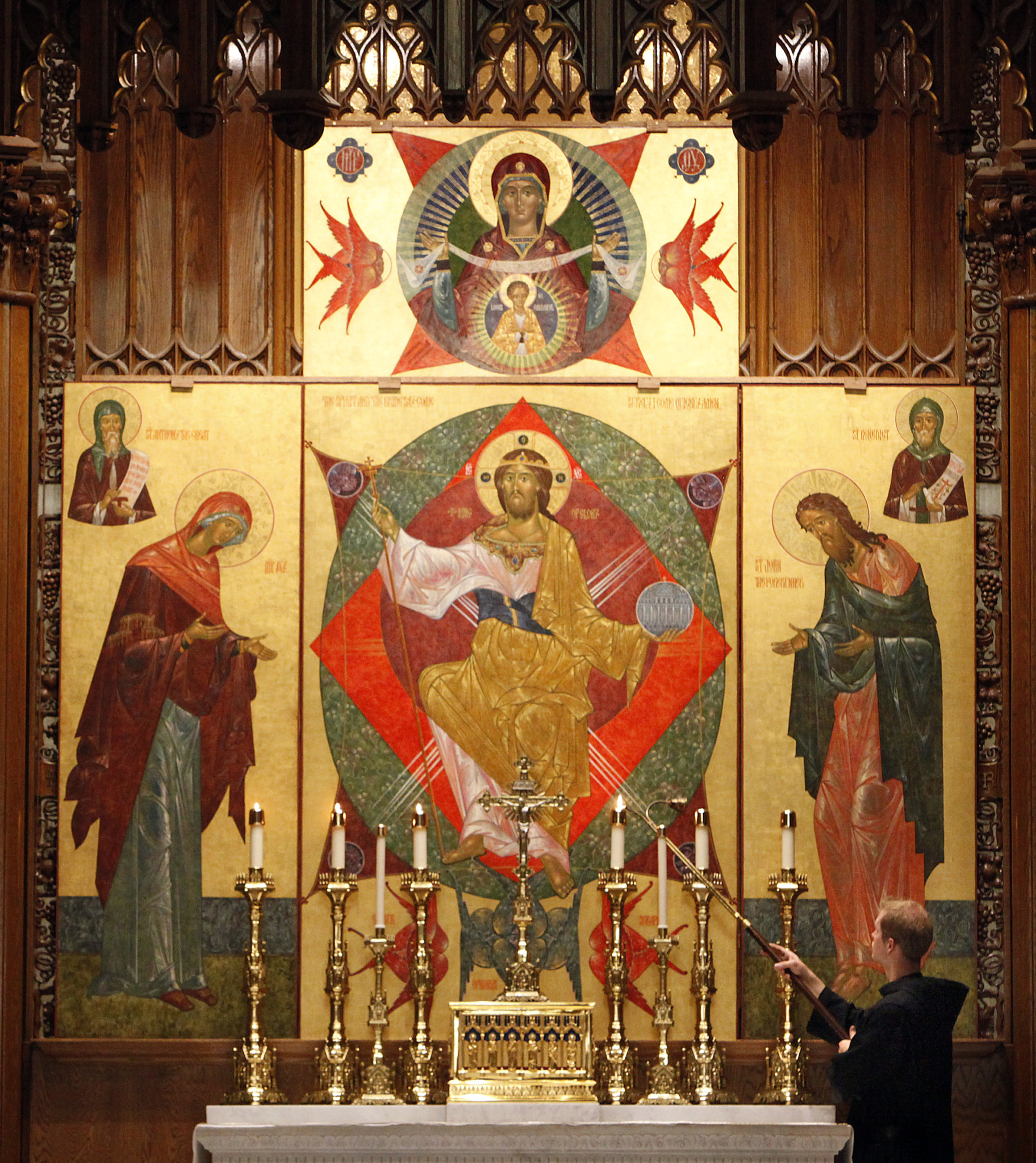
We recently installed a new high altar and choir stalls. We had known for a long time that we needed the old ones replaced. But the impetus for the change was the gift of three beautiful icons by a good friend of ours. And this gift opened our imaginations to discover potential in our church building that we might not have thought of otherwise. Had we set out to put in a new altar and then add icons, we probably would have reduced our imaginations to the somewhat run-down church that we already knew. It took a gift from someone else to produce in us monks an awareness of just how run-down our church actually was! And this in turn helped us to notice where we could make real improvements to the building, rather than just patches.

So it is with Christ. When Christ dies on the Cross and returns to us, what He invites us to is not simply a patch on our old life, but an invitation to a completely new kind of life. But just as the beautiful icon suggested to us that it was time to start over in a sense with our church building, so too, the new life that Christ offers us is an invitation to die to the old self. To do this requires renunciations, laying aside our old ways of being, and allowing ourselves to be led into the land that God will show us.

***

You can find an index to all of the posts in this series here.

On the Renunciations, Part 1

March 11, 2016

This past week, I was invited to offer a day of reflection at St. Mary’s parish in Greenville, SC. The entire event was an edifying one, with beautiful liturgies and Stations of the Cross on Friday evening. Here, I plan to reproduce and perhaps expand a bit on the talk. This first post will serve as an introduction, as well as an index for future posts (See the very bottom of this page to see an updated listing of the installments in this series.)

greenville interior

The beautiful interior of St. Mary’s, designed by Fr. Michael McInerney, OSB, from Belmont Abbey

The organizer of the event suggested that I break my talk into three parts. Being of a neo-Medieval mindset, I immediately began to ask myself which triad of topics I should choose. The Holy Trinity? The Paschal Triduum? The theological virtues? Since it is Lent, and since I thought it important to touch upon monastic spirituality, I decided to reflect on the three renunciations, according to St. John Cassian. We are all familiar with the idea of “giving up” something for Lent. Why do we do this? Is there something to this other than a temporary regime of self-improvement?

I will mainly focus on Cassian’s third Conference, but a fuller explanation of the renuciations requires that we touch on other monastic literature. The whole text of the Conferences is on-line and can be found here. To find the third Conference, follow this link.

As we will see a bit further on, Cassian was a kind of spiritual grandfather to Saint Benedict, the founder of our order. Saint Benedict says that the entire life of a monk should be like a continual Lent. If this is so, perhaps we can turn this around and say that Lent for the laity should be a taste of monastic life. In other words, the renunciations that we will examine, while intended originally for monks and nuns, should be adaptable to those outside the cloister, if we give them a bit of effort. And I believe that making this effort will help us to enter more fervently into this year’s celebration of Easter.

It is worth noting at the outset that Benedict also mentions “joy” twice in his brief chapter on Lent. Therefore the renunciations are not meant to plaster gloomy looks on our faces, but to give us renewed clarity of purpose in our lives by clearing out everything harmful or even unnecessary to flourishing.

The truth that we all make renunciations in all walks of life. This is a matter of prioritizing and schematizing life. Renouncing certain possibilities does not mean that they are evil. Marrying one man does not make all other men bad; but it does require renouncing certain types of relationships with them. Choosing a college requires renouncing attendance at others, but does not render all other colleges deficient.

As a composer, I take inspiration from something that the great Igor Sravinsky once wrote, in The Poetics of Music. It is worth quoting at length:

The creator’s function is to sift the elements he receives from [imagination], for human activity must impose limits on itself. The more art is controlled, limited, worked over, the more it is free.

As for myself, I experience a sort of terror when, at the moment of setting to work and finding myself before the infinitude of possibilities that present themselves, I have the feeling that everything is permissible to me….Igor_Stravinsky_original

Will I then have to lose myself in this abyss of freedom? To what shall I cling in order to escape the dizziness that seizes me before the virtuality of this infinitude? … Fully convinced that combinations which have at their disposal twelve sounds in each octave and all possible rhythmic varieties promise me riches that all the activity of human genius will never exhaust… I am always able to turn immediately to the concrete things that are here in question. I have no use for a theoretic freedom. Let me have something finite, definite–matter that can lend itself to my operation only insofar as it is commensurate with my possibilities. And such matter presents itself to me together with its limitations. I must in turn impose mine upon it….

My freedom thus consists in my moving about within the narrow frame that I have assigned myself for each one of my undertakings.

I shall go even farther: my freedom will be so much the greater and more meaningful the more narrowly I limit my field of action and the more I surround myself with obstacles. Whatever diminishes constraint diminishes strength. The more constraints one imposes, the more one frees oneself of the chains that shackle the spirit.

If this is true in music, how much more in the Christian life! What are we doing to shackle the Holy Spirit. In our next post, we will hear from Cassian on this important question.

Below are links to the other posts in this series:

Part 2

Christmas and Peace

December 26, 2015

I didn’t much like the song “The Little Drummer Boy” when I was young, finding it a bit trite, even contrived. Then I heard this version.

That might be the best track off of the amazing 1966 “Noel” album that Baez recorded with, of all people, Peter Schickele, better known for his PDQ Bach hilarity. It was conceived as a protest against the Vietnam War. The collaboration was such a musical success that Baez and Schickele combined for two more recordings.

Why a Christmas album for peace? I haven’t come across any interviews where Baez explains this choice. She had been, and would continue to be, outspoken against all war. She wrote many songs protesting injustice, and she recorded many songs of other writers on related topics. She could have made virtually any of her albums into statements for peace. But she chose to sing about Jesus Christ. She could have written songs using the teaching of Gandhi, who was a strong influence on her decision to found the Institute for the Study of Non-Violence. But she sang about the Prince of Peace.

So sand the prophet Isaiah, in another time of great turmoil and distress, while Jerusalem was under threat by the powerful Assyrian empire:

For every boot that tramped in battle,
every cloak rolled in blood,
will be burned as fuel for fire.

For a child is born to us, a son is given to us;
upon his shoulder dominion rests.

They name him Wonder-Counselor, God-Hero,
Father-Forever, Prince of Peace.

His dominion is vast
and forever peaceful,

Upon David’s throne, and over his kingdom,
which he confirms and sustains
By judgment and justice,
both now and forever.

The zeal of the LORD of hosts will do this!

[Isaiah 9: 4-6]

Happy Thanksgiving

November 26, 2015

“O Lord, refresh our sensibilities. Give us this day our daily taste. Restore to us soups that spoons will not sink in, and sauces which are never the same twice. Raise up among us stews with more gravy than we have bread to blot it with, and casseroles that put starch and substance in our limp modernity. Take away our fear of fat and make us glad of the oil which ran upon Aaron’s beard. Give us pasta with a hundred fillings, and rice in a thousand variations. Above all, give us grace to live as true men – to fast till we come to a refreshed sense of what we have and then to dine gratefully on all that comes to hand. Drive far from us, O Most Bountiful, all creatures of air and darkness; cast out the demons that possess us; deliver us from the fear of calories and the bondage of nutrition; and set us free once more in our own land, where we shall serve Thee as Thou hast blessed us – with the dew of heaven, the fatness of the earth, and plenty of corn and wine. Amen.”

–Robert Farrar Capon, The Supper of the Lamb: A Culinary Reflection

Belief, Behavior, Structure: More from Natural Symbols

November 3, 2015

“The system of control is validated by a typical bias in the system of belief. These tendencies are the subject of this book, for they make their own typical demands on the media of expression and thus produce natural systems of symbolic behavior.”

So this is as close to a thesis statement as I can find in Mary Douglas’s classic book on cosmology, Natural Symbols. It appears a couple of pages before the end of Chapter 4 “Grid and Group,” on pages 66-67 in my 2001 Routledge edition. Let me spend a moment unpacking this quote, then offer an example from monastic life to show why the ideas in this book are so important.

For any community to function, it must be structured. If structure among human beings is to have any staying power, individual members of communities need to be invested in it. Too much disaffection among too many members leads to a breakdown in cooperation, mutual trust and understanding. In order to be invested in the community structure, individuals must share some kind of belief in what they are doing and how the structure harnesses their individual efforts toward the common goal. This “system of belief” thus “validates” the “system of control,” or what I am here calling by the more benign term structure. This is the gist of the first sentence. Without a common belief, structure will falter.

Let’s apply this to a monastery.  A monastery traditionally is envisioned as a kind of family with the abbot as father and the rest of the community as sons and brothers. The brothers themselves have a pecking order. Saint Benedict’s Rule is quite firm about brothers observing clear rank based on date of entrance to the monastery. I will have much more to say about this aspect of the Rule tomorrow. For now, I merely need to point out that the behavior of individual brothers is limited, guided and structured by a system. In this system, the abbot has final say over everything. Junior members show respect to seniors (by giving place, using honorary titles, and so on), and seniors are to love the juniors (by watching over their spiritual growth, using familiar titles of fondness). This is a monastic “system of control.” Brothers do not usually feel free to act outside of these structured relationships. When they do step outside of this system, there is a long disciplinary code awaiting them and a series of penances to be assigned to bring the erring brother back into a just place within the structure.

For this structure to be legitimate, for it to have validity, Bit must be connected to a plausible common system of belief. At root, this system of belief is just the gospel, but in the specific locale of the cloister, Benedict extends Biblical and liturgical teaching to validate a very particular structure he has legislated. “The abbot is believed to hold the place of Christ.” Note that this places the most stringent demands on the abbot himself, who is repeatedly warned to reflect on whether his conduct and decisions are worthy of Christ. Thus the structure also controls the abbot himself, lest anyone imagine that the notion of control is a ruse for securing maximum latitude for those in power. The abbot is understood to be someone who excels in two areas: righteous conduct and correct teaching, which is to say he is someone who has internalized the ideal system of control and system of belief.

Now let’s apply all of this to the second sentence in the quote.

Human communities tend to structure themselves in a limited number of ways, and to validate these structures with typical types of beliefs. In turn, these structures and associated systems of belief give rise to typical “media of expression.” What are these media? Certainly they include ways of speaking. In the Rule, monks are not to speak until spoken to, and in particular they are to listen to the abbot. When they do need to speak, they must learn to do so humbly and reasonably and at the appropriate time. So beyond the actual words used, monks communicate by signs of humility. They also signal their intentions by making use of correct times and places (monks are not to contend with their abbot, even outside of the cloister, for example). In fact, we can take this much further. Monks communicate in all kinds of silent ways: in the order in which we stand at liturgy and sit at table, in the way we dress and cut our hair, in the way we care for the tools of the community, the way in which we comport ourselves in the oratory, and so on. This is properly symbolic behavior, and Mary Douglas convincingly demonstrates that the type of symbolic behavior depends on (and in turn influences) the community structure and belief.

For the sake of simplicity, I like to summarize this whole nexus of ideas with a diagram, which I will attempt to render within the limits of blogging software:

media of expression/symbolic communication

⇑                                     ⇑

⇓                                     ⇓

system of control/structure        ⇔            system of belief

So we have three mutually influencing ideas, from the most interior and intellectual (belief), through the exterior and bodily (symbolic communication), to the most public and collective (structure). Tinkering with any one area will change the others in subtle ways, though Dame Mary strongly suggests that we can predict relatively well just how these changes will play out.

Let me offer one insight that we have had here in our monastery from reflecting on this schema. Much of our interior monastic work involves battling sinful thoughts. I have discovered that many brothers find this spiritual warfare very difficult and discouraging. From a bit of digging and creative rethinking of various aspects of the broadest tradition, we’ve discovered that the exclusive dwelling on thoughts, without attention to how we comport ourselves bodily (and express ourselves, often unwittingly), and without attention to how we maintain community structure, will often lead to exactly this frustration. This is because our bodily behaviors (my pet peeve in this area is monks rushing about–the quickest way to get a rebuke from the superior in Chicago) are undermining our beliefs.

Another vast area of potential cognitive dissonance arises in the area of community structure. Brothers enter the monastery from a world where we believe in a distinction between the public and the private. But this is very much at odds with Benedict’s structure. If we were completely strict in this area, we would not have individual rooms. We would instead all sleep in a common dormitory. Even more, seniors would regularly inspect the beds for any items that monks have stashed away for private use. Now, to be fair, common dormitories have almost never worked in our tradition. But this is a major problem for modern monks, for whom the cell is not intuitively a place of emptiness and pure prayer. From habit, the cell tends to devolve into a simple bedroom, a place to go to be alone, rather than to go to be with God. But if this is so, is it any wonder that at the time of prayer, we are hounded by self-serving thoughts and the fear that God is distant? We’ve encoded this into a space where we spend perhaps half of our day.

So often enough the answer to obsessive thinking is a change of behavior in the areas of bodily comportment and submission to community structure. This takes a lot of the heat off of the individual brother, who can relax a bit into allowing the practices of the life to change him from the outside in.

How to Keep from Being a Cult

October 31, 2015

My blog isn’t particularly about the Benedict Option, but I have paid attention to the discussion that blogger and journalist Rod Dreher has occasioned by his efforts to unpack the last page of Alasdair MacIntyre’s important book After Virtue. He’s linked to me again (thank you!), and so I need to put out some more product. Years ago, I resisted reading MacIntyre, mostly because I didn’t have a lot of confidence in cultural conservatives to instigate a genuine moral reform of society, much as I felt that we needed it. And I figured that MacIntyre’s book was part of the conservative virtue brigade, a la William Bennett (it’s not). I’ve never been keen to the liberal/conservative divide that is woven into the general fabric of the modern world since the French Revolution. I’ve often felt about conservatism as I do about classical music (much as I like it). Whatever the merits of Mozart–and there are many, many of these–repeating Mozart over and over again will not revive the ancien regime. We may even distort our minds and waste valuable time pining for something totally imaginary, and not all that desirable in the end.

The social world that made Mozart possible is gone, and this is not entirely a bad thing. The social world that made the composition of Gregorian chant possible is almost gone, and this is definitely not a good thing.

How to revive monasteries? This is the question that Benedictines and others have been scrambling to answer since the suppressions of the Reformation and the Revolution. Just as we seemed to have answered it, as vocations were pouring into monasteries in the 1950’s, we discovered that the Western social milieu, that seemed so open to deep religious sentiment and observance, turned out not to have the goods after all. Large proportions of those vocations left the monasteries once the glow wore off and the 70’s got going.

The two options usually held out for religious life parrot the conservative/liberal divide: either return to strong, traditional observances (usually ones from the 1950’s, which were the same ones that failed to win the hearts of the droves who left in the 1970’s), or figure out ways to accommodate to a new cultural situation. Let me examine each option using the tools that Mary Douglas offers us in Natural Symbols.

First, let’s dismiss the accommodation possibility. Accommodate to what? Douglas begins her book with a withering review of the attempts of English bishops after the Second Vatican Council to update Friday abstinence and replace its dense symbolism (participation in the Passion, clear social demarcation from non-Catholics) with something more internal, “moral,”–perhaps we might say “sincere.” I will have a lot more to say about the social conditions that determined the bishops’ preferences for dumbing-down ritual and hyping up “heart religion.” Let me just note here that Dame Mary misses no opportunity gently to chide those who imagine that this heart religion is more advanced and progressive than the magical world of the lower-class “Bog Irish” for whom Friday abstinence was a matter of fidelity to a beleaguered homeland and the grandeur that was Rome. Anthropologists of the 1950’s could provide myriad examples of “primitive” African pygmy societies whose religion played more or less the same tune as the highly educated clerics who imagined themselves on the cutting edge.

What accommodation amounts to, If Prof. Douglas is correct, is the willing, albeit unwitting, suicide of the sacramental cosmic worldview of traditional Catholicism and Orthodoxy. So it’s not a road we can take if we are serious about belonging to a Mystical Body that includes Saint Paul, St. Basil, St. Benedict, St. Gertrude the Great, St. Hildegard of Bingen, Dante, St. Symeon the New Theologian, etc.

But what does non-accommodation look like? Critics of the Benedict Option challenge advocates to demonstrate that communities opting out will not become ingrown and cultish. Dame Mary has advice on this score, too.

In social arrangements that she calls “small group,” we see just these characteristics: strong boundaries separating the group from the external world, and fear of contamination by a world dominated by maleficent forces lurking everywhere outside and threatening to infect the group. She doesn’t spend a lot of time on these groups, but what she has to say contains more than enough information to know how to avoid becoming a cult (or, for that matter, how to become one, if that’s what you’re gunning for).

The small group is one in which the numbers are genuinely low. More importantly, authority is weak, and therefore internal structure is confused. Because authority is weak and structure is confused, the group is in constant danger of disintegrating, and generates for itself a fear of evil influences and a high premium on internal purity (both in terms of the group and the individual). This is a congregation of the saved, and they are saved by their own efforts of purification and prophylactic measures against a corrupted world.

I’ve pointed out to the brothers that the Rule of the Master gives us a perfect description of “small group.” And it is part of Saint Benedict’s great genius and sanctity that he corrects these tendencies of the Master in order to produce a community structure that it clear, articulated by ritual and symbol, discerningly open to the world, flexible and sure of itself (because based in Christ, the Logos, whose ordering principles are seen to inhere in the cosmos daily redeemed in the Holy Eucharist and Divine Office). Here is an example of the counter-intuitive fruits of taking Mary Douglas seriously: when a brother is struggling with thoughts, his first attempts to deal with them often involves an attempt to purify himself inwardly by an effort of will, coupled with a feeling of shame and guilt for having this inward impurity. My advice: definitely work against the thought, but often enough these troubling thoughts are a product of an unwillingness to observe clear roles within community life, to confuse structure and therefore to act inadvertantly as if we were a cult obsessed with internal purity. We desire internal purity, but we achieve it by accepting joyfully the roles that Providence has given us through the medium of the Church. So: keep your place in rank, honor those senior to you, love those junior to you, show up for things on time, follow Benedict’s Rule as literally as you can. This takes the heat off of the spiritual battle and involves the whole structure of the Church in the fight, and it offers the brothers the confidence of having a special place within the Church, a confidence that our spiritual foes really can be overcome by the power of Christ animating His Body.

Mary Douglas offered this advice to millennial movements: learn to organize! She died before she could watch movements like the Tea Party and Occupy Wall Street get undermined because of their steadfast refusal to organize. Benedictine Option pioneers should work to avoid the related fate of the irrelevant sectarian movements by learning to organize. There is a direct connection between the kind of social body we live in and the beliefs that we hold and behaviors that we legitimate. The connections between these three levels of 1) mind, 2) body, and 3) society I hope to explore in the next post on Natural Symbols.

Does Chant Style Matter? Part 1

October 21, 2015

Pray Tell Blog recently posted my review of Benedicta, a CD collection of Marian chants sung by the monks of Norcia. It’s really two reviews in one. One part of me admires the lovely singing, the warmth of tone, and the ringing intonation of the brothers’ voices. On this level, the recording stands up with the better chant recordings I’ve heard. The other part of me is uneasy, however, about some choices the monks made. Among these choices was their use of the “Solesmes method” of interpretation (which, as I understand, is no longer used even at Solesmes Abbey itself), which I identified as part and parcel of the larger problem of presenting the chants without context. The lone comment on the blog suggests that it shouldn’t matter whether the Solesmes method or some other approach is used. What matters is that the music is beautiful.

Even before reading the comment, I was puzzling over what I take to be the importance of getting past the Solesmes method. Is my position truly defensible? Or is it a personal preference? I believe that my position is rational, and therefore to be preferred to a ‘pre-rational’ assessment.

But defending my position will take some work. Let me give an example of the uphill battle we’re talking about here.

I was at a reception after Vespers recently, speaking with two members of our own Schola Laudis. I mentioned to them that one of the things driving my interest in chant and Renaissance music at the liturgy is that I was seeking a rational way to go forward with the composition of church music. I meant by this that we should have reasons for choosing one type of music over another. When it comes to church music, it seems that we are usually content with saying that we want music that is beautiful. Fair enough. Would it be too pedantic of me to ask why we consider some music to be beautiful and other music to be maudlin, ugly, or overly sentimental? Some people consider “Send in the Clowns” to be a beautiful song (me…not so much, though I get its appeal). I personally find the Prelude to Wagner’s opera Tristan und Isolde to be quite beautiful, in its way. These are not, and should not (I think) be models for church music. Many people, on the other hand, find Gregorian chant dull, elitist, hard to understand, difficult to sing with any connection to one’s emotions, etc. Yet church documents make very clear that this style is the basis of our sacred music tradition.

Much of what we take to be beautiful depends on our cultural upbringing and, one hesitates to point it out, on our level of achievement in virtues like moderation, chastity, and humility. Lacking such virtues might lead us to prefer ecstatic music to sober music, manipulative music to ordered music, or simply music that we liked as children to music that adults tell us we’re supposed to like when our tastes develop a bit more.

Therefore, simply saying that music ought to be beautiful is not specific enough. Church music needs to be beautiful to certain types of persons. And those of us who are not yet those sorts of persons need to be able to make an act of faith that the beauty of such music will become more apparent as we grow in virtue and knowledge. Furthermore, I think that it is reasonable, based on experience, to hope that exposure to “virtuous” music will actually assist us in growing in virtue (this argument goes back at least to Plato, though it is much contested). We have more likely been exposed to the opposite phenomenon, someone descending into vice accompanied by depressing, libidinous, or cruel music.

What remains, then, is for me to explain why the approach taken by the Norcia monks is delightful on one level, but, in my opinion, does not quite approximate the beautiful in the fullest sense. Furthermore, I should be able to show that their recording falls somewhat (not entirely, mind you) short of what it could have been because of specific choices that they made: the use of the Solesmes method, and the somewhat random manner in which the chants were selected (random with regard to liturgical rationales). These proofs will have to wait for a later post.

Bonus tracks: Prelude and Liebestod from Tristan und Isolde…music that is not quite chaste, deliberately eliding tonal boundaries in a manner uncomfortably parallel to the elision of marital boundaries in Wagner’s personal life at the time of its composition. He was falling in love with Mathilde Wesendonck, and perhaps carrying on an affair with her. Wagner’s indiscretions resulted in his separation from his wife Minna.

Here’s my example of ‘ecstatic’ music, “Giant Steps” by John Coltrane, a piece not without its own kind of beauty and order, yet clearly not in any way a model for church music.

And surely you didn’t think I’d leave you without “Send in the Clowns…”


  • « Go to Previous Page
  • Go to page 1
  • Interim pages omitted …
  • Go to page 21
  • Go to page 22
  • Go to page 23
  • Go to page 24
  • Go to page 25
  • Interim pages omitted …
  • Go to page 28
  • Go to Next Page »

Blog Topics

  • Beauty (22)
  • Contemplative Prayer (60)
  • Contra Impios (2)
  • Culture (32)
  • Discernment (32)
  • Formation (16)
  • General (43)
  • Going to the Father (18)
  • Gregorian Chant (5)
  • Holy Spirit (7)
  • Jottings (27)
  • Liturgy (98)
  • Meditations on Heaven (4)
  • Monastic Life (58)
  • Moral Theology (53)
  • Music (18)
  • Scripture (60)
  • The Cross (3)
  • Vatican II and the New Evangelization (21)

Blog Archives

  • April 2026 (2)
  • March 2026 (4)
  • February 2026 (3)
  • January 2026 (2)
  • December 2025 (6)
  • November 2025 (4)
  • October 2025 (2)
  • September 2025 (2)
  • August 2025 (3)
  • July 2025 (4)
  • June 2025 (4)
  • May 2025 (3)
  • April 2025 (4)
  • March 2025 (4)
  • February 2025 (3)
  • January 2025 (5)
  • December 2024 (8)
  • November 2024 (3)
  • October 2024 (9)
  • September 2024 (8)
  • August 2024 (9)
  • July 2024 (9)
  • June 2024 (8)
  • May 2024 (9)
  • April 2024 (4)
  • November 2023 (1)
  • April 2023 (1)
  • December 2022 (1)
  • October 2022 (1)
  • March 2022 (1)
  • February 2022 (1)
  • August 2021 (2)
  • June 2021 (1)
  • May 2021 (1)
  • April 2021 (1)
  • February 2021 (2)
  • January 2021 (1)
  • December 2020 (1)
  • August 2020 (4)
  • June 2020 (1)
  • May 2020 (4)
  • April 2020 (9)
  • March 2020 (4)
  • February 2020 (1)
  • January 2020 (1)
  • December 2019 (1)
  • July 2019 (2)
  • June 2019 (1)
  • May 2019 (1)
  • April 2019 (2)
  • March 2019 (1)
  • February 2019 (3)
  • January 2019 (1)
  • December 2018 (1)
  • November 2018 (2)
  • October 2018 (2)
  • September 2018 (2)
  • August 2018 (1)
  • July 2018 (2)
  • June 2018 (4)
  • May 2018 (7)
  • April 2018 (1)
  • March 2018 (1)
  • February 2018 (1)
  • January 2018 (2)
  • November 2017 (1)
  • October 2017 (1)
  • September 2017 (1)
  • August 2017 (1)
  • July 2017 (2)
  • June 2017 (2)
  • March 2017 (1)
  • February 2017 (2)
  • December 2016 (1)
  • November 2016 (3)
  • August 2016 (2)
  • May 2016 (2)
  • April 2016 (5)
  • March 2016 (2)
  • December 2015 (1)
  • November 2015 (2)
  • October 2015 (3)
  • August 2015 (10)
  • July 2015 (12)
  • June 2015 (17)
  • May 2015 (2)
  • April 2015 (7)

In This Section

  • Benedictine Life
  • History
  • Video Gallery
  • Et Incarnatus Est – The Prior’s Blog
 
© 2026 Monastery of the Holy Cross
  • Accessibility
Web Design by ePageCity