Monastery of the Holy Cross

  • Home
  • About
    • Benedictine Life
    • History
    • Video Gallery
    • Et Incarnatus Est - The Prior's Blog
  • Visit Us
    • Guesthouse
    • Prayer Schedule
      • Christmas 2025
    • The Catholic Readers Society
    • Caskets
  • Vocations
    • Monastic Experience Weekend
    • Formation
    • Oblates
      • Oblate Podcast
  • Solemn Vespers
    • Solemn Vespers for Mary, Mother of God
    • Chant
  • Contact
  • Donate

Articles tagged with culture

Does Chant Style Matter? Part 1

October 21, 2015

Pray Tell Blog recently posted my review of Benedicta, a CD collection of Marian chants sung by the monks of Norcia. It’s really two reviews in one. One part of me admires the lovely singing, the warmth of tone, and the ringing intonation of the brothers’ voices. On this level, the recording stands up with the better chant recordings I’ve heard. The other part of me is uneasy, however, about some choices the monks made. Among these choices was their use of the “Solesmes method” of interpretation (which, as I understand, is no longer used even at Solesmes Abbey itself), which I identified as part and parcel of the larger problem of presenting the chants without context. The lone comment on the blog suggests that it shouldn’t matter whether the Solesmes method or some other approach is used. What matters is that the music is beautiful.

Even before reading the comment, I was puzzling over what I take to be the importance of getting past the Solesmes method. Is my position truly defensible? Or is it a personal preference? I believe that my position is rational, and therefore to be preferred to a ‘pre-rational’ assessment.

But defending my position will take some work. Let me give an example of the uphill battle we’re talking about here.

I was at a reception after Vespers recently, speaking with two members of our own Schola Laudis. I mentioned to them that one of the things driving my interest in chant and Renaissance music at the liturgy is that I was seeking a rational way to go forward with the composition of church music. I meant by this that we should have reasons for choosing one type of music over another. When it comes to church music, it seems that we are usually content with saying that we want music that is beautiful. Fair enough. Would it be too pedantic of me to ask why we consider some music to be beautiful and other music to be maudlin, ugly, or overly sentimental? Some people consider “Send in the Clowns” to be a beautiful song (me…not so much, though I get its appeal). I personally find the Prelude to Wagner’s opera Tristan und Isolde to be quite beautiful, in its way. These are not, and should not (I think) be models for church music. Many people, on the other hand, find Gregorian chant dull, elitist, hard to understand, difficult to sing with any connection to one’s emotions, etc. Yet church documents make very clear that this style is the basis of our sacred music tradition.

Much of what we take to be beautiful depends on our cultural upbringing and, one hesitates to point it out, on our level of achievement in virtues like moderation, chastity, and humility. Lacking such virtues might lead us to prefer ecstatic music to sober music, manipulative music to ordered music, or simply music that we liked as children to music that adults tell us we’re supposed to like when our tastes develop a bit more.

Therefore, simply saying that music ought to be beautiful is not specific enough. Church music needs to be beautiful to certain types of persons. And those of us who are not yet those sorts of persons need to be able to make an act of faith that the beauty of such music will become more apparent as we grow in virtue and knowledge. Furthermore, I think that it is reasonable, based on experience, to hope that exposure to “virtuous” music will actually assist us in growing in virtue (this argument goes back at least to Plato, though it is much contested). We have more likely been exposed to the opposite phenomenon, someone descending into vice accompanied by depressing, libidinous, or cruel music.

What remains, then, is for me to explain why the approach taken by the Norcia monks is delightful on one level, but, in my opinion, does not quite approximate the beautiful in the fullest sense. Furthermore, I should be able to show that their recording falls somewhat (not entirely, mind you) short of what it could have been because of specific choices that they made: the use of the Solesmes method, and the somewhat random manner in which the chants were selected (random with regard to liturgical rationales). These proofs will have to wait for a later post.

Bonus tracks: Prelude and Liebestod from Tristan und Isolde…music that is not quite chaste, deliberately eliding tonal boundaries in a manner uncomfortably parallel to the elision of marital boundaries in Wagner’s personal life at the time of its composition. He was falling in love with Mathilde Wesendonck, and perhaps carrying on an affair with her. Wagner’s indiscretions resulted in his separation from his wife Minna.

Here’s my example of ‘ecstatic’ music, “Giant Steps” by John Coltrane, a piece not without its own kind of beauty and order, yet clearly not in any way a model for church music.

And surely you didn’t think I’d leave you without “Send in the Clowns…”


Who Is Running the Renewal?

August 28, 2015

I’ve been trying to figure out what it is about George Weigel’s recent post “Catacomb Time?” doesn’t sit right with me. I suspect that it is first of all due to an accumulation of fuzzy complaints with someone-or-other not quite specified. Who inhabit those “Catholic circles” who have “a passion for writing Build-It-Yourself Catacomb manuals”? I honestly have no idea who is meant by this. I suppose that he is referring to the Benedict Option, for which there is no shortage of critics, despite the fact that no one seems to know what it is exactly. The reference to “lukewarm, pick-and-choose” Catholics is always a dangerous one. Who of us doesn’t fall into the “pick-and-choose” category from time to time, even often?

Then there is this larger quote, expressing what seems to me a common enough sentiment, but one I just can’t get behind personally:

This same judgment—Catholicism by osmosis is dead—and this same prescription—the Church must reclaim its missionary nature—are at the root of every living sector of the Catholic Church in the United States: parish, diocese, seminary, religious order, lay renewal movement, new Catholic association.

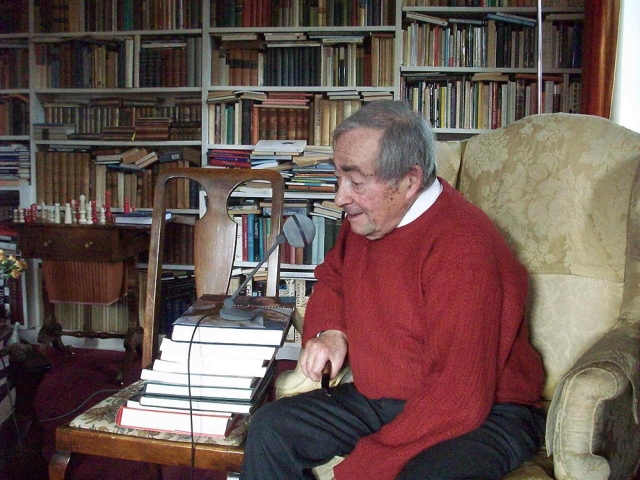
George Steiner in my dream study. He proposes "cortesia" (courtesy) as a mode of mutuality as a partial antidote to a critical and wordy discourse that empties language of its theological import.

George Steiner in my dream study. He proposes “cortesia” (courtesy) as a mode of mutuality as a partial antidote to a critical and wordy discourse that empties language of its theological import. In this, he comes remarkably close to Benedictine “hospitality” as a mode of encounter, and perhaps a way to reinterpret “mission” away from the excessive freight of unidirectional conquest toward a humble acknowledgement of the potential contributions of potential converts.

“Every living sector” of the Church in a country of almost 70 million Catholics? That’s a big claim. I think what troubles me most about this sort of language is the absence of any feint in the direction of the work of the Holy Spirit in animating the Church. Then there is the question of whether my own religious community qualifies as a “living sector” and whether we actually share that judgment and prescription. One reason I balk at that way of phrasing the “judgment” that “Catholicism by osmosis is dead,” is that it privileges what Mary Douglas refers to as “elaborated speech code” (the language of academia, personal commitment and conviction, related to what George Steiner calls out at the beginning of Real Presences) at the expense of “restricted speech code,” the more passive communicative modes of ritual and symbol. Much of what we learn in the Church is at least somewhat osmotic. Yes, we should pay attention at the liturgy, but often times it takes all kinds of exposure at various levels of awareness and engagement before connections are made. Perhaps I sense here, fairly or unfairly, a neglect of the fundamentally receptive nature of faith, prior to any genuine engagement in mission. St. Paul, the greatest missionary of all, spent well over a decade anonymously living the life of a Christian before the Holy Spirit set him apart as the Apostle of the Gentiles. During that time, what was he doing? Praying? Re-reading the Scriptures? I don’t know, but it was certainly a life of withdrawal, maybe not to the catacombs, but a withdrawal nonetheless.

And then let us not forget who is the patroness of the Church’s missions.

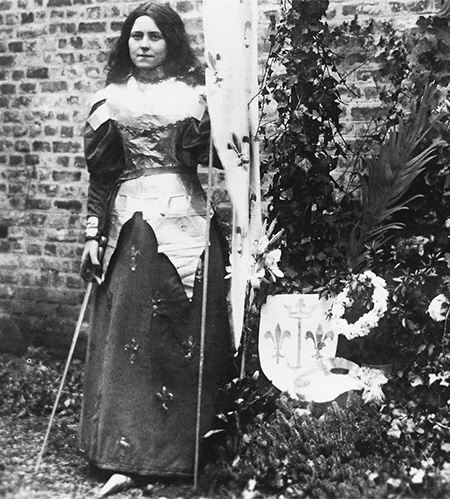
Behind the Church's missionary activity is St. Therese's little way of complete faith in all things.

St. Therese, patroness of the missions. Behind the Church’s missionary activity is St. Therese’s hidden little way of complete faith in all things.

I will leave it to reader to think about the connections between the contemplative life and missionary effectiveness.

Let me end with a little more explanation from Mary Douglas. In the first chapter of Natural Symbols, she relates asking her progressive clerical friends (in 1970) why they think it’s a good idea to move away from the Friday abstinence to more personally meaningful acts of charity–like working in a soup kitchen on Friday.

I am answered by a Teilhardist evolutionism which assumes that a rational, verbally explicit, personal commitment to God is self-evidently more evolved and better than its alleged contrary, formal, ritualistic conformity.

I will admit to nitpicking here a bit, but I think that it is worth watching our language very carefully on these points, lest we saw off the branch upon which we sit. The overall tone of the article supports an individualistic and activist mode of Church life that has the potential to undermine the communal, receptive, gratuitous, gracious, and humble life of faith and hope. Surely one of the points of the young Josef Ratzinger’s “Future Church” article is precisely that we are being called away from “edifices…built in prosperity,” as part of an invitation to leave behind triumphalism. Weigel comes uncomfortably close to a triumphalism-minus-edifices. It is striking that after the long quote from the future pope, a quote that ends with an emphasis on “faith in the triune God, in Jesus Christ, the son of God made man, in the presence of the Spirit until the end of the world,” Weigel never again mentions faith, Jesus Christ, or even God. Again, I will admit that finding such lacunae in a blog post runs the risk of straining justice. But as a monk, I am inclined to be watchful on these counts.

More than anything, this serves as an introduction to Mary Douglas, whose work I have put off writing about for long enough…

UPDATE: Recall that the relationship between mission and contemplative life is the crux at which our community began. Also, that while it is hard not to agree that practicing one’s faith will require great resolve and strength in the coming years, maybe decades, this must be a practice rooted in repentance and joyful humility, grounded in the sacrifice of Calvary, celebrated daily in the liturgy. Finally, while Fr. Ratzinger did say that the future Church will make “bigger demands on the initiative of her individual members,” [emphasis added] this mention of individual members needs to be read in the context of the future pope’s voluminous writings on the liturgy and the Church. The initiative he is calling for surely must be greater fidelity to the reality of the ongoing Incarnation in the local church (including a high mystical “Ignatian” vision of the bishop as Christ and priests as the bishops’ vicars). Otherwise, Weigel might be heard to be inviting individuals to greater creativity, initiative in a maverick kind of sense, rather than in a sense of responsive answerability toward the gospel. And the first step may well be admitting that I’m part of the problem with the contemporary Church.

Emotivism: a Prelude

August 21, 2015

Christians are called to conversion, to become different kinds of persons, a different kind of community. The liturgy is the place where we learn what sort of persons we are to be. I’ve given a number of theological reasons for this in recent weeks. I’d like now to turn to some other considerations.

First of all, what are we being converted from? The typical answer would be, “Sin.” And this is correct. But there is actually something more, something subtler that the gospel reveals. Baptism was frequently referred to in the early church as “Enlightenment.” So not only did baptism bring forgiveness of sins and sanctifying grace, but it brought about a change of thinking, a revelation, light and clarity where there had been darkness and obscurity, sight where there had been blindness.

The typical blind person in the gospels is, revealingly, the Pharisee. The Pharisees, it should be noted, were generally held to be models of virtue by the Jews of the day, and with good reason. They followed the Torah, kept ritually clean, tithed, looked after the poor, and all the rest. And yet, the Lord refers to more than one of them as blind. From this we can see that “sin”–understood as transgressions of specific laws–is not sufficient as an explanation of the worldview that we are meant to turn away from.

Gamaliel, a teacher of the law, held in honor by all the people (Acts 5: 34)

Gamaliel, a teacher of the law, held in honor by all the people (Acts 5: 34)

Saint Paul exemplifies this situation. He says in his own words that by the standards of the law, his younger self–a Pharisee–was blameless. What changed? We are apt to say something like, “He realized that he needed to be saved by faith instead of the law.” Now this gets us closer. But recall the question we are asking: from what sort of life are we being converted? This can’t be a rejection of the law, since those who do not keep it and prevent others from keeping it are least in the kingdom.

In Chapter 7 of Paul’s letter to the Romans, Paul makes some suggestive (though difficult) remarks. He writes about “sinful passions.” This word “passion” comes to play a big part in monastic spirituality and later throughout the Church (though with somewhat less emphasis). Passions are not the same as feelings. Simple movements of emotion are a natural part of our bodily structure. A feeling becomes a passion when we distort it by liking it beyond reasonable measure, seeking it out, treasuring it, allowing it to bend our minds. This is the source of blinding. When we are under the spell of a passion, we no longer think straight. We all know this in some obvious cases. All one has to do is listen to talk radio or read internet comment threads to discover that anger renders people narrow and illogical. We all have known persons (perhaps ourselves) who, enticed by an attractive person, leave all caution and good sense to the wind.

The law itself can have this effect. Paul was so good at the law that he took pride in fulfilling its prescriptions, and this pride became a debilitating passion in him. So much so that he failed to see that he was acting against God when he was persecuting the early Christian sect. A wiser Pharisee, Paul’s own teacher Gamaliel showed better sense when he urged that Sanhedrin to leave the Christians alone, lest they “even be found opposing God [see Acts 5: 33-40].” Young Saul thought he knew better than Gamaliel and even convinced the Sanhedrin to go against Gamaliel’s sound advice [see Acts 22: 3-5].

Now to our peculiar danger: according to Alasdair MacIntyre, our Western culture is an emotivist culture, and has been for some time. What is emotivism? I will use one of the next posts to give a fuller answer to that question, but here’s an attempt at a short answer. An emotivist is not as interested in truth as he or she is in effectiveness. And to oversimplify more, an emotivist wants to put in effect whatever he or she feels to be good. If MacIntyre is correct, we have wandered into an institutionalized blindness, for we have placed the passions in the driver’s seat, unaware that our arguments are not rational (an emotivist only pretends to be rational because an argument that appears to be rational is more effective than one that is naked nonsense).

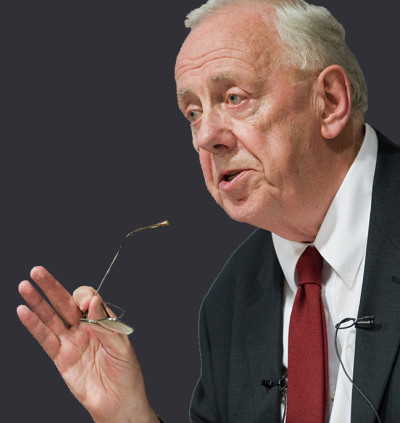
MacIntyre

MacIntyre

If the above is true, our conversion today needs to be away from emotivism toward genuine Truth and virtue. This is the spiritual analog to the argument put forward by MacIntyre over thirty years ago in After Virtue. It is worth noting that the traditional spiritual triad of the purgative, illuminative and unitive ways begin with the healing of behavior (purgative) and then of the mind (illuminative). For reasons that I hope to show in my coming post on emotivism, the problem with emotivism is precisely that it disposes us to willfulness and blindness, the opponents of virtue and truth. This can be true even when we have the outward appearance of a devout life of prayer and service. Emotivism hampers our ability to present the gospel to others, since it disposes us to hear the gospel in terms of effectiveness (and effectiveness in terms of realizing personal desire, not effectively achieving actual justice or compassion), rather than in terms of truth.

There is a lot to unpack here. Please send any questions you have to me, and I will try to clarify anything that you are having difficulty understanding. I will try to go slowly, as this is an important topic and worth the time it takes to master it.

Liturgy and the Stance of Weakness

July 1, 2015

Much of the exasperation with what people term “organized religion” comes from the fact that the Christian church has often given so much weight to doctrinal accuracy that the life-giving potential of worship, and faith itself, gets lost in the shuffle, made all but inaccessible to the skeptical multitudes. The poet Jonathan Holden epitomized a common attitude when he stated in The American Poetry Review that because “religious doctrine delivers us an already discovered, accepted, codified system of values–official truth,” a truth he defines as “static,” it can never attain the authenticity of a well-made work of art.–Kathleen Norris, Amazing Grace: A Vocabulary of Faith

I for one am grateful to profit from the great work of the saints, theologians and philosophers who have gone before me and have done so much to clarify the teachings of the Church. But I see Holden’s point here.

There is a danger to inheriting an accepted, codified system of values. We Catholics can lose our hunger for the dynamism of faith, a dynamism that is fueled by challenges, doubts and arguments. It is a gift to have to hand well-thought-out stances from the Catechism and Canon Law, but how do I know if I understand them properly? How can I be sure that I am applying them in the correct contexts?

An example I like to use is the “universal call to holiness.” This is a good, solid teaching rooted in the one baptism that all Christians share. It became obscured with the rise of a type of clericalism in the Middle Ages, along with the rise of the religious orders. Before the Second Vatican Council, it could appear that the Church had two levels of holiness, the religious and ordained ministries, and then the laity. The Council Fathers stated clearly that all members of the Church are called to holiness.

In my experience since the Council, this teaching is often misinterpreted, ironically enough, because of a lingering bias toward clericalism. “The priests had their turn to be holy [meaning occupying privileged places at the liturgy and elsewhere] and now it’s the laity’s turn.” What should have been a call to greater self-renunciation and prayer appeared paradoxically to call for greater assertiveness and personal privilege for persons who “felt called.” The universal call could even be used by religious as an excuse not to engage in holy practices, since these might reinforce the distinction between religious and laity and suggest that we still had a two-tiered structure of holiness.

What went wrong? The term and the teaching are correct, but the context in which the universal call is heard and interpreted causes a distortion. What is this context? We can describe it in many ways. Our cultural situation inclines us to atomistic individualism and its attendant focus on personal rights and equality, and our ecclesial situation, at least in the years immediately following the Council, inclined us to a “professional” understanding of the charisms, an understanding based in an overemphasis on the Church as the “Perfect Society,” and exemplified by the priest as certified dispenser of sacraments, reporting to the bishop as CEO of the diocese.

What is the correct context, then, and how do we find it, if we have to live in a culture that causes these distortions? The answer is found in the liturgy. Ut legem credendi lex statuat supplicandi. “That the law of praying established the law of believing.” Often this more exact phrase is rendered more simply, “Lex orandi lex credendi,” the law of prayer is the law of belief. In either case, we see that the “already discovered, accepted, codified system of values” should be in-formed by the practice of the liturgy, in which we conform ourselves to the high priestly prayer of Jesus Christ. This is what Kathleen Norris is after when she contrasts doctrinal accuracy with “the life-giving potential of worship.”

This also connects with what I was attempting to explain in yesterday’s post. Church teaching has not recognized same-sex marriage, and the weight of tradition is against such recognition. But how do we understand and live the truth of this teaching? As I wrote yesterday, I don’t really know, and I’m not sure that anyone is all that sure. We are in uncharted waters, and the biases of my own culture are against me [see: The first engagement with culture is at the level of thoughts]. I need a renewal of my mind and heart and I need the power of God to do this. So I must be content with my weakness.

The liturgy is the exercise of the high priesthood of Jesus Christ. When we enter the liturgy, it is Christ Who is the main ‘agent’ (which is why so many discussions about ‘active participation’ are confused), and we are all participants in His action of praising the Father in the Spirit. We are caught up in a world being brought into being, a world in which the True Light enlightens our minds and hearts that we may discern what is God’s will and carry it out with courage. At the liturgy, it is alright to be weak, because there God is strong, and this becomes our default stance toward the world. Liturgy is also full of a lot of confounding rites, texts, vestments and stimuli at once disorienting and reorienting. In this space of conversion to a new orientation toward Christ in all things, we have the chance to reassess argument, to hear anew the Word instructing us. We also see and experience the persons to whom we must first submit our ideas for living a new life. The liturgy sets the bounds of the community of faith and gives us our first audience for a new understanding.

More to come.

Obergefell v. Hodges: Second Thoughts

June 30, 2015

In my “first thoughts,” I suggested that Christians interested in upholding the Church’s view of marriage might be better off letting go of a language of rights, since rights divide a coercive power from a class of victims. Turning this around we can also say that appealing to rights is a way of claiming the mantle of a victim and casting the Other as a victimizer. Either way, I think that it is clear that any sense of a genuine common good is undermined, subtly, by naked appeals to rights. Catholic social teaching depends on a clear sense of a common good, and a disciplined determination to live by it.

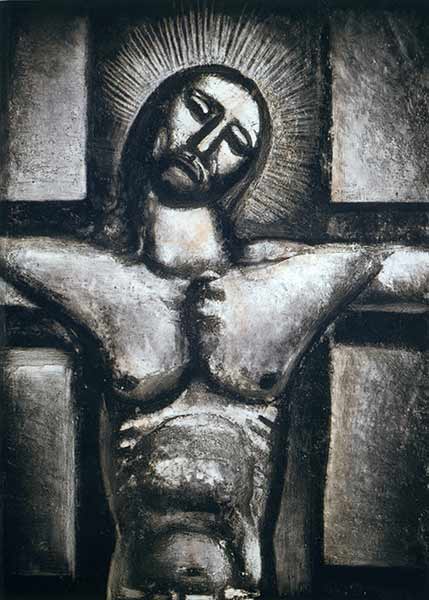
from Georges Rouault, Miserere

from Georges Rouault, Miserere

Here is where quite a bit of “Benedict Option” language also seems counterproductive, probably unintentionally. It sets the Opting party against the world. The language of separation tends toward a language of rejection. Now of course there are many attitudes in today’s dominant culture that a disciple of Jesus Christ must reject, and sometimes this rejection calls for disengagement from particular social structures. Repentance and conversion require new ways of living, and this means that behaviors must change. Conversion might require me to stop going to bars, or to movies, to the Freemason meetings, to my mistress’s apartment, and even to my place of employment. But the point of this is not to say, “Too bad for you, I’m outta here.” Rather, the penitent is aiming at identifying personal behaviors that are harmful and eliminating them.

If we actually believe in a common good, one of the best things that any one of us can do for others is to live a truly penitent and evangelical life. For when any one of us begins to live more vibrantly in Christ, all will benefit. Right?

And the inverse holds as well. When someone lives in contradiction to the truth, all suffer in some way.

Here is where I get to the Supreme Court ruling from three days ago. It is important to understand that what I am going to write needs to be read from a position of weakness (see my last post for an explanation).

This week’s Collect reads, in part:

grant, we pray,
that we may not be wrapped in the darkness of error
but always be seen to stand in the bright light of truth.

The bright light of truth! What a gift to know the Truth Who sets us free.

How deeply do we believe in the truth of the Church’s revelation? One of the dangerous habits of mind generated by our cultural emotivism is the assumption that any supposed statement of truth is in fact a statement of personal preference. From this perspective, all claims to truth are actually strategic claims, manipulating the hearer to feel obliged to accept what’s being stated. In other words, emotivism makes us all nihilists to some extent, perhaps a larger extent than we realize.

This conclusion, that many of us are closet nihilists, seems to me borne out by the fear, anger, and anxiety that I’ve encountered over the years when contemporary mores are discussed among Catholics. When, aided by the Church’s teaching, we identify actions as good or bad and we identify statements as true or false, how we happen to feel about the action or judgment makes no difference. Jesus Christ rose from the dead, and nothing changes about that if I happen to feel overjoyed about it or flatly unemotional. When we communicate the truth of the Faith, there is a tendency to add zest or urgency to our statements of truth by smiling, showing enthusiasm or worry or whatever. We act as if the Truth needs some goosing up, that it doesn’t stand on its own. But if the truth can’t stand on its own, it’s probably not true. [Digression: I personally see this as a weakness in the otherwise entertaining opinions penned by Justice Scalia.]

The other problem with emoting too much in discussions of truth is that the focus tends to be on ourselves and our feelings too much of the time. Thus many conservative responses to Obergefell v. Hodges that I’ve seen have focused on the dangers to Christians in the coming extension of the Culture War. Mind you, I think that these dangers are real, but again this reality isn’t going to be altered by me fulminating about it.

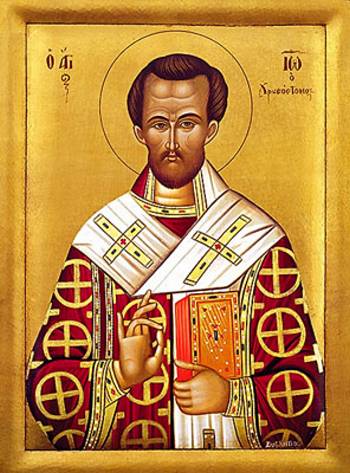
St. John Chrysostom, patron of preachers, champion of St. Paul

St. John Chrysostom, patron of preachers, champion of St. Paul

But the curious things about the Supreme Court ruling is this: if the resulting deformation of marriage really is about a false understanding of the nature of marriage, then the Court’s ruling will also harm precisely the persons that it is intended to help. This is just an inference from everything I’ve said so far. How will it hurt them? I have no clear idea at the moment. Nor do I wish to cook up a prophecy about what sort of harm is coming. But if this is true, then my concern should also be for my fellow Americans, providentially given to me by God for our mutual salvation, who embrace this new reality, even when they have the for the best possible intentions. Again, I would not attempt to walk up to a gay couple and baldly assert this and use it as grounds for them to renounce their marriage. I merely raise the issue to point out that it is possible to broaden our thinking about the situation in such a way as to keep from falling into the same adversarial stances that typify American public debates.

And even if it should come about that we suffer in some way for our beliefs, even this is more harmful, from the standpoint of faith, to the aggressor than to the victim. Here’s Saint John Chrysostom, the Golden-Tongued Wonder.

This is more than any one thing the cause of all our evils, that we do not so much as know at all who is the injured, and who the injurious person.

In focusing on the potential harm coming to those who oppose the redefinition of marriage, that is, to one segment of our world, we are liable to lose sight of the harm that we are all suffering together. Thus Pope Francis, “When our hearts are authentically open to universal communion, this sense of fraternity excludes nothing and no one.” [Laudato si, 92]

Obergefell v. Hodges: First Thought

June 27, 2015

When the Founding Fathers wrote the Constitution of the United States, they made liberal use of the concept of rights. They famously held that such rights were “self-evident,” and were an endowment from the “Creator.” This assertion made perfect sense in 1776 when Western civilization had been Christian for a thousand or more years. But historically speaking, there is a problem here. If human equality and the existence of a Creator are really self-evident truths, then what are we to make of societies that recognize neither? The confident assertion of self-evidence is connected to the general immodesty of the Enlightenment,

Read More »

Who’s MacIntyre? Why Virtue?

June 21, 2015

Seven or eight years ago, I was invited by a group of priests of the Marquette (Michigan) diocese to give a series of talks on music and morality. They were very receptive to my approach and suggested that I might set down my thoughts in a book. Hence the memoir I mentioned in the previous post. I chose the memoir format because music and morality are so difficult to write about in the abstract. And indeed, I more recently gave a similar talk at the University of Virginia’s St. Anselm Institute and faced some tough questions which, to be honest,

Read More »

Back to School

June 17, 2015

As many of you know, I am working on a memoir. This was first suggested to me by an editor at Paulist Press after a short interview I gave appeared in the Sun-Times few years ago. From January 1994 until July 1997, I performed in a jazz/rock sort of band called OM. And the transition I made, from playing at the Taste of Chicago, then five months later beginning my novitiate, has generated some interest. This band was not so typical. As I was working on the book on Monday, I noticed the fact that in some way or other, most of the significant persons who went through the band (our line-up had up to six people, including horns and violins) are now educators. I include myself in that group, since I am the prior of what Saint Benedict calls “a school of the Lord’s service.”

One of the interesting points of the memoir has to do with parallel themes in my former work as a musician and my life now as a monk. One such parallel has to do with the marginal status of both monks and artists in the world. Artists are often restless until they can pry open some hidden aspect of reality and show it to others. But then, not everyone has eyes to see what is uncovered, at least right away. Some ‘fusion of horizons’ needs to take place, to introduce others to the language of poetry, art and music, and then the unique perspective of the artist.

Did you see some kid fall from the sky? Nah. [Bruegel the Elder's depiction of Icarus unmourned]--"Not an important failure," as told by Auden.

Bruegel the Elder’s depiction of Icarus unmourned and unnoticed…a splash at the lower right… Did you see some kid fall from the sky? Nah; I wasn’t paying attention —“Not an important failure.”

At some point, my bandmates and I realized that for the average listener to take an interest in what we were doing, we needed to undertake some efforts at teaching. We took our cue from Wynton Marsalis, who was then teaching young people how to listen to jazz. In music, any effort to educate runs into serious problems, since musical interest is usually considered a matter of personal taste. The idea that one might deliberately change one’s taste because of someone else’s expertise smacks of snobbery. Yet any musician worth hearing ought to be passionate about the quality of the music she or he is performing. And this passion depends on the music being more than a personal predilection–somehow the it must be true, and this truth must be urgent. It doesn’t really belong to the performer at all. The performer is at most a conduit, maybe a conjurer. At least the performer is a witness.

Any good teacher is in a similar position. Henri Nouwen suggested many years ago that the model of education today is based in a kind of violence that is competitive (students competing for scarce recognition of achievements), unilateral (the transference of a commodified knowledge from strong teacher to weak student), and alienating (marking the gap between the material to be mastered and the real life that comes once one gets the degree). We’ve all had good teachers, though. What were they like? One of the best classes I took in college involved working through Newton’s Principia.

Noel Swerdlow, who taught initiated me into the magical world of Isaac Newton

Noel Swerdlow, who initiated me into the magical world of Isaac Newton

What was fantastic about the class was that the professor wrote out, and actually worked out, Newton’s proofs on the blackboard, inviting us to work through them with him. I will never forget his enthusiasm, as if he were the one discovering this and not Newton…rather that we were discovering the beauty of nature’s patterns together, with Newton as quirky guide, friends on an amazing journey past the veil of sense to the mathematical harmony of physics.

Sometimes a learning experience of this sort can be so powerful that it requires a reordering of our old way of thinking. Learning to like jazz or to understand calculus takes time and a kind of ‘conversion’ (Newton had to invent calculus to figure out the moon’s orbital math!). The early Christians called this metanoia.  Metanoia means literally to change one’s mind. This idea is also expressed as repentance. When Jesus began His ministry, he preached, “Repent [Metanoeite!] and believe the gospel [Mt. 4: 17].” Learn to think differently! We must undergo a kind of education–note that Jesus spends much of His public life teaching. He teaches not so much a series of facts. Nor does He just impart information. Repentance involves learning to think anew about old facts, seeing from a new perspective, noticing things that had always been there, but discovering in them God’s presence and transforming love. It requires something like contemplation.

Monastic formation is perhaps the most radical instance of this Christian conversion, but it is simply what all Christians pledge to do at baptism. The thought patterns of the old Adam must give way to the new Adam, to the mind of Christ [Phil. 2: 5; 1 Cor. 2: 16]. Recognizing how exactly the old Adam thinks is not so easy, for our cultural upbringing lingers in unsuspected ways. What’s more, we live in a peculiarly blind kind of culture, that no longer recognizes its own dependence on tradition. Freud thought that he discovered a universal psychological law in the Oedipal complex, but in fact, he was merely noticing the modern Western tendency to want to do away with one’s fathers. This habitual refusal to recognize our intellectual and cultural debts causes disruptions and discontinuities in our background tradition, and therefore in our thinking.

In our monastery, we are trying to counteract this situation with different approaches to teaching. One test case, upon which I will dwell more at length in a future post, would be the following question. Can a modern Christian learn to read the Scriptures from the profound spiritual sense that guided the formation of theology from St. Paul until Rupert of Deutz? We live in a scientific age, and Catholic Biblical scholars have been celebrating their freedom to engage in historical-critical method for the past sixty years. Should we even bother to go back to allegory?

But what if the historical-critical method and our enthusiasm for it would turn out to be an unhealthy preoccupation with the world that is passing away? What if it locks us into the very worldview that a conversion is meant to leave behind? Given the present struggles of the Catholic Church in her historic lands, this kind of question bears asking and patient and careful response. It also may call for metanoia. Repent and believe!

When Tradition Hides

June 16, 2015

I’ve mentioned ‘discontinuity’ a few times in recent weeks. This is what happens when a tradition like monastic life or liturgical music suddenly takes on a strikingly different form than what came immediately before. Why does this interest (or concern) me? If you are allergic to long quotations, you probably can read the first and last sentence of what follows, and still get the gist:

Read More »

The Love of Learning and the Desire for God

June 5, 2015

In the hands of a genius or a saint, or, even more so , a man who, like Bernard, is both, the artificial, the factitious, and art become natural, or, rather, nature yields itself unrestrainedly to art and its laws.

The specific type of cultural engagement of monasticism does not simply dissolve culture. It creates a new culture. Few have illustrated this with such erudition and passion as did Fr. Jean LeClercq, OSB. I opened with his description of the high art of St. Bernard’s prose and poetry. 

Read More »
  • « Go to Previous Page
  • Go to page 1
  • Go to page 2
  • Go to page 3
  • Go to page 4
  • Go to Next Page »

Blog Topics

  • Beauty (21)
  • Contemplative Prayer (54)
  • Contra Impios (2)
  • Culture (27)
  • Discernment (28)
  • Formation (14)
  • General (42)
  • Going to the Father (18)
  • Gregorian Chant (5)
  • Holy Spirit (5)
  • Jottings (27)
  • Liturgy (92)
  • Meditations on Heaven (4)
  • Monastic Life (54)
  • Moral Theology (49)
  • Music (18)
  • Scripture (57)
  • The Cross (1)
  • Vatican II and the New Evangelization (21)

Blog Archives

  • December 2025 (6)
  • November 2025 (4)
  • October 2025 (2)
  • September 2025 (2)
  • August 2025 (3)
  • July 2025 (4)
  • June 2025 (4)
  • May 2025 (3)
  • April 2025 (4)
  • March 2025 (4)
  • February 2025 (3)
  • January 2025 (5)
  • December 2024 (8)
  • November 2024 (3)
  • October 2024 (9)
  • September 2024 (8)
  • August 2024 (9)
  • July 2024 (9)
  • June 2024 (8)
  • May 2024 (9)
  • April 2024 (4)
  • November 2023 (1)
  • April 2023 (1)
  • December 2022 (1)
  • October 2022 (1)
  • March 2022 (1)
  • February 2022 (1)
  • August 2021 (2)
  • June 2021 (1)
  • May 2021 (1)
  • April 2021 (1)
  • February 2021 (2)
  • January 2021 (1)
  • December 2020 (1)
  • August 2020 (4)
  • June 2020 (1)
  • May 2020 (4)
  • April 2020 (9)
  • March 2020 (4)
  • February 2020 (1)
  • January 2020 (1)
  • December 2019 (1)
  • July 2019 (2)
  • June 2019 (1)
  • May 2019 (1)
  • April 2019 (2)
  • March 2019 (1)
  • February 2019 (3)
  • January 2019 (1)
  • December 2018 (1)
  • November 2018 (2)
  • October 2018 (2)
  • September 2018 (2)
  • August 2018 (1)
  • July 2018 (2)
  • June 2018 (4)
  • May 2018 (7)
  • April 2018 (1)
  • March 2018 (1)
  • February 2018 (1)
  • January 2018 (2)
  • November 2017 (1)
  • October 2017 (1)
  • September 2017 (1)
  • August 2017 (1)
  • July 2017 (2)
  • June 2017 (2)
  • March 2017 (1)
  • February 2017 (2)
  • December 2016 (1)
  • November 2016 (3)
  • August 2016 (2)
  • May 2016 (2)
  • April 2016 (5)
  • March 2016 (2)
  • December 2015 (1)
  • November 2015 (2)
  • October 2015 (3)
  • August 2015 (10)
  • July 2015 (12)
  • June 2015 (17)
  • May 2015 (2)
  • April 2015 (7)
 
© 2025 Monastery of the Holy Cross
  • Accessibility
Web Design by ePageCity