Monastery of the Holy Cross

  • Home
  • About
    • Benedictine Life
    • History
    • Video Gallery
    • Et Incarnatus Est - The Prior's Blog
  • Visit Us
    • Guesthouse
    • Prayer Schedule
      • Christmas 2025
    • The Catholic Readers Society
    • Caskets
  • Vocations
    • Monastic Experience Weekend
    • Formation
    • Oblates
      • Oblate Podcast
  • Solemn Vespers
    • Solemn Vespers for the 5th Sunday in Ordinary Time
    • Chant
  • Contact
  • Donate

Et Incarnatus Est – The Prior’s Blog

Going to the Father 3: Light from the East

July 14, 2015

Deo gratias! Our Br. Timothy made his Solemn Profession on Saturday, the Solemnity of Saint Benedict. Posting has been non-existent during the immediate preparation and aftermath. My thanks for your patience, especially to subscribers (do become a subscriber if you are not yet!). Now back to our liturgical history.
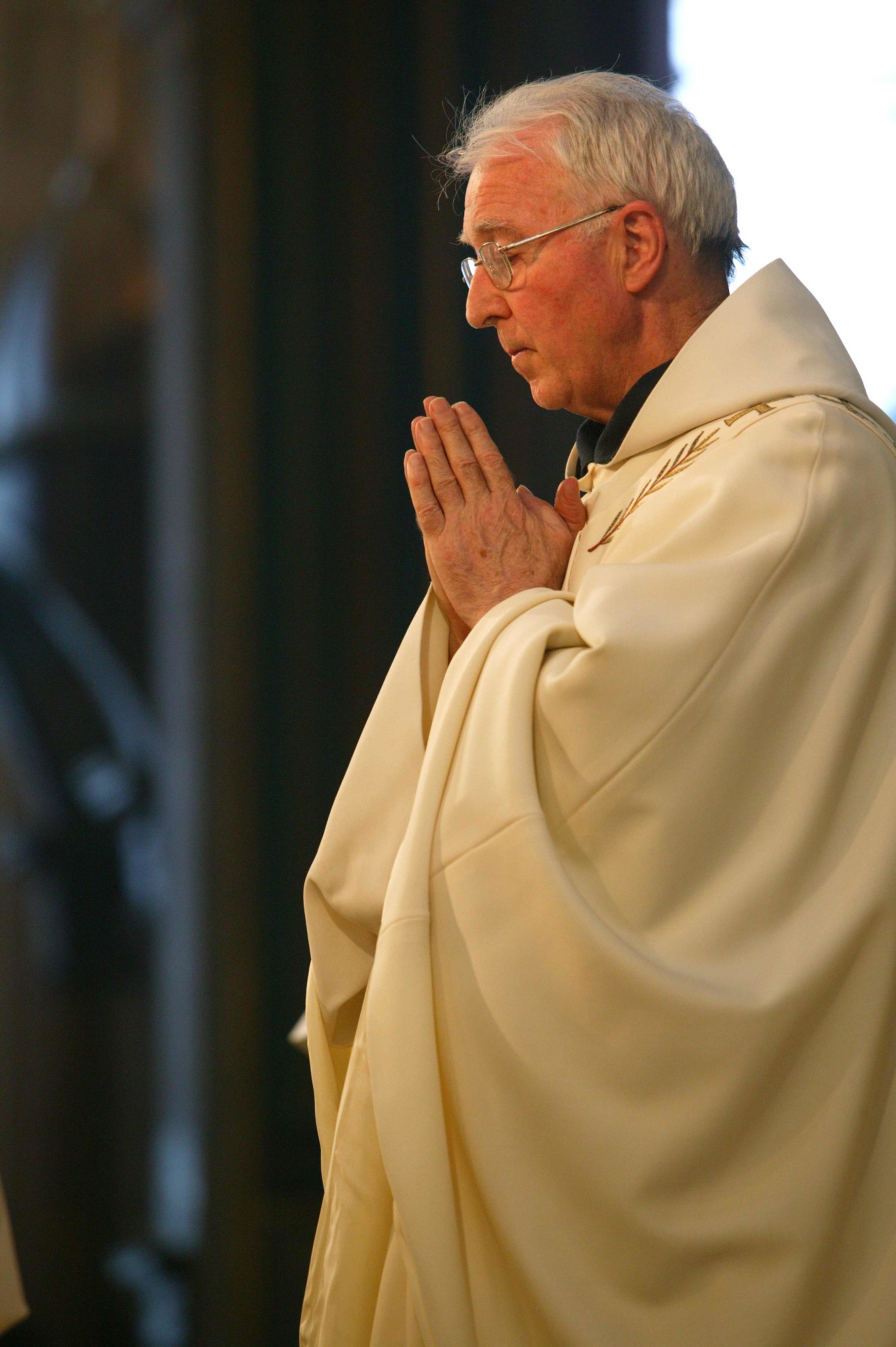
Fr. Pierre-Marie Delfieux, 1934-2013, founder of the Community of Jerusalem

Fr. Pierre-Marie Delfieux, 1934-2013, founder of the Community of Jerusalem

One of the biggest changes in our liturgical style over the years has been the adoption, within the Ordinary Form of the Mass, the ad orientem (“toward the East,” indicating especially the rising sun) stance of the principle celebrant. I will be offering many reflections on our experience and the theology of Mass ad orientem, but I thought I’d begin with a few scattered anecdotes to indicate how God brought this about.

As our Fr. Brendan tells it, the founder and long-time superior of the Jerusalem community, Fr. Pierre-Marie Delfieux, used to challenge the Paris community in the following way. “When a first-time visitor comes to our liturgy,” he would say, “I want them to ask not, ‘Who are these people?’ but ‘Who is the God they are worshipping?'” This itself reflected a deep sense, shared, interestingly enough, with a number of the emerging “high church” Anglicans of the nineteenth century, that the flattening effect of the modern industrial city called for greater attention to beauty, mystery, and transcendence in the liturgy. This helps to explain the apparent paradox that many high Church parishes are located in poorer neighborhoods in the large cities of England.
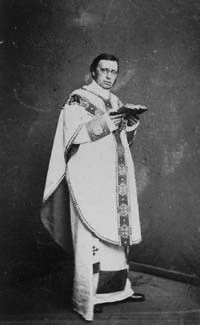
John Mason Neale, 1818-1866.  As an Anglican priest, he caused consternation by his desire for greater "Catholic" vesture and liturgical ornament combined with an  advocacy for the poor, especially their full inclusion in liturgical celebration (after James 2: 2-3).

John Mason Neale, 1818-1866.
As an Anglican priest, he caused consternation by his desire for greater “Catholic” vesture and liturgical ornament combined with an advocacy for the poor, especially their full inclusion in liturgical celebration (after James 2: 2-3).

The presence of a majestic God Who invites everyone into His glorious house is a reminder of the dignity of all human persons and our shared transcendent goal, the joy and splendor of the Kingdom of Heaven, in which the last shall be first and the poor share inherit the earth. And many of us city dwellers are poorer than we think, precisely because our imaginations have been leveled, and we have forgotten the new creation beyond tears and sorrows that is everywhere coming into being around us.

But how to communicate this? Especially out of a very poor monastic community such as we had? Around the year 1998 or so, we began reading the liturgical writings of Cardinal Ratzinger, and two brothers in the community were intrigued by the possibility of signalling God’s transcendence by turning the priest back around, as he had been until a few decades ago, and as he is in every other rite of the Church (with the exception of some Maronite customs that, in any case, were borrowed from the reform of the Roman rite), including the Eastern Orthodox rites.

This was a tough sell. Many of us Catholics had learned that this posture involved the priest “turning his back” on the congregation. It was seen as a rejection of Vatican II. I was a novice in the community at the time and felt vaguely uncomfortable about the discussion, though I also recognized that I had virtually no training in liturgical theology and so I made a point to read and listen. I had been to Orthodox liturgy, and in spite of the fact that the priest is barely even visible during the words of institution (he’s largely hidden by the iconostasis), I didn’t recall feeling as if the celebrant were somehow coldly distant. This fact has stayed with me over the years. Is there something about Catholic liturgy that lends itself to the opposite impression, when Mass is celebrated ad orientem? I didn’t know.
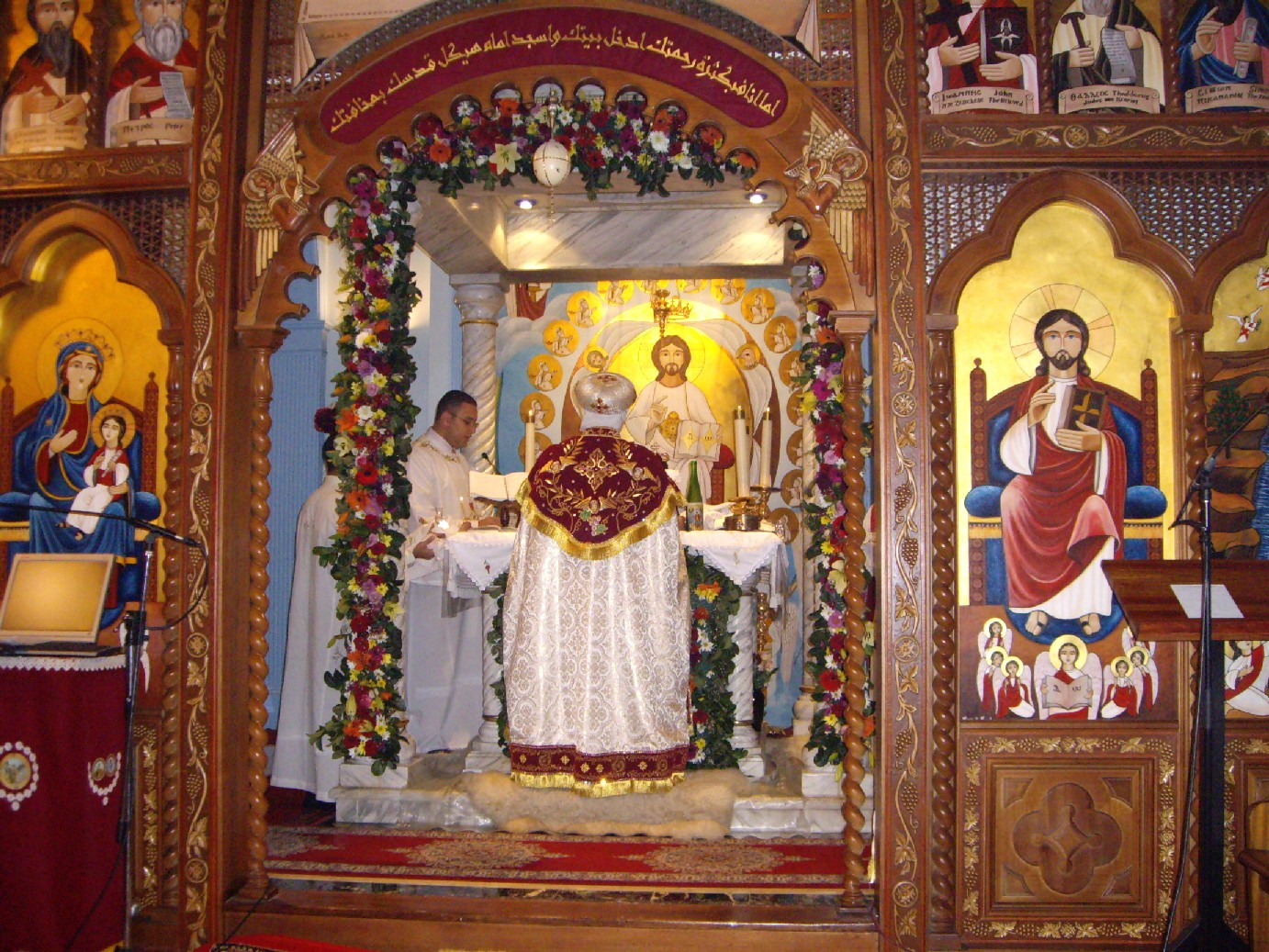
A coptic priest celebrating "ad orientem" behind the iconostasis

A Coptic priest celebrating the Divine Liturgy “ad orientem” behind the iconostasis: in this case there are no holy doors obscuring him

What changed my mind on the whole question was an intervention of Providence. I was still conducting choirs at St. Thomas the Apostle parish and Calvert House in Hyde Park, and on days of rehearsals, I couldn’t be around for the community Mass, which in those days was in the evening. So twice each week, I went to St. Barbara’s parish here in Bridgeport. One morning, I arrived for the Mass being celebrated by a newly-assigned priest. I hadn’t yet become acquainted with his personal style. At the preparation of the gifts, he invited anyone who so wished to come and stand around the altar. I was used to this kind of thing. I grew up in the 70’s after all. But I’m a bit shy and so took the option to remain in the pews. As a group of about ten people stood around the altar, I noticed something quite astonishing. They all stood in a semicircle…behind the priest. I nearly laughed out loud as I mused that they were deliberately choosing to have “Father’s back to them.” Indeed, it seemed an obvious thing to do! If we only rotated the whole scene 180 degrees, we would have Mass facing the East.

There was clearly an intuition among these guests around the altar that the presider was “leading,” that he occupied a position “out front.” But the proximity also seemed to indicate that the priest was “one among” rather than a separate class of person within the Body of Christ. This resonated with my experience of Orthodox liturgy, where the churches were often quite a bit smaller than the average Catholic parish in Chicago, and the priest sat quite near the congregation for the readings. I came back more enthusiastic about attempting Mass ad orientem, but Providence would need to intervene a second time.

To be continued…
Going to the Father 2: The Land of Unlikeness

July 7, 2015

As our brothers were preparing to come to Chicago to begin living the quasi-monastic life of the Community of Jerusalem, one brother discovered an article written by the late Fr. Aidan Kavanagh, OSB. Fr. Aidan was a monk of St. Meinrad’s Archabbey and a liturgist. His book On Liturgical Theology is a modern classic, a book to be read and savored again and again. The article appeared in Worship magazine, and, if memory serves, was his acceptance speech upon receiving an award from St. John’s School of Theology in Collegeville,

Read More »

Going to the Father, Part 1: Liturgy as Evangelization

July 6, 2015

We are preparing to have a new choir constructed and installed in our church. I have been invited by Fr. Anthony Ruff, OSB, at Pray Tell Blog, to offer some explanation of the theology behind the shape and placement of the choir. As a prelude to this project, and to give the fullest possible context, I would like to tell the story of our liturgical development, from the foundation of the monastery to the installation of the choir.

This story begins with our three founders working as missionaries in Haiti and Brazil

Read More »

Liturgy and the Stance of Weakness

July 1, 2015

Much of the exasperation with what people term “organized religion” comes from the fact that the Christian church has often given so much weight to doctrinal accuracy that the life-giving potential of worship, and faith itself, gets lost in the shuffle, made all but inaccessible to the skeptical multitudes. The poet Jonathan Holden epitomized a common attitude when he stated in The American Poetry Review that because “religious doctrine delivers us an already discovered, accepted, codified system of values–official truth,” a truth he defines as “static,” it can never attain the authenticity of a well-made work of art.–Kathleen Norris, Amazing Grace: A Vocabulary of Faith

I for one am grateful to profit from the great work of the saints, theologians and philosophers who have gone before me and have done so much to clarify the teachings of the Church. But I see Holden’s point here.

There is a danger to inheriting an accepted, codified system of values. We Catholics can lose our hunger for the dynamism of faith, a dynamism that is fueled by challenges, doubts and arguments. It is a gift to have to hand well-thought-out stances from the Catechism and Canon Law, but how do I know if I understand them properly? How can I be sure that I am applying them in the correct contexts?

An example I like to use is the “universal call to holiness.” This is a good, solid teaching rooted in the one baptism that all Christians share. It became obscured with the rise of a type of clericalism in the Middle Ages, along with the rise of the religious orders. Before the Second Vatican Council, it could appear that the Church had two levels of holiness, the religious and ordained ministries, and then the laity. The Council Fathers stated clearly that all members of the Church are called to holiness.

In my experience since the Council, this teaching is often misinterpreted, ironically enough, because of a lingering bias toward clericalism. “The priests had their turn to be holy [meaning occupying privileged places at the liturgy and elsewhere] and now it’s the laity’s turn.” What should have been a call to greater self-renunciation and prayer appeared paradoxically to call for greater assertiveness and personal privilege for persons who “felt called.” The universal call could even be used by religious as an excuse not to engage in holy practices, since these might reinforce the distinction between religious and laity and suggest that we still had a two-tiered structure of holiness.

What went wrong? The term and the teaching are correct, but the context in which the universal call is heard and interpreted causes a distortion. What is this context? We can describe it in many ways. Our cultural situation inclines us to atomistic individualism and its attendant focus on personal rights and equality, and our ecclesial situation, at least in the years immediately following the Council, inclined us to a “professional” understanding of the charisms, an understanding based in an overemphasis on the Church as the “Perfect Society,” and exemplified by the priest as certified dispenser of sacraments, reporting to the bishop as CEO of the diocese.

What is the correct context, then, and how do we find it, if we have to live in a culture that causes these distortions? The answer is found in the liturgy. Ut legem credendi lex statuat supplicandi. “That the law of praying established the law of believing.” Often this more exact phrase is rendered more simply, “Lex orandi lex credendi,” the law of prayer is the law of belief. In either case, we see that the “already discovered, accepted, codified system of values” should be in-formed by the practice of the liturgy, in which we conform ourselves to the high priestly prayer of Jesus Christ. This is what Kathleen Norris is after when she contrasts doctrinal accuracy with “the life-giving potential of worship.”

This also connects with what I was attempting to explain in yesterday’s post. Church teaching has not recognized same-sex marriage, and the weight of tradition is against such recognition. But how do we understand and live the truth of this teaching? As I wrote yesterday, I don’t really know, and I’m not sure that anyone is all that sure. We are in uncharted waters, and the biases of my own culture are against me [see: The first engagement with culture is at the level of thoughts]. I need a renewal of my mind and heart and I need the power of God to do this. So I must be content with my weakness.

The liturgy is the exercise of the high priesthood of Jesus Christ. When we enter the liturgy, it is Christ Who is the main ‘agent’ (which is why so many discussions about ‘active participation’ are confused), and we are all participants in His action of praising the Father in the Spirit. We are caught up in a world being brought into being, a world in which the True Light enlightens our minds and hearts that we may discern what is God’s will and carry it out with courage. At the liturgy, it is alright to be weak, because there God is strong, and this becomes our default stance toward the world. Liturgy is also full of a lot of confounding rites, texts, vestments and stimuli at once disorienting and reorienting. In this space of conversion to a new orientation toward Christ in all things, we have the chance to reassess argument, to hear anew the Word instructing us. We also see and experience the persons to whom we must first submit our ideas for living a new life. The liturgy sets the bounds of the community of faith and gives us our first audience for a new understanding.

More to come.

Obergefell v. Hodges: Second Thoughts

June 30, 2015

In my “first thoughts,” I suggested that Christians interested in upholding the Church’s view of marriage might be better off letting go of a language of rights, since rights divide a coercive power from a class of victims. Turning this around we can also say that appealing to rights is a way of claiming the mantle of a victim and casting the Other as a victimizer. Either way, I think that it is clear that any sense of a genuine common good is undermined, subtly, by naked appeals to rights. Catholic social teaching depends on a clear sense of a common good, and a disciplined determination to live by it.

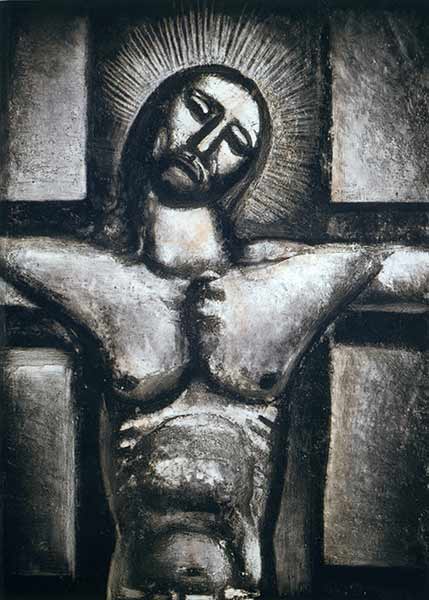
from Georges Rouault, Miserere

from Georges Rouault, Miserere

Here is where quite a bit of “Benedict Option” language also seems counterproductive, probably unintentionally. It sets the Opting party against the world. The language of separation tends toward a language of rejection. Now of course there are many attitudes in today’s dominant culture that a disciple of Jesus Christ must reject, and sometimes this rejection calls for disengagement from particular social structures. Repentance and conversion require new ways of living, and this means that behaviors must change. Conversion might require me to stop going to bars, or to movies, to the Freemason meetings, to my mistress’s apartment, and even to my place of employment. But the point of this is not to say, “Too bad for you, I’m outta here.” Rather, the penitent is aiming at identifying personal behaviors that are harmful and eliminating them.

If we actually believe in a common good, one of the best things that any one of us can do for others is to live a truly penitent and evangelical life. For when any one of us begins to live more vibrantly in Christ, all will benefit. Right?

And the inverse holds as well. When someone lives in contradiction to the truth, all suffer in some way.

Here is where I get to the Supreme Court ruling from three days ago. It is important to understand that what I am going to write needs to be read from a position of weakness (see my last post for an explanation).

This week’s Collect reads, in part:

grant, we pray,
that we may not be wrapped in the darkness of error
but always be seen to stand in the bright light of truth.

The bright light of truth! What a gift to know the Truth Who sets us free.

How deeply do we believe in the truth of the Church’s revelation? One of the dangerous habits of mind generated by our cultural emotivism is the assumption that any supposed statement of truth is in fact a statement of personal preference. From this perspective, all claims to truth are actually strategic claims, manipulating the hearer to feel obliged to accept what’s being stated. In other words, emotivism makes us all nihilists to some extent, perhaps a larger extent than we realize.

This conclusion, that many of us are closet nihilists, seems to me borne out by the fear, anger, and anxiety that I’ve encountered over the years when contemporary mores are discussed among Catholics. When, aided by the Church’s teaching, we identify actions as good or bad and we identify statements as true or false, how we happen to feel about the action or judgment makes no difference. Jesus Christ rose from the dead, and nothing changes about that if I happen to feel overjoyed about it or flatly unemotional. When we communicate the truth of the Faith, there is a tendency to add zest or urgency to our statements of truth by smiling, showing enthusiasm or worry or whatever. We act as if the Truth needs some goosing up, that it doesn’t stand on its own. But if the truth can’t stand on its own, it’s probably not true. [Digression: I personally see this as a weakness in the otherwise entertaining opinions penned by Justice Scalia.]

The other problem with emoting too much in discussions of truth is that the focus tends to be on ourselves and our feelings too much of the time. Thus many conservative responses to Obergefell v. Hodges that I’ve seen have focused on the dangers to Christians in the coming extension of the Culture War. Mind you, I think that these dangers are real, but again this reality isn’t going to be altered by me fulminating about it.

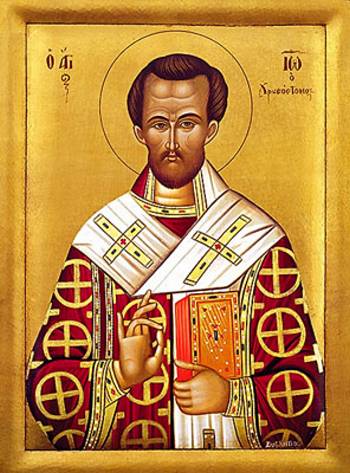
St. John Chrysostom, patron of preachers, champion of St. Paul

St. John Chrysostom, patron of preachers, champion of St. Paul

But the curious things about the Supreme Court ruling is this: if the resulting deformation of marriage really is about a false understanding of the nature of marriage, then the Court’s ruling will also harm precisely the persons that it is intended to help. This is just an inference from everything I’ve said so far. How will it hurt them? I have no clear idea at the moment. Nor do I wish to cook up a prophecy about what sort of harm is coming. But if this is true, then my concern should also be for my fellow Americans, providentially given to me by God for our mutual salvation, who embrace this new reality, even when they have the for the best possible intentions. Again, I would not attempt to walk up to a gay couple and baldly assert this and use it as grounds for them to renounce their marriage. I merely raise the issue to point out that it is possible to broaden our thinking about the situation in such a way as to keep from falling into the same adversarial stances that typify American public debates.

And even if it should come about that we suffer in some way for our beliefs, even this is more harmful, from the standpoint of faith, to the aggressor than to the victim. Here’s Saint John Chrysostom, the Golden-Tongued Wonder.

This is more than any one thing the cause of all our evils, that we do not so much as know at all who is the injured, and who the injurious person.

In focusing on the potential harm coming to those who oppose the redefinition of marriage, that is, to one segment of our world, we are liable to lose sight of the harm that we are all suffering together. Thus Pope Francis, “When our hearts are authentically open to universal communion, this sense of fraternity excludes nothing and no one.” [Laudato si, 92]

When I Am Weak

June 29, 2015

Today we celebrate the martyrdoms of Peter and Paul, twin pillars of the Roman Church, the Rock and the Apostle. Both of these men learned the hard way what Paul was to make into a famous maxim. All Christians would do well to adopt it.

When I am weak, then I am strong.

Second Corinthians is such a lovely letter, filled with brutally honest pathos:

Read More »

Obergefell v. Hodges: First Thought

June 27, 2015

When the Founding Fathers wrote the Constitution of the United States, they made liberal use of the concept of rights. They famously held that such rights were “self-evident,” and were an endowment from the “Creator.” This assertion made perfect sense in 1776 when Western civilization had been Christian for a thousand or more years. But historically speaking, there is a problem here. If human equality and the existence of a Creator are really self-evident truths, then what are we to make of societies that recognize neither? The confident assertion of self-evidence is connected to the general immodesty of the Enlightenment,

Read More »

Unmasking Emotivism

June 26, 2015

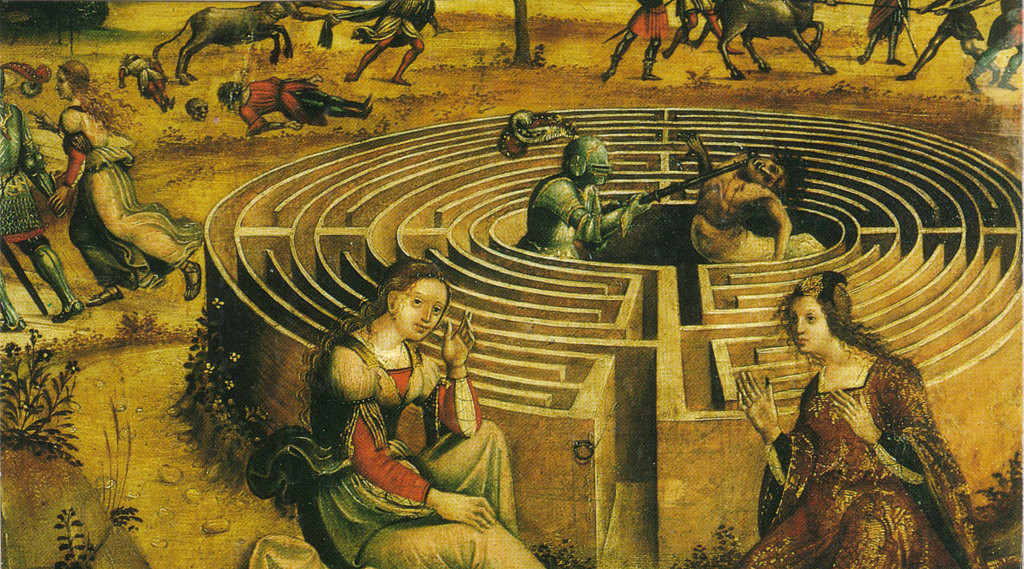
ariadne

Thanks to Ariadne’s thread, Theseus was able to escape the labyrinth after slaying the Minotaur. In the Middle Ages, the Church saw Theseus as a type of Christ, descending into the dissolution of hell, slaying death, and leading the lost souls from darkness to light.

“[I]t’s time for the LGBT community to start moving beyond genetic predisposition as a tool for gaining mainstream acceptance of gay rights. .  .  .For decades now, it’s been the most powerful argument in the LGBT arsenal: that we were “born this way.” .  .  .Still, as compelling as these arguments are, they may have outgrown their usefulness”

I begin with a quote from dancer and writer Brandon Ambrosino,

Read More »

Who’s MacIntyre? Why Virtue?

June 21, 2015

Seven or eight years ago, I was invited by a group of priests of the Marquette (Michigan) diocese to give a series of talks on music and morality. They were very receptive to my approach and suggested that I might set down my thoughts in a book. Hence the memoir I mentioned in the previous post. I chose the memoir format because music and morality are so difficult to write about in the abstract. And indeed, I more recently gave a similar talk at the University of Virginia’s St. Anselm Institute and faced some tough questions which, to be honest,

Read More »

Which Questions Should We Ask?

June 19, 2015

Why a blog on a monastery website? It could be used to share monastic spirituality, and I do hope to cover that. The seniors in our community teach monastic spirituality to the novices and juniors regularly. Thus, not only our own experience of prayer, work and silence should offer some fresh insights on Christian discipleship, but we should also be somewhat experienced in teaching this perspective to others.

What I have discovered, however, is that the spirit of monasticism can be misunderstood,

Read More »
  • « Go to Previous Page
  • Go to page 1
  • Interim pages omitted …
  • Go to page 23
  • Go to page 24
  • Go to page 25
  • Go to page 26
  • Go to page 27
  • Go to Next Page »

Blog Topics

  • Beauty (22)
  • Contemplative Prayer (55)
  • Contra Impios (2)
  • Culture (27)
  • Discernment (28)
  • Formation (14)
  • General (42)
  • Going to the Father (18)
  • Gregorian Chant (5)
  • Holy Spirit (5)
  • Jottings (27)
  • Liturgy (93)
  • Meditations on Heaven (4)
  • Monastic Life (55)
  • Moral Theology (49)
  • Music (18)
  • Scripture (57)
  • The Cross (1)
  • Vatican II and the New Evangelization (21)

Blog Archives

  • January 2026 (2)
  • December 2025 (6)
  • November 2025 (4)
  • October 2025 (2)
  • September 2025 (2)
  • August 2025 (3)
  • July 2025 (4)
  • June 2025 (4)
  • May 2025 (3)
  • April 2025 (4)
  • March 2025 (4)
  • February 2025 (3)
  • January 2025 (5)
  • December 2024 (8)
  • November 2024 (3)
  • October 2024 (9)
  • September 2024 (8)
  • August 2024 (9)
  • July 2024 (9)
  • June 2024 (8)
  • May 2024 (9)
  • April 2024 (4)
  • November 2023 (1)
  • April 2023 (1)
  • December 2022 (1)
  • October 2022 (1)
  • March 2022 (1)
  • February 2022 (1)
  • August 2021 (2)
  • June 2021 (1)
  • May 2021 (1)
  • April 2021 (1)
  • February 2021 (2)
  • January 2021 (1)
  • December 2020 (1)
  • August 2020 (4)
  • June 2020 (1)
  • May 2020 (4)
  • April 2020 (9)
  • March 2020 (4)
  • February 2020 (1)
  • January 2020 (1)
  • December 2019 (1)
  • July 2019 (2)
  • June 2019 (1)
  • May 2019 (1)
  • April 2019 (2)
  • March 2019 (1)
  • February 2019 (3)
  • January 2019 (1)
  • December 2018 (1)
  • November 2018 (2)
  • October 2018 (2)
  • September 2018 (2)
  • August 2018 (1)
  • July 2018 (2)
  • June 2018 (4)
  • May 2018 (7)
  • April 2018 (1)
  • March 2018 (1)
  • February 2018 (1)
  • January 2018 (2)
  • November 2017 (1)
  • October 2017 (1)
  • September 2017 (1)
  • August 2017 (1)
  • July 2017 (2)
  • June 2017 (2)
  • March 2017 (1)
  • February 2017 (2)
  • December 2016 (1)
  • November 2016 (3)
  • August 2016 (2)
  • May 2016 (2)
  • April 2016 (5)
  • March 2016 (2)
  • December 2015 (1)
  • November 2015 (2)
  • October 2015 (3)
  • August 2015 (10)
  • July 2015 (12)
  • June 2015 (17)
  • May 2015 (2)
  • April 2015 (7)

In This Section

  • Benedictine Life
  • History
  • Video Gallery
  • Et Incarnatus Est – The Prior’s Blog
 
© 2026 Monastery of the Holy Cross
  • Accessibility
Web Design by ePageCity