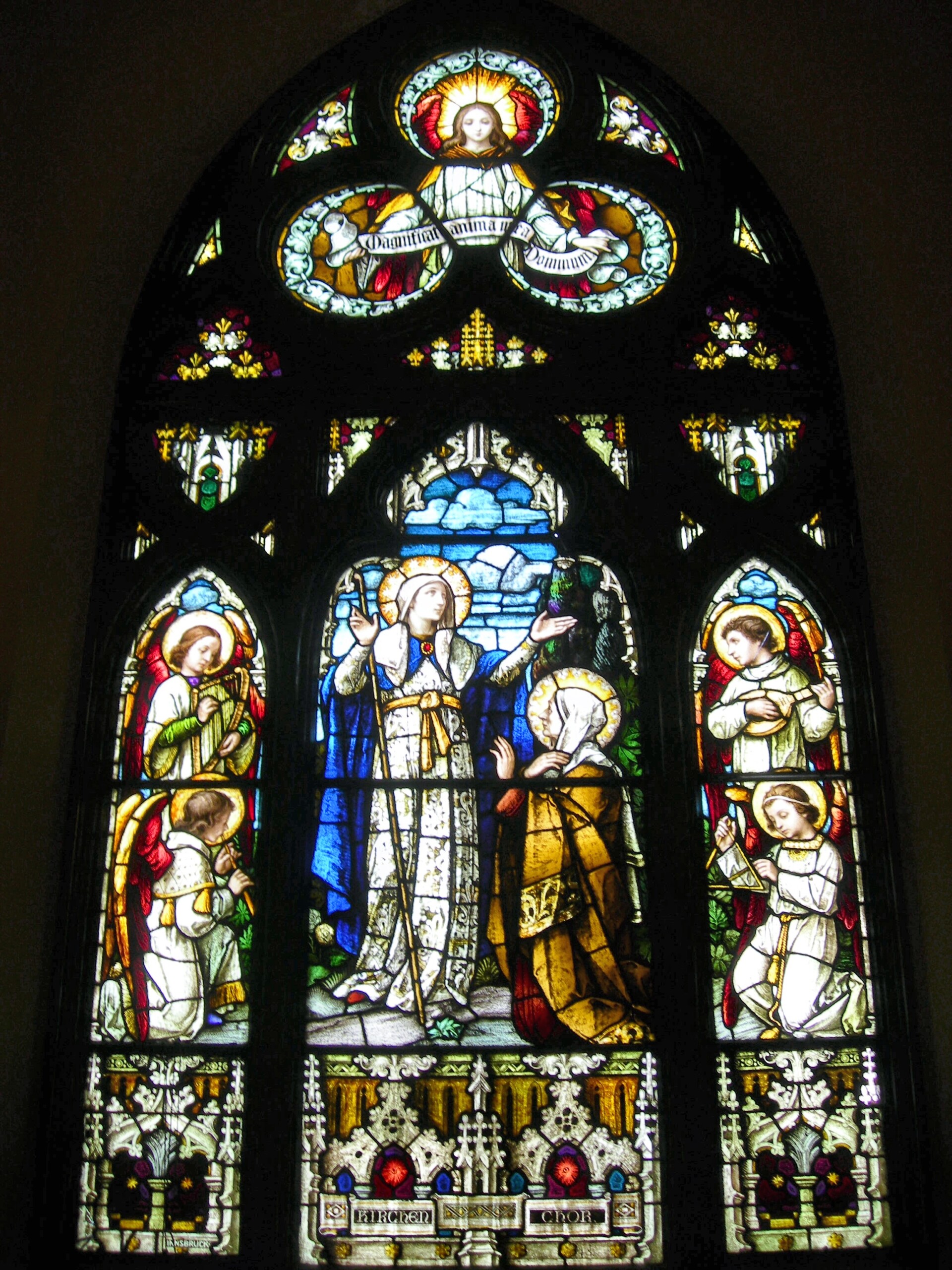
 Many years ago, I was talking with a Lutheran friend about trends common to modern Catholicism and various Protestant denominations. Mostly we focused on church construction and renovation, and the tendency to strip away decorations and simplify the interiors. My understanding was that this trend was intended to remove the potential distraction that supposedly came with stained glass windows and statues. My friend replied, “Don’t you think it would be better to be distracted by stained glass windows than the attractive woman a few pews ahead of you?”
Today I would take my friend’s amusing observation and strengthen it. What if those decorative elements of our church’s were, in some way, representative of our truer selves than our present bodies? Saint Paul says that “you are the temple of God,” and he uses the plural. In other words, Paul is not speaking of us as individuals, but as the Church. Elsewhere, Paul tells us that we are being built together into a dwelling place of God, upon the foundation of the apostles and prophets. It is noteworthy that our church has twelve green marble pillars. These show us who the Apostles are, in a way. What if the other elements of church buildings are meant to show us who we are?
If there were the case, which features of the Church are we? Perhaps through a devotion to Our Lady or another saint we are functioning as a piece of stained glass, in a window illuminating the presence of this saint. Perhaps through our acceptance of suffering and in uniting it to Christ’s Passion, we become an ornament of the Stations of the Cross. Perhaps through constant prayer in our hearts we are being revealed as a part of the altar. When we share the gospel with other, we function as the door of the Church, opening it to those outside. By devotion to the Eucharist, and by keeping the grace of that sacrament in our hearts at all time, we are being revealed as part of the tabernacle. If we are teachers or apologists for the faith, our lives resemble the candles that illuminate the church.
Traditionally, church buildings have been highly decorated, and the very variety and beauty of this consecrated building is meant to show us the beauty of our unity of mind and heart in Jesus Christ, through the harmony of very different kinds of lives building up the one Catholic Church. Beautiful churches invite us to see our fellow Christians in a new light. The decorations aren’t there to distract us from each other, but to raise the eyes of our minds to a vision of our truest selves as members of Christ’s risen Body, the temple of God in spirit and truth.
What makes church decorations more than appeals to our natural desire for beauty is the presence of God. When this building was consecrated, it came alive as a radiation of the transfigured Body of Christ. This is why we light the dedication candles on this feast every year, recalling the anointing of the church building and the entry of the Holy Spirit into this hallowed space. The symbolism is the same as the baptismal candle, lit from the Easter candle, the light of Christ, and given to the newly baptized to show the presence of Christ in the newly baptized. What had been spiritually inert or even not yet fully alive suddenly shines forth with divine luminosity. Thus, and lastly, the church is a symbol of the beauty of our own souls when they are sanctified by God. How beautiful should our lives be? More beautiful than the most exquisite church, and this is how they will shine if we recognize, honor, and guard God’s grace within our hearts with the greatest diligence. At times, we will need major renovations, such as our church is undergoing at the moment. These are difficult times when we struggle with faith, when we don’t want our walls repainted because it involves scraping away the old peeling paint, which we have grown used to .
Salvation has come to this house! Jesus means to abide with us today. Let us welcome Him in our hearts, and see Him in our brothers and sisters so that Spirit will be making us coworkers in the building up of that one true temple, the Body of Jesus Christ.