Monastery of the Holy Cross

  • Home
  • About
    • Benedictine Life
    • History
    • Video Gallery
    • Et Incarnatus Est - The Prior's Blog
  • Visit Us
    • Guesthouses
      • Ascension Retreat House
      • Garden House
      • Saint Joseph Loft
    • Prayer Schedule
      • Christmas 2025
    • The Catholic Readers Society
  • Vocations
    • Monastic Experience Weekend
    • Formation
    • Oblates
      • Oblate Podcast
  • Solemn Vespers
    • Chant
    • Anniversary of Church Dedication
  • Contact
  • Donate

Archives for October 2026

Homily for the Anniversary of the Dedication

October 24, 2026

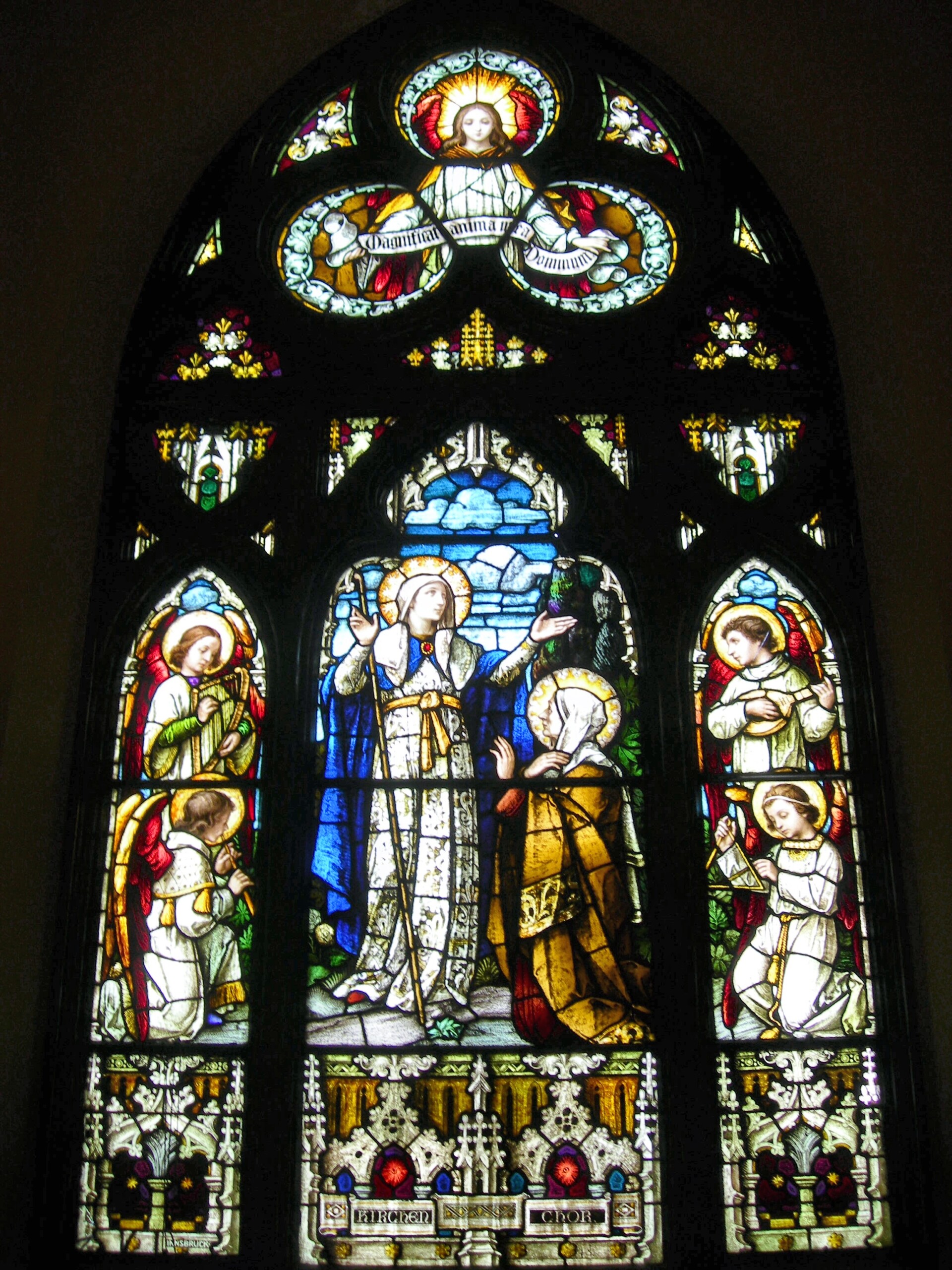
Many years ago, I was talking with a Lutheran friend about trends common to modern Catholicism and various Protestant denominations. Mostly we focused on church construction and renovation, and the tendency to strip away decorations and simplify the interiors. My understanding was that this trend was intended to remove the potential distraction that supposedly came with stained glass windows and statues. My friend replied, “Don’t you think it would be better to be distracted by stained glass windows than the attractive woman a few pews ahead of you?”

Today I would take my friend’s amusing observation and strengthen it. What if those decorative elements of our church’s were, in some way, representative of our truer selves than our present bodies? Saint Paul says that “you are the temple of God,” and he uses the plural. In other words, Paul is not speaking of us as individuals, but as the Church. Elsewhere, Paul tells us that we are being built together into a dwelling place of God, upon the foundation of the apostles and prophets. It is noteworthy that our church has twelve green marble pillars. These show us who the Apostles are, in a way. What if the other elements of church buildings are meant to show us who we are?

If there were the case, which features of the Church are we? Perhaps through a devotion to Our Lady or another saint we are functioning as a piece of stained glass, in a window illuminating the presence of this saint. Perhaps through our acceptance of suffering and in uniting it to Christ’s Passion, we become an ornament of the Stations of the Cross. Perhaps through constant prayer in our hearts we are being revealed as a part of the altar. When we share the gospel with other, we function as the door of the Church, opening it to those outside. By devotion to the Eucharist, and by keeping the grace of that sacrament in our hearts at all time, we are being revealed as part of the tabernacle. If we are teachers or apologists for the faith, our lives resemble the candles that illuminate the church.

Traditionally, church buildings have been highly decorated, and the very variety and beauty of this consecrated building is meant to show us the beauty of our unity of mind and heart in Jesus Christ, through the harmony of very different kinds of lives building up the one Catholic Church. Beautiful churches invite us to see our fellow Christians in a new light. The decorations aren’t there to distract us from each other, but to raise the eyes of our minds to a vision of our truest selves as members of Christ’s risen Body, the temple of God in spirit and truth.

What makes church decorations more than appeals to our natural desire for beauty is the presence of God. When this building was consecrated, it came alive as a radiation of the transfigured Body of Christ. This is why we light the dedication candles on this feast every year, recalling the anointing of the church building and the entry of the Holy Spirit into this hallowed space. The symbolism is the same as the baptismal candle, lit from the Easter candle, the light of Christ, and given to the newly baptized to show the presence of Christ in the newly baptized. What had been spiritually inert or even not yet fully alive suddenly shines forth with divine luminosity. Thus, and lastly, the church is a symbol of the beauty of our own souls when they are sanctified by God. How beautiful should our lives be? More beautiful than the most exquisite church, and this is how they will shine if we recognize, honor, and guard God’s grace within our hearts with the greatest diligence. At times, we will need major renovations, such as our church is undergoing at the moment. These are difficult times when we struggle with faith, when we don’t want our walls repainted because it involves scraping away the old peeling paint, which we have grown used to .

Salvation has come to this house! Jesus means to abide with us today. Let us welcome Him in our hearts, and see Him in our brothers and sisters so that Spirit will be making us coworkers in the building up of that one true temple, the Body of Jesus Christ.

Second Thought that Hinders Our Relationship With God

October 21, 2026

(This is a three-part post. Here is the Introduction. Here is the First Thought.)

The second thought is that God’s attention is elsewhere, on people He likes for some hard-to-fathom reason. And for other inscrutable reasons, He’s not that taken with me. I’m left out in some way. This is the product of a parental figure whom we perceived to be neglectful or absent. This might not have been the parent’s fault. He or she might have been sick, away on military duty, or distanced because of a divorce settlement. But what we internalized is that someone who is supposed to love us unconditionally instead mysteriously ignores us or is absent. We go on dutifully trying to love this inexplicably distant person, and we long for his or her love—for that easy acceptance—but it’s simply not there.

This hampers prayer in predictable ways. We will almost certainly pray with a perfunctory sense of it being the right thing to do. But we suspect that God has more important things to do than to listen to our concerns or to share whatever joys we’ve had today. He might offer me a surprising consolation, a moment of insight and connection, but when He is silent, we resolutely slink back into a kind of self-abnegating obscurity, a sad loneliness, resigning ourselves to the sense that “this is just how things are.”

And again, the good news here is that this set of thoughts is every bit as false as the thought that we can win God’s favor by hard work and never making a mistake. The proof of this is found most directly in Psalm 139 [138]:

O Lord, you search me and you know me,
you know my resting and my rising,
you discern my purpose from afar….

For it was you who created my bring,
knit me together in my mother’s womb.
I thank you for the wonder of my being,
for the wonders of all your creation.

We simply would not exist were it not for God creating us out of love. Each human being is a masterpiece of God’s, however opaque that reality appears at the moment. And each of us, in receiving the life of the risen Christ in baptism, is beheld with special love by God the Father, Who says to us, “Here is my beloved son (or daughter), in whom I am well-pleased.”

This is our battle, a battle to internalize the reality of this love. This is the love that, in Dante’s words, “moves the sun and other stars.” And it is very much meant for you.

First Thought that Hinders Our Relationship With God

October 14, 2026

(This is a three-part post. Here is the Introduction.)

I begin this post by briefly characterizing the two thoughts. The first one is:

“God will love me when I have proved that I am lovable.”

And the second one is:

“God’s deepest love is meant for other people. I’m certainly hoping to get into heaven and avoid hell, but heaven will the continuation of life in the Church now, which is to say, it will be ecstasy for the right sort of people and pleasant enough for me.”

We can speak of these thoughts as having a demonic origin, but the demons also pay attention to our strengths and weaknesses, and because of certain patterns in our early lives, we can be more susceptible to certain types of thoughts.

These are both varieties of vainglory and pride, oddly enough. I realize that will be difficult to hear from someone struggling with these thoughts. I mention this because I believe that we will be able to use the tools given by Evagrius and Cassian to fight them off, if we understand their origins correctly. Their origins are in the shortcomings of our parents and others charged with our upbringing. Our job is to redeem our parents’ shortcomings through a clear-eyed assessment of the truth of our situation, through God’s love and forgiveness, and through a resolution not to blame them for our own struggles, and rather to trust God’s powerful help in untying these knots.

So again, the first thought is that God will love me when I have proved that I am lovable.

This takes a variety of forms, often hidden deeply behind more acceptable thoughts.

So for instance, I can see myself as a hard worker, or I can be invested in a self-image that is strong, or unusually intelligent or thoughtful. These seem to be plausible aspects of ourselves, and these traits are often rewarded by the appreciation of others. But they are precarious because they are driven by a root fear that we are not lovable.

If I can prove that I am special in some way, then I will be lovable, and then God will be alright with me. In the end, we don’t quite believe it. There’s an absurdity in there. We can’t ever arrive at a place where we will have earned God’s infinite love.

Behind this is a parental figure who himself or herself struggled with self-acceptance and therefore projected expectations onto us. A devout parent might be very anxious to make sure that we were properly raised and put extra pressure on us to live up to unrealistic expectations. Perhaps it’s a parent who had a dream to be an athlete or musician or academic and who saw in us a chance to achieve the goals that were denied in his or her life.

The fact that this usually comes from a situation in which the parental figure is struggling with self-acceptance gives us an insight into the intractability of the problem, since to understand the dynamic fully (which is not necessarily for healing, by the way), we would need to see the circumstances under our parent was not able to arrive at self-acceptance, and this produces the infinite regress that we call original sin, ultimately arriving at Adam and Eve’s estrangement from God and its effects on Cain and Abel. And so on and so on.

Sadly, we often discover the truth of our predicament precisely when we fail, and we begin reproaching ourselves. Our own lack of self-acceptance re-emerges with a vengeance. “There you go again! You’ve blown it! When will you finally get it right and stop being such a klutz!” But this is not God’s voice and, in point of fact, it is not your voice. It is a false thought, and one that causes intense pain and shame. What would it take to let go of it?

The truth is that God is not waiting for us to clear any bar at all to approach Him and be loved by Him. The worst sinner is loved by God and welcomed by God when he turns to Him for mercy. Think of the father of the prodigal son, watching for his son, running out to meet him without any reproach at all!

But admitting our neediness can be very risky, when we’ve spent many years crafting a persona of competence. It requires real faith to let go of that self-image. But it is worth it in order to shed that false thought that we must live up to some arbitrary standard before God will show us His acceptance.

Two Thoughts that Hinder Our Relationship With God: Introduction

October 9, 2026

For freedom Christ set us free, and we will experience freedom to the extent that we live the life of the Spirit of freedom in Christ. This necessarily means that we will need to be men and women of prayer.

It is important to note that in the monastic tradition, prayer is always a battle.

It’s a peculiar type of battle, however, as it’s a battle to believe and interiorize the reality that God is every bit as great as His reputation among the saints. That His love and mercy are real and meant for us, no matter how undeserving we feel. That no matter how dry prayer is, it is the path that will eventually put us face to face with the God Who is calling us out of darkness into His own marvelous light.

We also know that the battle is with the logismoi, those thoughts that obtrude themselves between our hearts and God. Part of the difficulty in identifying these thoughts is that they may have become so deeply engrained in our awareness that we confuse them with reality or with our own true assessment of reality.

These thoughts will almost certainly affect all of us at one time or another, and some of us will be affected by them profoundly for much of our lives. They are doors into greater self-knowledge and greater faith and love of God. But we must understand them properly to find the key to this door.

So, I would begin this meditation by having each of us ask himself, “How do I feel when I kneel down to pray?”

Do I feel like I am approaching a Father Who loves me, accepts me, is even seeking me out to share life with me? Do I feel like I’m sharing my concerns, hopes and dreams with someone who really cares about them?

Do I feel like prayer is an obligation, and one that I’m not really up to? That I would put off praying if I could, to get myself in better shape spiritually, to be “presentable” to God? Do I attend common prayer dutifully, but struggle to enter into it because it seems to be about someone else? That is for those better qualified than I am to pray, perhaps someone whom God loves more than He loves me? When it is time for lectio divina, am I eager to hear what God has to say, or do I fear that it will just be more criticism and guilt-tripping? Or more high-flown sentiments that seem meant for those blessed to be saints, but in the end not applicable to me?

These distracting thoughts, which are, in fact, false, fall into two types which I would like to unpack over the next two posts.


Blog Topics

  • Beauty (24)
  • Contemplative Prayer (75)
  • Contra Impios (2)
  • Culture (44)
  • Discernment (42)
  • Formation (21)
  • General (43)
  • Going to the Father (18)
  • Gregorian Chant (5)
  • Holy Spirit (7)
  • Jottings (27)
  • Liturgy (109)
  • Meditations on Heaven (4)
  • Monastic Life (72)
  • Moral Theology (61)
  • Music (19)
  • Scripture (69)
  • Silence (1)
  • The Cross (6)
  • Vatican II and the New Evangelization (21)

Blog Archives

  • October 2026 (4)
  • September 2026 (4)
  • August 2026 (2)
  • July 2026 (3)
  • June 2026 (4)
  • May 2026 (4)
  • April 2026 (3)
  • March 2026 (4)
  • February 2026 (3)
  • January 2026 (2)
  • December 2025 (6)
  • November 2025 (4)
  • October 2025 (2)
  • September 2025 (2)
  • August 2025 (3)
  • July 2025 (4)
  • June 2025 (4)
  • May 2025 (3)
  • April 2025 (4)
  • March 2025 (4)
  • February 2025 (3)
  • January 2025 (5)
  • December 2024 (8)
  • November 2024 (3)
  • October 2024 (9)
  • September 2024 (8)
  • August 2024 (9)
  • July 2024 (9)
  • June 2024 (8)
  • May 2024 (9)
  • April 2024 (4)
  • November 2023 (1)
  • April 2023 (1)
  • December 2022 (1)
  • October 2022 (1)
  • March 2022 (1)
  • February 2022 (1)
  • August 2021 (2)
  • June 2021 (1)
  • May 2021 (1)
  • April 2021 (1)
  • February 2021 (2)
  • January 2021 (1)
  • December 2020 (1)
  • August 2020 (4)
  • June 2020 (1)
  • May 2020 (4)
  • April 2020 (9)
  • March 2020 (4)
  • February 2020 (1)
  • January 2020 (1)
  • December 2019 (1)
  • July 2019 (2)
  • June 2019 (1)
  • May 2019 (1)
  • April 2019 (2)
  • March 2019 (1)
  • February 2019 (3)
  • January 2019 (1)
  • December 2018 (1)
  • November 2018 (2)
  • October 2018 (2)
  • September 2018 (2)
  • August 2018 (1)
  • July 2018 (2)
  • June 2018 (4)
  • May 2018 (7)
  • April 2018 (1)
  • March 2018 (1)
  • February 2018 (1)
  • January 2018 (2)
  • November 2017 (1)
  • October 2017 (1)
  • September 2017 (1)
  • August 2017 (1)
  • July 2017 (2)
  • June 2017 (2)
  • March 2017 (1)
  • February 2017 (2)
  • December 2016 (1)
  • November 2016 (3)
  • August 2016 (2)
  • May 2016 (2)
  • April 2016 (5)
  • March 2016 (2)
  • December 2015 (1)
  • November 2015 (2)
  • October 2015 (3)
  • August 2015 (10)
  • July 2015 (12)
  • June 2015 (17)
  • May 2015 (2)
  • April 2015 (7)
 
© 2026 Monastery of the Holy Cross
  • Accessibility
Web Design by ePageCity