Monastery of the Holy Cross

  • Home
  • About
    • Benedictine Life
    • History
    • Video Gallery
    • Et Incarnatus Est - The Prior's Blog
  • Visit Us
    • Guesthouses
      • Ascension Retreat House
      • Garden House
      • Saint Joseph Loft
    • Prayer Schedule
      • Christmas 2025
    • The Catholic Readers Society
  • Vocations
    • Monastic Experience Weekend
    • Formation
    • Oblates
      • Oblate Podcast
  • Solemn Vespers
    • Chant
    • Second Sunday of Advent
  • Contact
  • Donate

Archives for November 2026

On Monastic Reading: Part 2

November 19, 2026

The first post concluded with a brief discussion of lectio divina, one of the most traditional types of monastic prayer. “Divine reading” is undertaken in faith, with a belief that God reveals Himself in a text. That very text, limited as human words and expressions, nonetheless mysteriously discloses divine realities, what are known as the spiritual senses. The genuineness of these spiritual senses is their continuity with the literal sense; hence the importance of understanding grammar and vocabulary.

The need to secure the literal sense of the text has some aspects of historical and critical thought. The Bible itself displays some of this, where, for example, the author of First Samuel glosses the word “seer” with a parenthetical comment, “he who is now called a prophet was formerly called a seer.” Following the work of Origen, the early monks were concerned to get good manuscripts and debated among themselves which variant readings were authentic.

But none of this work of establishing correct readings partook of the critical spirit of what in modern times we call the historical-critical method. This method tends to take as its point of departure a spirit of doubt rather than faith—doubt, in particular, that traditional interpretations convey the right meaning of the text. In monastic reading, scholastic reading and historical-critical reading, there is need of addressing obscurities and ambiguities. In monastic reading, these are assumed, at some level, to be intentional mysteries left by the Holy Spirit to force us to seek God’s help. In scholasticism, the commentator uses synthetic logic to find a higher intellectual perspective to make sense of these obscurities. In historical-critical method, it is assumed that the author or copyist made a mistake!

The historical-critical method also departs from the monastic method in another crucial way, one that was identified outside the cloister by Pierre Hadot in his classic Philosophy as a Way of Life. Christianity was identified by Justin Martyr in the second century as the true philosophy, and later monks were identified as living the true philosophic life. To be a lover of wisdom required the discipline of an ordered life, lived apart from the typical network of social life.

The goal of the training that monks underwent did not stop at correcting behavior and morals. The discipleship of monks helped to unlock the hidden meaning of the Scriptures. Certain aspects of the Bible could only be understood by attempting to live the life of wisdom taught by Wisdom Himself, the Son of God. In other words, to understand the Bible, it was first understood that one must make a gift of oneself to God in faith, that one must accept the worldview of the Bible as transmitted by those who lived within it. This is obviously as far from the critical spirit of contemporary Biblical exegesis as one can get.

But there is also a difference in this approach from the techniques of the scholastics. The classic study of this is Fr. Jean LeClercq’s book The Love of Learning and the Desire for God. In his reckoning, the scholastic seeks clarity, precision of meaning, consistency of signification. None of these are bad in themselves, and I personally don’t feel there is any need to denigrate the scholastics, whose achievements speak for themselves. But where the school method aims to elicit objective knowledge, monastic reading seeks to draw out of the heart of the monk or nun an experience of God, a love of God, and a greater desire to know God. Rather than intellectual knowledge, monastic reading seeks wisdom and relationship.

The scholastic famously puts questions to the text. The monk is questioned by the text, which holds up a mirror to his life and shows up those areas where the monk still needs growth.

Let me offer one last example of the contrast between the monastic and scholastic approaches. During what we now call the Semi-Pelagian controversy that affected Western monasticism in the fifth century, John Cassian has often been accused of harboring semi-Pelagian leanings. He was aware of these criticism and responded in a couple of ways. For our purposes, the most interesting response is his thirteenth Conference. The question at hand is whether human beings can make any movement toward the good without an anterior movement of grace. The concern of monks was that the hyper-Augustinian solution to this question made a kind of caricature of monastic asceticism as inherently Pelagian, an attempt to earn salvation by one’s own efforts. The monks did not see themselves in this way and defended the notion that efforts at moral correction were necessary, as I have already indicated, in order to understand the Scriptures. Cassian’s argument, such as it is, consists in the marshalling of over 150 Biblical quotations, going back and forth between the two sides without resolving them. Two observations: first compare this with the approach of Peter Abelard or Peter Lombard, both of whom would line up these apparent contradictions in order to discover a higher synthesis at the level of understanding. By this standard, Cassian’s efforts appears woefully inadequate. And it did to me when I first read it almost thirty years ago. But after many years in the monastery, I now really appreciate what Cassian is doing. But he is writing for monks, assuming that they will take seriously the obligation to synthesize these apparent contradictions not by thinking about them, but by carrying out the Biblical injunctions in relationship with God, Who is ready to supply grace. The apparent contradiction dissolves in a life of integral holiness.

These are vast oversimplifications, but my aim this morning is to make the contrast as clear as possible.

So I’ve drawn a contrast between monastic reading of Scripture, scholastic reading, and contemporary historical-critical reading. Both of the latter, I have suggested, seek knowledge that may or may not penetrate to the heart and lead to ongoing conversion, and a greater and greater capacity for God. Let’s say a bit more about the process of reading for the monk.

The monk is to be a lover of the text, since it is his vehicle to God, his passageway to prayer. Like the scholastic, the monk aims to make his intellect adequate to the message, but he does this less by training in logic and more by interiorization of the text. This often takes the form of meditation, which for monks often meant the quiet repetition of a text to learn it by heart. And as George Steiner again has pointed out, learning by heart has a different resonance than memorization. The point isn’t simply recall of information, but the savoring of truth. There is a tactile element to this, of repeatedly allowing the text to play upon the tongue and lips and voice.

It emerges in the monastic office, which, in contrast with the cathedral office in the early church, simply repeated the Psalms over and over. Saint Athanasius wrote in his Letter to Marcellinus that the Psalms are a kind of digest of the entire scriptural revelation. So the constant meditation on Psalms is a way of turning over the events of salvation history and exploring the mysteries of the Trinity and Incarnation and Resurrection in this physical manner. The chanting of the Psalms deepens their emotional impact and eventually opens up into genuine musical composition, where I began this reflection.

The commitment of the words of Scripture to the heart means that the first images and words to describe one’s own experience are those of the Scriptures. As Fr. LeClercq puts it, the monastic becomes a walking concordance, and the reminiscences of texts that share words and images, or even just similar sounding words, causes the monastic to make continual connections between different aspects of revelation. This is part of that poetic inclination at the heart of monastic reading. Poets exploit the wide ranging connotations of words, and even their ambiguities to creatively generate meaning, and this is very much how monastics have tended to read. For someone not inside that tradition, some of the interpretations can seem arbitrary, perhaps overly sentimental, a bit of a stretch, or even simply baffling. It has happened to me many times that an opaque passage in a monastic author suddenly becomes clear because I recognize the Biblical resonances behind the text.

Before we finish, I would like to reflect a bit on monastics reading Patristics and reading secular works. Monasticism is inherently Patristic, for the monks turned to the Fathers for information on interpreting the Scriptures. And they especially prized the writings on monastic fathers such as Gregory the Great, Jerome, Basil the Great and Cassian. These last two are explicitly enjoined by Saint Benedict in his Rule for Monks. A very similar dynamic attends this patristic reading. It is not primarily about answering questions, but of sharing a love of the Bible and its deep meanings. In reading primary monastic sources such as the Life of Antony the Great or the words of Evagrius or Cassian, or the sayings of the Desert Fathers, the monks are again looking to put into action the words they read. The life of Antony is not of historical interest, but is a template for monastic conversion and contemplation, and so Antony’s life is read with this desire for holiness rather than information.

Jerome and Isidore also supplied important information about obscurities in the text. The Bible was written far away from Latin Europe, and the plants, trees, gems and place names were not familiar to men and women living in early medieval France, England or Italy. Now again, the monastics were not so much interested in the genus and species of plants, but in their deeper symbolic meaning, which is supplied by Jerome and especially Isidore. In my experience, these are some of the more difficult texts for us to enter into because of our scientific habits of thought. Science can risk getting us stuck in an ultra literal mode, that an object simply is what it is made of, and doesn’t disclose deeper spiritual mysteries. I don’t think that science is at all incompatible with monastic learning, but tempering our scientific habits requires practicing a different form of reading and observing the world.

When Michael asked me to offer this reflection, he mentioned that the academy tends to specialize in analytic thinking. I am saying here that the scientific mindset does tend to analyze things, which means breaking them down into constituent parts. This doesn’t allow us easily to relate to the logos in the object, its divine rationality as a symbolic disclosure of God’s loving intentions. Isidore’s text is exclusively about this revelatory aspect of creatures.

Isidore is dependent on other secular authors such as Pliny the Elder’s Natural History. Pliny is one of a number of classical authors who were read and even loved by medieval monks. The goal was, once again, not to gain information, but to learn Latin, not only by the grammarians such as Donatus, but by learning to love it, as it was written by great authors like Seneca and Cicero, but especially Vergil. This was not mere expediency; the entire humanist heritage of ancient Rome found it true destiny in the Christian dispensation. But just as human beings need the regenerating waters of baptism to participate in this new creation, the Latin sources needed purification. The Biblical passage that supplied the images of this redemption was found in Deuteronomy. If an Israelite wished to marry a pagan woman taken in war, she must first undergo a thirty-day period of separation from her own people, at the beginning of which she shaves her head and pares her nails and mourns the loss of her family. After this, the man may marry her. So it was with the absorption of pagan literature; time was required to sift through the work to discover what was useful and of the truth. Then it could be read safely. This was a long process, by the way; you may be aware that the Fathers of the Church were extremely skeptical of much of pagan literature. Gradually, in the safe precincts of the cloister, the best fruits of the pagan past could patiently be extracted and converted to a part of the Christian patrimony.

Speaking in a contemporary context, and first for myself: secular authors can help reveal certain biases that creep into every cultural situation. I have found, for example, the diagnoses of Alasdair MacIntyre very helpful in understanding the limits of my own education in moral philosophy and how that affected my ability to submit to the Church’s moral teachings. An interesting example of the purification of secular writing that has had a direct impact on me is the book Ressentiment by Max Scheler. Scheler, who was a Catholic when he wrote it. In this book, he praises Nietzsche’s genuine insight into the phenomenon of ressentiment, a certain form of bitterness that by a process of repression brings about a reversal of values. But he also points out that Nietzsche attributes the growth of ressentiment to Christianity. Scheler very carefully parses the parts of this powerful insight so as to keep what is genuinely useful and pare away what is false.

The Christian has a confidence in the Truth, again, because we know that Truth is a Person, Whom we experience in everyday life. The monk wishes to experience the realities that he professes, and believes that God wishes this as well. The experiences that we have include the root experiences of the liturgy, especially the Mass. When a monk of old read in Psalm 33 “Taste and see how good the Lord is,” he understood this not merely as a poetic meditation, but as a literal exhortation. Receive Christ in holy communion and you will know the goodness of God. The Psalm goes on to say, “Blessed is the man who will hope in Him.” Whatever perplexing situations arise, whatever obscurities attend to our efforts at understanding the world, the constant is God’s fidelity and will to save us. This confident hope extends to all reading and assists us to test all things and hold fast what is good.
On Monastic Reading: Part 1

November 13, 2026

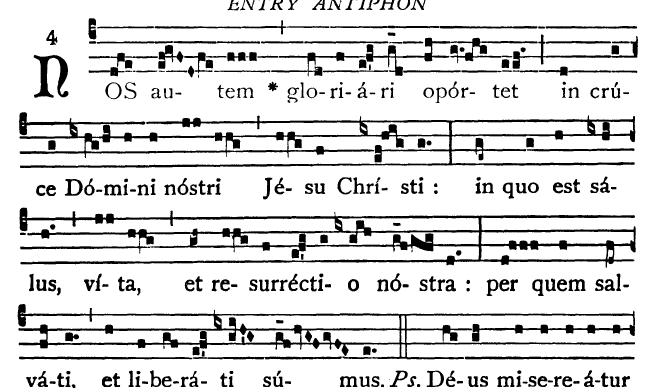
The goal of this two-part post is to present the difference between reading inside a monastery and outside a monastery. We may as well begin with the most extreme example and then work our way back to finer distinctions. So let me begin with a monastic reading of Paul’s Letter to the Galatians, chapter 6, verse 14. The English text would be “We however must glory in the cross of our Lord Jesus Christ, in Whom is our salvation, our life and our resurrection; through Whom we are saved and set free.”

Here is one way to interpret that text in Latin:


Now monks don’t read everything that way, but in a real sense, this is a shared reading that we do in common in the liturgy. It is an interpretation given by the monastic and ecclesial tradition. What can we say about the habits of reading that result in this celebratory rendering? First, that these are words to be cherished, to be committed to memory, to be an occasion of rejoicing and prompt of prayer. As they are sung in the liturgy, they are exhortatory. We are sharing an experience of the efficacy of the very words being sung. These are words that produce an experience of God, of joy and love.

Another interesting aspect of chant is that it is grammatical. The phrases reflect blocks of meaning. Word accents shape the musical contour. This reflects the habit of reading aloud, of memorizing through recitation, the tactile experience of the Word of God manifest in the Holy Scriptures.

Now, this is an extreme example, but it is most certainly an outgrowth of the reading habits of monks and nuns. Let’s begin with the celebratory aspect. At the heart of all reading is the revealed Word of God. This Word is a Word of love, redemption, mercy, in a word, salvation. As such it is to be received with loving attentiveness and then cherished.

God speaks to humankind, and he does so in a manner that uses human words, grammar, letters, and literary genres. In the Old Testament, this is an Incarnation in anticipation of the Incarnation. It is the same Son of God speaking, the same Holy Spirit Who has spoken through the prophets.

Toward the end of this reflection, I will extend the application of monastic reading habits to the Fathers of the Church and even into secular works, not only Donatus the Grammarian and Pliny the Elder, but perhaps even figures as unlikely as Friedrich Nietzsche and Richard Rorty, whose names I have personally heard on the lips of contemporary monks. But it might be useful first to draw more contrasts that I think will be illuminating.

While there may be insights in the words of Euclid or Kant or Heidegger that bring the reader a sense of awe, even joy, I dare say that few scholars would set about singing excerpts from their texts. I should note that we monks do in fact sing texts, not exactly of scholars, but of the Fathers; there are antiphons in the Divine Office taken from texts of Gregory the Great, Eusebius of Vercelli, Augustine, and copiously from the legendaria of the saints.

As a thought experiment, I tried to think of modern scholarly or pseudo-scholarly texts that might be set to music. The Communist Manifesto comes to mind. Perhaps Carl Sagan’s Cosmos is a candidate. Obviously poetry is set to music, and some of it rises to the level of a communal, even political statement, such as in the operas of Wagner and Verdi, and Beethoven’s use of Schiller in his Ninth Sympthony. Still, while these lean toward the celebratory aura of monastic reading, which is also a political reading, I don’t know that they rise to the kind of delectation that is a part of monastic reading.

Cantare, amantis est. That is Saint Augutine, normally rendered as “only the lover sings”. To sing belongs to one who loves, and this love for God is at the heart of monastic habits in the approach to texts of all kinds.

In his wonderful book Real Presences, George Steiner ponders these sorts of enigmas and makes a very interesting observation. The only proper commentary on a work of art is another work of art. Thus the best commentary on the Aeneid is Dante’s Divine Comedy, and the most penetrating interpretation of Madame Bovary by Flaubert is Tolstoy’s Anna Karenina, according to Steiner. To be great authors required Dante and Tolstoy to be extremely discerning readers, readers who loved their text—Dante makes Vergil his guide through hell and Purgatory—and who were made fertile by the text.

The monk is one whose aim is to be a saint, to experience the Kingdom of God by storming it by force, as it were. The artwork of the monk is most typically his life. The text of Scripture that he reads lovingly is the means by which he mounts toward his desire. His interpretation of the text is his conversion of life. What we call the “moral sense” or the “tropological sense” of Holy Scripture is that meaning that must be put into action and lived. The proof of the accuracy of the interpretation is in the life of the monk.

Since the message of the Bible, is, in a sense, God Himself, there is no limit to the interpretation that can be discovered in the text. Here, I want to be careful and clear: I am not saying that the text can mean anything at all or that every individual interpretation is equally valid. A trustworthy reading not only brings forth a holy life, but that interpretation is one that accords with all other aspects of revelation, especially the liturgy.

So at the heart of monastic reading is the conviction that Truth is more than the “adequation of the mind to reality”. Truth is a Person, the Second Person of the Holy Trinity, God’s Word, a reality that transcends every provisional notion that we have. And more than that: Truth as a Person is experienced as a Personal reality that seeks a relationship with me, Someone knocking at the door of my heart, that One Who is the Way to eternal peace and joy, reconciliation and love.

That this Truth incarnates within human language is highly significant for many reasons. Let’s begin with the obvious fact that human language can be used in many ways. In a mathematics textbook, language and other symbol systems strive for a one-to-one correspondence between the symbol and the reality. But in most communication, we use words that open up onto other realities. When I say the word “lion,” it first of all refers to the animal. But God’s creatures are poetic realities, and so we quite naturally extend the concept of a lion to represent danger, nobility, strength. When the Bible refers to the Lion of Judah, we know immediately that it is not referring to a literal lion. And when we read of the exploits of King Richard Lionheart, we understand something of what his contemporaries admired about him in giving him this appellation.

So virtually all words have a literal signification and then poetic extensions. Which is to say that the objects that words signify connect at many levels to a deeper insight into reality, into Truth. Let me offer two practical examples. When the Psalmist refers to enemies, we discover through a careful consideration of the New Testament and monastic tradition that these refer not to any human enemies, but to spiritual enemies, evil and demonic thoughts. When the Psalm speak of subduing the earth, or of the land bringing forth fruit, this is almost always taken to refer to the purification of the monk’s or nun’s body, the triumph of reason over appetite.

To know what a lion really is, or earth or enemies, beyond any literal instantiation of isolated instances of these objects, is to enter more deeply into God’s Wisdom. This insight is what the monastic fathers, especially in the East, called physike, or natural contemplation. It is seeing the nature of things from God’s perspective. Since all things were created through the logos, God’s Word, or reason, or rationality, all things bear some trace of the logos, and natural contemplation sees the logos in created things.

The Incarnation of the Logos in the person of Jesus of Nazareth is the hinge on which this deeper understanding turns. The poetic images of the Old Testament, the ceremonies of the temple, even the events of the history of Israel, have revealed about them their true natures as their purposes converge in the one Mediator between God and Man, the man Jesus Christ. Every word in the Scriptures in some way discloses the vast richness of the spiritual world now emerging from every creature, when it is read in the light of Christ.

Not only that—and this is key to understanding monastic culture—our very lives and experiences disclose God’s purposes when read in this same light. All things have a literal existence that both veils and unveils spiritual depth. Read in Christ, my life unveils the hidden actions of God, and at the same time, because God is always greater than my understanding, the limitations of my understanding veil God’s presence again. This dynamic is why the monks of old loved and endlessly commented on the Song of Songs, seeing the disappearance and discovery of the Bridegroom and the desire of the Bride and her nighttime wanderings as allegories of the soul seeking God.

The manner in which the words of Scripture open onto hidden spiritual realities are promptings for prayer. With this, I have now described to you something of what is still known as lectio divina, one of the most traditional types of monastic prayer. Divine reading is undertaken in faith, with a belief that God reveals Himself in a text. That very text, limited as human words and expressions, nonetheless mysteriously discloses divine realities, what are known as the spiritual senses. The genuineness of these spiritual senses is their continuity with the literal sense; hence the importance of understanding grammar and vocabulary. The difficulties involved in vocabulary will return when we look at secular authorities in the next post.

Homily for All Souls Day

November 3, 2026

From the perspective of history, the timing of All Saints and All Souls is an accident. The Church didn’t choose to place them in November because of any relationship to autumnal weather. But from the perspective of faith and Providence, what could be more fitting than celebrating All Saints and All Souls in November?

The argument for All Saints is a strong one but requires perhaps a bit of specialized knowledge. In the Old Testament, there were three major feasts in which all Jews were to visit Jerusalem: Passover, Pentecost, and the feast of Tabernacles. They marked the first growth of the crops in the spring, the first fruits in early summer, and the ingathering of all the crops in the autumn.

In the Christian calendar, these feasts correspond to Easter, Pentecost and All Saints. Easter celebrates the Resurrection of Jesus; Pentecost, the extension of salvation to the People of God, the Church; and finally, the salvific ingathering of all of the nations is celebrated on All Saints. In fact, in the first reading from yesterday’s Mass from the book of Revelation, we see the multitude of saints in heaven whom no one can number, processing with palm branches, which is exactly what was done during the feast of Tabernacles, the autumnal feast.

So that’s a bit obscure—hopefully less so for you now than it was a minute ago. But for All Souls, the correspondence is not abstract at all. It’s something that we feel at gut-level.

All around us, the world has the look of weariness, enervation, even death.

The arrival of winter in many ancient cultures was connected with death, often the death of a goddess, such as Persephone in Greek mythology. As the darkness begins to overwhelm the light, as vigorous green shrivels into auburn, and animals gather food for the coming hibernation, it is fitting to ponder our own mortality.

Faces of the dead, once familiar to us in life, pale more and more each year.

This could be a sobering call to Stoic detachment, acceptance of the finitude of all creatures.

For us Christians, All Souls Day does resonate with that grim reality. We, however, are permitted to feel it differently than do the Stoics.

Just as Jesus wept at the death of Lazarus, the Christian is allowed to experience the real pain at the loss of loved ones, to feel the sting of lost potential, broken relationships that never had the space to heal, things we would have said if we knew when a friend was going to be passing beyond this world. All Souls Day does not ask us to bracket these feelings, but to use them as motivations for prayer.

In fact, those relationships are not over. They have entered a new phase, and perhaps a more productive one, precisely because one half of it is now beyond the corrupting effects of this fallen world.

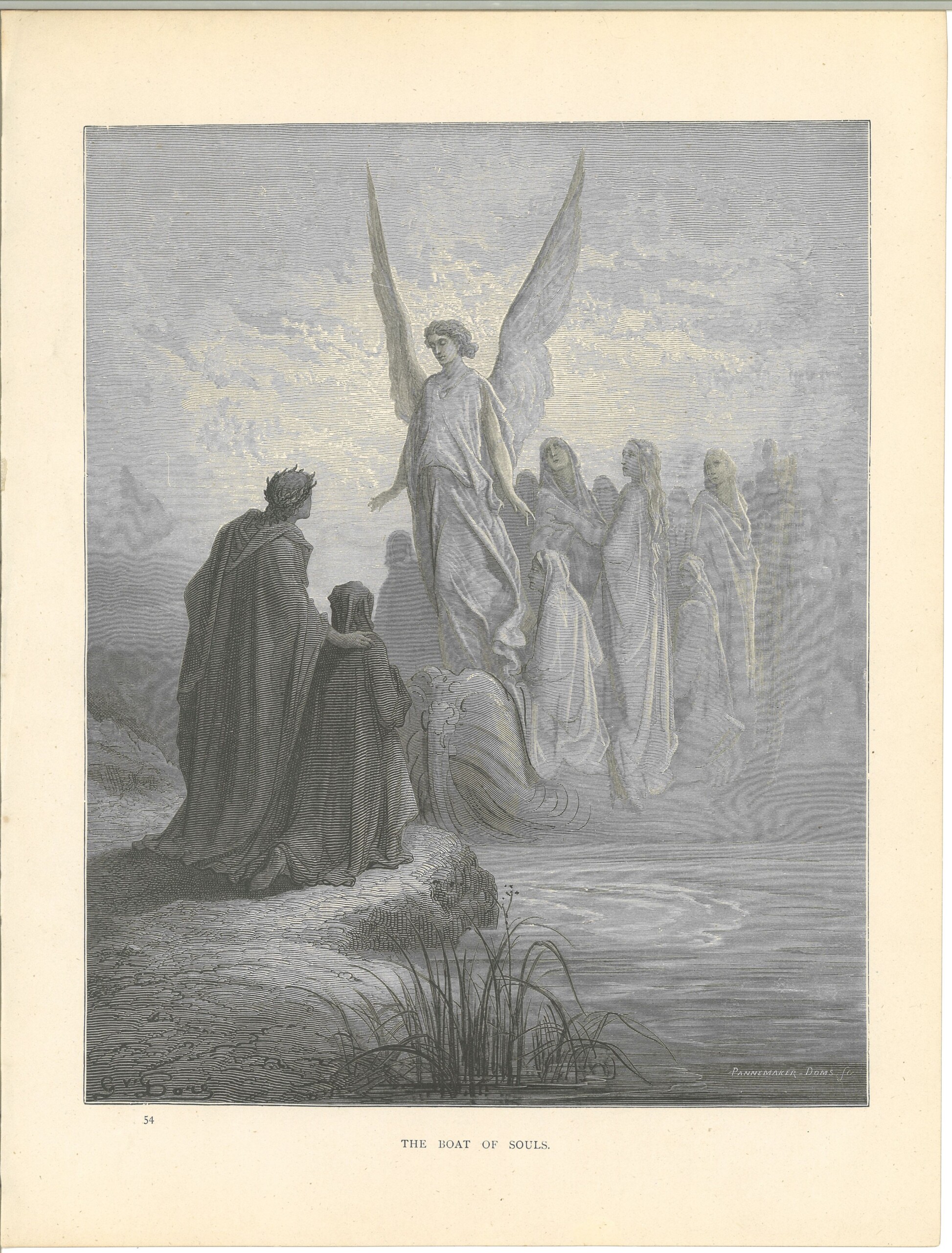
To explain this idea, let me invoke one of the greatest Christian poets, Dante Alighieri. In the middle book of his Divine Comedy, he travels through Purgatory.

He meets thousands of souls doing the exacting labor of purification from their sins. Does this agony make them bitter? Not at all; in fact, a quiet joy pervades the entire book. These souls are saturated with hope and a confident longing for an eternity of peace and rest. When they discover that Dante is still alive in the body, they entreat him to pray for them and to ask everyone else to pray for them.

Nothing helps these souls like the prayers of the living. It lightens their burdens, renews their strength, and brings them great joy and gratitude.

We are gathered here tonight to assist just such souls with our sacrifice. And so I return to those troubled relationships that we have all known—that unfinished business with deceased family members and friends.

Think of that exacting parent or grandparent or teacher for whom none of our actions ever seemed to merit praise. Or the friend suffering from addiction who always had an excuse for one more drink and then blamed it on us. Or the person whom we deeply wounded by a thoughtless or even malicious word or action, with whom we were never able to make a satisfactory apology to get back to a time before the estrangement.

In these relationships in this world, often enough we are simply reduced to prayer in trying to mend whatever wounds opened between us. But now that relationship has something new about it: the departed have taken an irreversible step toward God. And even amid the exacting and just penance, the dead know the presence and love of God in a way that was not possible in this life. When we reach out to them now, and we send up prayers for them in this new dispensation, the response we get is no longer suspicion, bitter recrimination, or criticism, but gratitude. For the relationship on their side is from a place that knows forgiveness and real hope. With sights set on heaven, these souls have no time or inclination to rehash old injuries.

Finally, our anxiety about the state of their souls is a sure sign of our love for them, often so clumsily offered. Our love is the slenderest hint of the truly overpowering love of God. And just as the leaves falling about us are not, in fact, a sign of final death, but of the sleep that precedes the fresh burst of new life, so our separation from the dead is not an eternal one. It is a quiet, mysterious preparation for the eternal glory to be revealed in all of us, restored to full and loving communion with God and one another.

We send up our prayers in deep concern, but also with unshakeable hope that the death and Resurrection of Jesus Christ is our death and resurrection, that the love of God is stronger than death. While their going forth from us seems in the eyes of the world to be utter destruction, in the embrace of Christ, they are at peace.

Blog Topics

  • Beauty (24)
  • Contemplative Prayer (76)
  • Contra Impios (2)
  • Culture (46)
  • Discernment (43)
  • Formation (21)
  • General (43)
  • Going to the Father (18)
  • Gregorian Chant (5)
  • Holy Spirit (7)
  • Jottings (27)
  • Liturgy (112)
  • Meditations on Heaven (5)
  • Monastic Life (74)
  • Moral Theology (61)
  • Music (19)
  • Scripture (70)
  • Silence (1)
  • The Cross (6)
  • Vatican II and the New Evangelization (21)

Blog Archives

  • November 2026 (3)
  • October 2026 (4)
  • September 2026 (4)
  • August 2026 (2)
  • July 2026 (3)
  • June 2026 (4)
  • May 2026 (4)
  • April 2026 (3)
  • March 2026 (4)
  • February 2026 (3)
  • January 2026 (2)
  • December 2025 (6)
  • November 2025 (4)
  • October 2025 (2)
  • September 2025 (2)
  • August 2025 (3)
  • July 2025 (4)
  • June 2025 (4)
  • May 2025 (3)
  • April 2025 (4)
  • March 2025 (4)
  • February 2025 (3)
  • January 2025 (5)
  • December 2024 (8)
  • November 2024 (3)
  • October 2024 (9)
  • September 2024 (8)
  • August 2024 (9)
  • July 2024 (9)
  • June 2024 (8)
  • May 2024 (9)
  • April 2024 (4)
  • November 2023 (1)
  • April 2023 (1)
  • December 2022 (1)
  • October 2022 (1)
  • March 2022 (1)
  • February 2022 (1)
  • August 2021 (2)
  • June 2021 (1)
  • May 2021 (1)
  • April 2021 (1)
  • February 2021 (2)
  • January 2021 (1)
  • December 2020 (1)
  • August 2020 (4)
  • June 2020 (1)
  • May 2020 (4)
  • April 2020 (9)
  • March 2020 (4)
  • February 2020 (1)
  • January 2020 (1)
  • December 2019 (1)
  • July 2019 (2)
  • June 2019 (1)
  • May 2019 (1)
  • April 2019 (2)
  • March 2019 (1)
  • February 2019 (3)
  • January 2019 (1)
  • December 2018 (1)
  • November 2018 (2)
  • October 2018 (2)
  • September 2018 (2)
  • August 2018 (1)
  • July 2018 (2)
  • June 2018 (4)
  • May 2018 (7)
  • April 2018 (1)
  • March 2018 (1)
  • February 2018 (1)
  • January 2018 (2)
  • November 2017 (1)
  • October 2017 (1)
  • September 2017 (1)
  • August 2017 (1)
  • July 2017 (2)
  • June 2017 (2)
  • March 2017 (1)
  • February 2017 (2)
  • December 2016 (1)
  • November 2016 (3)
  • August 2016 (2)
  • May 2016 (2)
  • April 2016 (5)
  • March 2016 (2)
  • December 2015 (1)
  • November 2015 (2)
  • October 2015 (3)
  • August 2015 (10)
  • July 2015 (12)
  • June 2015 (17)
  • May 2015 (2)
  • April 2015 (7)
 
© 2026 Monastery of the Holy Cross
  • Accessibility
Web Design by ePageCity