The goal of this two-part post is to present the difference between reading inside a monastery and outside a monastery. We may as well begin with the most extreme example and then work our way back to finer distinctions. So let me begin with a monastic reading of Paul’s Letter to the Galatians, chapter 6, verse 14. The English text would be “We however must glory in the cross of our Lord Jesus Christ, in Whom is our salvation, our life and our resurrection; through Whom we are saved and set free.”
Here is one way to interpret that text in Latin:
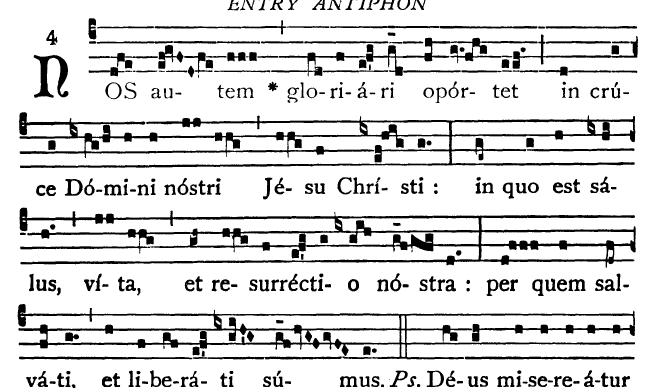
Now monks don’t read everything that way, but in a real sense, this is a shared reading that we do in common in the liturgy. It is an interpretation given by the monastic and ecclesial tradition. What can we say about the habits of reading that result in this celebratory rendering? First, that these are words to be cherished, to be committed to memory, to be an occasion of rejoicing and prompt of prayer. As they are sung in the liturgy, they are exhortatory. We are sharing an experience of the efficacy of the very words being sung. These are words that produce an experience of God, of joy and love.
Another interesting aspect of chant is that it is grammatical. The phrases reflect blocks of meaning. Word accents shape the musical contour. This reflects the habit of reading aloud, of memorizing through recitation, the tactile experience of the Word of God manifest in the Holy Scriptures.
Now, this is an extreme example, but it is most certainly an outgrowth of the reading habits of monks and nuns. Let’s begin with the celebratory aspect. At the heart of all reading is the revealed Word of God. This Word is a Word of love, redemption, mercy, in a word, salvation. As such it is to be received with loving attentiveness and then cherished.
God speaks to humankind, and he does so in a manner that uses human words, grammar, letters, and literary genres. In the Old Testament, this is an Incarnation in anticipation of the Incarnation. It is the same Son of God speaking, the same Holy Spirit Who has spoken through the prophets.
Toward the end of this reflection, I will extend the application of monastic reading habits to the Fathers of the Church and even into secular works, not only Donatus the Grammarian and Pliny the Elder, but perhaps even figures as unlikely as Friedrich Nietzsche and Richard Rorty, whose names I have personally heard on the lips of contemporary monks. But it might be useful first to draw more contrasts that I think will be illuminating.
While there may be insights in the words of Euclid or Kant or Heidegger that bring the reader a sense of awe, even joy, I dare say that few scholars would set about singing excerpts from their texts. I should note that we monks do in fact sing texts, not exactly of scholars, but of the Fathers; there are antiphons in the Divine Office taken from texts of Gregory the Great, Eusebius of Vercelli, Augustine, and copiously from the legendaria of the saints.
As a thought experiment, I tried to think of modern scholarly or pseudo-scholarly texts that might be set to music. The Communist Manifesto comes to mind. Perhaps Carl Sagan’s Cosmos is a candidate. Obviously poetry is set to music, and some of it rises to the level of a communal, even political statement, such as in the operas of Wagner and Verdi, and Beethoven’s use of Schiller in his Ninth Sympthony. Still, while these lean toward the celebratory aura of monastic reading, which is also a political reading, I don’t know that they rise to the kind of delectation that is a part of monastic reading.
Cantare, amantis est. That is Saint Augutine, normally rendered as “only the lover sings”. To sing belongs to one who loves, and this love for God is at the heart of monastic habits in the approach to texts of all kinds.
In his wonderful book Real Presences, George Steiner ponders these sorts of enigmas and makes a very interesting observation. The only proper commentary on a work of art is another work of art. Thus the best commentary on the Aeneid is Dante’s Divine Comedy, and the most penetrating interpretation of Madame Bovary by Flaubert is Tolstoy’s Anna Karenina, according to Steiner. To be great authors required Dante and Tolstoy to be extremely discerning readers, readers who loved their text—Dante makes Vergil his guide through hell and Purgatory—and who were made fertile by the text.
The monk is one whose aim is to be a saint, to experience the Kingdom of God by storming it by force, as it were. The artwork of the monk is most typically his life. The text of Scripture that he reads lovingly is the means by which he mounts toward his desire. His interpretation of the text is his conversion of life. What we call the “moral sense” or the “tropological sense” of Holy Scripture is that meaning that must be put into action and lived. The proof of the accuracy of the interpretation is in the life of the monk.
Since the message of the Bible, is, in a sense, God Himself, there is no limit to the interpretation that can be discovered in the text. Here, I want to be careful and clear: I am not saying that the text can mean anything at all or that every individual interpretation is equally valid. A trustworthy reading not only brings forth a holy life, but that interpretation is one that accords with all other aspects of revelation, especially the liturgy.
So at the heart of monastic reading is the conviction that Truth is more than the “adequation of the mind to reality”. Truth is a Person, the Second Person of the Holy Trinity, God’s Word, a reality that transcends every provisional notion that we have. And more than that: Truth as a Person is experienced as a Personal reality that seeks a relationship with me, Someone knocking at the door of my heart, that One Who is the Way to eternal peace and joy, reconciliation and love.
That this Truth incarnates within human language is highly significant for many reasons. Let’s begin with the obvious fact that human language can be used in many ways. In a mathematics textbook, language and other symbol systems strive for a one-to-one correspondence between the symbol and the reality. But in most communication, we use words that open up onto other realities. When I say the word “lion,” it first of all refers to the animal. But God’s creatures are poetic realities, and so we quite naturally extend the concept of a lion to represent danger, nobility, strength. When the Bible refers to the Lion of Judah, we know immediately that it is not referring to a literal lion. And when we read of the exploits of King Richard Lionheart, we understand something of what his contemporaries admired about him in giving him this appellation.
So virtually all words have a literal signification and then poetic extensions. Which is to say that the objects that words signify connect at many levels to a deeper insight into reality, into Truth. Let me offer two practical examples. When the Psalmist refers to enemies, we discover through a careful consideration of the New Testament and monastic tradition that these refer not to any human enemies, but to spiritual enemies, evil and demonic thoughts. When the Psalm speak of subduing the earth, or of the land bringing forth fruit, this is almost always taken to refer to the purification of the monk’s or nun’s body, the triumph of reason over appetite.
To know what a lion really is, or earth or enemies, beyond any literal instantiation of isolated instances of these objects, is to enter more deeply into God’s Wisdom. This insight is what the monastic fathers, especially in the East, called physike, or natural contemplation. It is seeing the nature of things from God’s perspective. Since all things were created through the logos, God’s Word, or reason, or rationality, all things bear some trace of the logos, and natural contemplation sees the logos in created things.
The Incarnation of the Logos in the person of Jesus of Nazareth is the hinge on which this deeper understanding turns. The poetic images of the Old Testament, the ceremonies of the temple, even the events of the history of Israel, have revealed about them their true natures as their purposes converge in the one Mediator between God and Man, the man Jesus Christ. Every word in the Scriptures in some way discloses the vast richness of the spiritual world now emerging from every creature, when it is read in the light of Christ.
Not only that—and this is key to understanding monastic culture—our very lives and experiences disclose God’s purposes when read in this same light. All things have a literal existence that both veils and unveils spiritual depth. Read in Christ, my life unveils the hidden actions of God, and at the same time, because God is always greater than my understanding, the limitations of my understanding veil God’s presence again. This dynamic is why the monks of old loved and endlessly commented on the Song of Songs, seeing the disappearance and discovery of the Bridegroom and the desire of the Bride and her nighttime wanderings as allegories of the soul seeking God.
The manner in which the words of Scripture open onto hidden spiritual realities are promptings for prayer. With this, I have now described to you something of what is still known as lectio divina, one of the most traditional types of monastic prayer. Divine reading is undertaken in faith, with a belief that God reveals Himself in a text. That very text, limited as human words and expressions, nonetheless mysteriously discloses divine realities, what are known as the spiritual senses. The genuineness of these spiritual senses is their continuity with the literal sense; hence the importance of understanding grammar and vocabulary. The difficulties involved in vocabulary will return when we look at secular authorities in the next post.