Monastery of the Holy Cross

  • Home
  • About
    • Benedictine Life
    • History
    • Video Gallery
    • Et Incarnatus Est - The Prior's Blog
  • Visit Us
    • Guesthouses
      • Ascension Retreat House
      • Garden House
      • Saint Joseph Loft
    • Prayer Schedule
      • Christmas 2025
    • The Catholic Readers Society
  • Vocations
    • Monastic Experience Weekend
    • Formation
    • Oblates
      • Oblate Podcast
  • Solemn Vespers
    • Chant
    • Anniversary of Church Dedication
  • Contact
  • Donate

Archives for September 2026

Homily: God’s Ways and Our Ways

September 23, 2026

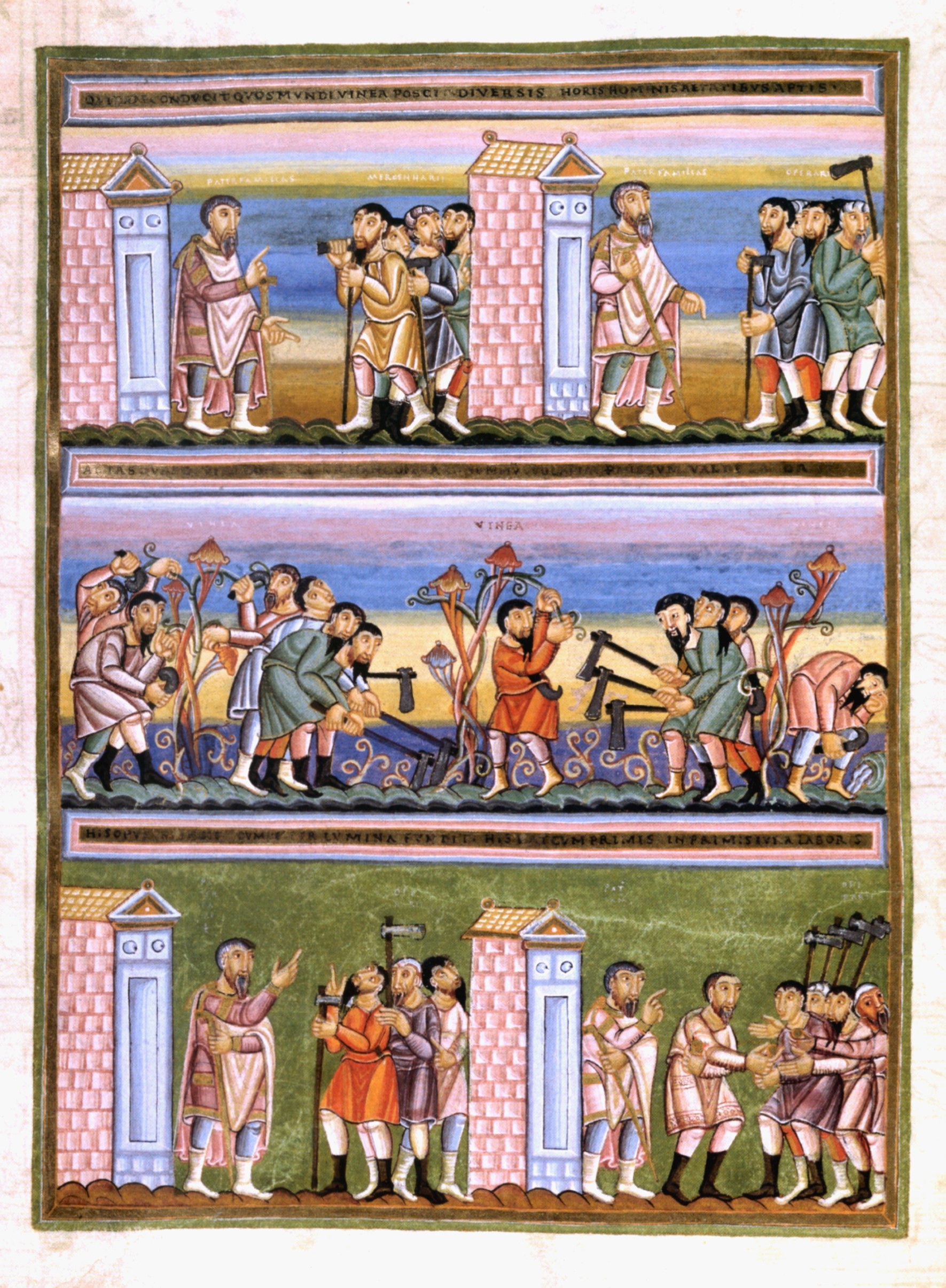
God’s thoughts are high above our thoughts. Perhaps it would be a good idea to take a look at our thoughts regarding the characters in today’s gospel.

What kind of people are these men who are hired at 5:00 in the evening? How do we honestly feel about them?

Given the number of men the master is hiring, it’s clearly the height of the harvest. Lots of help is needed. Where we these men at the beginning of the day? At the middle of the day? Sleeping in after a night of partying? Procrastinating because they didn’t really feel like working that day?

Or what if they had been sick, or their wife or a child had been sick? Perhaps the foreman doing the hiring were trying to hire the fewest amount of men needed to save on labor expenses, and so a few unlucky guys got ignored. There are all kinds of reasons, some legitimate, why a someone seeking employment might not be available at the beginning of the day.

Jesus surely invites us to think about the economic implications of this parable by choosing the images He does, so let’s reflect on that for just a bit. The Catholic Church teaches that in a healthy world, in healthy communities, employers pay employees a just wage.

What makes a wage just is that it is enough to support the worker and his dependents, meaning, mainly his family. This is a very challenging teaching, so let me say a bit more by way of explanation. Let’s avoid, first of all, thinking of the just wage doctrine as a moral command for all employers regardless of context. Let’s think more broadly about that context. If we want to live in a healthy world and in healthy communities, each of will see that my flourishing is bound up with the flourishing of everyone in the community. Employers are community leaders, since they help to organize labor that benefits everyone. They give meaningful work and wages to laborers, and the laborers’ work produces goods that everyone can use. As organizers, employers are de facto leaders within communities.

I’ve kept this explanation fairly abstract because the very concept of flourishing communities is one that is almost impossible to grasp in our current moment. For example, globalization often puts a lot of pressure on both employers and workers, who must compete with goods produced in faraway communities that don’t necessarily share Christian values. Even in a place like Chicago, this kind of community awareness is very difficult to sustain. We used to be a city of neighborhoods, where local businesses were more often operated by local businessmen and employed local men and women. In a very real way, they profited the neighborhood.

Today, increased mobility and individualism mutually reinforce each other and cause breakdowns in the community fabric. Our awareness of the mutual obligations that arise between neighbors is blunted. Another way of putting this is that we struggle to understand and put into practice the idea of a common good.

This is all to say that we will probably have to stretch our imaginations to understand today’s parable. What the master did for the men who were hired later in the day was to pay them a just wage. They went home with enough money to sustain their families, even if they technically hadn’t worked for it. The master’s generosity meant that they wouldn’t be reduced to poverty, at least not for today. And that’s good for everyone connected to them.

Now the reason Jesus tells the parable is not primarily to give us an economics lesson. He is saying that this is like the Kingdom of Heaven. And today’s first reading gives us some idea of how to interpret it. God is generous in forgiving, and is calling all scoundrels and the wicked to turn away from their ways and receiving His mercy. God goes on to say, “For my thoughts are not your thoughts, nor are your ways my ways.” In other words, this offer of mercy seems too good to be true. We know how this is. A person caught up in all kinds of bad behavior, living at a distance from God, finds it almost impossible to believe that God could simply and generously wipe away all that wrongdoing and welcome the sinner back. I think that we are also aware today, maybe in a manner different from Christians in other eras, of how poor life choices often are simply manifestations of larger systemic problems in community life, family life, the educational system, and so on. In other words, these scoundrels might have something in common with those workers who couldn’t find anyone to hire them early in the day.

But they have something else in common, which is that they did return. Jesus says elsewhere in the gospel that tax collectors and prostitutes are entering the kingdom of God ahead of those who count themselves as friends of God. Tax collectors and prostitutes, outcasts because of their behavior, have been turning to Jesus. What have they to lose? The choice of the eleventh-hour workers in the parable is similar. Why not work at least one hour for whatever the master will pay, since it’s better than nothing.

And in both cases, they receive far more than they hoped for. The worker gets enough money to sustain his family, and the tax collector and prostitute find reconciliation with God. So high are God’s ways above our ways.

Jesus doesn’t end there. He concludes the gospel saying, “The last will be first, and the first will be last.” The workers all got the same amount, but those hired first are grumbling against the master’s generosity rather than rejoicing in the good fortune of the workers hired last.

Our world at the moment seems to be waking up to God again. Many are returning to the Church. Can we see in this return a sign of the generosity of God, and take joy in the reconciliation of others, welcoming them as brothers and sisters in the Lord? There is always risk involved. The one-hour worker might try to make a habit of getting more than he strictly deserves, and the convert might grow self-important from the mercy lavished upon him. Welcoming those whom God has welcomed will always stretch us. But if God’s ways are high as the heavens above us, it is good to have some stretching to do.

Homily for the Monastery’s Foundation Day

September 17, 2026

The Christian faith has had detractors from the very beginning. This makes some sense, since its founder, Jesus Christ, united all the powers of the world against Him. Thus He came to the end of His earthly life as a victim of capital punishment. This very fact was proof enough for the earliest opponents of the Christian Way. How is it possible that the One, True God could consent to take the form of a criminal, and the worst sort of criminal at that?

In the intervening centuries, the Church that Christ founded by the opening of His side on the Cross has spread over the whole world, and the Cross itself has become so commonplace a symbol that its scandal has been largely neutralized. Also of note is that the detractors of Christianity are often today atheists or agnostics rather than polytheists as was the case in the ancient world. There is some irony to this, inasmuch as Christians were frequently accused by the Romans of being atheists because they refused to recognize the divinity of the many gods of the Roman pantheon and worshipped a God who could not be represented in images.

In any case, today’s detractors are more likely to be scandalized by a different aspect of the Incarnation. They point to its arbitrariness. Why was Jesus born a Jew and not a Persian? Or Chinese? Or Inca? Why did He speak Aramaic? Why was He born at that specific time? And finally, why make such a big deal out of the Cross? It’s just one form of capital punishment among countless horrendous tortures cooked up by the infernal ingenuity of the world’s rulers. I’ve heard it asked: “If Jesus had died in an electric chair, would Christians would wear stylized electric chairs on chains around their necks?”

Even though this objection to Christianity sounds new, the Fathers of the Church had, in some ways, anticipated it. To them, the brute fact of the Cross was not arbitrary at all. From the time that Adam and Eve sinned by eating the forbidden fruit of the tree in the Garden, there was an almost inevitable movement toward a new tree that would undo that sin. In this light, perhaps the specific punishment of the Cross is not arbitrary at all. Somehow it represents the inner logic of the cosmic drama of sin and its healing, as suggested by this morning’s first reading (about the healing effects of the bronze serpent) and Jesus’s interpretation of it in the gospel.

The Romans may not have invented crucifixion, but they refined it into a kind of diabolical art. As I already mentioned, this was the punishment for the worst sorts of criminals, meaning for slaves and others who had no worldly power at all. It was intended to be a strong deterrent against any lowlifes who might get it into their heads to challenge the powers that be. And the Romans were not only the greatest empire to have existed at that point, but they have remained the epitome of imperial success. And their success was underwritten by the more or less constant threat of brutality against those who tried to stand up against them.

But why did they fix on crucifixion as the most concentrated form of this threat? If we can understand this, we can understand more deeply God’s complete inversion of worldly power, since the Son of God would then be going right to the root of its poisonous growth. First of all, crucifixion needed to be public. Everyone had to see exactly what criminals had coming. The shape of the Cross is a kind of mockery of the human form, humans being the one truly upright-walking animal, with a head that can search out the heavens and arms that can embrace all things. That dignity needed to be subverted and ridiculed. Furthermore, it is a mockery of life itself, being a parody of fruit-bearing trees, the message being that the state itself gives life and takes it away.

Jesus walks right into this display of pompous human arrogance, takes the Cross, its symbol, and by His Resurrection, carries it off in triumph. In Christ’s Crucifixion, we see the climax of a epochal struggle between God and His spiritual enemies. God had been patiently training His chosen people, while the worldly powers of Babylon, Macedonia and Rome repeatedly subjugated them. And when the ungodly powers unleashed all of their fury on God’s greatest and most Beloved ambassador, Jesus demonstrated God’s serene sovereignty by uniting Himself to all that is lowly by human estimation, all that represents our sad exile from paradise, embracing all our disgrace, humiliation, and shame in the form of the Cross. By this obedience, Christ shows us that salvation is never far for those who learn to trust God, no matter how utterly hopeless the situation might appear from a worldly perspective. The lowly—those excluded from the advantages that the world purports to hold for those who embrace its logic of violence—more instinctively see in the Cross a vindication of their dignity before God. In celebration of Christ’s triumph on the Cross, let us strive to be among those poor in spirit who experience His salvation.

The Nativity of Our Lady and the Birth of Our Community

September 9, 2026

Yesterday, we celebrated the feast of the Birth of the Virgin Mary. Aside from its intrinsic significance in the liturgical calendar, it is a date with special meaning for our community. Our three founders all made their religious professions on September 8 with the Congregation of the Immaculate Heart of Mary, before transferring to monastic life. The founders have now been in vows for over fifty years—longer than half of our community has been alive. So we had a special celebration of their fidelity to their vows and of God’s fidelity to our community.

During our celebration, Fr. Edward shared a few memories of his vows and his ordination to the priesthood. Even though I’ve heard some of these stories many times, they are very important to share, especially with the new men in the community. These stories always include and presuppose, in some sense, God’s actions. God acts in concrete circumstances, and His providence has shaped us into a particular community with a unique expression of monastic life. This is true for every monastery. It is only through the memory of God’s actions in the past that each monastery understands His unique mission for us today.


The Cross We Need

September 4, 2026

“God doesn’t give us the Cross we ask for; He gives us the Cross we need.”

This was perhaps the most helpful teaching I received from my Novice Master, when I was a young novice. Youth is a time for ideals, for great efforts in service of noble goals. This is as it should be, and it is part of what makes the young so attractive. And so, at that tender age, I was eager for ascetical practices of all kinds, ready for every kind of self-denial—so long as I was still in control. I was eager to take up several Crosses of my own choosing.

Eventually, a great purification began to take place in me through sufferings that were not of my choosing. In fact, these were often baffling, contrary to my beliefs about what religious life ought to be like. It helped me to remember that this was the Cross God chose for me, the one I needed. It was precisely in those areas in which I was spiritually blind that I needed the painful actions of grace to open the eyes of my heart. That meant accepting all manner of contrary experiences as a participation in the saving Cross of Christ, the Cross I had not (intentionally) asked for.

In a similar way, repentance is never easy, but at least when we can name our own faults, we can rebrand repentance as self-help. We can seek out the advice that appeals to our tastes and promises improvement according to our own self-assessment.

On the other hand, when someone else points out our faults, however accurately, it is quite a bit more painful. They might even call our attention to faults that we didn’t know we had.

Sometimes a hidden fault of ours is uncovered in the rough and tumble of everyday life, revealed through circumstances not entirely in our control. In monastic life, we often find that progress against one sin uncovers a completely different sinful habit that we weren’t aware of. For example, pushing back against gluttony by fasting often makes us irritable. What this reveals is that I have the sin of anger within. But I’ve been avoiding it by distracting myself with delights of the palate. Here, a sinful disposition is revealed to me. But this time, instead of a person pointing it out to me, the revelation comes through the hard truth of reality.

There is a conundrum in all of this. If we want to be holy, we must address our hidden sins. Yet these are the ones we most readily resist confronting. This raises a question: is there a way to dispose ourselves so that when unexpected criticism arrives, we can receive it humbly, with a willing heart? Can we take up this unasked-for Cross?

To answer this, I offer another anecdote. A couple of years before entering the Monastery, I was having dinner with a very dear friend. I can no longer remember the context of her criticism, but I remember the substance of it well. In the course of our conversation, she suggested that I could do a better job of listening to what other people were saying and asking them questions. I remember the sting of hearing this, but I also went home resolved to capitalize on this tough advice.

What made me able to receive this rebuke profitably (I hope!) was the mutual love shared between two friends. My esteem for my friend short-circuited the typical reaction of defensiveness. Love turned the shame of acknowledging a fault into motivation for change. The effect is the one that Jack Nicholson’s character discovers in the movie “As Good As It Gets.” He says to Helen Hunt’s character, the only person in the movie who has shown him kindness, “You make me want to be a better man.” Her kindness opened his heart and made him ready to welcome the hard truth that he needed to change his life. Love makes all things possible.

So a strategy for living in the truth with greater fidelity is to love more. Whether the hard truth is delivered by a comment or by the unbending fiber of reality, love provides an opening to our hearts. “Where there is not love, put love — and you will find love [Saint John of the Cross].” When we love our neighbor, we are better disposed to any and all truths about ourselves that he or she may bring to light.

This also works in our encounter with the world around us. When we love, in a proper way, the creatures that God gave us, we can learn to trust them as His messengers. God’s message always emanates from His love. Reality is not an obstacle—even when it brings suffering—but was fashioned by God for our benefit. For “all things work for the good of those who love Him [Romans 8: 28],” even the Cross that we have been avoiding.

Blog Topics

  • Beauty (23)
  • Contemplative Prayer (72)
  • Contra Impios (2)
  • Culture (43)
  • Discernment (39)
  • Formation (21)
  • General (43)
  • Going to the Father (18)
  • Gregorian Chant (5)
  • Holy Spirit (7)
  • Jottings (27)
  • Liturgy (108)
  • Meditations on Heaven (4)
  • Monastic Life (69)
  • Moral Theology (61)
  • Music (19)
  • Scripture (69)
  • Silence (1)
  • The Cross (6)
  • Vatican II and the New Evangelization (21)

Blog Archives

  • September 2026 (4)
  • August 2026 (2)
  • July 2026 (3)
  • June 2026 (4)
  • May 2026 (4)
  • April 2026 (3)
  • March 2026 (4)
  • February 2026 (3)
  • January 2026 (2)
  • December 2025 (6)
  • November 2025 (4)
  • October 2025 (2)
  • September 2025 (2)
  • August 2025 (3)
  • July 2025 (4)
  • June 2025 (4)
  • May 2025 (3)
  • April 2025 (4)
  • March 2025 (4)
  • February 2025 (3)
  • January 2025 (5)
  • December 2024 (8)
  • November 2024 (3)
  • October 2024 (9)
  • September 2024 (8)
  • August 2024 (9)
  • July 2024 (9)
  • June 2024 (8)
  • May 2024 (9)
  • April 2024 (4)
  • November 2023 (1)
  • April 2023 (1)
  • December 2022 (1)
  • October 2022 (1)
  • March 2022 (1)
  • February 2022 (1)
  • August 2021 (2)
  • June 2021 (1)
  • May 2021 (1)
  • April 2021 (1)
  • February 2021 (2)
  • January 2021 (1)
  • December 2020 (1)
  • August 2020 (4)
  • June 2020 (1)
  • May 2020 (4)
  • April 2020 (9)
  • March 2020 (4)
  • February 2020 (1)
  • January 2020 (1)
  • December 2019 (1)
  • July 2019 (2)
  • June 2019 (1)
  • May 2019 (1)
  • April 2019 (2)
  • March 2019 (1)
  • February 2019 (3)
  • January 2019 (1)
  • December 2018 (1)
  • November 2018 (2)
  • October 2018 (2)
  • September 2018 (2)
  • August 2018 (1)
  • July 2018 (2)
  • June 2018 (4)
  • May 2018 (7)
  • April 2018 (1)
  • March 2018 (1)
  • February 2018 (1)
  • January 2018 (2)
  • November 2017 (1)
  • October 2017 (1)
  • September 2017 (1)
  • August 2017 (1)
  • July 2017 (2)
  • June 2017 (2)
  • March 2017 (1)
  • February 2017 (2)
  • December 2016 (1)
  • November 2016 (3)
  • August 2016 (2)
  • May 2016 (2)
  • April 2016 (5)
  • March 2016 (2)
  • December 2015 (1)
  • November 2015 (2)
  • October 2015 (3)
  • August 2015 (10)
  • July 2015 (12)
  • June 2015 (17)
  • May 2015 (2)
  • April 2015 (7)
 
© 2026 Monastery of the Holy Cross
  • Accessibility
Web Design by ePageCity