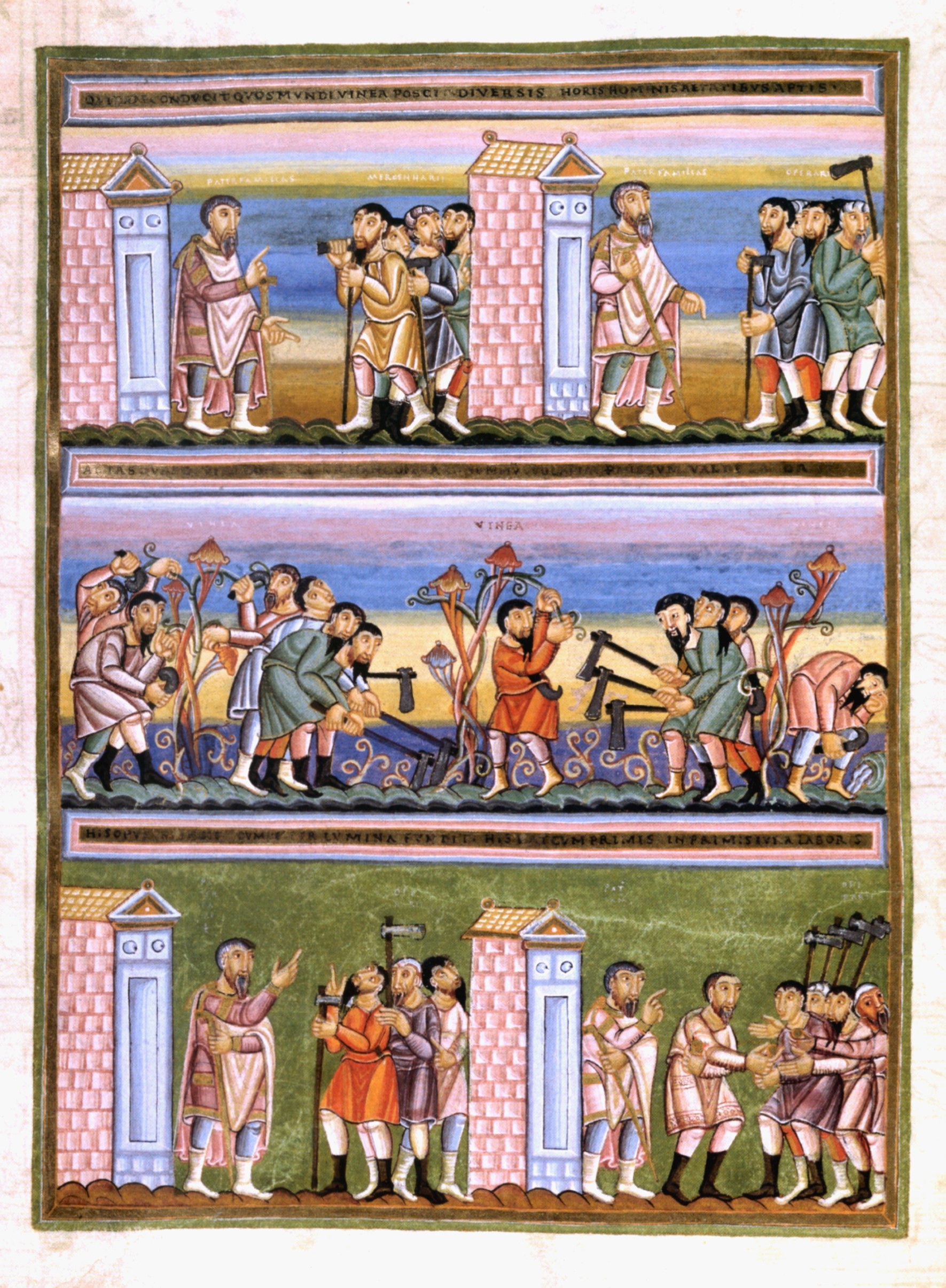
 God’s thoughts are high above our thoughts. Perhaps it would be a good idea to take a look at our thoughts regarding the characters in today’s gospel.
What kind of people are these men who are hired at 5:00 in the evening? How do we honestly feel about them?
Given the number of men the master is hiring, it’s clearly the height of the harvest. Lots of help is needed. Where we these men at the beginning of the day? At the middle of the day? Sleeping in after a night of partying? Procrastinating because they didn’t really feel like working that day?
Or what if they had been sick, or their wife or a child had been sick? Perhaps the foreman doing the hiring were trying to hire the fewest amount of men needed to save on labor expenses, and so a few unlucky guys got ignored. There are all kinds of reasons, some legitimate, why a someone seeking employment might not be available at the beginning of the day.
Jesus surely invites us to think about the economic implications of this parable by choosing the images He does, so let’s reflect on that for just a bit. The Catholic Church teaches that in a healthy world, in healthy communities, employers pay employees a just wage.
What makes a wage just is that it is enough to support the worker and his dependents, meaning, mainly his family. This is a very challenging teaching, so let me say a bit more by way of explanation. Let’s avoid, first of all, thinking of the just wage doctrine as a moral command for all employers regardless of context. Let’s think more broadly about that context. If we want to live in a healthy world and in healthy communities, each of will see that my flourishing is bound up with the flourishing of everyone in the community. Employers are community leaders, since they help to organize labor that benefits everyone. They give meaningful work and wages to laborers, and the laborers’ work produces goods that everyone can use. As organizers, employers are de facto leaders within communities.
I’ve kept this explanation fairly abstract because the very concept of flourishing communities is one that is almost impossible to grasp in our current moment. For example, globalization often puts a lot of pressure on both employers and workers, who must compete with goods produced in faraway communities that don’t necessarily share Christian values. Even in a place like Chicago, this kind of community awareness is very difficult to sustain. We used to be a city of neighborhoods, where local businesses were more often operated by local businessmen and employed local men and women. In a very real way, they profited the neighborhood.
Today, increased mobility and individualism mutually reinforce each other and cause breakdowns in the community fabric. Our awareness of the mutual obligations that arise between neighbors is blunted. Another way of putting this is that we struggle to understand and put into practice the idea of a common good.
This is all to say that we will probably have to stretch our imaginations to understand today’s parable. What the master did for the men who were hired later in the day was to pay them a just wage. They went home with enough money to sustain their families, even if they technically hadn’t worked for it. The master’s generosity meant that they wouldn’t be reduced to poverty, at least not for today. And that’s good for everyone connected to them.
Now the reason Jesus tells the parable is not primarily to give us an economics lesson. He is saying that this is like the Kingdom of Heaven. And today’s first reading gives us some idea of how to interpret it. God is generous in forgiving, and is calling all scoundrels and the wicked to turn away from their ways and receiving His mercy. God goes on to say, “For my thoughts are not your thoughts, nor are your ways my ways.” In other words, this offer of mercy seems too good to be true. We know how this is. A person caught up in all kinds of bad behavior, living at a distance from God, finds it almost impossible to believe that God could simply and generously wipe away all that wrongdoing and welcome the sinner back. I think that we are also aware today, maybe in a manner different from Christians in other eras, of how poor life choices often are simply manifestations of larger systemic problems in community life, family life, the educational system, and so on. In other words, these scoundrels might have something in common with those workers who couldn’t find anyone to hire them early in the day.
But they have something else in common, which is that they did return. Jesus says elsewhere in the gospel that tax collectors and prostitutes are entering the kingdom of God ahead of those who count themselves as friends of God. Tax collectors and prostitutes, outcasts because of their behavior, have been turning to Jesus. What have they to lose? The choice of the eleventh-hour workers in the parable is similar. Why not work at least one hour for whatever the master will pay, since it’s better than nothing.
And in both cases, they receive far more than they hoped for. The worker gets enough money to sustain his family, and the tax collector and prostitute find reconciliation with God. So high are God’s ways above our ways.
Jesus doesn’t end there. He concludes the gospel saying, “The last will be first, and the first will be last.” The workers all got the same amount, but those hired first are grumbling against the master’s generosity rather than rejoicing in the good fortune of the workers hired last.
Our world at the moment seems to be waking up to God again. Many are returning to the Church. Can we see in this return a sign of the generosity of God, and take joy in the reconciliation of others, welcoming them as brothers and sisters in the Lord? There is always risk involved. The one-hour worker might try to make a habit of getting more than he strictly deserves, and the convert might grow self-important from the mercy lavished upon him. Welcoming those whom God has welcomed will always stretch us. But if God’s ways are high as the heavens above us, it is good to have some stretching to do.