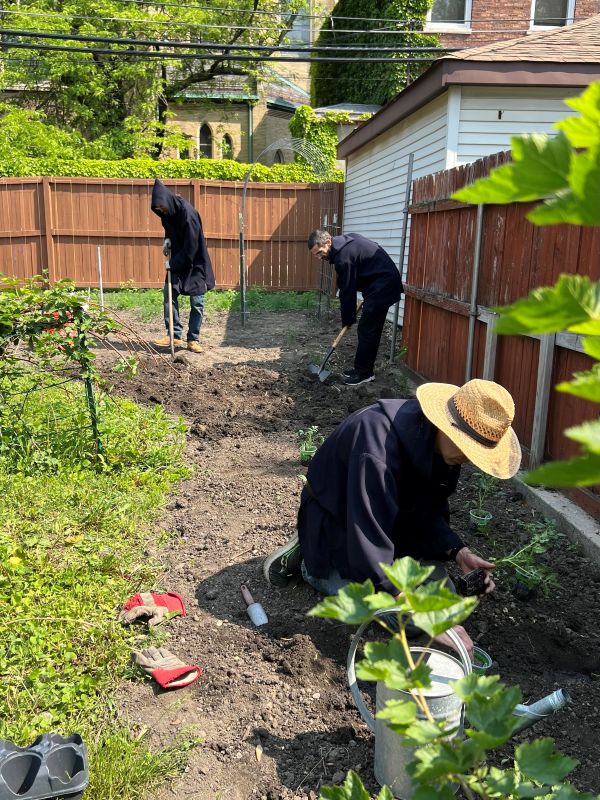
 About twenty-five years ago, our community, looking to expand our property, purchased a lot just south of the monastery, upon which sat an old house. The house, alas, was not salvageable, for reasons that would take too long to explain. In any case, the decision was made to have the house demolished and to convert the lot into a garden.
If only removing a house were as easy as picking it up and dropping it somewhere else. In fact, demolition, as you can imagine, is an untidy business. Making the conversion to a garden took many years, as we continually, gradually removed all the broken concrete, glass, pieces of metal and the like. Today, we have a pretty well-functioning garden with decent soil and generally good yields, especially in chard, green beans, and berries.
The lesson here is that soil can be improved, which is good news for us as Christians.
That’s because Jesus today tells us that our hearts are like soil, some of it rich, some of it poor. What grows in our hearts is not literally weeds and wheat, but their spiritual counterparts, the Word of God and the habits of mind that are contrary to the flowering of God’s Word. Our Lord gives us several helpful images for understanding the work that we need to do if God’s Word is to take root in our hearts and bear abundant fruit.
The first obstacle to the Word taking root is a lack of understanding. This is likened to seed that falls on a footpath, where lots of people trample upon it. It’s important to connect this image with Jesus’s explanation. He says that the seed that falls on the path is akin to the Word falling upon a heart that fails to understand it, so the Word fails to take root.
So understanding is an important thing to seek. It’s not enough to hear the Word. Sometimes we need to take the time to puzzle over it, even to listen to homilies about it.
What Jesus implies here, however, is that the lack of understanding does not come from a lack of intellectual capacity. The point of the footpath is that the seed doesn’t ever settle into the soil because it’s being trampled upon by many people walking by. Surely this must be related to distraction in our minds and hearts, a failure to distinguish between what is truly important and what simply attracts our attention at the moment.
And we have a lot to distract us. We have access to more information than any previous generation. More than that, by means of tools like the internet, it is information clamoring for our attention. We now even have terms like “The Attention Economy” or “Attention Capitalism.” In a paper last year, Georgetown law professor Rai Hasen Massoud warned that, “The attention economy erodes core democratic values, undermining the cognitive autonomy, reflective reasoning, and informed citizenship necessary for healthy democratic societies.”
I’m less interested in the connection with democracy, and more concerned about the idea that all of these entities trying to capture our attention erode reflective reasoning, which seems to be the good soil that we are trying to cultivate. We can’t allow ourselves to fall into a situation where God’s Word is just one more voice clamoring for our attention. We need to take time deliberately, as you are at this moment, to sit with God’s Word and assimilate ourselves to it.
But more of that when we get to the good soil. We still have two examples of poor soil to examine. The second example is the seed that falls on rocky ground. This is the person who does understand the Word, at least in a superficial way. The roots don’t go very deep. Gardeners will know that the weeds that have little root are a cinch to pull up, whereas the ones that have deep roots can be almost impossible to eradicate. God’s Word will drive roots deeper and deeper into our hearts to the extent that we shape our actions in conformity with it.
We will need to go beyond having a grasp of the principles of revelation. The goal is consciously to take on God’s values and desire what He desires, as Jesus always did. Then God’s Word will be very difficult to uproot in us.
This also does require regular work. Routine can be a potential enemy here: we have to find ways each day to choose what God wants because God wants it, and not simply because it is painless or convenient for us at the moment.
Now on to the third example, the seed sown among thorns. Our Lord again has a specific idea in mind: that the thorns, the problematic thoughts growing up alongside the Word of God, are thoughts about worldly anxiety and the lure of riches. In the limited time we have, let’s focus on worldly anxiety. This is the temptation that Jesus teaches us to combat by saying “Give us this day our daily bread,” in the Lord’s Prayer.
God has given us all work to do to provide for ourselves and others, but He ultimately is the one who provides for us, who makes the work fruitful. Anxiety about procuring what we need can lead us to a place, where, rather than pray and listen to God’s Word, we need to get just one more thing done. I’ll pray and worry about my interior when I get everything in order, when I have all of my work done, and that work is determined not by God’s gracious generosity, but by my fear of failing to provide for myself. Work is good, but it is intended to be subordinate, in some way, to our relationship with God, who can easily provide what we need, and knows better than we do what we truly do need.
And so we arrive at the good soil. Let us notice that a thirtyfold yield in the ancient world was considered true abundance. And though a hundredfold yield was not impossible, it was spectacular. This is the kind of good that Jesus promises to those who truly take the time to interiorize His message, the message of love, forgiveness, and eternal life that Jesus came to earth to bring.
So let’s take a little extra time this week and see whether we can’t make some improvement in the soil of our hearts.